
Accessory styling mistakes keep showing up because menswear has sped up. Trends cycle weekly, outfits get photographed daily, and the smallest detail can flatten an otherwise strong look. A bad watch fit, a mismatched metal tone, a tie bar placed wrong—these aren’t “rules” so much as signals. People read them instantly.
Men Fashion is watching a quiet shift: fewer loud statement pieces, more intentional choices, and a sharper eye for proportion. That’s the real pressure point. When accessories feel random, the wearer looks uncertain. When they feel edited, the outfit looks expensive—even if it isn’t.
This piece stays close to what goes wrong in the real world, and why. Not to lecture. To give the kind of clarity you only get after seeing the same errors repeat in mirrors, photos, and crowded rooms.
When the “one more piece” instinct ruins the outfit
Most accessory styling mistakes don’t start with a bad item. They start with momentum. A watch goes on, then a bracelet, then a chain, then rings—each decision feels harmless until the whole look starts talking over itself.
Men Fashion sees this most with smart-casual outfits, where the base is intentionally simple. Accessories are meant to finish the look, not become the look. The moment every surface has something on it, the outfit stops reading as considered and starts reading as noise.
A clean approach is often the most mature: one hero item and one supporting item. That might be a great watch with nothing else. Or a signet ring with a plain strap. Accessory styling mistakes multiply when every piece is trying to be the headline.
Even “minimal” pieces can stack into clutter. Thin chains, narrow cuffs, micro rings—together they still create a visual swarm. Men Fashion treats editing as the real skill: not buying, not collecting, but stopping at the right point.
Wearing the wrong scale for your frame and your clothes
Proportion is where accessory styling mistakes turn brutal, because cameras exaggerate them. A tiny watch on a broad wrist reads like an afterthought. A huge dial with a slim knit polo can look like costume. Scale is not about price or brand; it’s about balance.
Men Fashion has long treated tailoring as a system of ratios—lapel width, tie width, collar spread. Accessories live in that same system. If your jacket has soft shoulders and a relaxed drape, heavy, sharp-edged hardware fights the tone. If you’re in a structured suit, delicate jewelry can disappear or look oddly casual.
The fix is less “buy a different thing” and more “match the weight.” Chunky boots pair well with a chunkier watch. Fine-gauge knitwear pairs well with slimmer metals and softer finishes. Accessory styling mistakes often happen when people dress in one lane and accessorize in another.
And yes, body size matters, but clothing silhouette matters more. Oversized clothing can swallow small accessories. Slim clothing can make oversized pieces look aggressive. Men Fashion frames it as coherence, not rules.
Mixing metals without a reason, then calling it “style”
Some accessory styling mistakes are easy to spot across a room: gold watch, silver chain, black-buckle belt, bright steel rings. The problem isn’t mixed metals; it’s mixed messages.
Men Fashion has no issue with mixing metals when there’s an anchor. The anchor might be a two-tone watch that legitimately contains both colors. Or a chain with a pendant that ties gold and silver together. Without that bridge, the look feels unplanned, like you got dressed in the dark and tried to call it intentional.
The other trap is mixing finishes. Polished gold with brushed steel with matte black hardware can work, but only when the outfit is controlled and the textures are chosen on purpose. Otherwise, the details start competing for attention.
If you’re unsure, keep one metal dominant and let the other appear once, quietly. Accessory styling mistakes thrive in equal weighting—two metals fighting for leadership with no hierarchy. Men Fashion prefers a clear lead and a subtle echo.
Wearing “formal” accessories with casual clothing
A tie pin with a hoodie. A glossy dress watch with gym shoes. A pocket square with an unstructured overshirt. These accessory styling mistakes are rarely about being wrong; they’re about being confusing.
Men Fashion tracks this as a context problem. Some pieces carry a strong social setting with them. A cufflink isn’t just a small object; it’s a signal of ceremony, corporate formality, or tradition. When that signal lands on casual clothes, it can look like parody.
The better move is to translate, not transplant. If you like the neatness of formal accessories, pick casual versions: a textured strap instead of glossy leather, a matte buckle instead of mirror-shine, a knit tie instead of silk. Keep the spirit, lower the formality.
Casual clothing can handle accessories, but it wants softness—woven textures, muted shine, worn-in finishes. Men Fashion notices that the most stylish casual looks use accessories as quiet punctuation, not loud declarations.
Ignoring the neckline, then wondering why the chain looks off
Necklines decide how jewelry sits, and ignoring that is a classic source of accessory styling mistakes. A chain that works with an open collar can look cramped under a crewneck. A pendant that looks sharp on a plain tee can feel messy on a patterned shirt.
Men Fashion thinks of the collar area as real estate with strict limits. If the neckline is tight, you either go shorter and intentional (a clean chain that sits above the collar) or you skip it entirely. If the neckline is open, the chain can sit naturally in the space without fighting fabric.
Layering chains is where things go wrong fast. Two chains that land at the same length tangle visually and physically. A pendant that sits right on the collar edge reads awkward, like it’s unsure where it belongs.
The simplest correction is to treat the neckline as the frame. Pick jewelry that respects that frame, then stop. Accessory styling mistakes often happen when the outfit has no space for the accessory, yet the accessory gets forced in anyway.
Choosing statement pieces that don’t match your personality
Accessories can look great in isolation and still fail on a person. That’s not mystical; it’s alignment. A bold luxury-logo belt on someone who dresses quietly can look like a costume. A skull ring on a clean-cut office wardrobe can feel like an interrupted sentence.
Men Fashion has seen this shift with social media: people buy “signature” pieces before they have a signature style. The result is accessory styling mistakes that feel like borrowed identity.
The better route is to let personality lead, not trends. If you’re restrained, your best accessories will likely be about material and construction—good leather, solid metal, subtle texture. If you’re expressive, you can push shapes and symbols, but still need a thread that connects it all.
The goal isn’t to look safe. It’s to look believable. Men Fashion values believability because it reads as confidence, and confidence makes even simple accessories feel elevated.
Wearing accessories that fight the color story
Color doesn’t need to be matched perfectly, but it needs to be understood. Accessory styling mistakes happen when the palette has no logic: warm brown shoes, cool grey watch, bright white belt, neon bracelet. Each piece may be fine, yet together they don’t speak the same language.
Men Fashion treats accessories as part of the outfit’s color temperature. Warm outfits—tan, olive, cream, brown—tend to pair naturally with gold, brass, and warm leather. Cool outfits—charcoal, navy, black, crisp white—often pair best with silver, steel, and black hardware.
The tricky zone is mixed palettes. That’s where one repeated color becomes the glue: matching strap to shoes, matching metal to belt buckle, repeating a subtle accent across two points. Accessory styling mistakes show up when there’s no repeated note, so the eye can’t settle.
Not every accessory must match. But one or two should connect. Men Fashion sees that as the difference between “thrown on” and “put together.”
Wearing cheap-looking accessories that undermine good clothing
A well-fitting outfit can be sabotaged by one flimsy item. A belt with peeling edges. A watch with a shiny, rattly bracelet. Sunglasses that look like novelty plastic. These accessory styling mistakes hurt because they’re read as quality clues.
Men Fashion doesn’t treat this as snobbery. People don’t notice labels; they notice finish. Cheap accessories often fail at the points where hands and eyes land: buckle edges, clasp feel, lens clarity, metal plating that turns. Even from a distance, poorly made pieces often reflect light in a harsh way.
You don’t need expensive. You need solid. A simple leather belt with clean stitching beats an overdesigned one with weak hardware. A modest watch with a good strap beats a flashy dial with bad proportions.
Accessory styling mistakes here are avoidable with one habit: buy fewer pieces, buy better versions. Men Fashion would rather see two reliable accessories worn repeatedly than a drawer of disposable “options.”
Getting the watch fit wrong, even when the watch is good
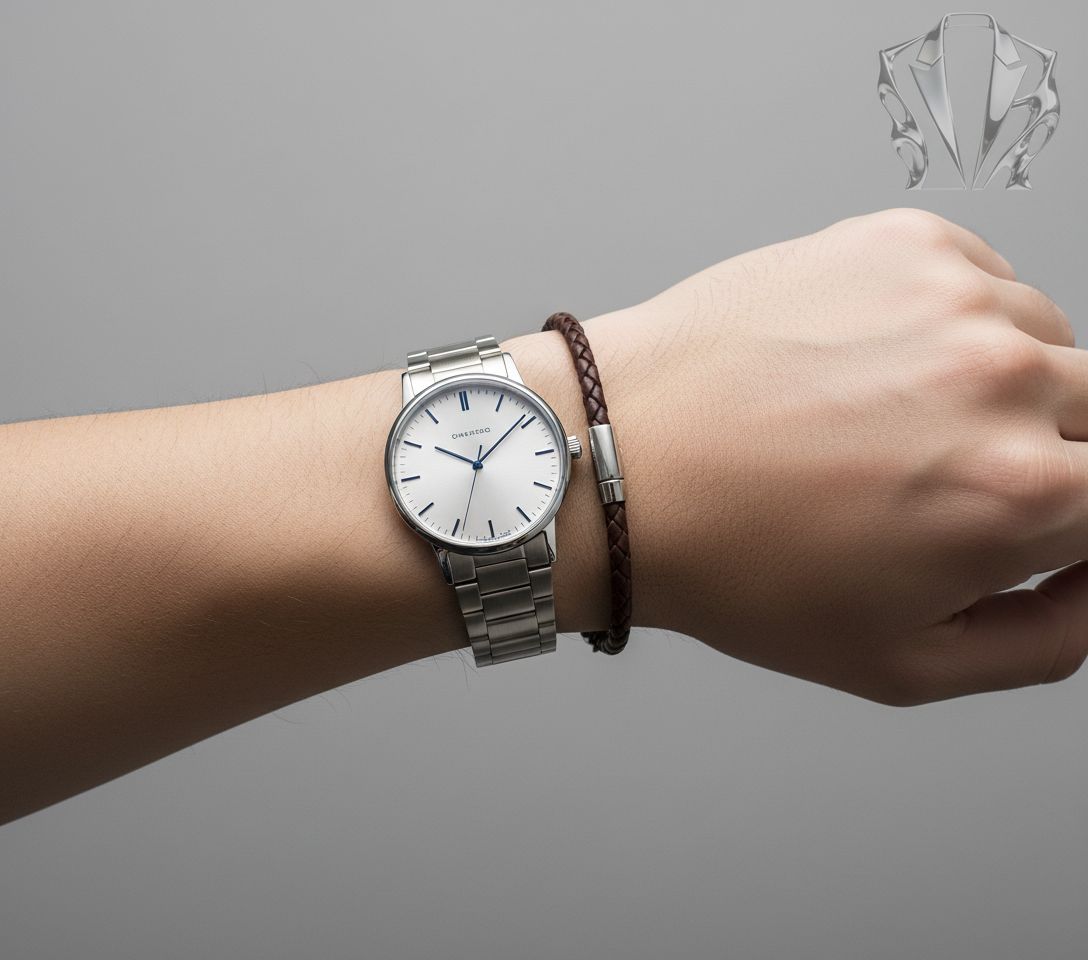
Watch fit is a small detail with big consequences, and it’s one of the most common accessory styling mistakes. A watch sliding down onto the hand looks sloppy. A watch worn too tight looks uncomfortable and draws attention to itself for the wrong reason.
Men Fashion tends to frame this as posture for the wrist. The watch should sit just above the wrist bone, stable, not clamped. The strap should be secure without pinching. The case size should suit the wrist, but the lug-to-lug length is often the real problem—too long and it overhangs.
Strap choice changes the entire read. A dress watch on a sporty rubber strap can look confused. A rugged diver on glossy leather can look like it’s playing a role. Accessory styling mistakes happen when the strap tells a different story than the outfit.
Fit is also seasonal. Leather can swell with heat; metal bracelets can feel tighter in warm weather. Men Fashion expects adults to adjust, not suffer, because discomfort shows in the way you move.
Letting branding become the loudest part of the look
Logos on accessories are powerful because they’re small and high-impact. That’s exactly why they create accessory styling mistakes. A branded belt buckle can dominate a whole outfit. A monogram wallet chain can turn subtle styling into a brand announcement.
Men Fashion has noticed a quiet correction in recent years: the most expensive-looking outfits often have the least visible branding. Not because branding is “bad,” but because heavy branding is easy to buy and hard to wear.
If you like branded pieces, keep them in one place. Let the rest of the accessories stay quiet. The moment multiple logos appear, the outfit can start reading like a shopping receipt.
The deeper issue is dependency. When the logo becomes the style, everything else weakens. Men Fashion respects brand craftsmanship, but the best looks feel built around silhouette, fabric, and proportion—with accessories supporting, not shouting.
Misunderstanding sunglasses as an afterthought
Sunglasses can be the sharpest accessory in menswear, yet they’re often treated like a spare item grabbed near the door. That’s why accessory styling mistakes here are so common: wrong face shape, wrong frame thickness, wrong vibe for the outfit.
Men Fashion sees sunglasses as architecture. They sit on the center of your face, alter expression, and change perceived proportions. A frame that’s too wide can dwarf features. A frame that’s too small can look dated or timid. Lens tint matters too—heavy mirrored lenses push the look toward sporty or flashy fast.
Quality also shows immediately: lenses that distort, frames that creak, cheap hinges. Even people who can’t describe why will register it as “off.”
Sunglasses should match the mood of the clothes. Minimal tailoring loves classic frames. Streetwear can take thicker acetate. Workwear can take rugged shapes. Accessory styling mistakes happen when sunglasses are chosen for trend, not for the face and the outfit in front of them.
Wearing accessories in the wrong social setting
Not every mistake is visual. Some accessory styling mistakes are contextual. A stack of rings at a conservative client meeting. A loud chain at a wedding where the dress code is understated. A novelty tie at a serious event. These misreads don’t just affect style—they affect how you’re perceived.
Men Fashion treats this as situational intelligence. Accessories are signals, and signals are interpreted differently depending on setting, culture, and expectation. What reads expressive in one room can read disrespectful in another.
That doesn’t mean you must erase personality. It means you choose where to deploy it. One strong piece can be enough: a distinctive watch, a subtle ring, or a clean chain under the shirt.
Accessory styling mistakes often come from treating every day like the same day. Men Fashion considers context part of dressing well, because clothing is social language whether you want it to be or not.
Conclusion
Accessory styling mistakes usually aren’t dramatic. They’re small misjudgments that add up—too many pieces, the wrong scale, competing metals, a watch that doesn’t sit right. The fix is rarely a new purchase. It’s a tighter edit and a clearer story.
Men Fashion keeps returning to the same idea: accessories should feel inevitable, like they belong to the outfit rather than interrupt it. When they’re right, you don’t notice them first. You notice the person, then the details.
Trends will keep shifting, and people will keep buying. The men who look consistently well put-together aren’t chasing more. They’re choosing better, wearing with intent, and leaving just enough unsaid.
What are the most common accessory styling mistakes men make?
Accessory styling mistakes usually come from over-accessorizing, mismatched metals, poor fit, and loud branding that overpowers the outfit’s tone and proportions.
Can mixed metals look good in men’s accessories?
Yes, mixed metals can work when there’s an anchor piece bridging tones, otherwise accessory styling mistakes make the look feel random and unplanned.
How many accessories should a man wear at once?
Usually one hero piece and one supporting piece. Beyond that, accessory styling mistakes stack up and distract from the clothing’s silhouette.
Why does watch size matter so much?
Watch size affects balance. Oversized cases or tiny dials create accessory styling mistakes by breaking proportion with wrist size and outfit weight.
Where should a watch sit on the wrist?
Just above the wrist bone, stable and comfortable. Sliding onto the hand is one of the clearest accessory styling mistakes in photos.
Should belt hardware match watch metal?
Often, yes. Matching helps coherence. When everything differs, accessory styling mistakes create a scattered, unfinished impression.
Are logo belts always a bad idea?
Not always, but big logos dominate quickly. Accessory styling mistakes happen when branding becomes the loudest element in the outfit.
What chain length works best with a crewneck?
Shorter chains that sit above the collar work best. Longer chains under tight necklines are common accessory styling mistakes.
Can I wear bracelets with a dress watch?
You can, but keep it minimal. Too many pieces near the cuff create accessory styling mistakes and clutter the wrist visually.
Do sunglasses need to match the outfit?
They should match the mood and scale. Wrong frames are accessory styling mistakes because they change how your face and outfit read.
Why do some accessories look “cheap” even when new?
Poor finishing and harsh shine give it away. Those details create accessory styling mistakes that undermine otherwise solid clothing.
Is it okay to wear rings with casual outfits?
Yes, but choose scale and finish carefully. Too many rings can become accessory styling mistakes instead of a clean personal signature.
What’s the biggest mistake with formal accessories?
Using them on casual clothing without translating the vibe. That mismatch is a common source of accessory styling mistakes.
How do I avoid accessories clashing with color tones?
Keep a consistent temperature—warm or cool—and repeat one detail. Accessory styling mistakes happen when nothing connects visually.
Should shoes and belt always match?
Not always, but they should relate. Accessory styling mistakes happen when the belt looks like it belongs to a different outfit.
Can sporty watches work with tailoring?
Sometimes, if the tailoring is relaxed. Otherwise accessory styling mistakes appear when a rugged watch fights a formal silhouette.
Why do layered chains often look messy?
Similar lengths tangle and crowd the neckline. That’s why layered looks create accessory styling mistakes without careful spacing.
Is a tie bar necessary with a tie?
Not necessary, but it can be sharp when placed right. Bad placement becomes accessory styling mistakes that draw attention to the wrong spot.
What’s the correct tie bar position?
Between the third and fourth shirt buttons, roughly. Too high or low creates accessory styling mistakes and looks awkward in photos.
How do I choose accessories that fit my personality?
Pick pieces that feel believable with your wardrobe. Accessory styling mistakes happen when items look like borrowed identity, not personal style.
Are statement accessories worth it?
They can be, but they need restraint elsewhere. Accessory styling mistakes happen when every item tries to be the statement.
What’s the fastest way to make an outfit look more expensive?
Edit the accessories and improve quality. Reducing accessory styling mistakes often makes the whole outfit read sharper and more intentional.
Can accessories be too quiet?
Yes, if they disappear completely. The goal isn’t invisibility; it’s balance, so accessory styling mistakes don’t steal focus.
What accessories work best for everyday wear?
A reliable watch, a clean belt, and understated eyewear. These avoid common accessory styling mistakes and stay consistent across outfits.
How do I know when I’ve added too much?
When the accessories become the first thing people notice. That’s usually where accessory styling mistakes begin to overrun the outfit.
Should accessories change by occasion?
Yes, context matters. Ignoring setting is one of the most damaging accessory styling mistakes because it affects perception, not just style.
Essential Style Reports
Sharp fashion guides, wardrobe rules and accessory advice.