

Joaquin Phoenix does not approach celebrity style like a man trying to win a best-dressed list. His strongest looks come from restraint, repetition, and a willingness to appear slightly undone. That approach mirrors his career: selective, unpredictable, and more interested in conviction than polish.
Born in Puerto Rico and raised within a traveling American family, Phoenix developed from a child performer into an actor associated with psychologically demanding roles. Gladiator, Walk the Line, The Master, Her, Joker, and You Were Never Really Here show the range behind his reputation. He later returned to large-scale filmmaking with Napoleon and Joker: Folie à Deux, followed by Ari Aster’s Eddington. His awards include an Academy Award, two Golden Globes, a Grammy, a Screen Actors Guild Award, and Cannes recognition.
His clothing tells a parallel story. Early red-carpet outfits often looked loose or indifferent. Later appearances became sharper without losing their irregular character. The repeated Stella McCartney tuxedo, cropped formalwear, bright white socks, gray beard, and distinctive sunglasses turned simplicity into an identifiable fashion language. This profile examines the biography, family, career, lifestyle, physical transformations, and menswear choices behind that image.
Biography, Age & Background
Phoenix’s background explains much of the tension in his public identity. He belongs to Hollywood, yet often appears uncomfortable with its rituals. He grew up performing, but he rarely behaves like someone who enjoys routine celebrity exposure. His childhood involved movement, financial uncertainty, family performance, and an early awareness of social causes. Those experiences did not produce a conventional movie-star personality. They helped form an actor whose private habits, ethical positions, and clothing choices frequently resist the industry around him.
Born in Puerto Rico, Raised Across Borders
Joaquin Rafael Phoenix was born Joaquin Rafael Bottom on October 28, 1974, in San Juan, Puerto Rico. He is 51 years old as of July 2026 and will turn 52 in October. Although Puerto Rico was his birthplace, he is generally identified as an American actor because of his citizenship, family background, and career in the United States.
His parents, Arlyn and John Lee Bottom, lived an unconventional and mobile life. The family spent periods in Puerto Rico, Venezuela, Trinidad, Florida, and California. His siblings River, Rain, Liberty, and Summer also became involved in acting, music, or social causes. This was less like a traditional stage family with formal training and more like a collective built around singing, performance, improvisation, and survival.
The family eventually adopted the surname Phoenix as a symbol of starting again. That idea of reinvention later became visible in Joaquin’s career. He has repeatedly moved between mainstream productions and uncomfortable independent films without settling into one commercial identity. His wardrobe has followed a similar course. It can switch from classic black tie to rumpled layers without looking like a total change of personality.
From Leaf Phoenix to Joaquin Again
As a child, Phoenix used the name Leaf. The choice matched the nature-inspired names of his siblings and appeared in his early television and film credits. He acted alongside River and appeared in programs during the early 1980s before moving into feature films such as SpaceCamp and Parenthood. Later, he returned to Joaquin, his birth name, as he entered a more mature stage of his career.
That name change seems small, but it reflects a pattern that continued into adulthood. Phoenix does not treat public identity as a fixed product. The mock-documentary period surrounding I’m Still Here, his sudden physical changes for roles, and his reluctance to explain himself all disrupt the stable image expected from a major actor.
His style benefits from the same resistance. He has never maintained the tidy uniform of a conventional leading man. At times, he has worn oversized tailoring, loosely arranged ties, worn-in shoes, or hair that looks barely controlled. Later refinement did not erase those habits. Instead, it made the contrast more useful. A clean tuxedo has greater impact on someone who does not seem permanently dressed for an awards ceremony.
How a Family of Performers Shaped His Instincts
The Phoenix children sang, danced, entered talent contests, and appeared in screen roles while still young. Joaquin’s early experience therefore came from observation and group performance rather than an isolated pursuit of fame. River’s early success also gave him a close view of both the opportunities and costs attached to public attention.
River remained a major personal and artistic influence until his death in 1993. Joaquin has resisted simplistic claims that grief explains his ability to play damaged characters, yet he has spoken with respect about his brother’s instincts and encouragement. It was River who urged him to return to acting after an early break from the profession.
That family history helps explain Phoenix’s guarded relationship with promotion. He knows how quickly a person can become a public narrative rather than a human being. His clothing often limits what the red carpet can extract from him. Dark colors, repeated garments, sunglasses, and familiar silhouettes redirect attention away from novelty. The effect is not invisibility. It is control.
Height, Weight & Body Measurements
Physical appearance matters more than usual in Phoenix’s career because he frequently treats his body as part of a character’s psychology. He has appeared lean, broad, soft, muscular, and severely underweight across different films. Those changes make static online body statistics unreliable. Height can be reasonably reported as an estimate, but current weight, chest size, waist size, and shoe size are not supported by dependable public records. What can be examined more usefully is how his proportions, posture, and changing build affect his clothes.
What Is Joaquin Phoenix’s Reported Height?
Phoenix is commonly reported at about 5 feet 8 inches, or roughly 173 centimeters. That figure should be treated as an entertainment-profile estimate rather than an officially measured statistic. Reputable award and film organizations document his work but do not publish certified body measurements.
At that height, jacket and trouser proportions become especially important. Long jackets, low-rise trousers, and excessive fabric around the ankles can visually shorten the body. Phoenix has worn all three, sometimes intentionally and sometimes with mixed results. GQ’s criticism of one 2012 appearance focused on an oversized jacket, pooled trousers, and heavy square-toed footwear. The outfit showed how an otherwise interesting combination can lose definition when the alterations are incomplete.
His stronger formal looks use shorter jackets, controlled trouser length, and a visible waist. These choices create vertical continuity without attempting to make him look unnaturally tall. Men of average height can apply the same lesson: clean proportions matter more than trying to disguise stature.
Why His Frame Changes So Dramatically on Screen
There is no dependable public figure for Phoenix’s normal weight. Online profiles that provide an exact everyday number often fail to distinguish between his baseline body and temporary film transformations. That distinction matters because Phoenix has changed his build for several roles.
For You Were Never Really Here, he appeared heavier and physically dense, giving his character the shape of someone capable of violence but worn down by life. For The Master, he became markedly leaner and used compressed posture and facial tension to create Freddie Quell’s damaged presence. His most discussed change came with Joker, for which Vanity Fair reported that he lost 52 pounds while working with a doctor.
These shifts affect every costume decision. A narrow frame makes shoulder construction, collar width, and trouser volume more visible. A heavier frame can support workwear, broad coats, and textured layers. Phoenix’s screen wardrobes often respond to the body he has built for the character rather than forcing that body into fashionable proportions.
Proportion, Posture, and the Way His Clothes Sit
Phoenix has a naturally expressive posture. One shoulder can appear lower or more forward, and he often stands with his torso slightly folded rather than held in a rigid red-carpet pose. Vanity Fair reported that he was born with a shoulder difference, while Phoenix described the visible mark above his upper lip as a nonsurgical scar present from birth.
A highly structured jacket can fight that posture. Softer tailoring tends to work better because it follows his body rather than attempting to straighten it. His modern Stella McCartney suits often succeed for this reason. The shoulders remain clean, but the overall construction does not look armored.
His stance also explains why his outfits appear different in motion than in posed photographs. A slightly loosened tie, open jacket, or cropped trouser can seem odd in a still image yet natural when he walks. For everyday dressing, the useful lesson is to judge clothing while moving. A suit that looks exact in front of a mirror may feel stiff once the wearer sits, turns, or puts his hands in his pockets.
Wife, Girlfriend & Family
Phoenix protects his family life more carefully than many actors at his level of fame. Public information confirms a long-term partnership with Rooney Mara and two children, but the couple rarely releases intimate details. Their relationship is also tied to shared professional and ethical interests. Both are actors, both maintain low-profile public lives, and both have supported animal-rights causes. That common ground seems more central to their public identity than conventional celebrity-couple branding.
Rooney Mara and a Partnership Kept Mostly Private
Phoenix met Rooney Mara while working on Her, released in 2013. They remained friends before beginning a romantic relationship several years later, around the period when they worked together on Mary Magdalene. Their relationship became public in 2017, and reports of an engagement followed in 2019.
Their exact legal marital status has not been formally explained in a detailed public announcement. Phoenix referred to Mara as his wife during a 2024 podcast appearance, which prompted marriage reports. More recent profiles still describe the couple mainly through their engagement and family life rather than pointing to a confirmed public wedding. It is therefore safest to describe Mara as his long-term partner and the mother of his children.
Their red-carpet pairing works because their styles are related without matching too closely. Mara favors narrow black-and-white palettes, archival fashion, and restrained silhouettes. Phoenix uses the same dark foundation but adds looseness, sunglasses, or unexpected proportions.
Fatherhood, Two Children, and Firm Boundaries
Phoenix and Mara welcomed their first child, a son named River, in 2020. The name honors Phoenix’s late brother. Mara publicly revealed her second pregnancy at the Berlin International Film Festival in February 2024. Current reporting confirms that the couple has two children, but they have not broadly publicized identifying details about their younger child.
That privacy is consistent with the way both actors handle fame. Their children are not used as social-media content, and family photographs are uncommon. Public discussions tend to focus on parenting values, creative home life, and ethical choices rather than personal routines.
Fatherhood appears to have reinforced Phoenix’s separation between work and celebrity theater. He still attends premieres and festivals, but his off-duty image remains practical. The style lesson is indirect but useful: a wardrobe does not need constant reinvention once personal responsibilities change. Dependable jeans, plain shirts, sunglasses, and repeatable formalwear can support a demanding schedule better than a closet built around newness.
River Phoenix’s Lasting Place in the Family Story
River Phoenix was Joaquin’s older brother, fellow performer, and early source of professional encouragement. River died in 1993 at age 23. The loss became inseparable from how the media discussed Joaquin for years, although he has often resisted having his career reduced to that tragedy.
The family has honored River through charitable and creative work. Joaquin’s son carries his name, while Rain, Summer, and other family members have supported projects connected with peacebuilding, music, and social action. The tribute is therefore active rather than purely symbolic.
River’s influence may also be visible in Joaquin’s suspicion of celebrity excess. It would be too simple to claim one direct cause, but Phoenix’s public choices consistently favor substance over display. He does not present wealth, family, or clothing as proof of status. Even his most famous luxury outfit became notable because he kept wearing it instead of replacing it.
Career, Income & Net Worth
Phoenix’s career combines commercial visibility with unusual risk. He can lead a billion-dollar studio film, then work with directors whose projects are difficult to market. This mix has given him both artistic standing and major earning power. Still, there is no public audit of his finances. Salary reports tied to individual films are more dependable than net-worth websites, which rely on estimates of contracts, property, taxes, investments, and expenses that are not fully disclosed.
From Child Actor to the Roles That Redefined Him
Phoenix began appearing on television as a child, often alongside River. His early films included SpaceCamp, Russkies, and Parenthood. After stepping away for a period, he returned under his birth name and gained attention through To Die For and Quills.
Gladiator shifted him into a wider international category. His portrayal of Commodus produced his first Academy Award nomination. Walk the Line then proved he could carry a major biographical drama, perform songs associated with Johnny Cash, and create a convincing physical and vocal character. The soundtrack later earned him a Grammy.
The next stage was less predictable. The Master, Her, Inherent Vice, and You Were Never Really Here established him as an actor willing to distort conventional leading-man appeal. Joker brought that intensity back into a commercial framework, while C’mon C’mon, Beau Is Afraid, Napoleon, and Eddington continued his movement between intimate and large productions.
The Awards Record Behind His Prestige
Phoenix has received four acting nominations from the Academy: supporting actor for Gladiator and leading actor for Walk the Line, The Master, and Joker. He won Best Actor for Joker at the 2020 ceremony.
His wider record includes Golden Globe wins for Walk the Line and Joker, a Screen Actors Guild Award for Joker, a Grammy connected with the Walk the Line soundtrack, and the Cannes Best Actor award for You Were Never Really Here. He also won the Volpi Cup at Venice for The Master.
Awards affect fashion because they increase the number and importance of formal appearances. Phoenix’s 2020 run was especially significant: the same black tuxedo appeared across several events while the awards accumulated. The garment became visually linked with professional recognition. Rather than wearing a series of competing designer looks, he allowed one suit and his changing ties, beard, and sunglasses to carry the entire season.
The Reported Salaries and Estimated Fortune Behind the Work
Variety reported that Phoenix earned about $4.5 million for the first Joker and was set to receive $20 million for Joker: Folie à Deux. These numbers show how sharply the financial value of a role can rise after commercial success and an Academy Award. They do not reveal taxes, representation fees, profit participation, or the full terms of either agreement.
Celebrity wealth sites commonly estimate Joaquin Phoenix’s net worth at around $80 million. That number is not an official financial disclosure and should not be treated as a verified account balance. His actual wealth could differ because private investments, residuals, producer income, property, charitable commitments, and expenses are unknown.
His income appears to come mainly from acting, producing, soundtrack work, and negotiated compensation tied to major films. There is little evidence that he has built a public-facing empire of fashion labels, alcohol brands, restaurants, or mass endorsements. That absence protects his artistic image. It also means his public style is less likely to feel like a campaign for products he owns.
House, Cars & Luxury Lifestyle
Phoenix has the resources associated with a top Hollywood actor, but he rarely builds his public image around possessions. His documented property activity shows substantial wealth, while interviews and appearances suggest a quieter daily life than celebrity-estate headlines imply. Reliable reporting exists for parts of his real-estate history. Evidence for a large car, watch, or private-jet collection is far weaker. The responsible approach is to discuss what has been documented and leave unsupported lists aside.
A Low-Key Hollywood Hills Property Footprint
Architectural Digest reports that Phoenix bought a mission-style Hollywood Hills home in 2006 for about $4.8 million. The residence dates to 1929 and sits on a sizable piece of land. In 2013, he purchased a neighboring house for roughly $1.4 million, expanding his property footprint without moving toward a highly publicized new-development mansion.
He also once co-owned a New York loft with filmmaker Casey Affleck. Architectural Digest reported that the property was later sold in 2020. These purchases indicate valuable real estate, but Phoenix has not offered the kind of architectural tours that turn celebrity homes into lifestyle advertisements.
The known California home is often described through traditional character rather than futuristic luxury. That fits his wardrobe. Phoenix seems more comfortable with things that acquire personality through age and use. A mission-style bungalow, a repeated tuxedo, and familiar sunglasses all reject the idea that status must look newly purchased.
Why a Verified Car Collection Is Hard to Find
There is no dependable public record confirming an extensive Joaquin Phoenix car collection. Online lists regularly assign luxury vehicles to actors based on photographs, movie roles, or unverified entertainment posts. None of those methods proves ownership.
Phoenix has been photographed arriving at events and has discussed a past road accident, but those facts do not establish a current garage filled with exotic cars. Claims about specific Ferraris, Teslas, motorcycles, or vintage vehicles should therefore be treated skeptically unless supported by purchase records or direct statements.
This absence is informative. Cars are a common shortcut in male celebrity profiles because they create an instant image of wealth. Phoenix offers a different form of status. His authority comes from role selection, awards, and rarity of access. For readers, the practical lesson is that personal style does not require a public inventory of expensive objects. A recognizable pair of glasses or a well-cut jacket often says more than a rotating collection of machines.
Luxury Through Privacy, Travel, and Purposeful Spending
Phoenix travels for major festivals, premieres, and film productions, but there is no solid evidence that private jets form part of his personal lifestyle. In fact, during the 2020 Golden Globes period he publicly criticized unnecessary private-jet use while discussing environmental responsibility.
His version of luxury appears to be privacy, land, control over projects, and the ability to choose work selectively. Those advantages are less visible than supercars but often more valuable. He can maintain a home away from constant public access, take long periods between films, and avoid many promotional habits expected from leading actors.
His purchases in fashion follow a similar pattern. He may wear designer tailoring and premium eyewear, yet he tends to reuse recognizable items. Cost is present, but consumption is not the main performance. That distinction gives his luxury accessories credibility. They look owned rather than borrowed for a single photograph.
Celebrity Fashion & Personal Style
Fashion is where Phoenix’s contradictions become most readable. He can appear indifferent to formal rules while making choices that attract detailed menswear coverage. His wardrobe includes classic black tuxedos, cropped suits, plain white T-shirts, relaxed denim, white socks, dark shoes, and bold acetate sunglasses. The pieces are not unusual on their own. Their proportions, repetition, and slightly rebellious styling create the identity.
The Same Tuxedo That Changed His Red-Carpet Narrative
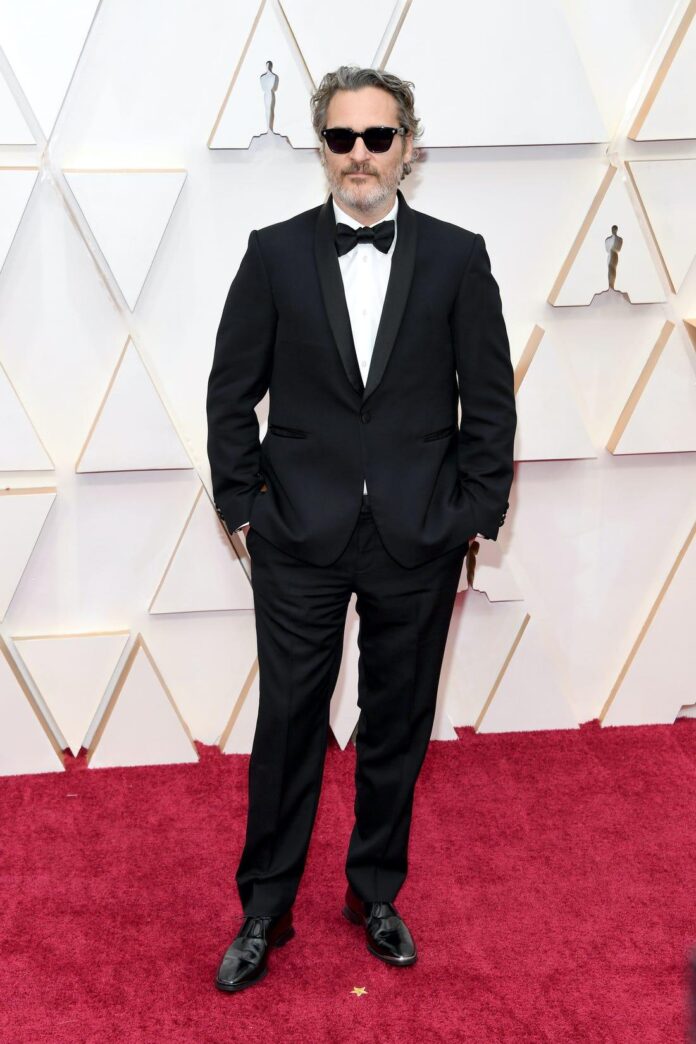
During the 2020 awards season, Phoenix wore the same custom black Stella McCartney tuxedo to several major events, including the Golden Globes, Critics Choice Awards, Screen Actors Guild Awards, BAFTAs, and Oscars. McCartney stated that the decision was intended to reduce waste.
The suit itself was controlled and conventional: black fabric, a single-button front, satin lapels, matching trousers, and a white shirt. Phoenix changed smaller elements, moving between a necktie and bow tie while sometimes adding sunglasses. Because black tie already follows a narrow visual code, repetition did not feel lazy. It exposed how unnecessary the demand for a new celebrity outfit at every event can be.
This remains his most influential fashion decision. The useful lesson is not that every man needs one designer tuxedo. It is that formalwear earns value through repeated use. A properly altered dark suit, maintained shoes, and two or three shirt-and-tie combinations can cover years of events. Familiarity can become a signature rather than a failure of imagination.
From Loose, Unpolished Fits to Sharper Modern Tailoring
Phoenix’s earlier formal style was inconsistent. Some appearances featured roomy jackets, long trouser breaks, heavy footwear, and shirts that introduced color without enough structural control. GQ’s 2012 assessment of his The Master premiere outfit praised the indigo shirt, patterned tie, and aviators but criticized the oversized suit and pooled hems.
That looseness gave him character, yet it could obscure his frame. Over time, his tailoring became more deliberate. The 2020 Stella McCartney tuxedo had cleaner shoulders and a better jacket length. For the 2023 Paris premiere of Napoleon, he wore a cropped Stella McCartney suit with short trousers, visible white socks, dress shoes, and a loosened tie. GQ noted how the irregular styling separated him from standard post-strike premiere dressing.
At Cannes in 2025, Phoenix appeared in a Givenchy tuxedo for the Eddington premiere. The look preserved his dark palette while presenting a more refined luxury finish. The evolution is clear: better fit, but not perfect obedience.
Sunglasses, White Socks, and Accessories With Personality
Sunglasses are Phoenix’s most consistent luxury accessory. He has worn classic aviator shapes, dark rectangular frames, and thicker Wayfarer-style acetate designs. During the Joker: Folie à Deux press period, GQ identified a pair as Garrett Leight Ace Sun sunglasses. At Cannes in 2025, fashion coverage identified Oliver Peoples eyewear with his Givenchy tuxedo.
The frames work because they contrast with his face and grooming. Thick acetate gives structure beside soft gray hair and an uneven beard. Dark lenses also preserve his guarded public character. They are functional, but they have become part of the image.
His visible white socks at the Napoleon premiere created a different effect. Paired with short trousers and black shoes, they interrupted the dark suit and added a slightly awkward retro note. That move is harder for most men to copy. It depends on precise trouser length and confidence. The sunglasses are more accessible: choose one frame shape that suits the face and repeat it until it becomes familiar.
Hair, Beard & Grooming Style
Phoenix’s grooming has never looked engineered for perfection. Gray hair, irregular facial growth, and visible natural features support his preference for character over gloss. Film roles have changed his haircut, color, weight, and facial hair, but his off-screen grooming usually returns to a textured, adult appearance. He does not seem interested in hiding age. That makes his current image more believable than an aggressively maintained attempt to resemble his younger self.
Gray Texture and the Value of an Unforced Haircut
Phoenix’s current public hairstyle is usually medium-short, gray, and brushed back or loosely parted. The sides are controlled without being clipped into a sharp skin fade. Texture remains visible at the front and crown, which prevents the style from looking flat under formal lighting.
His film hair has covered a wide range. Her used a clean side part and high forehead to support Theodore’s restrained personality. Joker relied on longer, oily hair before the character’s dyed-green transformation. Napoleon placed him in a severe historical cut, while Eddington used a more ordinary small-town shape suited to the role.
Men with graying hair can take the off-screen version as the better reference. A matte finish, moderate length, and natural color create depth without demanding constant styling. The barber should remove bulk around the ears and neckline while leaving enough length on top to move. Phoenix’s look works because it is maintained without appearing freshly sculpted.
How His Beard Changes the Shape of His Face
Phoenix moves between clean-shaven roles, a mustache, light stubble, and a full salt-and-pepper beard. Each version changes the apparent length and structure of his face. A beard adds width around the jaw and softens the strong lines created by weight loss or aging. Stubble keeps more of his facial expressions visible.
His fuller gray beard pairs especially well with black tailoring. The contrast adds texture to a plain tuxedo and stops the look from becoming too formal. When his hair and beard are both longer, however, a loose suit can push the entire outfit toward neglect. Cleaner clothing proportions become more important as grooming becomes more relaxed.
The useful approach is balance rather than imitation. Men with uneven beard growth should keep the outline short and avoid forcing density that is not present. A natural beard can still look intentional when the neckline is cleaned and the mustache is kept away from the lip. Phoenix’s appeal comes from accepting irregularity, not from pretending it is absent.
The Upper-Lip Mark, Minimal Grooming, and What Not to Copy
A visible mark runs from Phoenix’s upper lip toward his nose. It has often been misidentified online as a repaired cleft lip. Phoenix told Vanity Fair that it is a nonsurgical scar he was born with. No further medical conclusion is needed.
That feature has become part of his face rather than something hidden through makeup or grooming. It supports the broader authenticity of his image. The same applies to lines, gray hair, and beard variation. He allows natural details to remain visible even at heavily photographed events.
There is no dependable public information confirming a personal skincare line, signature fragrance, or exact grooming-product routine. Articles that assign him a specific pomade, beard oil, or cologne without direct evidence should not be trusted. Readers can recreate the spirit of his grooming through restraint: healthy hair length, a tidy neckline, light product, and no attempt to erase every sign of age.
Fitness, Diet & Body Transformation
Phoenix is not primarily marketed as a fitness celebrity, but physical preparation has shaped several of his most memorable performances. His body changes are tied to storytelling rather than year-round display. That distinction matters because temporary actor transformations are poor templates for ordinary health goals. Public reporting confirms medical oversight during his severe Joker weight loss, yet Phoenix himself later suggested that repeating the process at his age was not wise.
The 52-Pound Joker Transformation and Its Limits
For the first Joker, Phoenix lost 52 pounds through a highly restrictive diet advised by a doctor who had also assisted with his preparation for The Master. The result was central to Arthur Fleck’s appearance. Ribs, shoulder blades, posture, and movement became part of the performance rather than background details.
Phoenix explained that the lower weight changed how he could move. The famous bathroom dance and several other physical moments draw power from that altered balance. Still, the transformation should not be separated from professional supervision, a defined production period, and the demands of a fictional role.
Rapid loss of that size is not a reasonable general fitness target. Phoenix did not publish a plan for fans, and responsible coverage should not invent one. The style impact is also temporary. Clothes designed for an extremely lean screen body will not fit the same after weight restoration. Anyone changing weight should delay major tailoring alterations until their measurements become stable.
Vegan Since Childhood, Without a Public Meal Plan
Phoenix has followed a vegan lifestyle since early childhood. He has connected that decision to witnessing the killing of a fish while traveling with his family. Animal-rights organizations have documented his long involvement in campaigns concerning food, clothing, and animal treatment.
Veganism is part of his ethics as much as his diet. It also influences fashion. Phoenix has spoken against animal-derived materials, worked with Stella McCartney, and supported campaigns challenging the use of leather, wool, and other animal products. His sustainable tuxedo therefore made sense within a position he had held long before the 2020 awards season.
There is no verified everyday menu, calorie target, supplement stack, or detailed home meal plan available. A past interview indicated that he generally avoided processed food while still eating occasional convenience food, which is more human than the rigid celebrity diets often invented online.
Dance Rehearsals, Role Preparation, and a Safer Lesson
Phoenix again reduced his weight for Joker: Folie à Deux. At the 2024 Venice Film Festival, he said the process felt harder because the role also required extensive dance rehearsals. He declined to provide exact diet details and stated that, at 49, he probably should not repeat such a transformation.
That comment is more useful than a copied actor workout. It recognizes that the body responds differently with age and that professional results can carry costs. The film required stamina, choreography, vocal work, and control at a reduced body weight. Those circumstances are specific to the production.
A practical lesson is to train for function rather than a dramatic photograph. Walking, resistance work, mobility, dance, or a sport can support energy and posture without forcing an actor’s temporary appearance. Clothes also look better on a body that moves comfortably. Phoenix’s strongest physical performances come from control and expression, not from maintaining one ideal size throughout his life.
Conclusion
Joaquin Phoenix has built a public image from resistance. He resists easy roles, fixed body expectations, constant access, disposable formalwear, and the pressure to turn every possession into content. That does not make him detached from fashion. It makes his fashion choices more revealing.
His style evolution moved from oversized, imperfect tailoring toward cleaner designer suits that still retain disruption. The repeated Stella McCartney tuxedo remains the defining example. It was classic enough to work at every ceremony, personal enough to match his ethics, and simple enough to expose the waste built into red-carpet culture. Later outfits expanded that language through cropped trousers, loosened ties, visible white socks, Givenchy tailoring, and premium sunglasses.
The most useful part of his wardrobe is not its price. It is the consistency between clothing and character. His gray hair is not hidden. His beard is not shaped into artificial perfection. His accessories recur. His suits become memorable through use.
Men taking inspiration from Phoenix should begin with one idea: buy fewer pieces that can survive repetition. Alter the jacket, control the trouser break, choose sunglasses that fit the face, and allow natural features to remain visible. Personal style becomes convincing when it stops asking permission from every new trend.
Frequently Asked Questions
How old is Joaquin Phoenix?
Joaquin Phoenix was born on October 28, 1974. He is 51 years old as of July 2026 and will turn 52 in October 2026. He was born in San Juan, Puerto Rico, and began working as a child performer during the early 1980s.
How tall is Joaquin Phoenix?
He is commonly reported to be around 5 feet 8 inches, or approximately 173 centimeters. The figure is an entertainment-profile estimate rather than a publicly certified measurement. His best formal outfits use shorter jackets and controlled trouser lengths that complement his average-height frame.
Is Joaquin Phoenix married to Rooney Mara?
Phoenix referred to Rooney Mara as his wife during a 2024 interview, but the couple has not issued a detailed public wedding announcement. They became engaged in 2019 and are best described as long-term partners unless they choose to clarify their legal marital status publicly.
How many children do Joaquin Phoenix and Rooney Mara have?
They have two children. Their son River was born in 2020 and named in honor of Joaquin’s late brother. Mara revealed her second pregnancy in February 2024, but the couple has kept details concerning their younger child largely private.
What is Joaquin Phoenix’s estimated net worth?
Celebrity finance publications commonly estimate his net worth at about $80 million, but the figure is not audited or officially confirmed. Variety reported salaries of roughly $4.5 million for Joker and $20 million for its sequel, offering firmer evidence of his earning power.
Where does Joaquin Phoenix live?
Public property reporting connects him with a mission-style home in the Hollywood Hills that he purchased in 2006. He later bought a neighboring property. Exact street information is intentionally omitted, and current household arrangements should be treated as private.
What is Joaquin Phoenix’s signature fashion style?
His style combines black tailoring, relaxed proportions, plain casual basics, gray grooming, and statement sunglasses. His defining fashion moment was wearing the same custom Stella McCartney tuxedo throughout the 2020 awards season as a stand against unnecessary waste.
How much weight did Joaquin Phoenix lose for Joker?
He reportedly lost 52 pounds for the 2019 film while working with a doctor. Phoenix later underwent another demanding reduction for Joker: Folie à Deux and said he probably should not repeat the process. These role-specific transformations are not suitable as unsupervised fitness plans.
Celebrity Style Reports
Signature wardrobes, red-carpet fashion and personal style evolution.