

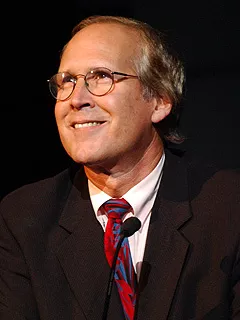
Chevy Chase’s wardrobe has always worked best when it supports his natural comic confidence rather than competing with it. During his rise in the 1970s, he had the height, dark hair, relaxed posture, and leading-man looks to make a traditional tuxedo feel slightly rebellious. Decades later, the same basic formula remains visible: dark tailoring, crisp shirts, restrained accessories, round glasses, and enough ease to prevent formalwear from appearing stiff.
Born Cornelius Crane Chase, the American actor, comedian, and writer became the first major breakout performer from the original Saturday Night Live cast. His appeal soon expanded through films such as Foul Play, Caddyshack, National Lampoon’s Vacation, Fletch, Three Amigos, and National Lampoon’s Christmas Vacation. His later role in Community introduced his dry delivery and physical comedy to another generation.
His style history is less about fashion labels than proportion, consistency, and personality. The strongest Chevy Chase looks show how a tall man can wear classic suits without appearing boxed in, how glasses can become part of a recognizable image, and why comfortable tailoring often ages better than aggressive trends. This profile examines those lessons while separating verified public information from online assumptions.
Biography, Age & Background
Understanding Chase’s background helps explain the contrast at the center of his image. He arrived on television looking polished and self-assured, yet his humor often depended on falls, awkward pauses, and carefully controlled disorder. His upbringing, education, musical ability, and early writing work formed a broader creative base than his deadpan television persona suggested. That mixture of intelligence and physical comedy later shaped how audiences saw him in both formal clothing and casual screen costumes.
From Cornelius Crane Chase to a National Comedy Name
Chevy Chase was born Cornelius Crane Chase on October 8, 1943, in Lower Manhattan, New York. He was 82 years old as of July 2026. His official biography says his grandmother gave him the nickname Chevy, while the Television Academy identifies his birthplace as Lower Manhattan and his profession as actor and comedian.
He grew up partly in Woodstock, New York, within a family connected to writing, music, publishing, and the arts. His father, Edward Tinsley Chase, worked as an editor and writer. His mother, Cathalene Parker, was a concert pianist and librettist. That artistic environment did not produce an uncomplicated childhood, however. Chase and members of his family have spoken publicly about abuse he experienced from his mother and stepfather, including in the 2026 documentary I’m Chevy Chase and You’re Not.
The contrast between privilege, creativity, and private instability adds context to his public character. His screen confidence often carried a defensive edge. Even his best-dressed appearances rarely looked overly rehearsed; a loose posture or comic expression kept the polish from feeling remote.
Bard College, Music, and the Road to Satire
Chase attended Bard College and earned a degree in English. Bard lists him among its notable comedian alumni, while his official biography notes that he graduated after having been valedictorian of his high school class.
Music was also a serious part of his early development. He played drums and keyboards and spent time in a college band with Donald Fagen and Walter Becker, who later formed Steely Dan. His daughters have also inherited musical interests, according to a 2026 family profile.
That background matters because Chase’s comedy has always depended on timing. His pauses, falls, facial reactions, and line readings operate almost like musical beats. The same instinct can be seen in his clothing. He tends to look strongest in outfits with a clear rhythm: one dark suit, one pale shirt, one focused accessory, and little visual clutter.
Men trying to learn from his look should notice that restraint. A wardrobe does not need many decorative elements when the wearer already has a strong physical presence.
The First-Season SNL Breakout Who Changed His Trajectory
Before television fame, Chase worked with the National Lampoon comedy circle and wrote for television. He joined the debut season of NBC’s Saturday Night Live in 1975, becoming the original anchor of “Weekend Update.” NBC continues to recognize him as the first official host of the segment, while the Television Academy describes it as a defining part of the show’s early success.
His desk persona was calm, smug, and sharply dressed. That visual control made the jokes stronger. He appeared less like a frantic sketch performer and more like a traditional broadcaster who had quietly decided not to respect the format.
He became the first original cast member to leave the series, moving into films while his fame was still rising. The decision created a template later followed by other sketch-comedy stars: use television to establish a persona, then translate that persona into movie roles.
His early suits helped that transition. They told audiences that he could move from counterculture comedy into romantic comedy, studio pictures, and leading-man publicity without needing a complete image change.
Height, Weight & Body Measurements
Chase’s height has always been a central part of his visual presence. He could dominate a frame while remaining loose enough for physical comedy, a useful combination for characters who appeared confident before suddenly losing control. Exact celebrity measurements are often copied across websites without primary evidence, so reported figures should be treated carefully. More useful than an uncertain number is an examination of how his proportions affect tailoring, posture, and the way clothing reads on camera.
What Is Chevy Chase’s Reported Height?
Chase is widely reported to stand around 6 feet 4 inches, or roughly 193 centimeters. However, his official website, Television Academy profile, and recent major interviews do not publish a verified current height measurement. The familiar figure should therefore be understood as a commonly reported estimate rather than a formally confirmed statistic.
No dependable current public source confirms his weight, chest measurement, waist size, shoe size, or other body statistics. Those numbers can change substantially over a lifetime, making old or unattributed listings poor guides.
His visible proportions are easier to assess. He has long limbs, a relatively long torso, and naturally broad upper-body lines. In younger photographs, his slim build and height gave him the proportions associated with late-1970s leading men. Later appearances show a fuller, older frame, yet the underlying height still allows him to carry a longer jacket without being overwhelmed.
For readers, the lesson is simple: observed proportions are more useful than copying a celebrity’s supposed measurements.
How His Tall Frame Shaped Screen Presence and Suit Fit
A tall man can appear commanding in a suit, but poor tailoring becomes easier to notice. Sleeves that are too short, a jacket that ends too high, or trousers with insufficient length can make the outfit appear borrowed. Chase’s strongest formal looks avoid those problems by giving his frame enough fabric.
A 1979 image highlighted by GQ shows him in a dark tuxedo with a proper jacket length, generous lapels, a white shirt, and a black bow tie. The proportions match the era, yet they also suit his body. The lapels have enough width to balance his shoulders, while the jacket does not pinch tightly around his torso.
That approach remains useful for tall men. A slightly longer jacket can create a cleaner vertical line. Medium or wider lapels keep a broad chest from making narrow lapels look fragile. Trousers need enough rise and length to prevent the body from appearing divided into disconnected sections.
Chase rarely benefits from clothing that looks aggressively slim. Ease is not the same as poor fit; on a tall frame, it often creates better balance.
Aging, Proportion, and the Value of Better Jacket Structure
Body proportions change with age, even when height remains largely constant. The waist may become fuller, shoulders may appear softer, and posture can shift. Clothing that worked at 35 may pull or collapse at 75. Chase’s later formal appearances demonstrate both the risks and the solutions.
At the 2025 SNL anniversary celebration, he wore a black tuxedo with a white shirt, black bow tie, pocket square, and round glasses. The look succeeded because it relied on a stable shoulder line and a familiar monochrome palette rather than a sharply narrowed silhouette.
Older men often make the mistake of sizing up without considering shape. That produces excess fabric around the shoulders and sleeves. A better approach is a jacket with comfortable room through the middle, supported shoulders, sufficient length, and sleeves adjusted precisely.
Chase’s height gives him some tolerance for volume, but structure still matters. The jacket should frame the body instead of hanging from it. Tailoring becomes more useful with age, not less.
Wife, Girlfriend & Family
The private side of Chase’s life differs from the combative or detached characters associated with his comedy. His marriage to Jayni Chase has lasted far longer than many Hollywood relationships, and their three daughters describe a close family identity built around music, humor, animals, and creative work. Family has also influenced where he lived and how he presented himself publicly, especially after he moved away from full-time Hollywood life.
A Marriage Built Beyond Hollywood’s Usual Timeline
Chase has been married to Jayni Chase since 1982. They met while working on the 1981 film Under the Rainbow, where Jayni was a production coordinator. In a January 2026 interview, the couple discussed their 43-year marriage and the affection that has supported it through career changes and personal difficulties.
Jayni has worked on environmental causes and has promoted greener household practices. Her public image is practical and outdoors-oriented rather than centered on Hollywood fashion. That may help explain why the couple’s appearances together often feel coordinated without looking staged.
At the SNL50 event, Chase wore classic black tie while Jayni chose a black-and-white outfit with glasses. The shared neutral palette created visual unity without matching item for item.
That is a useful formalwear lesson for couples. Coordination works best through color temperature and degree of formality. Identical accessories or forced color matching can make two adults look like part of a promotional uniform.
Three Daughters and the Creative Thread in the Chase Family
Chevy and Jayni Chase have three daughters: Cydney, Caley, and Emily. People’s recent family profiles describe Cydney as a singer-songwriter and painter, Caley as an actress, musician, and writer, and Emily as someone connected to music and environmental advocacy.
The family’s creative interests are not limited to acting. Music, visual art, writing, and environmental work run through their public lives. Chase has said that fatherhood is among the parts of his life that make him proudest, and he became a grandfather when Emily welcomed a daughter named Ivy.
This family context gives his later style a different meaning. During his early fame, formal clothing supported the image of a young comedy star moving into films. In later decades, his suits often appeared at family events, anniversary programs, tribute evenings, or career retrospectives.
The clothes became less about selling a new leading-man role and more about acknowledging his place in comedy history while standing beside people close to him.
How Family Softened a Public Image Built on Sharp Comedy
Chase has long carried a reputation for difficult professional relationships and cutting humor. The 2026 documentary about his life did not avoid those accounts, but it also included perspectives from Jayni, his daughters, his brother Ned, and longtime colleagues. The Associated Press described the result as a portrait of a talented yet complicated performer whose family sees greater vulnerability than his public image suggests.
Public photographs with his wife and daughters tend to reveal a less guarded physical presence. His posture is looser, his expressions are warmer, and the formality of a suit feels secondary to the interaction.
That distinction is worth noticing because style is affected by emotional setting. The same black jacket can appear severe in a solo studio portrait and approachable in a family photograph. Clothing does not carry meaning alone; expression and body language complete it.
Chase’s family appearances show why men should avoid treating formalwear as armor. A suit looks better when the wearer remains visibly engaged with the people around him.
Career, Income & Net Worth
Chase’s career contains a rare sequence: early writing, instant television fame, major studio comedies, a difficult middle period, and a later ensemble television role that introduced him to younger viewers. That history created several possible income sources, but his private finances have never been publicly documented in enough detail to support a precise wealth calculation. The responsible approach is to examine known work and describe online net-worth numbers as outside estimates.
Weekend Update, Emmys, and the First Major Breakthrough
Chase’s first great career asset was not a film salary or endorsement. It was recognition. His “Weekend Update” role made his face, name, voice, and delivery familiar during the first season of Saturday Night Live. His opening catchphrase built a public character around confidence bordering on arrogance.
The Television Academy credits Chase with three Primetime Emmy Awards from five nominations. His wins include performance and writing honors connected to NBC’s Saturday Night, plus a writing award for The Paul Simon Special. He was also inducted into the Television Academy Hall of Fame in 2017 as part of the original SNL cast.
Awards did more than validate his comedy. They helped position him as a performer who could carry projects outside sketch television. The Golden Globes later nominated him twice for Foul Play: once for best actor in a musical or comedy and once as a new male star.
That brief period established the polished leading-man image still visible in his strongest vintage formalwear.
The Film Run Behind Fletch, Vacation, and Caddyshack
Chase’s most valuable screen period stretched through the late 1970s and 1980s. His filmography includes Foul Play, Caddyshack, National Lampoon’s Vacation, Fletch, Spies Like Us, Three Amigos, Funny Farm, and National Lampoon’s Christmas Vacation.
Those movies did not demand one fixed wardrobe identity. Ty Webb in Caddyshack used understated golf clothing to suggest ease and social confidence. Clark Griswold’s clothes often reflected middle-class ambition, suburban practicality, and comic misjudgment. Fletch moved through disguises, sportswear, jackets, and casual clothing as part of the character’s investigative games.
Screen costumes should not be confused with Chase’s personal wardrobe, yet they affected how audiences understood him. He could appear believable in a tuxedo, golf shirt, crewneck sweater, or rumpled jacket because his persona remained recognizable underneath.
His later role as Pierce Hawthorne in Community made traditional jackets, sweaters, and older-man casualwear part of the joke while restoring him to a widely watched ensemble series.
What Can Be Said Responsibly About His Net Worth
No official financial disclosure confirms Chevy Chase’s net worth. Figures published by celebrity-wealth websites are estimates based on incomplete assumptions about salaries, property, taxes, expenses, residuals, investments, and career contracts. They should not be presented as audited facts.
His known income opportunities have included television writing, acting, film salaries, series work, voice roles, public appearances, royalties, and possible residual payments. The scale of those earnings is difficult to calculate because entertainment contracts from his peak decades are not fully public.
His career also included commercial disappointments, a short-lived 1993 talk show, periods with fewer major roles, and professional controversies that may have affected later opportunities. The Washington Post’s 2018 profile described him as wanting more work while facing resistance within the industry.
A responsible profile can say he earned substantial money during a long career. It cannot confirm how much of that income became lasting personal wealth.
House, Cars & Luxury Lifestyle
Chase’s lifestyle does not fit the usual celebrity-content formula built around supercars, watch vaults, and constantly changing mansions. His public story is more closely connected to a wooded New York home, family life, music, animals, and distance from Hollywood’s daily machinery. Some properties have been linked to him in published profiles, but claims about exact values, current ownership, vehicle collections, or private possessions require caution.
A Longtime New York Family Base Away From Hollywood
The Chase family has long been associated with the Bedford and Mount Kisco area of Westchester County, New York. A 2018 Washington Post profile was reported from his wooded Westchester home and described the porch, kitchen, and quieter setting in which he was spending his time. The same report noted that he had moved from Hollywood to a small New York community in the 1990s to raise his daughters with Jayni.
Published family photographs also place Chase, Jayni, and their daughters at their Bedford home during the 1990s. No private street address is needed to understand the lifestyle choice.
The move supported a less industry-centered identity. Westchester offers access to New York City while allowing more privacy, land, and separation from entertainment events.
For style, that shift encouraged a wardrobe that could move between outdoor family life and occasional formal appearances. A man does not need red-carpet clothing every day when most of life happens away from a premiere line.
Publicly Seen Comfort, Not a Showroom Version of Luxury
Recent documentary material has shown Chase at home playing piano, reading letters, playing chess, interacting with animals, and taking part in ordinary errands. The Associated Press noted these domestic scenes while describing I’m Chevy Chase and You’re Not.
That is a different form of celebrity lifestyle from one based on visible collecting. His public surroundings suggest comfort, space, family history, and personal objects rather than a spotless house designed mainly for social media.
Even his clothing fits that mood. Chase often appears most natural in soft shirts, sweaters, uncomplicated jackets, and trousers that allow movement. These items may lack the visual impact of a red-carpet tuxedo, but they align with the way he spends much of his publicized home life.
Luxury can mean privacy and time rather than constant display. That idea is easier for ordinary men to apply: spend on useful materials, alterations, and pieces that suit daily routines before buying clothes intended for rare photo opportunities.
Why His Car Collection and Luxury Purchases Remain Unconfirmed
No dependable public source confirms that Chase currently owns a major car collection, private jet, large watch archive, or specific fleet of luxury vehicles. Many online lists attach cars to celebrities without purchase records, direct interviews, or clear photographs proving ownership.
The same caution applies to watches and designer brands. Chase has been photographed in suits, tuxedos, ties, glasses, casual jackets, and sports clothing, but those images rarely provide reliable brand identification. A visible item may be borrowed, supplied by a stylist, part of a costume, or chosen for one event.
It is more accurate to describe his lifestyle through documented settings and habits. He has lived in New York’s Westchester County, maintained a long marriage, raised three daughters, played music, and remained connected to comedy events.
The absence of a verified collection is not a gap that needs to be filled with guesses. Restraint protects both factual accuracy and the subject’s privacy.
Celebrity Fashion & Personal Style
Chase’s fashion reputation rests on a small number of dependable ideas rather than dramatic experimentation. He has worn wide-lapeled 1970s tuxedos, traditional black tie, pinstripe business suits, colorful neckties, golf clothing, relaxed jackets, and approachable American casualwear. His best outfits succeed when they respect his height and allow his personality to remain visible. The progression also offers a useful record of how men can adapt classic tailoring across several decades without chasing every trend.
The 1979 Tuxedo That Captured His Leading-Man Peak
One of Chase’s most memorable formal images comes from the 1979 Emmy era. He wore a dark tuxedo with broad satin lapels, a white formal shirt, and a black bow tie. His dark, slightly loose hair and relaxed expression prevented the outfit from looking ceremonial. GQ later included the appearance in a gallery of memorable Emmy red-carpet looks.
The outfit reflects late-1970s proportions, but it remains useful as a reference. The lapels are broad enough for his chest and shoulders. The jacket has room rather than clinging to his body. His bow tie is visible without becoming oversized, and the monochrome palette lets his face remain the focus.
A narrower modern tuxedo could make a man of his height look longer and less balanced. Wider lapels interrupt that vertical line and reconnect the shoulders with the torso.
The lesson is not to copy the decade exactly. It is to choose formalwear that matches physical scale. A tall man often needs more lapel, more jacket length, and a stronger shirt collar than current slim-cut displays suggest.
How His Suits Shifted From Playboy Sharpness to Relaxed Formality
As Chase aged, his tailoring became less sleek and more forgiving. At the 2004 Vanity Fair Oscar party, he wore a black tuxedo with a bow tie and formal shirt studs. The outfit retained classic eveningwear codes while his round glasses made the presentation more personal.
At a 2007 Jazz at Lincoln Center gala, he chose a dark pinstripe suit, white shirt, and deep red tie. The vertical stripe worked naturally with his height, while the red tie gave the outfit one clear point of contrast.
His 2025 SNL50 look returned to black tie. The tuxedo was roomier, reflecting his older frame, but the white pocket square, bow tie, glasses, and clean color scheme kept it recognizable as event dressing.
The progression shows that personal style does not require wearing the same cut forever. Chase kept the vocabulary—dark tailoring, white shirts, traditional ties, minimal accessories—while adjusting the shape. Consistent colors can provide continuity when the body and fit need to change.
Seven Chevy Chase Fashion Lessons Men Can Use
The first lesson is proportion. Tall men should resist jackets that are short enough to expose too much trouser rise. Second, lapel width should relate to shoulder width. A narrow lapel can disappear on a broad or long frame.
Third, black tie works best when each part does its job quietly. Chase’s tuxedos rarely depend on unusual prints or bright footwear. Fourth, one strong color is often enough. His dark suit and red tie combinations create focus without turning the tie into a costume.
Fifth, glasses can function like a permanent accessory. Frames should fit the face and remain consistent enough to become part of the wearer’s identity. Sixth, comfort must be planned through tailoring rather than achieved by choosing shapeless clothing. Room through the waist can coexist with clean shoulders and adjusted sleeves.
The seventh lesson is the most useful: do not copy a celebrity outfit without considering context. Chase’s wide 1979 lapels suited his age, era, build, and public image. A modern reader can borrow the balance while choosing quieter proportions. Inspiration works when it is translated, not duplicated.
Hair, Beard & Grooming Style
Chase’s grooming has changed gradually rather than through sharp reinventions. His early image depended on dark hair, a clean-shaven face, expressive eyebrows, and a polished but slightly untidy finish. As his hair receded and turned silver, round glasses became more visually important. He has not publicly built a grooming brand around products, fragrances, or complicated routines, so the useful analysis comes from visible choices rather than unsupported claims.
Dark Waves, Silver Hair, and an Unforced Aging Story
Young photographs show Chase with dark, medium-length hair that carried natural movement around the ears and crown. The style suited the 1970s and softened his long face. It also helped balance his height by adding some width around the upper head.
Over time, his hairline receded and the color shifted through gray to silver and white. He generally kept enough length for a soft side direction rather than cutting the hair into a severe, exposed crop. Recent appearances show a natural texture with no attempt to disguise age through an unnaturally dark color.
That approach works because the grooming remains believable. Men with thinning hair do not always need the shortest possible haircut. Some can retain modest length when the sides are controlled and the top is kept light.
The key is avoiding a heavy comb-over or thick product buildup. Chase’s better later looks allow the hair to sit naturally, which suits both his age and his relaxed public manner.
Round Glasses as a Functional Signature
Round or softly rounded glasses became one of Chase’s most recognizable grooming features. They appear across decades of red-carpet photographs, including his 2004 tuxedo, 2007 pinstripe suit, and 2025 SNL anniversary appearance.
The frames work because they contrast with his longer face and relatively straight facial lines. A narrow rectangular frame could lengthen his face further, while a round shape introduces width and softness. Thin dark or metal rims also avoid competing with formal clothing.
Men recreating this idea should focus on scale. Small round glasses may look theatrical on a broad face, while oversized circles can dominate the eyes. The frame should sit securely at the bridge, follow the brow area, and leave enough space around the temples.
Consistency matters too. Wearing a similar frame shape over time can create recognition, much like a familiar haircut or watch. Chase’s glasses feel personal because they appear in both formal and casual settings.
Clean-Shaven Grooming and What Not to Overcopy
Chase has spent most of his public career clean-shaven. That choice keeps attention on his facial expressions, which are central to his comedy. It also works with round glasses by preventing the lower face from becoming visually busy.
A clean shave can sharpen formalwear, but it does not need to produce an artificial, heavily polished finish. Chase’s skin texture and aging remain visible in recent photographs. The result feels human rather than filtered.
No reliable evidence confirms a particular skincare line, shaving product, fragrance, or salon routine. Claims connecting him to specific grooming products should be treated as advertising or speculation unless supported by a direct statement.
The practical lesson is to choose grooming that serves personal features. Men with expressive faces and statement glasses may not need a beard. Men who prefer facial hair can still borrow Chase’s restraint by keeping the beard shape simple and avoiding an additional stack of bold accessories.
Fitness, Diet & Body Transformation
Chase is not known for promoting a branded workout program or public diet plan. His relationship with movement is better understood through physical comedy, changing body weight, natural aging, and the demands of a long performance career. Public reports have discussed periods of weight loss and health difficulty, but no reliable current source provides an exact training schedule, calorie target, supplement list, or daily menu. Any fitness discussion must remain within those limits.
Physical Comedy Was His Original Athletic Language
During his early career, Chase’s physical ability was visible in falls, collisions, sudden changes of posture, and controlled clumsiness. His comedy often required him to look unprepared while landing a movement at the right moment. That demands timing, coordination, spatial awareness, and confidence in the body.
His tall frame made those falls more dramatic. A smaller performer dropping behind a desk creates one effect; a man around 6 feet 4 inches folding out of view produces another. NBC’s early SNL material still emphasizes the pratfalls and physical bits associated with his first seasons.
This does not prove that he followed a formal athletic program. It shows that his work involved more physical control than the relaxed delivery suggested.
For everyday readers, the transferable lesson is movement variety. Strength matters, but balance, mobility, coordination, and safe practice matter too. Attempting professional stunt comedy without training would be unwise. The useful principle is to remain capable across several types of movement.
Public Weight Changes Without a Celebrity Workout Myth
A 2018 Washington Post profile reported that Chase was sober and approximately 40 pounds lighter than he had been during a difficult earlier period. The report did not provide a detailed workout or diet plan that readers could verify or reproduce.
His weight and appearance have continued to change with age. Recent public photographs show a fuller build than his slim 1970s frame, which is normal across a career spanning more than five decades. It would be misleading to describe every change as a planned “transformation.”
No confirmed evidence supports exact claims about how often he trains, which exercises he performs, what he eats each day, or whether he follows a named diet. Public health events have also been discussed by Chase and his family, but they should not be converted into fitness advice.
The better editorial approach is to acknowledge the limits. A photograph can show a change in shape, but it cannot explain the medical, nutritional, or lifestyle causes behind it.
Practical Fitness Lessons From an Older Performer’s Public Life
Chase’s later public schedule has included anniversary events, interviews, screenings, live appearances, and family activities. These do not reveal a structured fitness program, but they show the practical value of maintaining enough mobility and energy to participate in public life.
For older men, useful goals may include comfortable walking, stable balance, joint-friendly strength work, and recovery between demanding days. Those goals should be adjusted with qualified medical or fitness guidance, especially when a person has a history of health problems.
Clothing also affects how the body feels during long events. A jacket with room through the waist, trousers that do not restrict sitting, supportive shoes, and a properly sized shirt can reduce unnecessary discomfort. Chase’s later formalwear works best when it accommodates his body rather than forcing it into his younger silhouette.
The lasting lesson is not to chase a past measurement. Fitness and style both improve when they support the life a man is living now.
Conclusion
Chevy Chase’s best-dressed looks are memorable because they never erase the person inside them. The dark 1979 tuxedo worked with his youthful height, loose hair, and rising movie-star confidence. His later pinstripe suits, traditional bow ties, red neckties, round glasses, and roomier jackets adapted the same visual language to a different age and body.
His style is not defined by constant designer attribution or headline-producing experiments. It is built from familiar American menswear: black tuxedos, dark business suits, white shirts, clear tie choices, casual sweaters, golf clothing, and frames that became part of his face. That consistency helped connect several versions of his public identity—the smug news anchor, romantic-comedy lead, suburban movie father, ensemble television character, husband, and comedy veteran.
The practical lesson is to treat classic clothing as a flexible system. Keep the colors and garments that feel natural, but change the cut when the body changes. Give a tall frame enough jacket length. Choose lapels that match physical scale. Use one accessory with purpose instead of several competing details.
Chase looks most convincing when his clothes provide structure while leaving room for humor. That balance, more than any single tuxedo, is what makes his style worth studying.
Frequently Asked Questions
How old is Chevy Chase in 2026?
Chevy Chase is 82 years old as of July 2026. He was born on October 8, 1943, in Lower Manhattan, New York, and will turn 83 in October 2026.
How tall is Chevy Chase?
He is commonly reported to be about 6 feet 4 inches, or 193 centimeters. Major official profiles do not publish a verified current measurement, so the number should be treated as a widely repeated estimate rather than a formally confirmed figure.
Who is Chevy Chase’s wife?
He is married to Jayni Chase. The couple met during the production of Under the Rainbow in 1981 and married in 1982. They discussed their long relationship in a January 2026 interview.
Does Chevy Chase have children?
Chevy and Jayni Chase have three daughters named Cydney, Caley, and Emily. Their daughters have pursued interests including music, painting, writing, acting, and environmental work. Chase is also a grandfather.
What is Chevy Chase’s net worth?
No audited or official figure is publicly available. Online estimates vary and may not account for taxes, expenses, residual agreements, property ownership, or private investments. His career income has come from acting, television writing, films, voice work, and public appearances.
Where does Chevy Chase live?
Published profiles have long connected Chase and his family with the Bedford and Mount Kisco area of Westchester County, New York. A 2018 Washington Post interview took place at his wooded Westchester home. A private street address should not be published.
What are Chevy Chase’s best suit looks?
His strongest formal appearances include his broad-lapeled 1979 tuxedo, the classic black tuxedo worn at the 2004 Vanity Fair Oscar party, a 2007 pinstripe suit with a red tie, and his black-tie look at the 2025 SNL50 celebration.
What hairstyle and glasses are associated with Chevy Chase?
His younger look featured dark, softly waved hair and a clean-shaven face. As he aged, he kept his thinning hair natural and silver. Thin round glasses became his most consistent grooming signature because their curved shape balances his long facial proportions.
Comedy Legends, Classic Tailoring and Modern Style
Explore signature suits, statement coats, luxury footwear, refined accessories and memorable casual looks from celebrated actors and comedians.