

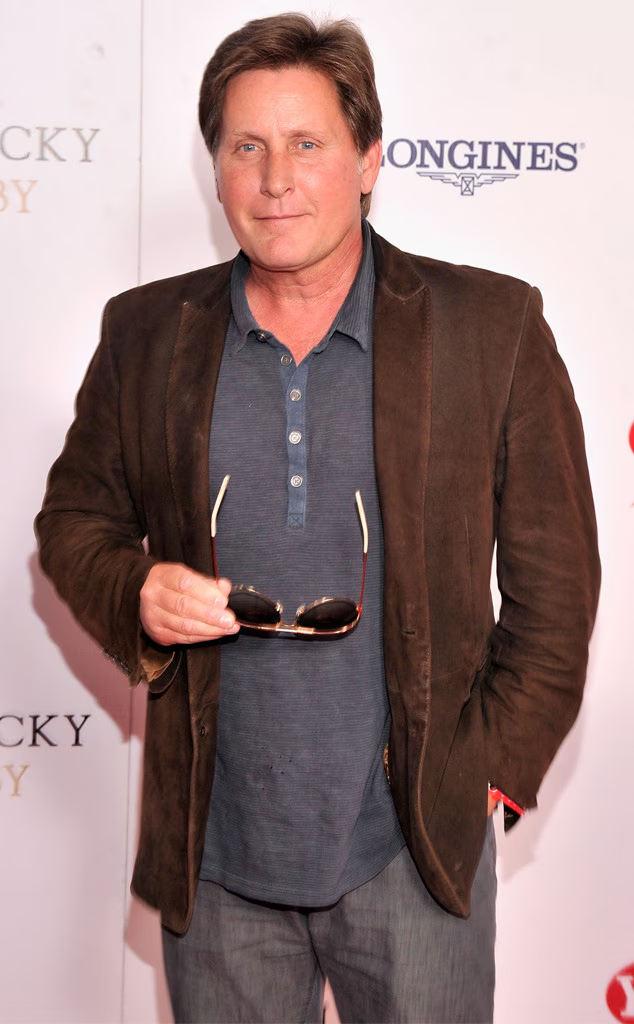
Emilio Estevez has always appeared more comfortable in a well-cut dark jacket than in the machinery of celebrity spectacle. His red-carpet wardrobe reflects that attitude. Instead of loud designer statements, experimental silhouettes, or heavy jewelry, he tends to favor classic suits, relaxed blazers, neutral shirts, and grooming that looks controlled without appearing overworked.
The American actor, writer, director, and producer became one of the defining young stars of 1980s cinema through The Outsiders, Repo Man, The Breakfast Club, St. Elmo’s Fire, and the Young Guns films. He later built a second professional identity behind the camera, directing projects including Bobby, The Way, and The Public. His public image has matured in the same way as his career: less concerned with attention, more focused on purpose and personal comfort.
Estevez’s best red-carpet outfits usually rely on dark tailoring, modest proportions, open collars, and clean grooming. His signature suits work because they respect his compact frame rather than trying to make him look taller through obvious tricks. The same restraint shapes his hair, facial hair, and casual clothing. That combination of clothing, grooming, biography, family, work, and lifestyle forms the editorial frame of this profile.
Emilio Estevez Biography, Age & Background
Estevez’s background explains much of his independent public identity. He grew up inside a successful acting family, yet he made deliberate choices that separated his career from his father’s established name. His childhood mixed film sets, home moviemaking, coastal California life, and early exposure to the unstable nature of acting. Those experiences helped create a performer who could become a major commercial star while still questioning the value of fame.
Born Into Film but Determined to Keep the Estevez Name
Emilio Estevez was born on May 12, 1962, in New York City. He turned 64 in May 2026. His father is actor Martin Sheen, born Ramón Estévez, while his mother, Janet Templeton Sheen, has worked as an actress and producer. Emilio is the eldest of four children, followed by Ramon Estevez, Charlie Sheen, and Renée Estevez.
He kept the Estevez surname when entering the film business, even though the Sheen name already carried professional value. That decision became an early statement about identity. It also gave him a different public texture from his father and brother Charlie.
For style readers, the choice fits the man’s later wardrobe. Estevez rarely builds his image around borrowed status. His clothing tends to look personal rather than managed by an aggressive celebrity-fashion campaign. The effect is quiet confidence: recognizable without depending on a famous label, whether that label belongs to a family or a fashion house.
Malibu Childhood, Santa Monica High, and a Camera at Home
The Estevez family moved west when Emilio was young, eventually settling in Malibu. He attended Santa Monica High School and grew up around other future performers, including young people connected to Hollywood families. Film was part of normal household life rather than an unreachable industry operating beyond the family home.
Martin Sheen gave the children a portable movie camera, allowing Emilio and his friends to make short films. Estevez also visited major film sets through his father’s work and briefly appeared as an extra in Apocalypse Now, although his footage did not remain in the finished movie. After graduating in 1980, he chose acting instead of college.
That mix of access and experimentation matters. He did not learn only how to perform for a camera; he became interested in what happened behind it. His later shift toward writing and directing was not a retreat from acting. It continued a habit that began with a camera in childhood.
From Tex and The Outsiders to a Distinct Public Identity
After early television work, Estevez gained attention with Tex in 1982 and Francis Ford Coppola’s The Outsiders in 1983. Repo Man followed in 1984, giving him a stranger and less polished role than the conventional young-leading-man parts that could have defined him. Then The Breakfast Club and St. Elmo’s Fire made his face central to the youth culture of the decade.
The “Brat Pack” label connected him permanently to a group of young actors. Estevez later spoke about how that label affected professional choices and encouraged him to avoid projects that might reinforce the image. In 2025, however, he joined the full Breakfast Club cast for a 40th-anniversary reunion in Chicago, saying the place and timing made the occasion feel personal.
His image now carries both histories: the youthful star people remember and the private filmmaker who spent years resisting nostalgia. That tension gives his current appearances more weight than constant visibility would.
Emilio Estevez Height, Weight & Body Measurements
Physical proportions affect how clothing sits, yet celebrity measurement pages often create false precision. Estevez’s reported height is useful when examining his tailoring, but current weight, chest size, waist size, and shoe size are not supported by strong public documentation. His photographs provide better style evidence than unsourced number lists. They show a compact build that benefits from moderate lapels, controlled jacket length, and limited visual clutter.
What Is Emilio Estevez’s Reported Height?
Emilio Estevez is commonly listed at around 5 feet 7 inches, or approximately 170 centimeters. That figure appears across entertainment profiles, though it does not come from a recent official measurement released by Estevez or his representatives. It should therefore be treated as a widely reported figure rather than a certified statistic.
His height never prevented him from carrying athletic, romantic, action, or authority-based roles. In The Breakfast Club, he played wrestler Andrew Clark. In Young Guns, he led an ensemble as Billy the Kid. As Gordon Bombay in The Mighty Ducks, his visual authority came from posture, expression, and wardrobe rather than physical scale.
The same principle works in menswear. Presence does not depend on height alone. A clean shoulder line, trousers without excess fabric, and a jacket that ends at the correct point can create more impact than exaggerated platform shoes or an overly tight suit.
Why His Compact Frame Favors Clean Tailoring
Estevez looks strongest when his jackets remain close to the body without appearing squeezed. Broad, heavily padded shoulders could overpower his proportions, while long suit coats could shorten the visible leg line. His better formal outfits use moderate structure and conventional jacket lengths.
Dark single-breasted suits also create an uninterrupted vertical shape. When the shirt and tie stay within the same tonal family, the eye moves upward without stopping at several strong color changes. This is one reason his black and charcoal combinations photograph well.
Men with a similar build can take the same approach. A jacket should cover the seat but not extend farther than needed. Sleeves should reveal a narrow strip of shirt cuff, and trousers should have little pooling above the shoe. Estevez’s style shows that tailoring does not need extreme slimming. Balance matters more than chasing the smallest possible measurements.
The Limits of Public Weight and Measurement Claims
Some celebrity databases attach a weight of around 150 pounds or 68 kilograms to Estevez, but no dependable current interview, studio biography, or verified profile confirms an up-to-date figure. Weight can also change between productions, decades, and ordinary stages of life. Presenting one permanent number would create a false impression of accuracy.
Reliable chest, waist, biceps, and shoe measurements are also unavailable. Public photographs show an average, compact build rather than the heavily trained shape associated with modern superhero casting. That description is more useful than an unsupported tape-measure chart.
Clothing fit should respond to the body that exists now. Estevez’s later appearances demonstrate this well. His jackets allow movement, his collars are rarely restrictive, and his trousers do not depend on a narrow runway cut. Comfort can still look refined when the shoulder, sleeve, and hem positions are correct.
Emilio Estevez Wife, Girlfriend & Family
Estevez belongs to one of the best-known acting families in the United States, yet he has kept much of his adult private life outside the daily entertainment cycle. Confirmed family information includes a former marriage, two adult children, his parents, and three siblings. Recent reputable coverage does not identify a current wife or publicly confirmed partner, so older relationships should not be presented as current facts.
His Marriage to Paula Abdul and Current Relationship Privacy
Estevez married singer, dancer, and television personality Paula Abdul in 1992. The marriage ended in divorce roughly two years later. Since then, he has not maintained a publicly documented marriage comparable with the constant media attention surrounding many celebrity relationships. Recent family profiles continue to describe Abdul as his former wife rather than naming a current spouse.
Earlier relationships have attracted media coverage, but a responsible current profile should not turn old dating history into a list of present-day claims. No reliable recent source reviewed for this article confirms that he is married or identifies a current girlfriend.
That privacy shapes his public style. He usually arrives at professional events to support a film, reunion, or family project rather than to stage a couple-focused fashion moment. His red-carpet identity therefore remains centered on his own work and clothing rather than coordinated outfits with a partner.
Taylor and Paloma: The Two Children He Keeps Out of Headlines
Estevez has two adult children from his former relationship with model Carey Salley: Taylor Levi Estévez and Paloma Estevez. Taylor has appeared publicly with his father and worked on some family-connected film projects. Paloma has maintained a lower profile.
Taylor also played a part in the history behind The Way. A journey along the Camino de Santiago with his grandfather Martin Sheen helped inspire conversations that developed into the film. Taylor later received an associate producer credit, connecting three generations of the family to the project.
Estevez does not regularly use his children as part of his celebrity brand. That restraint is significant in an era when family content can become another promotional channel. The limited public exposure allows his children to be discussed through confirmed professional or family connections rather than speculation about their private lives.
Martin Sheen, Janet Sheen, and the Estevez Sibling Bond
Martin and Janet Sheen raised Emilio, Ramon, Charlie, and Renée in a household closely connected to performance and filmmaking. All four children later worked in entertainment, though their levels of visibility and professional paths differed. Emilio and his siblings kept the Estevez surname, while Charlie adopted the Sheen stage name used by their father.
Family collaboration appears throughout Emilio’s career. Martin starred in The Way, while Janet worked as a producer. Emilio has acted with Charlie and has continued to support him publicly while avoiding turning private family difficulties into promotional material. In 2025, Emilio interviewed Charlie for Interview magazine around the release of Charlie’s memoir and documentary.
The visual resemblance between Emilio and Martin has become stronger with age. Both favor classic hair, expressive faces, and clothing that places character ahead of fashion performance. It is a family resemblance in attitude as much as appearance.
Emilio Estevez Career, Income & Net Worth
Estevez’s career cannot be measured through acting credits alone. He moved from teenage drama and cult cinema into commercial action, family films, writing, producing, and directing. That range created several income streams, but it also involved self-financed or independent work carrying financial risk. Public net worth figures remain estimates because his contracts, investments, property holdings, and production accounts are private.
The 1980s Roles That Made Him a Box-Office Name
The early run from The Outsiders and Repo Man to The Breakfast Club, St. Elmo’s Fire, Stakeout, and Young Guns made Estevez one of the decade’s most visible young actors. He could play a clean-cut athlete, an anxious professional, a rebellious outsider, or a Western outlaw without losing his recognizable screen identity.
His 1990s career added Young Guns II, Men at Work, Freejack, Judgment Night, and the Mighty Ducks franchise. Gordon Bombay became one of his most durable roles, introducing him to younger viewers who had no direct connection to the Brat Pack period.
Commercial success also influenced his wardrobe. Early publicity photographs often placed him in broad-shouldered 1980s jackets, denim, leather, and casual sportswear. By the Mighty Ducks years, relaxed professional clothing helped turn him into a believable coach and mentor. Costume and public image matured together.
Why Directing Became More Important Than Staying Famous
Estevez made his feature directing debut with Wisdom and later directed Men at Work, The War at Home, Bobby, The Way, and The Public. After a period of major studio visibility, he chose work that gave him more control over subject, tone, and production. He told Vanity Fair that he entered the business because he loved making movies, not because he wanted fame or wealth.
Bobby became a major statement of that second career. The ensemble drama competed at the Venice Film Festival and received a Golden Globe nomination for best motion picture drama. Estevez has spoken openly about the sharp contrast between projects that struggled to hold an audience and the strong festival response to Bobby.
Current projects continue that pattern. The Way: Chapter 2 has been listed in pre-production, while Young Guns 3: Dead or Alive was officially announced for New Mexico with Estevez directing and returning as Billy the Kid.
Net Worth Estimates, Film Income, and What Can Be Confirmed
Celebrity wealth websites commonly estimate Emilio Estevez’s net worth between approximately $15 million and $18 million. These figures are not audited financial disclosures, and the sites producing them do not have complete access to his contracts, taxes, production losses, residual payments, or property transactions. The range should be read as media estimation, not a confirmed bank balance.
His confirmed earning channels are easier to describe. They include decades of acting, directing, screenwriting, producing, television work, film residuals, and past involvement in wine production. Some projects were commercial studio releases, while others belonged to the less predictable independent market.
Estevez has also discussed the emotional and financial cost of independent filmmaking. That matters when reading wealth estimates. A director who develops and supports personal films may accept more risk than an actor collecting only studio salaries. Career value and liquid wealth are not the same measurement.
Emilio Estevez House, Cars & Luxury Lifestyle
Estevez’s public lifestyle differs from the showroom version of celebrity wealth. Reports have connected him to Malibu agriculture, winemaking, Cincinnati architecture, road travel, and independent filmmaking rather than private jets or rotating supercar collections. Some details describe earlier periods and should not be mistaken for confirmed current ownership. His strongest luxury signal is control over time and environment, not constant display.
From a Malibu Urban Farm to Life in Cincinnati
In 2011, Bon Appétit visited Estevez at a one-acre Malibu property where he grew Pinot Noir grapes, vegetables, berries, and other produce. The land also included chickens, honeybees, a worm farm, a wood-burning oven, and outdoor cooking areas. The feature presented him as an involved urban farmer rather than a homeowner who treated the grounds as decoration.
A decade later, Estevez told Vanity Fair that he was living happily in Cincinnati. He praised the city’s restaurants, breweries, historic architecture, affordability, and family connection: his mother was born there, while his father came from nearby Dayton. That 2021 interview does not prove where his primary home is in 2026, but it confirms a meaningful residential link with the city.
The two settings reveal similar taste. Both favor local character, older structures, food culture, and practical daily life over insulated celebrity compounds.
Casa Dumetz, Food, Wine, and a Hands-On Version of Luxury
Estevez was involved with Casa Dumetz, a wine project connected to winemaker Sonja Magdevski. The Malibu property described in 2011 produced a small Pinot Noir crop, while Casa Dumetz offered wines including Viognier, Syrah, Grenache, and sparkling rosé. The project drew on Estevez’s Spanish family heritage and his experience making The Way.
His farming routine required direct work. The interview described crop damage from birds, rabbits, and raccoons alongside vegetable growing, beekeeping, cooking, and vineyard care. This was not luxury defined through perfect landscaping maintained out of sight.
There is also a style connection. Men who work around gardens, kitchens, or production spaces often build wardrobes around repeatable layers: sturdy shirts, denim, boots, lightweight jackets, and clothing that improves with wear. Estevez’s casual image carries that lived-in quality. Even at premieres, he often looks like a filmmaker who has changed jackets for the evening rather than a model wearing a temporary costume.
What Is Known About His Cars, Travel, and Private Spending
No dependable public record confirms a major Emilio Estevez car collection. Online lists may attach luxury vehicles to celebrities without registration records, direct interviews, or clear photographs. Specific ownership claims should be avoided unless Estevez or a trusted publication documents them.
His interest in road travel is better supported. In a 2023 KCRW conversation, he discussed enjoying trips across the United States because driving allowed him to enter smaller communities, spend time in unfamiliar places, and speak with people. The attraction was observation rather than speed or automotive status.
Public information also does not confirm private-jet ownership, a major watch collection, or routine spending on yachts and exotic cars. His visible lifestyle appears grounded in filmmaking, food, wine, architecture, and travel. For readers, that is a more useful model of luxury: spend on experiences and environments that shape daily life, not objects selected mainly for public proof.
Emilio Estevez Celebrity Fashion & Personal Style
Estevez’s fashion works through restraint. His strongest red-carpet outfits are rarely difficult to understand: a dark suit or blazer, a pale or tonal shirt, polished dark shoes, and restrained accessories. The interest comes from fit, texture, and attitude. Across several decades, he has moved from the larger proportions of 1980s menswear toward softer tailoring that suits both his frame and filmmaker identity.
The Black-Tie Formula Behind His Strongest Red-Carpet Looks
At the 2006 AFI Fest opening gala for Bobby, Estevez wore one of his clearest formal formulas: a black tuxedo, white shirt, and black necktie. The jacket featured satin-faced peak lapels, which added enough ceremony without requiring a patterned shirt, decorative pin, or bright pocket square.
The outfit’s strength came from visual concentration. Black lapels framed his face, the white shirt provided a clean break, and the dark tie kept the center line controlled. The shirt collar was larger than many current narrow collars, but it matched the width and period of the lapels.
Men recreating the idea do not need the exact tuxedo. A dark dinner jacket with moderate lapels, a crisp white shirt, and a plain silk tie can produce the same effect. The warning lies in proportion. An oversized collar or wide tie paired with narrow modern lapels would look mismatched. Estevez’s outfit worked because its parts spoke the same design language.
Signature Suits: Dark Color, Soft Structure, Minimal Noise
Dark navy, charcoal, and black form the base of Estevez’s formal wardrobe. Those shades support his coloring, photograph consistently, and allow his face to remain the focal point. They also connect naturally with his serious directing work, where a fashion-forward suit might feel out of step with the subject of the film.
At the 2018 Santa Barbara International Film Festival opening for The Public, he wore a textured dark blazer with a gray button-front shirt and no tie. The combination sat between business tailoring and smart casual clothing. Soft shoulders and a relaxed collar made the outfit suitable for a filmmaker presenting his own project rather than an actor attending a major awards ceremony.
His suits seldom rely on sharp contrast stitching, oversized pocket squares, or statement footwear. This keeps the eye from breaking his frame into small sections. Men of average or shorter height can borrow that idea: choose one dominant dark shade, then add texture through the fabric rather than multiple competing colors.
Casual Blazers, Open Collars, and the Best Lessons for Men
One of Estevez’s most repeatable combinations is a dark blazer over a gray, blue, black, or subtly patterned shirt. At a Toronto film-festival appearance, he paired a dark jacket with a black checked shirt, leaving the tie at home. The tonal pattern added depth while preserving a calm outline.
An open collar suits his public role. It makes him look approachable without reducing the professionalism of the jacket. The method works best when the shirt collar holds its shape and the blazer has enough texture to stand apart from office suiting.
The most practical lesson is not to copy each item. It is to identify the level of formality needed. Estevez often removes one conventional element rather than replacing it with something loud. He may lose the tie, but he keeps the jacket. He may choose a casual shirt, but he keeps the palette dark. Subtraction creates personality without turning the outfit into a stunt.
Emilio Estevez Hair, Beard & Grooming Style
Estevez’s grooming has changed gradually rather than through dramatic reinvention. His hair moved from the thick, longer shapes associated with his young career toward shorter, side-directed styles. Facial hair appears in controlled phases, ranging from clean-shaven looks to a mustache, goatee, or short stubble. The common thread is moderation, which helps his grooming support the clothing instead of competing with it.
The Side-Parted Haircut That Has Aged With Him
Young Estevez was known for dense hair with movement through the front and sides. In the 1980s, added volume suited the broader jackets, denim layers, and casual sportswear of the period. The shape also helped frame his youthful face in films where he played athletes, rebels, and young professionals.
His later haircut keeps more control at the sides while allowing enough length on top to move backward or across the forehead. A soft side part avoids the severe effect of a sharply shaved parting line. At the 2018 The Public event, the hair was brushed away from the face with a natural finish and limited visible product.
The style suits mature men because it does not fight the natural hairline. A barber can recreate the idea with scissor-cut sides, extra length through the top, and light tapering near the ears. Heavy skin fades would create a different, more trend-led result.
Clean-Shaven Years, Short Stubble, and Face Shape Balance
Estevez spent much of his early career clean-shaven, which emphasized his jawline and supported the youthful characters he played. During later appearances, he has worn a neat mustache, a compact goatee, and short connected facial hair. These additions bring definition around the mouth and chin without hiding his expressions.
The TIFF appearance shown in public photographs offers a useful example. His facial hair follows the natural mustache and jaw area, while the cheeks remain relatively clean. This creates structure without the volume of a full beard.
Men with a similar face shape should keep the outline narrow and the neck clean. Too much width at the cheeks could make the face appear shorter. Even stubble works best when its borders look intentional. Estevez’s grooming seldom appears carved into an unnatural shape, which keeps it compatible with both tailoring and casual clothing.
How to Recreate the Grooming Without Chasing Exact Products
No dependable source confirms that Estevez uses a particular pomade, beard oil, razor, moisturizer, or fragrance. Product claims attached to celebrity grooming are often marketing guesses unless the person has discussed them in an interview or campaign.
The look can still be recreated through technique. Ask for a classic scissor cut with moderate length on top, controlled sides, and no extreme fade. Dry the hair in the direction of the part, then use a small amount of low-shine styling cream. The result should retain movement rather than forming a rigid shell.
For facial hair, select one clear finish: clean-shaven, even stubble, or a closely trimmed mustache-and-chin combination. Keep the neckline tidy and shorten any hair that extends over the upper lip. Estevez’s example shows that grooming consistency often matters more than luxury products. Hair and beard should look connected to the man’s age, work, and wardrobe.
Emilio Estevez Fitness, Diet & Body Transformation
Estevez has played athletes, outlaws, laborers, and action characters, but he has never built a public identity around gym content. There is no verified modern workout program, calorie plan, supplement schedule, or named personal trainer linked to him. His public interviews point more toward active work, farming, walking, travel, and production demands than a celebrity fitness business.
Athletic Roles Without a Public Celebrity Workout Brand
Playing Andrew Clark in The Breakfast Club required Estevez to look believable as a high-school wrestler. The Young Guns films added horseback action, outdoor movement, and physical scenes, while The Mighty Ducks connected his image to skating and coaching. These roles created an athletic screen identity even though he did not promote a branded training method.
No strong source documents the exact workouts used for those films. Claims about daily lifting schedules or specific martial arts routines would therefore be guesses. Production training may also involve stunt rehearsal and repeated scene practice rather than a conventional gym program.
His compact build helped him appear quick and grounded on screen. He was not presented as an oversized action figure. For everyday men, that offers a more reachable model: maintain enough strength, mobility, and stamina to perform required tasks rather than training only for maximum visual size.
Farming, Travel, and the Active Habits Seen in His Interviews
The 2011 account of Estevez’s Malibu property described vineyard work, vegetable growing, beekeeping, animal care, cooking, and regular attention to a productive acre of land. Those tasks involve carrying, bending, walking, digging, and staying outdoors, even if they are not presented as formal exercise.
His connection to The Way also placed long-distance walking and travel near the center of his creative life. The film grew partly from his family’s experience with the Camino de Santiago, while later interviews have shown his continuing interest in road journeys and direct contact with places outside Hollywood.
None of this proves a current weekly fitness schedule. It does show a lifestyle that values movement with a purpose. Gardening, walking, location scouting, and travel can support baseline activity without turning every hour into a measured performance.
A Realistic Fitness Lesson From His Long Career
Estevez’s appearance has changed naturally across more than four decades on screen. He no longer has the exact body, hair, or facial structure seen in The Breakfast Club, nor does he attempt to dress as though time stopped in 1985. That acceptance is one reason his current style feels believable.
A sensible lesson is consistency rather than transformation. Walking, basic resistance training, mobility work, sleep, and ordinary balanced meals offer a safer foundation than copying an unsupported celebrity plan. Any routine should reflect age, ability, prior injuries, and advice from qualified health professionals.
His wardrobe supports the same idea. Properly fitted clothing can accommodate natural physical change without hiding the body or forcing it into an outdated silhouette. Fitness and style work together when both are based on the present. Estevez looks strongest when he appears comfortable with the man he is now, not when nostalgia asks him to reproduce the young star he once was.
Conclusion
Emilio Estevez’s public image has lasted because it contains more than one version of him. He was a central face of 1980s youth cinema, a commercial leading man, a family-film coach, and a filmmaker willing to move away from mainstream visibility. His life outside premieres has included family collaboration, winemaking, farming, travel, and an attachment to cities and communities that offer more than celebrity access.
His style follows the same path. The strongest Emilio Estevez red-carpet outfits do not rely on novelty. Dark tailoring, soft jacket construction, tonal shirts, controlled trouser lines, and simple shoes create a frame for the person rather than a distraction from him. His grooming works in much the same way. Side-directed hair, natural texture, and neatly limited facial hair help him look polished without appearing manufactured.
The practical lesson is to remove what does not serve the wearer. A man does not need a bright suit, an oversized watch, a severe haircut, and a visible designer logo in the same outfit. One fitted jacket, a well-shaped shirt collar, and grooming suited to the face can carry more authority.
Estevez’s lasting style is not built on looking untouched by time. It comes from allowing experience to become part of the look.
Frequently Asked Questions
How old is Emilio Estevez?
Emilio Estevez was born on May 12, 1962. He turned 64 in May 2026. His career began during his youth and has now covered more than four decades of acting, writing, directing, and producing.
How tall is Emilio Estevez?
He is widely reported to be approximately 5 feet 7 inches, or 170 centimeters. The figure is common in entertainment profiles, though no recent official measurement has been released by Estevez or his representatives.
Is Emilio Estevez currently married?
Recent reliable coverage does not identify a current wife. Estevez was married to Paula Abdul from 1992 until their divorce in the mid-1990s. A current girlfriend or confirmed partner has not been established through dependable recent public reporting.
Does Emilio Estevez have children?
He has two adult children, Taylor Levi Estévez and Paloma Estevez, from his former relationship with Carey Salley. Taylor has worked on film-related projects and has appeared publicly with his father, while Paloma keeps a lower profile.
What is Emilio Estevez’s net worth?
Online estimates commonly place his wealth between about $15 million and $18 million. These figures are unofficial and unaudited. His known income sources include acting, directing, writing, producing, residual payments, and past wine-related business activity.
Where does Emilio Estevez live?
He said in a 2021 interview that he was living happily in Cincinnati, a city connected to both sides of his family. Earlier reporting documented a one-acre Malibu property and vineyard. Reliable current information does not confirm which residence is now his primary home.
What is Emilio Estevez’s signature fashion style?
His signature look centers on dark suits, lightly structured blazers, tonal shirts, open collars, and restrained accessories. He favors classic proportions over loud patterns or fashion stunts, making many elements of his wardrobe practical for men with compact or average builds.
What haircut and beard style does Emilio Estevez wear?
He usually wears a classic side-directed haircut with moderate length on top and controlled sides. His facial hair has ranged from clean-shaven to short stubble, a mustache, or a neat goatee. No reliable source confirms the specific grooming products he uses.
Celebrity Tailoring and Timeless Menswear
Explore luxury tailoring, signature coats, polished accessories, modern footwear and memorable red carpet looks from distinguished actors.