

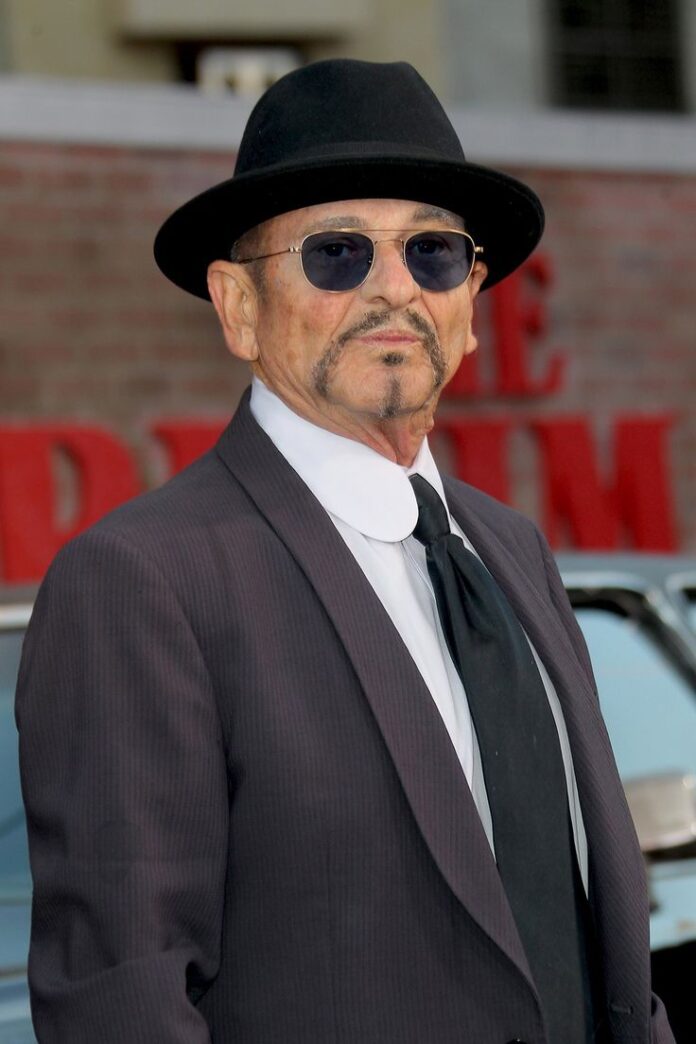
Joe Pesci has never needed a large frame, loud wardrobe, or constant publicity to dominate a room. His presence comes from precision: a controlled voice, alert posture, unmistakable facial expressions, and clothes that strengthen rather than compete with his personality. Born in New Jersey and celebrated for both crime dramas and broad comedy, the actor has built a public image that feels sharper than the sum of its parts.
His most recognizable clothing choices include structured suits, broad lapels, dramatic shirt collars, dark ties, leather jackets, tinted glasses, and brimmed hats. Some of these pieces belong to famous film characters, while others appear in his personal premiere wardrobe. Separating costume design from off-screen preference matters because no dependable public record identifies a permanent list of Joe Pesci’s favorite fashion labels.
What can be studied with confidence is his approach to proportion. His best tailoring gives a compact build clean vertical lines, firm shoulders, and enough room for movement. His appearance at The Irishman premiere showed that the same principles still worked decades after Goodfellas: dark tailoring, a high-contrast shirt, distinctive eyewear, strong cuffs, and grooming with character.
That mix of personal style, exact tailoring, and carefully separated brand evidence defines the focus of his fashion profile.
Joe Pesci Biography, Age & Background
Pesci’s style makes more sense when viewed through his New Jersey upbringing and long entertainment career. He did not enter Hollywood through a single dramatic breakthrough. Music, live comedy, television, barbering, and small film roles all shaped the controlled physical presence audiences later recognized. His background also helps explain why his public image carries elements of nightclub formality, Italian-American tailoring, working-class practicality, and old-school show-business grooming.
Newark Beginnings and a Childhood Spent Performing
Joseph Frank Pesci was born on February 9, 1943, in Newark, New Jersey, and raised in nearby Belleville. He turned 83 in February 2026. Public biographies describe his mother as a part-time barber and his father as a bartender and forklift driver. Pesci began performing as a child and was appearing in New York productions before reaching his teenage years.
By about age 10, he had become a regular on the television variety program Star Time Kids. That experience gave him an unusually early education in camera awareness. Even in later roles built around sudden anger or nervous energy, his movements remained measured enough to register clearly on screen.
Belleville also placed him close to a lively Italian-American entertainment network. The environment was less polished than a formal acting academy, but it taught practical lessons about timing, presentation, and reading an audience. Those same skills later helped him make small gestures—a collar adjustment, a stare, a slight change in posture—carry dramatic weight.
Music, Barbering and the Route Toward Show Business
Acting was only one part of Pesci’s early professional life. He worked as a barber and pursued music, playing guitar and recording under the name Joe Ritchie. His 1968 album, Little Joe Sure Can Sing!, showed that his musical ambitions existed long before his best-known films. He later released Vincent LaGuardia Gambini Sings Just for You in 1998 and Pesci… Still Singing in 2019.
His connection to barbering is an interesting part of his grooming history. There is no verified account of a personal product routine, yet growing up around professional hair care would have made details such as shape, sideburn length, neckline, and facial-hair balance familiar rather than mysterious.
Pesci also knew musicians connected with the group that became the Four Seasons. His early work placed him around performers who understood that clothing, hair, voice, and stage manner had to form one readable identity. That principle stayed visible throughout his career, whether he was playing an anxious criminal, a fast-talking attorney, or a restrained crime boss.
How a Low-Budget Crime Film Led to Raging Bull
Pesci performed with actor Frank Vincent as a comedy partnership during the 1970s. Their act mixed insults, character work, and rapid exchanges. He then appeared with Vincent in the low-budget film The Death Collector, released in 1976. The film did not make him a mainstream star, but his performance caught the attention of Martin Scorsese and Robert De Niro.
Scorsese cast him as Joey LaMotta in Raging Bull. The role earned Pesci his first Academy Award nomination for supporting actor and established a professional relationship that would shape American crime cinema. He later reunited with Scorsese and De Niro for Goodfellas, Casino, and The Irishman.
That career path also affected his style image. Pesci became associated with tailored clothing because filmmakers repeatedly placed him in stories where clothing communicates status, danger, aspiration, or belonging. He did not become a fashion figure through endorsements. He became one because costume, character, and physical presence worked together with unusual force.
Joe Pesci Height, Weight & Body Measurements
Pesci’s proportions are central to understanding his screen presence and tailoring. Many actors use size to project authority; he often does the opposite. His compact build concentrates attention on his face, shoulders, hands, and vocal rhythm. Accurate numbers are limited, particularly for weight and clothing measurements, so visual analysis is more dependable than repeating figures from unsourced celebrity databases.
How Tall Is Joe Pesci?
IMDb reports Pesci’s height as 5 feet 4¼ inches, or about 1.63 meters. Heights listed by entertainment databases are not medical measurements, but this figure closely matches the scale visible beside his co-stars and the long-standing public description of him as a shorter actor.
His height became part of his casting identity without limiting his authority. In Goodfellas, the contrast between his compact frame and Tommy DeVito’s explosive behavior makes the character harder to predict. In My Cousin Vinny, his proportions add to the initial impression that Vinny is out of place, allowing the character’s intelligence and confidence to overturn that judgment.
For clothing, the lesson is straightforward. Height matters less than line and balance. Pesci tends to look strongest when jackets establish the shoulder clearly, trousers avoid excessive stacking, and shirt details remain large enough to appear intentional. A shorter man does not need every detail reduced; he needs those details coordinated.
Why Structured Jackets Suit His Compact Frame
A shaped shoulder gives Pesci’s jackets authority without requiring heavy bulk. His strongest suits create a firm upper outline and then fall cleanly toward the hip. This reduces visual interruption and keeps his torso from appearing divided into too many small sections.
Jacket length is equally important. A coat that is too long can overwhelm a shorter wearer, while one that is aggressively cropped can make the body look square. Pesci’s better formal looks sit between those extremes. They cover the seat, preserve a traditional silhouette, and allow enough trouser leg to remain visible.
His red-carpet wardrobe also shows the value of tonal continuity. Dark jacket and trouser combinations extend the body as one line. A white shirt introduces contrast near the face, directing attention upward. Men with similar proportions can follow that logic without copying his theatrical collars or hats. Begin with clean trousers, a correctly placed jacket button, and sleeves that expose a controlled amount of cuff.
Reported Weight and the Measurements That Remain Private
No reliable current source publishes Pesci’s verified weight, chest size, waist size, shoe size, or full body measurements. Numbers circulated on celebrity profile sites should be treated cautiously because they rarely explain when or how a measurement was taken.
His appearance has naturally changed across a career spanning several decades. Early roles show a leaner face and narrow torso. Later appearances show a fuller build, though his posture and clothing choices continue to create a defined outline. These changes should not be mistaken for evidence of a documented fitness or diet program.
The practical point is that tailoring should respond to the wearer’s present body rather than an old size label. Pesci’s mature formalwear leaves more ease through the torso while preserving shape at the shoulders and collar. That is a better approach than forcing a slim cut that pulls at the button, opens at the lapels, or restricts movement.
Joe Pesci Wife, Relationships & Family
Pesci protects his private life more closely than many actors of comparable fame. Reliable information confirms past marriages and one daughter, but detailed family interviews are scarce. That reserve is part of his broader public identity: he appears when a project requires it, says relatively little about domestic life, and avoids turning relatives into an extension of his celebrity brand.
His Marriage to Claudia Haro and Earlier Relationships
Recent profiles report that Pesci has been married three times. His most publicly documented marriage was to actress and model Claudia Haro. They married in 1988 and divorced in 1992. The former couple share one daughter.
Some older entertainment coverage has also discussed a later relationship with model and actress Angie Everhart. The pair were reported to have become engaged before separating in 2008. Since Pesci has not built a public platform around his romantic life, historical reports should not be treated as evidence of his current relationship status.
No dependable recent source confirms that he is presently married or identifies a current partner. Calling someone his wife or girlfriend without public confirmation would turn speculation into fact. His limited visibility makes that distinction especially important; absence from celebrity media does not prove either a relationship or a lack of one.
What Is Publicly Known About His Daughter Tiffany
Pesci has one daughter, Tiffany Pesci, from his marriage to Claudia Haro. Current entertainment profiles identify her as his only child, but little verified information is available about her occupation or private life.
That lack of material appears consistent with the family’s preference for privacy. Tiffany has not been presented as a regular red-carpet companion, public business partner, or entertainment personality whose life can be documented through professional sources.
Respecting that boundary keeps a celebrity profile accurate. A famous parent does not automatically make an adult child’s personal history a public subject. The useful conclusion is limited: Pesci is a father of one, and he has largely kept that relationship away from promotional culture. No claims about her influence on his spending, clothing, home choices, or career decisions can be supported by dependable reporting.
Family Roots Behind His Grooming and Musical Interests
Pesci’s parents were not entertainment celebrities, yet their occupations and community shaped his early identity. His mother’s barbering work provides a direct connection to grooming, while his father’s working-class jobs place the family story far from the image of inherited Hollywood privilege.
His Italian-American background also placed him around music, social clubs, formal occasion dressing, and a regional style language that later appeared in his screen roles. That does not mean every suit or collar reflects a private family tradition. Much of the clothing audiences remember was created by professional costume departments.
Still, Pesci’s comfort with polished hair, shaped facial hair, jewelry, dress shirts, and expressive tailoring feels grounded rather than borrowed. He appears to understand how those elements communicate before a character speaks. His childhood performance experience and musical background likely strengthened that awareness, although he has not publicly reduced his style development to one family influence.
Joe Pesci Career, Income & Net Worth
Pesci’s career combines prestige films, commercial comedies, music, television, and selective returns after semi-retirement. That range makes his finances difficult to calculate from the outside. Awards and box-office success are documented; private contracts, residual arrangements, investments, and current assets are not. Any net-worth figure should therefore be treated as an estimate rather than an audited fact.
The Scorsese Roles That Defined His Dramatic Reputation
Raging Bull introduced Pesci to a wide film audience, but Goodfellas made his screen identity permanent. As Tommy DeVito, he delivered a performance that could shift from humor to threat within a single exchange. He won the Academy Award for Best Supporting Actor at the 1991 ceremony. The Academy later described his acceptance remarks as one of the shortest speeches in Oscar history.
He returned to Scorsese’s world for Casino in 1995. More than two decades later, he played Russell Bufalino in The Irishman, earning his third supporting-actor Oscar nomination. The role reversed expectations: instead of frantic aggression, Pesci used quiet speech, stillness, and controlled dress to project power.
Those performances show why his tailoring remains memorable. The suits are not decoration. They support a different form of authority in each film, from Tommy’s restless flash to Bufalino’s restrained respectability.
Comedy, Semi-Retirement and Selective Returns
Pesci proved that his intensity could work in comedy as effectively as in crime drama. He played burglar Harry Lime in Home Alone and Home Alone 2, attorney Vincent Gambini in My Cousin Vinny, and Leo Getz in several Lethal Weapon films. These roles widened his audience and made his vocal patterns, facial reactions, and compact physicality recognizable beyond Scorsese’s films.
He stepped away from regular acting in 1999, though his retirement was never absolute. Later appearances included The Good Shepherd, The Irishman, the Peacock series Bupkis, and the 2023 film Day of the Fight.
His selective approach has protected his screen identity from overexposure. It also means his wardrobe appearances are relatively rare. When he attended The Irishman premiere in 2019, the look attracted fashion coverage partly because audiences had not watched him move through years of routine promotional events.
How Much Is Joe Pesci Worth?
No public financial filing or statement from Pesci confirms his net worth. Entertainment websites publish estimates, but the methods behind those numbers are usually unclear. Treating one of them as a settled figure would give false precision.
His documented sources of income include a decades-long acting career, work in commercially successful film franchises, three studio albums, television appearances, and property ownership. The exact value of residuals, royalties, investment income, or private business interests is not available.
The sale of his Jersey Shore property provides evidence of valuable real estate, but one transaction cannot establish total wealth. Architectural Digest reported that the home sold for $5 million in 2022 after having been listed for $6.5 million. The publication also reported that he had bought it for $850,000 in 1994. Those figures describe one asset and sale, not his complete financial position.
Joe Pesci House, Cars & Luxury Lifestyle
Pesci’s publicly documented lifestyle looks private, comfortable, and rooted in personal interests rather than constant display. His former waterfront home offered the clearest look at how he lived, combining large-scale entertaining spaces with music, film memorabilia, and a reference to his barbering past. Claims about exotic car fleets, private aircraft, or vast watch collections are far less dependable.
Inside His Former Jersey Shore Waterfront Home
Pesci owned a waterfront residence in Lavallette, New Jersey, for nearly three decades. The roughly 7,200-square-foot property contained eight bedrooms, eight and a half bathrooms, a dock, a heated pool and spa, and broad views of the water. It was listed for $6.5 million and sold for $5 million in 2022.
The home had an Art Deco-influenced exterior with curved windows and a central tower. Inside, a winding staircase, glossy surfaces, white cabinetry, black countertops, and a large mirrored dining-room fixture reflected the glamorous design language of the late 1980s and early 1990s.
It was not a minimalist celebrity property staged in pale neutral tones. The architecture and furnishings had personality, much like Pesci’s stronger outfits. Both relied on bold details held within a clear structure. The lesson for readers is not to reproduce the décor, but to recognize the value of keeping objects that express genuine history and taste.
Film Posters, Instruments and a Barber-Chair Detail
The former residence contained media and game areas decorated with posters from Pesci’s films. Reports also noted pianos and guitars, linking the interior to his long interest in music rather than treating those instruments as generic luxury props.
One of the most personal reported details was a barber chair, included as a reference to his early work. That object says more about his lifestyle than a list of expensive finishes. It connects an Academy Award-winning career to the trade he practiced before Hollywood recognition.
The home therefore appeared to function as both a comfortable waterfront property and an informal record of his life. Its rooms reflected acting, music, grooming, and entertainment. His wardrobe works in a related way. Hats, collars, leather, jewelry, and tailoring are not random signs of expense; they connect with different stages of his career and the show-business culture in which he developed.
Are Joe Pesci’s Cars and Watches Publicly Documented?
No dependable current source provides an authenticated inventory of cars owned by Pesci. Online lists may connect him with luxury vehicles, but photographs of an actor near a car, vehicles used in films, and unsourced ownership claims are not enough to establish a collection.
The same caution applies to watches and jewelry. Pesci has worn rings, watches, sunglasses, and other accessories in public and on screen. Yet a visible item cannot always be identified accurately from a photograph, and costume pieces should not be presented as personal purchases.
His former home’s dock and waterfront setting suggest an interest in coastal living, but even that does not confirm ownership of a particular boat. The most accurate description of his luxury lifestyle is measured: he owned a large waterfront property, displayed music and film interests, and dressed distinctively for selected events. Claims beyond those documented details remain uncertain.
Joe Pesci Celebrity Fashion & Personal Style
This is where Pesci’s influence becomes easiest to see. He has never operated as a fashion ambassador who changes labels each season. His appeal comes from a stable visual vocabulary: dark tailoring, controlled proportion, prominent collars, polished leather, strong eyewear, occasional jewelry, and grooming that gives formal clothes a little danger. The result is memorable because it fits both his body and public character.
The Tailoring Principles Behind His Best Suits
Pesci’s strongest suits build outward from the shoulders rather than squeezing tightly around the torso. A clear shoulder line gives him presence, while a traditional jacket length maintains proportion. The lapels are often broad enough to balance his face and prevent the jacket from appearing small or timid.
His trousers usually work best when they sit near the natural waist and fall with limited bunching. A low-rise trouser would lengthen the torso and shorten the visible leg, which is rarely helpful for a compact build. Tonal dressing—dark jacket, dark trousers, dark tie—also creates continuity.
The fit is not always narrow. That matters. Men often assume that shorter bodies require the tightest possible suit, but tight cloth can emphasize width, pulling, and interrupted lines. Pesci’s better tailoring leaves enough room for the jacket to hang. The personality comes from the collar, hat, glasses, or jewelry rather than from fabric straining across the body.
How Spearpoint Collars Became Part of His Screen Identity
The long, pointed shirt collars associated with Pesci are among the most recognizable menswear details in modern crime films. GQ traced their effect through films such as Raging Bull, Goodfellas, and Casino, describing the shape as part of the menace and period character surrounding his roles.
For Goodfellas, costume designer Richard Bruno helped create the film’s precise mid-century gangster wardrobe. An oral history reported that Pesci and De Niro were measured by an Italian tailor and that cloth was brought from Italy. Crew members also stressed the importance of correct collar lengths, tie shapes, knots, and jewelry.
These details belong to costume history, not proof of Pesci’s private brand loyalty. Still, he wears exaggerated collars convincingly because his face, neck, and compact frame can support a strong geometric shape. For everyday use, a moderate spearpoint or longer point collar is more practical than the film versions, which can look like costume outside a tailored setting.
His 2019 Premiere Look and the Question of Favorite Labels
At the Los Angeles premiere of The Irishman, Pesci wore a dark suit with a white shirt, black tie, black brimmed hat, tinted round glasses, and a shaped goatee. The shirt’s large white cuffs and rounded collar added visual interest without breaking the dark vertical line of the outfit. GQ singled out the hat, glasses, facial hair, collars, and oversized cuffs when praising the appearance.
The outfit succeeded because every dramatic detail appeared near his face or hands. The jacket and trousers remained quiet. This is a useful formula for men who like expressive accessories: keep the base controlled, then choose one or two areas for character.
No trustworthy interview, official endorsement, or stylist account confirms a fixed list of Pesci’s favorite fashion labels. Italian tailoring influenced famous film wardrobes, but that does not establish a favorite personal designer. His most defensible “essentials” are therefore categories rather than brands: a dark suit, white dress shirt, black tie, leather shoes, statement glasses, and a well-proportioned hat.
Joe Pesci Hair, Beard & Grooming Style
Pesci’s grooming has changed enough to distinguish different stages of his career, yet it has always served his face rather than following every trend. Earlier roles favored thick, combed-back hair and clean or lightly shadowed facial grooming. Later appearances introduced gray hair, a defined goatee, tinted eyewear, and hats. Each change adjusted the frame around his expressive eyes and mouth.
The Slicked-Back Hair Associated With His Classic Roles
In many of Pesci’s best-known films, his hair is combed away from the forehead with controlled volume. This exposes the face and sharpens his expressions. It also works well with broad shirt collars because the hairstyle does not compete with the clothing around the neck.
The look varies by character. Tommy DeVito’s hair in Goodfellas feels neat enough for nightlife but not overly polished. Vinny Gambini’s darker, fuller style supports the character’s flashy confidence. Later roles use graying hair and softer density to convey age and authority.
Men recreating the general shape should focus on direction rather than stiffness. Hair can be guided backward with a side influence while retaining some natural movement. A barber can keep the sides tidy without creating an extreme skin fade, which would shift the look from classic Northeast grooming toward a more modern contrast cut.
Why the Fedora, Glasses and Goatee Work Together
Pesci’s Irishman premiere grooming created a complete frame around his face. The black hat established a strong horizontal line, the round tinted glasses centered attention on his eyes, and the mustache-and-goatee combination defined his mouth and chin.
These elements work because their shapes are distinct. The hat has a firm brim, the glasses are rounded, and the facial hair follows the curves around the mouth. None of the pieces disappears, yet the repeated dark tones keep them connected.
This combination is harder to copy than a plain haircut. A brim that is too wide can overpower a shorter man, while large glasses may crowd a compact face. Pesci’s hat sits close enough to the head to maintain balance. His facial hair is also carefully edged rather than grown into a large beard, preserving visible skin along the cheeks and jaw.
Practical Grooming Lessons Without Inventing His Products
No reliable public source identifies Pesci’s preferred shampoo, pomade, beard trimmer, skincare line, fragrance, or barber. Product claims attached to his name should therefore be treated as marketing unless supported by an interview or official partnership.
Readers can still learn from his grooming decisions. First, facial hair should create structure. His goatee gives the lower face a clearer boundary without adding width at the cheeks. Second, eyewear can become a signature when its scale remains consistent with the face. Third, gray hair does not need to be hidden to look deliberate.
Maintenance matters more than expensive branding. Clean cheek lines, a controlled mustache, trimmed neckline, balanced sideburns, and a hat that fits securely will do more for this look than buying a celebrity-inspired product bundle. Pesci’s grooming appears distinctive because each part has a defined job.
Joe Pesci Fitness, Diet & Body Transformation
Pesci is not publicly associated with bodybuilding, wellness sponsorships, or detailed diet interviews. His physical reputation comes from performance: fast reactions, forceful gestures, physical comedy, and the ability to make a smaller body feel dangerous or disruptive. Any discussion of his fitness must remain within what his work and public appearances support rather than inventing private routines.
Physical Acting Made His Size an Advantage
Pesci’s performances depend on timing throughout the body. In crime films, he can move from stillness to sudden aggression with little warning. In Home Alone, he handles falls, impacts, chases, and exaggerated reactions designed around slapstick. The contrast between physical control and apparent chaos is part of the comedy.
His compact frame helps these movements read quickly. Gestures stay close to the center of the body, facial reactions remain visible, and changes in posture can alter the character’s apparent size. A lifted chest and squared shoulders make him look confrontational; a compressed stance can make him look cornered or irritated.
This type of acting requires coordination, rehearsal, and awareness, but it does not prove a specific gym routine. Film sets also use stunt professionals, safety planning, editing, and effects. Describing the finished scene as evidence of a personal training program would ignore how screen action is produced.
What Is Known About His Workout and Diet?
Pesci has not publicly established a verified workout plan, weekly training schedule, calorie target, supplement list, or named diet. There is also no dependable evidence that he follows a celebrity trainer’s program or maintains his body for fashion campaigns.
That gap should be stated rather than filled. Photos taken decades apart show natural changes in weight, hair, posture, and facial shape, but photographs alone cannot explain diet, health, or exercise habits. They capture a moment, often under event lighting and inside structured clothing.
For readers, the sensible lesson is to avoid copying imagined celebrity routines. A man in Pesci’s age group would need exercise and nutrition choices suited to his health, mobility, medical history, and professional guidance. His style does offer one body-positive point: clothing can be adjusted to the current frame, and authority does not depend on height or an athletic-model build.
Aging, Consistency and Dressing the Present Body
Pesci’s later public appearances show a mature body dressed without pretending it has the same proportions seen in his 1980s films. His jackets offer more room through the middle, while dark colors, defined shoulders, and strong accessories maintain a clear identity.
This is a useful form of consistency. The exact cut changes, but the underlying style remains recognizable. He continues to favor tailored structure, high contrast around the face, and accessories with personality. The result acknowledges age without making age the subject of the outfit.
Men can apply the same approach by reassessing fit instead of automatically buying an old size. Waist position, shoulder comfort, sleeve pitch, trouser rise, and jacket closure may all need adjustment over time. A garment that closes cleanly and allows natural movement will look sharper than a smaller garment chosen to preserve a number on the label.
Conclusion
Joe Pesci’s public image is built on concentration. His acting compresses humor, danger, irritation, and intelligence into small movements, and his best clothing works in the same way. Dark suits provide a disciplined foundation. Broad lapels, dramatic collars, tinted glasses, shaped facial hair, visible cuffs, and brimmed hats supply the personality.
His most famous wardrobe details cannot all be called personal choices. The spearpoint shirts and period suits of Goodfellas, Casino, and The Irishman were products of skilled costume design. They became linked with Pesci because he understood how to inhabit them. Off screen, his 2019 premiere appearance showed that he could translate parts of that vocabulary into a personal formal look without dressing as one of his old characters.
There is no sound evidence for a permanent list of favorite fashion labels, and inventing one would miss the stronger lesson. Brand names are not what make his style distinctive. Proportion, consistency, and control do.
A man taking inspiration from Pesci should start with a properly altered dark suit, higher-rise trousers, a crisp shirt, and one expressive accessory. The power is not in wearing more. It is in making every visible detail count.
Frequently Asked Questions
How old is Joe Pesci?
He was born on February 9, 1943, in Newark, New Jersey, making him 83 years old in 2026. He began performing as a child and later built parallel interests in acting, comedy, music, and barbering before becoming internationally known through films such as Raging Bull and Goodfellas.
How tall is Joe Pesci?
IMDb lists his height as 5 feet 4¼ inches, or about 163 centimeters. The figure is widely repeated, though entertainment database measurements are not the same as verified medical records. His compact proportions have become an important part of his screen presence and tailoring identity.
Is Joe Pesci currently married?
No reliable recent report confirms that he is presently married. He has reportedly been married three times, with his best-documented marriage being to actress and model Claudia Haro from 1988 until 1992. Claims about a current wife or partner should not be made without public confirmation.
Does Joe Pesci have children?
He has one daughter, Tiffany Pesci, from his marriage to Claudia Haro. Dependable public information about her career and private life is limited. She has not been positioned as a regular celebrity personality, and Pesci generally keeps his family relationships away from publicity.
What is Joe Pesci’s net worth?
No official document confirms his net worth. Online estimates should be treated cautiously because private contracts, residuals, investments, taxes, and current assets are not publicly available. His known income sources include acting, music, television work, and property ownership, but they do not reveal a precise total.
Where was Joe Pesci’s house?
He formerly owned a large waterfront home in Lavallette on the Jersey Shore. The approximately 7,200-square-foot property had eight bedrooms, a pool, spa, dock, music-related décor, and film memorabilia. It sold for a reported $5 million in 2022.
What fashion style is Joe Pesci known for?
He is associated with dark suits, structured shoulders, broad lapels, long point collars, white dress shirts, dark ties, leather jackets, tinted glasses, hats, and restrained jewelry. Many famous examples came from film costumes, though his premiere wardrobe shows a related preference for classic tailoring with expressive accessories.
What are Joe Pesci’s favorite clothing brands?
No reliable interview or official partnership confirms a permanent list of favorite labels. Italian tailoring and imported cloth were used for some of his famous screen wardrobes, especially Goodfellas, but those were costume-production choices. His identifiable preferences are better described through fit, garment type, and styling than unsupported brand names.