

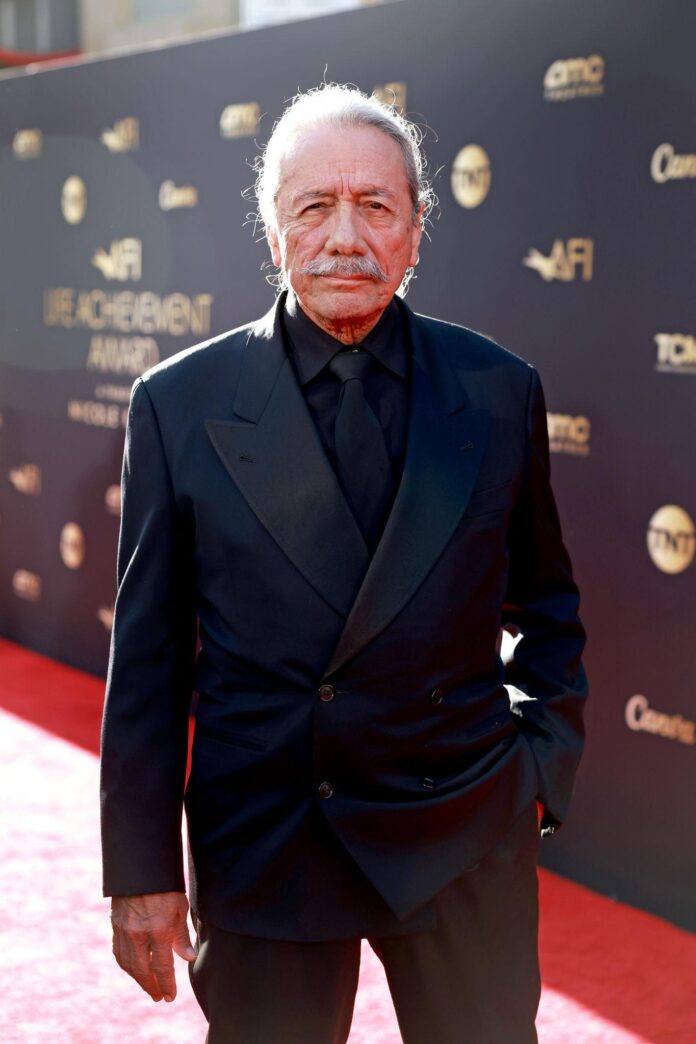
Edward James Olmos has never depended on loud color, oversized logos, or passing trends to command attention. His strongest outfits work through shape: a broad double-breasted front, a dark tonal palette, a substantial coat, polished shoes, and grooming that reflects experience rather than a fear of aging. Across decades of premieres, award ceremonies, cultural events, and public appearances, his clothing has carried the same seriousness that defines many of his screen characters.
Born in East Los Angeles, Olmos is an actor, director, producer, and activist whose major roles include Lieutenant Martin Castillo in Miami Vice, Jaime Escalante in Stand and Deliver, Detective Gaff in Blade Runner, Abraham Quintanilla in Selena, and Admiral William Adama in Battlestar Galactica. At 79, he remains active, appearing in Netflix’s 2026 film Office Romance and continuing his work for Latino storytelling and representation.
His style appeals to men who prefer authority over novelty. The black tailoring, statement coats, brushed-back silver hair, round glasses, and established mustache create a recognizable identity without making the clothes appear theatrical. His biography and public lifestyle reveal why that restraint feels natural rather than manufactured.
Edward James Olmos Biography, Age & Background
Olmos’s clothes make more sense when viewed alongside his upbringing and career. He did not enter public life through fashion campaigns or Hollywood social circles. His image developed through East Los Angeles, competitive sports, live music, political awareness, theater, and demanding character roles. That background helps explain why he dresses with weight and intention. Even at celebratory events, his presentation tends to communicate discipline before glamour. The effect is mature, personal, and closely tied to the authority he has built over more than five decades.
East Los Angeles Roots Behind His Public Identity
Edward Huizar Olmos was born on February 24, 1947, in East Los Angeles, California, to Pedro Olmos and Eleanor Huizar. His father was born in Mexico, while his mother had Mexican-American and Tejano family roots. Olmos grew up in a culturally mixed Los Angeles community that shaped his understanding of identity, representation, and the stories he later chose to tell. He became a Mexican citizen in addition to his US citizenship in 2007.
He attended Montebello High School and later studied sociology and criminal justice at East Los Angeles College. That education did not lead him directly into a conventional profession, but it supported the social awareness seen throughout his acting, directing, and community work. The Latino Film Institute’s biography lists him as its founder and board chairman, while Latino Public Broadcasting describes his lasting influence as both an artist and activist.
This background also separates his style from standard celebrity luxury. His tailoring projects dignity, but rarely looks detached from the communities he represents.
Baseball, Rock Music and the Discipline of Performance
Before acting became his profession, Olmos pursued baseball with serious ambition. Accounts of his youth describe him as a catcher who used the sport to avoid the gangs and drugs present around him. Baseball taught repetition, timing, concentration, and physical control, qualities that later appeared in his still, tightly managed acting style.
Music then pulled him toward the stage. As a teenager, he sang and played with the band Pacific Ocean, which released an album in the late 1960s. Performing in clubs gave him an early understanding of how clothing, movement, sound, and presence combine before an audience. He was not yet developing the refined black tailoring associated with his later years, but he was learning how a performer could hold a room.
That music background remains visible in his willingness to wear clothing with a stage-ready silhouette. A long jacket or raised collar suits him because he understands posture. The garment does not carry the entire image; the person inside it supplies the conviction.
How Zoot Suit Established More Than an Acting Career
Olmos’s major theatrical breakthrough came as El Pachuco in Luis Valdez’s Zoot Suit. The production moved to Broadway, where his performance earned a Tony Award nomination. He later repeated the role in the 1981 film adaptation. AFI describes the movie as a drama rooted in the events surrounding the Los Angeles Zoot Suit Riots, connecting the role to a history of clothing as cultural identity and resistance.
El Pachuco required more than wearing an exaggerated suit. The character’s high-waisted trousers, long jacket, wide shoulders, and controlled movement turned menswear into visual language. Olmos learned early that tailoring could announce pride, danger, defiance, and self-possession before a line was spoken.
His present style is quieter, but the same lesson remains. A double-breasted black jacket gives his torso structure. A longer hem adds drama without decoration. Monochrome clothing creates a unified outline. His red-carpet wardrobe can therefore be read as a mature continuation of ideas he explored in Zoot Suit: clothes matter most when they reinforce character.
Edward James Olmos Height, Weight & Body Measurements
Celebrity measurement pages often repeat numbers without identifying where they originated. Olmos has not built his public image around bodybuilding statistics, designer sample sizing, or formal modeling profiles, so exact physical information is limited. His proportions are easier to assess through decades of film and event photography than through unsupported online charts. What matters for menswear is not a perfect measurement sheet. It is how he uses jacket length, shoulder construction, trouser line, and tonal dressing to create presence through different stages of life.
What Reliable Sources Say About His Reported Height
Olmos is commonly listed by entertainment databases and celebrity profiles at around 5 feet 10 inches, or approximately 178 centimeters. No recent official biography or verified statement from the actor appears to confirm an exact figure, so that number should be treated as a widely reported estimate rather than a measured fact.
His screen presence has often made him appear taller because he controls movement and rarely fidgets. As Martin Castillo in Miami Vice and William Adama in Battlestar Galactica, he frequently stood square to other characters, kept his chin level, and allowed silence to carry authority. Camera placement helped, but posture did much of the work.
The same principle works in clothing. Men of average height can gain visual length through a jacket with clean shoulders, trousers without excess fabric at the ankle, and one uninterrupted color family. Olmos often chooses black from collar to shoe, reducing horizontal breaks that could shorten his outline.
Why His Proportions Suit Double-Breasted Tailoring
Olmos has a solid frame with naturally broad visual weight through the chest and upper torso. Double-breasted jackets suit that structure because their overlapping front creates a firm central panel. Wide peak lapels also balance the face and shoulders, while a longer jacket skirt prevents the upper body from appearing compressed.
The risk with this style is excess bulk. A stiff, boxy double-breasted suit can overwhelm a shorter or fuller man. Olmos usually avoids that problem by keeping the shirt, tie, jacket, and trousers in closely related dark tones. The eye reads one vertical shape rather than several competing sections. Public photographs from award ceremonies and film events repeatedly show him in black double-breasted tailoring, often with minimal accessories.
His trouser choices are also restrained. He rarely relies on exaggerated width or dramatic cropped hems. The practical lesson is simple: strong tailoring should establish shape, not trap the body inside layers of padding and fabric.
Physical Changes Following Cancer Treatment
Olmos disclosed in 2023 that he had undergone chemotherapy and radiation for throat cancer during 2022. He said the experience caused a loss of about 55 pounds as well as significant muscle mass. The treatment ended in December 2022, after which he began the difficult process of rebuilding his strength.
By 2024, he reported being in remission and spoke about exercising, eating well, sleeping properly, and appreciating the support around him. At a May 2026 premiere, he said he was approaching three years since his cancer experience and felt grateful to have come through it.
His public appearance naturally changed during recovery. Recent tailoring has often been softer and less rigid, which works well on a body that has experienced major weight variation. Men dealing with ordinary age-related changes can take a similar approach: reassess fit, avoid wearing an old size out of habit, and let the jacket follow the present body.
Edward James Olmos Wife, Girlfriend & Family
Olmos has discussed family as a source of identity, responsibility, and support, but he does not present his home life as an ongoing publicity campaign. Public records document several marriages and six children, while current romantic details remain less clear. A respectful profile must distinguish between established history and unanswered questions. His family story also offers an important counterpoint to his stern screen image. Behind roles built around command and control is a man whose later health interviews placed strong emphasis on care, connection, and gratitude.
Parents, Heritage and the Household That Shaped Him
His parents, Pedro Olmos and Eleanor Huizar, separated while he was young. Biographical accounts say he was also raised with substantial help from his maternal great-grandparents as his parents worked. That extended family structure exposed him to different religious, cultural, and generational influences during childhood.
Olmos has often connected his public work to the Mexican-American experience without reducing that experience to one type of character. His roles have included teachers, military commanders, detectives, fathers, workers, political figures, and morally conflicted men. That range helped challenge a Hollywood system that often confined Latino actors to narrow stereotypes.
The influence reaches his clothes as well. His formal style does not attempt to hide age or heritage beneath a generic celebrity makeover. The silver hair, mustache, dark tailoring, and occasional Pachuco reference feel connected to personal history. He dresses as someone carrying a past, not someone trying to appear disconnected from it.
His Marriages and Present Relationship Status
Olmos married Kaija Keel in 1971. She is the daughter of actor and singer Howard Keel, and the couple had two sons, Bodie and Mico, before their marriage ended in divorce. He later married actress Lorraine Bracco in 1994; that marriage ended in the early 2000s after a period of separation. He also married actress and producer Lymari Nadal in 2002, with public reports stating that they separated in 2013.
No dependable recent source clearly identifies a current wife, girlfriend, or confirmed romantic partner as of 2026. Describing him as publicly single would go beyond the available evidence, as would presenting any past spouse as his current wife.
His approach to public events has changed accordingly. Earlier award photographs often showed him arriving with a spouse. Later appearances tend to center his work, fellow actors, children, and cultural organizations. The absence of a partner on a red carpet should not be treated as evidence about private relationship status.
Fatherhood and His Six Children
Public biographies state that Olmos has six children. Bodie and Mico are his sons from his marriage to Kaija Keel, and he has four adopted children named Daniela, Michael, Brandon, and Tamiko. Several of his children have worked in or around film, while Bodie appeared in Battlestar Galactica and has attended industry events with his father.
Family also played a direct role during Olmos’s cancer recovery. In 2026, he spoke about the support he received from his children and said that one child, a Zen Buddhist monk, helped keep him emotionally centered during treatment.
That detail adds dimension to his public image. Olmos often looks self-contained on camera, yet his account of recovery stresses dependence, patience, and care. His family has not been turned into a branded celebrity unit, which helps explain why reliable information is limited. Public visibility is selective, and that boundary deserves to remain intact.
Edward James Olmos Career, Income & Net Worth
Few actors move comfortably between experimental theater, network crime drama, independent film, science fiction, voice work, directing, production, and cultural advocacy. Olmos has done so without losing a clear public identity. His career value comes from longevity and trust rather than constant celebrity exposure. That distinction matters when discussing earnings. A long résumé can suggest substantial financial success, but it does not reveal contracts, expenses, ownership stakes, taxes, or investment results. His achievements are documented; his personal balance sheet is not.
From the Stage to a Five-Decade Screen Career
After his breakthrough in Zoot Suit, Olmos appeared in films including Wolfen, Blade Runner, and The Ballad of Gregorio Cortez. His television role as Lieutenant Martin Castillo in Miami Vice introduced him to a broad audience during the 1980s. He played the character with an unusual economy, often using a lowered voice and still posture while the show’s surrounding world moved at a faster pace.
Later roles expanded his range. He played teacher Jaime Escalante in Stand and Deliver, directed and starred in American Me, portrayed Abraham Quintanilla in Selena, and became Admiral William Adama in the reimagined Battlestar Galactica. Younger audiences have also encountered his voice in Coco and his work in Mayans M.C..
His 2026 appearance in Office Romance reunited him with Jennifer Lopez almost three decades after Selena. Netflix identifies him as Captain Jack Cruz, once again playing her character’s father.
Awards That Mark His Industry Influence
Olmos won a Primetime Emmy for supporting actor in a drama for Miami Vice. He also received a Golden Globe for the role. His performance in Stand and Deliver earned an Academy Award nomination for best actor, while Zoot Suit brought him a Tony nomination. Those honors place him among the relatively small number of performers recognized at high levels across theater, film, and television.
Awards tell only part of the story. His lasting influence also comes from the authority he brought to Latino characters at a time when such roles were often marginal or poorly written. Latino Public Broadcasting and the Latino Film Institute extend that work beyond his own performances by supporting filmmakers, festivals, educational projects, and public media.
This institutional involvement affects his fashion identity. At many public appearances, he dresses less like a promotional celebrity and more like a senior cultural figure: dark suit, controlled detail, limited ornament, and an emphasis on presence.
Income Sources and the Limits of Net Worth Estimates
Olmos’s likely career income has come from acting fees, directing, producing, voice performances, appearances, and related entertainment work. Individual salaries for his best-known films and television series have not been publicly documented by reliable financial sources. No confirmed evidence establishes major fashion endorsements, a large consumer business portfolio, or ownership of a public company.
Celebrity-finance websites often publish net worth estimates for him, sometimes placing the figure in the low eight-figure range. Such numbers are not audited statements and may be built from assumptions about past salaries, properties, and residual payments. They should not be treated as confirmed wealth.
A more accurate conclusion is that Olmos has sustained a long, high-level career with several sources of professional income. His nonprofit and cultural leadership also suggests that not every project is selected for its maximum commercial return. Career influence and private wealth can overlap, but they are not interchangeable measurements.
Edward James Olmos House, Cars & Luxury Lifestyle
The public knows far more about Olmos’s work than about his possessions. That is unusual in an entertainment culture where homes, cars, watches, and vacations are often used as extensions of personal branding. His appearances communicate refinement, yet reliable reporting does not support a detailed inventory of luxury assets. Instead of filling that gap with rumors, it is more useful to examine the type of lifestyle he chooses to make visible: film festivals, educational projects, family connections, advocacy, professional travel, and formal clothing built for repeated wear.
Why Details About His Current Home Remain Private
No strong recent source confirms the location, value, architecture, or interior design of Olmos’s current primary residence. Older biographical reporting notes that he lived in West New York, New Jersey, from 1979 to 1987 while building his stage career, but that period does not establish where or how he lives now.
He remains closely associated with Los Angeles through his upbringing, acting career, Latino Film Institute work, and frequent appearances at California cultural events. That connection should not be converted into an unsupported claim about a particular neighborhood or property.
This privacy fits his public character. His clothing can be elegant, but it is not designed to advertise the price of his home. A black double-breasted suit functions in Los Angeles, New York, Madrid, or a film-festival setting without revealing personal property. The image is portable and professional, which may be one reason it has remained consistent.
Cars, Motorcycles and Unverified Ownership Claims
Reliable public reporting does not document a personal collection of luxury cars belonging to Olmos. Search pages sometimes attach actors to vehicles they drove on screen, arrived beside at events, or encountered during promotional work, but none of those situations proves ownership.
His role in the 2024 Prime Video film One Fast Move placed him inside a motorcycle-racing story. He played Abel, a former racer and motorcycle-shop owner who serves as a mentor to younger characters. The film expanded the mechanical, masculine side of his screen image, but it provides no evidence about what he drives privately.
That distinction matters in celebrity lifestyle writing. A character’s motorcycle, a production vehicle, and an actor’s personal purchase are separate facts. In Olmos’s case, there is not enough sound information to name a favorite car, assign him a collection, or estimate its value.
A Form of Luxury Built Around Cultural Access
Olmos’s visible lifestyle appears rich in access rather than display. He attends major premieres, award ceremonies, film festivals, industry tributes, and cultural celebrations. His work has taken him through Hollywood institutions, Broadway, international cinema events, and public-service organizations. Getty’s event archive documents decades of appearances ranging from the Zoot Suit opening period to recent Sundance and Los Angeles events.
That environment allows for fine tailoring, travel, and formal social settings without requiring conspicuous consumer imagery. He seldom builds an outfit around a heavily promoted watch, jewelry stack, rare sneaker, or visible designer monogram.
For everyday men, this is a more usable model of refinement. A well-shaped coat, polished footwear, clean glasses, and proper alterations can create status without broadcasting a label. The expensive part of Olmos’s image is not always the garment. It is the confidence produced by decades of knowing where he stands.
Edward James Olmos Celebrity Fashion & Personal Style
Olmos’s personal style is strongest when it sits between classic tailoring and character dressing. He understands that formal clothes can communicate moral weight, artistic history, and cultural memory. Black dominates his wardrobe, but the repetition does not feel empty because he changes the silhouette, surface, and proportions. Some appearances feature a standard suit; others move closer to a military coat, a Pachuco-influenced long jacket, or a formal double-breasted blazer. His best looks prove that mature menswear does not require constant reinvention. It requires consistency with enough adjustment to prevent uniformity.
Why Black Double-Breasted Tailoring Became His Signature
Black double-breasted suits have appeared repeatedly in Olmos’s public wardrobe. At the 2012 Screen Actors Guild Awards, the 2014 Peabody Awards, the 2015 Platino Awards, the 2023 Los Angeles Latino International Film Festival, and other formal events, he used overlapping fronts and dark tonal layers to create a strong rectangular outline. Public photography also shows his continued preference for black tailoring at recent film screenings and industry ceremonies.
The choice supports his build and reputation. Double-breasted tailoring adds authority through symmetry, buttons, and lapel width. Black keeps those elements from appearing decorative. A matching black shirt and tie make the jacket’s architecture more visible because color does not distract from the cut.
This approach is easy to misunderstand. Buying a black double-breasted suit will not automatically recreate his presence. The shoulders must sit cleanly, the waist cannot pull, and the jacket needs enough length to balance the torso. Fit carries the look; darkness alone does not.
Statement Coats That Add Drama Without Costume
Some of Olmos’s most effective jackets sit close to the line between suit coat and outerwear. They are longer than a cropped modern blazer, often double-breasted, and substantial enough to frame his body like a formal coat. This extra length recalls military uniforms, classic Hollywood evening clothes, and the extended zoot-suit silhouette linked to his theatrical history.
A statement coat works for him because the rest of the outfit remains quiet. He does not commonly compete with the coat through bright trousers, patterned footwear, stacked chains, or a contrasting shirt. One strong outline receives the attention. That is controlled drama.
Men adapting the idea should choose one feature: length, lapel width, texture, or an unusual collar. Combining every feature can cross into costume. A charcoal overcoat over a black knit, or a longer navy double-breasted jacket with plain trousers, captures the principle without imitating Olmos line for line. The goal is presence through proportion.
Refined Details: Tonal Shirts, Ties, Shoes and Texture
Olmos often pairs black tailoring with a black shirt and black tie. The combination might appear flat under normal lighting, but formal fabrics reflect light differently. A wool jacket, cotton or silk-blend shirt, satin-faced lapel, and smooth tie can create depth even when every item belongs to the same color family.
He also favors restrained black footwear and limits visible jewelry. Round glasses provide more personality than a large accessory would. At the 2026 Office Romance premiere, he introduced greater surface interest through a black patterned ensemble, showing that texture can refresh a long-standing color preference without breaking the identity.
The practical lesson is to separate color from visual interest. Men do not need a bright palette to avoid looking dull. Matte and polished surfaces, lapel shape, button placement, collar height, and fabric weight can do the work. Olmos’s strongest outfits reward a second look because their distinction is built into construction rather than obvious decoration.
Edward James Olmos Hair, Beard & Grooming Style
His grooming has aged alongside him instead of being repeatedly redesigned to chase a younger image. Silver hair, a full mustache, expressive facial lines, and round glasses now form a stable visual signature. Each feature supports the others. The hair creates height and movement, the mustache adds width through the center of the face, and the glasses provide a clear frame around the eyes. This consistency is useful for men who find trend-based grooming exhausting. A recognizable look can become stronger through age when its proportions remain controlled.
The Brushed-Back Silver Hairstyle Associated With Olmos
Olmos generally wears his silver hair brushed away from the forehead, with some natural length through the sides and back. The style has varied across his career, but recent versions avoid a hard part, sharp fade, or highly sculpted finish. The movement appears soft, allowing the silver color and natural texture to remain visible.
Brushing the hair back opens the face and works well with glasses because it reduces competition around the temples. It also adds a small amount of height, which helps balance a broad jacket collar or wide peak lapels. Public photographs from recent premieres show that he sometimes wears the hair more tightly controlled and sometimes allows loose strands around the sides.
A man recreating the idea needs enough length on top to move backward without forcing it flat. The finish should remain touchable rather than wet or rigid. No reliable source identifies the products Olmos uses, so any exact pomade, cream, or spray recommendation would be speculation.
How His Mustache Shapes His Mature Image
The mustache has become one of Olmos’s most recognizable grooming features. It follows the natural width of his upper lip and carries enough fullness to remain visible beneath his nose without becoming an exaggerated handlebar or heavily shaped fashion mustache.
On an older face, this type of facial hair can create a strong central line and draw attention toward the mouth. It also complements silver hair by repeating the color lower on the face. Olmos keeps the cheeks and chin largely clean, so the mustache remains deliberate rather than appearing like part of unfinished stubble.
Maintenance matters more than complexity. The lower edge should not cover the lip, stray hairs need trimming, and the ends should follow the face instead of extending too far downward. His version works because it feels established. Men with thinner growth or a different face shape may look better with short stubble or a compact beard rather than forcing the same result.
Round Glasses as His Most Consistent Accessory
Round or softly rounded eyeglass frames have accompanied Olmos through many public appearances. They contrast with the straight shoulders, peak lapels, and rectangular front of his jackets. That difference keeps his face from looking too severe, especially when he is dressed entirely in black.
The frames are usually slim enough not to dominate his features. Their scale also leaves room for the mustache and swept-back hair to remain part of the composition. This is a useful example of accessory balance: when grooming already includes several recognizable elements, glasses do not need bright color or oversized branding.
Men choosing similar frames should consider eyebrow position, lens width, and bridge fit. A perfectly circular frame can exaggerate roundness in some faces, while a slightly oval or flattened shape is easier to wear. Olmos’s look is not built on eyewear as a novelty. The glasses serve his vision, then quietly reinforce his intellectual and artistic public image.
Edward James Olmos Fitness, Diet & Body Transformation
Fitness has appeared in different forms throughout Olmos’s life. Youth baseball provided an athletic foundation, acting required stamina, and later health challenges forced him to rebuild strength under difficult conditions. Public information supports a few broad habits, including swimming, daily movement, attention to nutrition, and better sleep. It does not support a detailed weekly lifting plan, supplement list, or fixed calorie target. His experience is therefore most useful as a story about consistency and recovery rather than a celebrity workout template.
Baseball Created His Early Athletic Foundation
As a young catcher, Olmos developed coordination, leg strength, throwing mechanics, and the patience required to stay focused through long games. Accounts of his childhood describe baseball as both a competitive pursuit and a protective structure that kept him engaged outside difficult street influences.
Catching is demanding because the position combines repeated squatting, sudden explosive movement, hand-eye coordination, and strategic attention. Although there is no reason to assume he continued baseball-style training throughout adulthood, that early experience may help explain his physical discipline and controlled posture.
The value for readers is not a specific baseball drill. It is the benefit of finding movement that also supplies identity and community. Exercise is easier to maintain when it is connected to a skill, team, place, or purpose. Olmos’s early athletic life was not built around mirror-based body goals. It was tied to survival, competition, and belonging.
The 55-Pound Loss and Difficult Return to Strength
Cancer treatment caused Olmos to lose around 55 pounds and much of his muscle mass. He described being unable to eat, drink, speak, or swallow normally during the hardest phase after chemotherapy and radiation. He also explained that improvement became more noticeable around 90 to 100 days after treatment ended.
During recovery, he spoke about swimming and exercising daily as he worked to regain strength. Later interviews mentioned nutrition, sleep, faith, family support, and an increased awareness of how fragile health can be.
This was a medically serious experience, not a standard celebrity weight-loss transformation. Readers should not copy the circumstances, compare ordinary fitness progress with treatment-related weight change, or use his story as medical guidance. The meaningful lesson is that rebuilding can be slow and that visible body changes do not reveal the full difficulty behind them.
Sustainable Habits Matter More Than a Branded Routine
Olmos has not published a verified workout program or commercial diet system. His public comments support a simpler picture: regular exercise, swimming during recovery, sensible nutrition, rest, and continued engagement with work and family. AARP’s 2024 profile linked his recovery outlook with faith and exercise, while later reporting described his focus on healthier daily habits.
At 79, consistency is more relevant than extreme intensity. Swimming can offer cardiovascular work with less joint impact, while walking, mobility practice, and age-appropriate resistance exercise can support independence. The correct form and workload depend on personal health and professional advice.
His changing physique also demonstrates why clothing and fitness should work together. A good tailor can adjust the external silhouette while the body is rebuilding. Men do not need to postpone dressing well until they reach a former weight. The stronger approach is to care for the present body and wear clothes that respect it.
Conclusion
Edward James Olmos has built a style identity from repetition, but not stagnation. Black tailoring returns across the years because it fits his character, proportions, work, and cultural position. Double-breasted jackets give him structure. Longer coats add controlled drama. Tonal shirts and ties remove visual noise. Silver hair, a measured mustache, and round glasses make aging part of the image rather than something to conceal.
His clothing also carries traces of a wider life. East Los Angeles, baseball, rock music, Zoot Suit, Miami Vice, Stand and Deliver, Selena, Battlestar Galactica, activism, fatherhood, and recovery all contribute to the way he is read before he speaks. The outfits feel convincing because they belong to a consistent public identity.
The most practical lesson is not to copy his all-black wardrobe without thought. It is to identify a silhouette that supports who you are and repeat it with care. Alter the length, fabric, texture, or grooming details as your body and life change, but retain the parts that feel honest. Olmos proves that refined style can grow quieter with age while becoming more recognizable.
Frequently Asked Questions
How old is Edward James Olmos in 2026?
He is 79 years old. Olmos was born on February 24, 1947, in East Los Angeles, California. He remained professionally active during 2026, appearing in Netflix’s Office Romance and participating in film-festival and cultural events.
How tall is Edward James Olmos?
He is commonly reported to be around 5 feet 10 inches, or approximately 178 centimeters. No recent official biography confirms a professionally measured height, so the figure should be read as an estimate rather than an independently verified measurement.
Is Edward James Olmos currently married?
No reliable recent report clearly confirms a current wife or partner. He was previously married to Kaija Keel, Lorraine Bracco, and Lymari Nadal. Public reporting stated that Olmos and Nadal had separated by 2013, but later relationship details have remained private.
How many children does Edward James Olmos have?
Public biographies list six children. He had two sons, Bodie and Mico, with his first wife, Kaija Keel, and has four adopted children named Daniela, Michael, Brandon, and Tamiko. Some of his children have also worked within the entertainment industry.
What is Edward James Olmos’s net worth?
No audited or officially confirmed figure is publicly available. Entertainment-finance websites often publish low eight-figure estimates, but their methods are unclear. His known income sources include acting, directing, producing, voice work, and other entertainment projects accumulated over a career spanning more than five decades.
What type of fashion is Edward James Olmos known for?
His signature wardrobe centers on black double-breasted suits, longer tailored jackets, monochrome shirts and ties, restrained shoes, and minimal jewelry. The strong silhouette is softened by round glasses, swept-back silver hair, and a full mustache, creating a formal style that feels authoritative rather than trend-driven.
Did Edward James Olmos lose weight during cancer treatment?
He said he lost about 55 pounds and considerable muscle mass while undergoing chemotherapy and radiation for throat cancer in 2022. He later discussed swimming, exercising, improving his nutrition, resting, and gradually rebuilding strength during remission.
What is Edward James Olmos’s current hairstyle?
He generally wears his silver hair brushed back from his forehead, with moderate length through the sides and rear. The style is natural rather than sharply faded or heavily sculpted. It works well with his round eyeglasses, mustache, and structured formal jackets.
Celebrity Tailoring and Timeless Menswear
Explore luxury tailoring, signature coats, polished accessories, modern footwear and memorable red carpet looks from distinguished actors.