
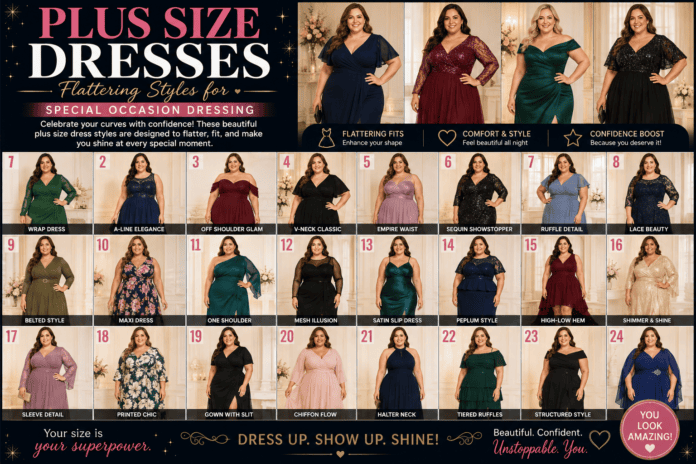
A special-occasion dress has to do more than look good on a hanger. It needs to sit correctly through the bust and waist, move comfortably when you walk or sit, work with the formality of the event, and still feel like something you would willingly wear for several hours.
The best plus size dresses accomplish that through proportion, fabric, construction, and fit rather than tricks meant to make the body appear smaller. A well-placed waist seam can define shape. A skirt with enough sweep keeps movement comfortable. Structured fabric can support a clean silhouette, while softer materials create fluid drape without clinging to every contour.
There is no single cut that flatters every plus-size figure. Two people wearing the same numerical size may have completely different bust, waist, hip, torso, and height proportions. That is why shopping by silhouette alone can be frustrating. Start with how the dress is built, then consider where and how you plan to wear it.
What Makes a Special Occasion Dress Flattering?
“Flattering” is often treated as another word for slimming. That is too narrow. Clothing can flatter by creating balanced proportions, defining a feature you like, hanging smoothly, or simply fitting so well that you are not adjusting it throughout the evening.
Fit problems are frequently construction problems rather than body problems. A dress that pulls horizontally across the bust needs more room or a different bodice shape. Fabric pooling above the hips may indicate excess torso length. A waist seam sitting several inches too high or low can make an otherwise attractive dress feel wrong.
Look at the garment’s shape before its size
Pay attention to where the dress creates structure. Princess seams, darts, shaped waistbands, wrap fronts, and paneled bodices can provide contour without requiring a skin-tight fit.
Vertical seaming is particularly useful in formalwear because it lets the garment follow several areas of the body independently. Instead of one flat piece of fabric stretching from bust to hip, multiple panels can create room where it is needed and a closer fit elsewhere.
The waist position matters, too. A natural-waist seam works beautifully when it lands at the actual narrow point of the torso. Someone with a shorter waist may prefer a slightly raised seam. A longer torso may need a true natural or dropped-waist design to avoid an awkwardly high fit.
Comfort is part of the silhouette
A dress that photographs well for five minutes but restricts sitting, eating, dancing, or walking is rarely a successful occasion dress.
Test movement when trying something on. Sit in a chair. Raise your arms. Walk quickly. Bend slightly to see whether the neckline stays secure. Formal dresses sometimes behave differently in motion than they do in front of a fitting-room mirror.
Also check the armholes. Tight armholes can become uncomfortable long before the rest of the dress does, especially if the fabric has little stretch.
A-Line Dresses Give Shape Without Restricting Movement
An A-line dress fits closer through the upper body before gradually widening toward the hem. It is popular for weddings, dinners, graduations, holiday parties, and other events because the silhouette works across a broad range of proportions.
The important detail is where the skirt begins to open.
If an A-line dress stays fitted too far below the waist, it can behave more like a fit-and-flare style. If it expands immediately beneath the bust, it starts approaching an empire silhouette. Neither is inherently better, but they produce different proportions.
Choose enough skirt volume for the fabric
Light chiffon can support a relatively full skirt without feeling heavy. Dense satin or embellished fabric creates more visual volume at the same circumference.
For an understated formal look, medium-weight crepe is particularly useful. Its surface is less reflective than glossy satin, and a properly lined crepe skirt tends to fall in longer, cleaner lines.
Fuller skirts also need enough fabric to accommodate sitting. A dress that looks roomy while standing may become surprisingly tight across the hips when seated if the pattern was cut narrowly through that area.
A defined bodice keeps the look intentional
An A-line skirt paired with a completely loose bodice can lose definition. Shaped seams, a fitted waistband, or a controlled wrap detail create a clearer transition between upper and lower portions of the dress.
This does not mean the waist must be cinched tightly. Even subtle shaping can establish proportion.
For a semi-formal afternoon wedding, for example, a knee-to-midi A-line dress with a structured bodice and softly draped skirt often feels more appropriate than a heavily embellished floor-length gown. Formality should still guide the styling decision.
Wrap Dresses Allow More Adjustment Through the Torso
A true wrap dress crosses one side of the garment over the other and fastens at the waist. That adjustable construction can accommodate moderate differences in waist and bust proportions.
Faux-wrap dresses create a similar diagonal neckline but are sewn closed. They can look equally polished, though they offer less adjustment.
The diagonal line across the bodice gives a wrap dress much of its visual character. Instead of dividing the torso horizontally, it creates movement across the body and naturally draws attention toward the neckline and waist.
Check neckline coverage before the event
A wrap bodice can sit differently depending on bust fullness, torso length, and fabric stretch. What appears secure while standing may open more when sitting or leaning forward.
For a wedding, work function, or formal dinner, test the neckline under realistic movement. A hidden snap or small piece of fashion tape can solve minor movement, but a bodice that needs constant correction is probably the wrong fit.
A lightweight camisole can provide extra coverage, although it changes the visual depth of the neckline.
Avoid tying the waist too tightly
Pulling a wrap closure harder does not necessarily improve its fit. Excess tension can distort the neckline, create bunching at the back, or make the skirt pull across the hip.
The dress should close securely while allowing the fabric to fall naturally.
A wrap style in jersey may be comfortable for a dinner or cocktail party, whereas crepe, velvet, or another dressier construction can move the same basic silhouette into more formal territory.
Fit-and-Flare Dresses Create a Stronger Waist-to-Skirt Contrast
Fit-and-flare styles typically remain fitted through the bodice and waist before widening noticeably into the skirt. Compared with a classic A-line, the transition is more pronounced.
This silhouette is particularly effective when you want the waist to become a visible focal point.
The flare can come from gathered fabric, pleats, godets, circular cutting, or structured panels. Those details matter because they determine where the volume appears.
Watch where the fullness starts
Heavy gathers placed directly at the waist create noticeably more volume than smooth panels that widen farther down the skirt.
Neither construction is automatically more flattering. The choice depends on the effect you want.
Someone seeking a cleaner formal silhouette may prefer fitted panels that gradually release into the skirt. For a festive party dress, pleats or a fuller circle skirt can add deliberate movement.
Dress length changes the proportion again. Knee and midi lengths often emphasize the flare because the hem remains visually close to the waist. Floor-length versions create a longer, more formal line.
Column and Sheath Dresses Can Work Beautifully in Plus Sizes
Close-cut dresses are sometimes excluded from plus-size styling advice on the assumption that loose clothing is always more forgiving. That overlooks the effect of proper tailoring.
A column dress falls relatively straight from the upper body toward the hem. A sheath follows the body more closely. Both can look exceptionally refined when the fabric has enough substance and the garment has been shaped for the wearer’s proportions.
The goal is not to remove every visible curve. It is to prevent unwanted pulling, twisting, or bunching.
Fabric weight becomes especially important
Thin stretch fabric tends to follow whatever is underneath it. Heavier crepe, lined ponte, velvet, or structured woven fabric behaves differently because the material has enough body to maintain its own surface.
That distinction becomes obvious around pockets, underwear edges, waistbands, and seam allowances.
Lining also matters. A lined dress can move more cleanly over the body because the outer material is not rubbing directly against hosiery or undergarments.
Slits need to work when you walk
Long fitted dresses often need a back, front, or side slit to provide enough stride.
Check where that opening ends when sitting as well as standing. A slit that seems modest in a fitting room may rise considerably once the knees bend.
For a gala, formal reception, or evening event, a long column gown with restrained draping can have more presence than a dress covered in decorative detail.
Empire-Waist Dresses Offer a Softer, Less Structured Option
An empire waist places the main seam beneath or relatively close to the bust, allowing the remainder of the dress to fall from a higher point on the torso.
This can be comfortable when you do not want firm shaping around the natural waist. It also works well with chiffon and other fabrics designed for movement.
Proportion is the main challenge.
If the seam sits too high against a fuller bust, the bodice may look cramped. If the skirt contains excessive gathering, it can create far more volume than intended. A well-cut empire dress gives the bust enough room before releasing into the skirt with controlled fullness.
For warm-weather ceremonies, soft formal dinners, and outdoor celebrations, that relaxed construction can be especially practical.
Fabric Changes How Every Silhouette Behaves
Two dresses cut from the same pattern can look completely different when made from different materials.
Fabric controls drape, reflection, movement, weight, and how clearly the garment reveals what sits underneath it.
Crepe creates a controlled drape
Crepe is useful for dresses that need movement without excessive shine. Depending on its fiber and weight, it can work for wrap dresses, A-lines, jumpsuit-inspired formal looks, or long gowns.
A heavier crepe generally creates smoother vertical lines than an extremely thin version.
Chiffon adds movement without much physical weight
Chiffon works particularly well for layered skirts, sleeves, overlays, and dresses intended for spring or summer celebrations.
Because it is sheer, it normally relies on lining. Check where the opaque lining ends. Some dresses use a noticeably shorter lining beneath a sheer outer skirt, which changes the overall formality.
Satin demands more attention to fit
Satin reflects light, so folds and tension are more visible. A satin dress that is slightly too tight may show pulling more clearly than a matte crepe version of the same design.
That does not make satin unsuitable for plus-size formalwear. It means sizing and construction deserve more attention. Bias-cut satin can drape beautifully, while thicker satin can hold a highly structured shape.
Velvet brings visual weight
Velvet works naturally for colder seasons, evening weddings, holiday functions, and winter formal events.
Its rich surface often needs less embellishment. Simple necklines and clean seams allow the material itself to carry much of the look.
Necklines Can Change the Balance of a Dress
The neckline sits close to the face, so it influences the overall outfit more than many shoppers expect.
V-necks create a strong vertical opening. Scoop necks have a softer curve. Square necklines introduce sharper geometry and can pair well with structured bodices. Boat necks visually broaden the shoulder area, while one-shoulder designs create deliberate asymmetry.
There is no neckline that every plus-size wearer should choose.
Bust shape, shoulder width, neck length, bra requirements, and personal comfort are more useful considerations than generic body-type rules.
A beautifully cut neckline is also easier to accessorize. A detailed high neckline may need no necklace at all. A clean V-neck leaves more space for a pendant or shorter statement piece.
Sleeves Should Be Chosen for Movement, Not Concealment
Sleeves are often marketed to plus-size shoppers primarily as arm coverage. Their construction matters more than that.
A narrow fitted sleeve can restrict movement if the upper-arm measurement is wrong. Flutter sleeves have more freedom but add visible width near the shoulder. Bishop sleeves create softness before gathering at the wrist. Sheer sleeves offer coverage without the visual weight of opaque fabric.
For an event involving dancing or long periods at a dinner table, arm mobility should influence the choice.
Try crossing your arms and reaching forward. If the entire bodice moves when the sleeve does, the sleeve or back may be too tight.
Use Color and Print to Support the Dress Design
Black is not a requirement for flattering formalwear.
Deep green, navy, burgundy, cobalt, chocolate, plum, metallic neutrals, soft pastels, and saturated jewel tones can all work for special occasions. The better question is whether the color fits the event, season, and garment.
Print scale deserves similar flexibility. Large prints can make a strong statement on a long dress because there is enough fabric to show the motif properly. Small prints often read as texture from a distance.
Placement matters more than simplistic rules about which print supposedly makes someone look larger or smaller. A poorly positioned oversized flower directly across a seam can be distracting. A thoughtfully placed botanical or abstract pattern can give a simple silhouette depth.
For weddings, color selection also needs to respect the event’s dress expectations. If the invitation specifies a palette or theme, follow it. When in doubt about a shade that appears close to the bride’s attire, choosing another color avoids unnecessary uncertainty.
Match the Dress to the Actual Occasion
A flattering dress can still feel wrong when its formality conflicts with the event.
Cocktail events
Midi dresses, sophisticated wrap styles, fitted sheath dresses, and shorter A-lines often fit cocktail settings. Texture, fabric, footwear, and jewelry can shift the same silhouette toward relaxed or dressy.
Formal weddings
Long dresses and polished midi styles are common choices, depending on the invitation and venue. Satin, velvet, chiffon, crepe, and embellished fabrics tend to communicate more formality than casual cotton or everyday jersey.
Black-tie occasions
Floor-length gowns are the safest traditional direction when a black-tie dress code is clearly stated. This is an occasion where fabric quality, fit, and finishing can matter more than adding more decoration.
Outdoor celebrations
Think beyond appearance. Grass, gravel, heat, wind, and uneven paths change what works.
A floor-sweeping hem may become difficult at a garden event. Narrow stilettos can sink into soft ground. Heavy velvet at a warm afternoon ceremony can become uncomfortable long before dinner begins.
Venue conditions are part of getting dressed well.
Do Not Let the Size Label Decide the Fit
Sizing varies between brands and even between styles from the same brand. Special-occasion dresses can be especially inconsistent because some designs have rigid bodices, internal structure, or fabrics with little stretch.
Use the garment’s measurement chart when available.
Bust, waist, and hip measurements are more useful than assuming your normal size will transfer directly. If your measurements fall between sizes, consider which part of the dress is hardest to alter. A tailor can often reduce a waist or shorten a hem. Creating substantial extra room through a tightly constructed bust may be far more difficult.
Allow time for alterations before an important event. Hem length, straps, sleeves, waist placement, and neckline fit can all change how expensive and polished a dress appears.
Shapewear Is Optional, Not a Requirement
A plus-size formal dress does not automatically require shapewear.
Some people prefer smoothing shorts, bodysuits, slips, or supportive garments because they change how certain fabrics sit. Others are more comfortable without them.
If you plan to wear shapewear, try it with the dress before the occasion. The edge of a garment can sometimes create a visible line beneath a close-fitting dress, and an overly restrictive piece may become uncomfortable after several hours.
Bra compatibility deserves equal attention. Backless dresses, plunging necklines, thin straps, and one-shoulder styles may require different support solutions. Check those details before removing tags from the dress.
The Best Dress Is the One That Fits the Event and Your Proportions
Successful special-occasion dressing rarely comes from following a rule about which bodies should wear which silhouettes. It comes from looking closely at construction.
Start with the occasion. Then examine the bodice, waist placement, skirt shape, fabric weight, lining, neckline, and ease of movement. Try the dress while sitting and walking, not only while standing in front of a mirror. If a nearly right dress has good construction, a small alteration may be more effective than searching endlessly for another style.
A-line, wrap, fit-and-flare, empire, sheath, and column plus size dresses can all flatter when their proportions correspond to the person wearing them. The strongest choice does not need to disguise the body or obey an outdated list of fashion restrictions. It needs to fit correctly, move naturally, and make sense for the room you are walking into.
That is what turns a dress from something that merely fits into something worth wearing to the occasion.
Frequently Asked Questions
What dress shape is most flattering for plus-size women?
There is no universal best shape. A-line, wrap, fit-and-flare, sheath, empire, and column dresses can all work well. Bust-to-waist proportions, torso length, hip shape, fabric behavior, and garment construction are more useful guides than the size printed on the label.
Are wrap dresses good for special occasions?
Yes, particularly when made from dressier materials such as crepe, velvet, or refined jersey. True wrap designs also provide some adjustment through the waist. Check that the neckline remains secure while sitting and moving.
Can plus-size women wear fitted formal dresses?
Fitted dresses can work beautifully when they fit without pulling. Look for adequate room through the bust and hips, clean seams, appropriate lining, and fabric with enough structure to maintain the intended silhouette.
What fabric works well for a plus-size evening dress?
Medium-weight crepe is a strong all-around option because it combines controlled drape with a relatively matte surface. Chiffon creates softer movement, velvet suits cooler-weather events, and satin can produce a striking formal look when the fit is precise.
Should I size up when buying a formal dress?
Use the individual brand’s garment or body measurement chart rather than automatically sizing up. If different measurements point to different sizes, choose with alteration possibilities in mind. Taking in excess fabric is often easier than adding room to a tightly constructed area.
What length works best for a formal occasion?
Dress code and venue matter more than body size. Midi lengths suit many cocktail and semi-formal events, while floor-length gowns are customary for many black-tie occasions. Outdoor settings may make extremely long hems less practical.
Do plus-size formal dresses need sleeves?
No. Sleeves are a design and comfort choice rather than a requirement. Sleeveless, cap-sleeve, flutter-sleeve, long-sleeve, and one-shoulder dresses can all work. Prioritize secure fit and unrestricted arm movement.
How can I make a simple plus-size dress look more formal?
Start with the fabric and fit before adding accessories. A well-tailored crepe or satin dress can already read as formal. Refined shoes, earrings, a clutch, and one intentional jewelry element can raise the dress code without overwhelming the silhouette.