
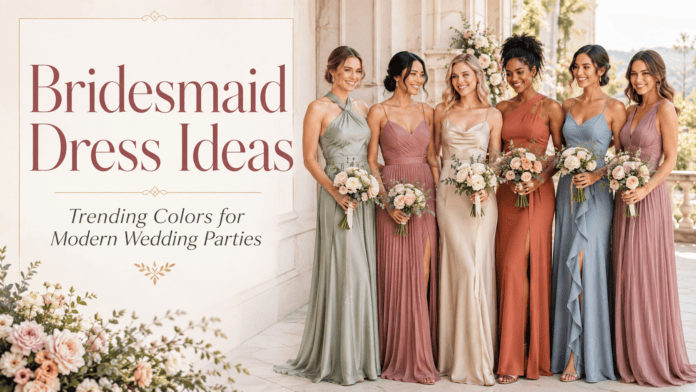
Bridesmaid color is no longer a choice between blush, navy, and whatever shade happens to match the table linens. Modern wedding parties are becoming more personal, with dresses coordinated through color families, fabric, or formality instead of requiring every person to wear an identical gown.
For 2026, bridesmaid dress ideas are moving in two directions at once: softer nature-inspired shades remain strong, while saturated pinks, yellows, oranges, blues, and teals are bringing noticeably more color back into wedding photography. David’s Bridal describes the shift as one from a single matching color toward curated palettes, while Vogue’s current bridesmaid coverage points to a broader move away from overly sweet, traditional bridesmaid styling.
The most convincing wedding parties are not necessarily the most perfectly matched. They are the ones where color, fabric, venue, and individual dresses look as though they belong in the same visual conversation.
What Bridesmaid Colors Are Trending for Modern Weddings?
Current bridal fashion is less interested in identifying one universal “color of the year” for bridesmaids. Several distinct color stories are happening at the same time.
David’s Bridal’s Summer 2026 forecast highlights saturated pink, orange, yellow, and teal combinations; light green, blue, pink, and lavender pastels; tonal blue, green, and purple groups; and champagne neutrals. The retailer also singles out brighter sky blue and yellow as particularly fresh choices.
That range matters because it gives couples more freedom. A minimalist city wedding can use chocolate or black without looking severe. A garden ceremony can combine eucalyptus, lavender, and pale yellow rather than choosing one pastel. A destination wedding can lean into coral, tangerine, turquoise, and hot pink without pretending to be understated.
Here are the color directions worth considering first.
Butter Yellow for a Soft but Noticeable Wedding Party
Butter yellow sits in an interesting position between neutral and statement color. It has more personality than champagne yet does not dominate photographs the way a saturated lemon yellow can.
Pale yellow works particularly well in chiffon, georgette, matte satin, and fabrics with gentle movement. Against green gardens or outdoor summer venues, it reads warm and fresh rather than sugary.
Yellow also has stronger trend momentum than many couples may realize. David’s Bridal identified both pale buttery yellow and brighter sunflower tones in its 2026 forecast, while Brides and Minted selected the yellow-green Island Citrus as their 2026 Wedding Color of the Year.
For a restrained palette, combine butter yellow with cream, champagne, soft sage, or pale blue. Brides who want more energy can push it toward tangerine, coral, and pink.
One caution: “yellow” is too broad an instruction for a mismatched bridal party. Lemon, mustard, butter, and golden yellow behave like four different colors. Give bridesmaids approved swatches rather than a color name alone.
Sky Blue as the Newer Alternative to Dusty Blue
Dusty blue has spent years in wedding palettes because its gray undertone makes it easy to coordinate. Sky blue feels like its cleaner, brighter cousin.
David’s Bridal specifically points to sky blue as a fresh update for Summer 2026, describing it as lighter yet more vibrant than the dusty blues that have dominated previous seasons.
That extra clarity makes a difference in photographs. Sky blue holds its color against bright daylight and white flowers instead of fading into gray.
For coastal weddings, pair it with ivory, sand, deeper marine blue, or a restrained amount of yellow. At garden ceremonies, blue works surprisingly well with lavender and fresh green. An indoor formal wedding can take the same idea darker by mixing French blue with navy.
Fabric changes the personality of blue considerably. Chiffon softens it. Matte crepe makes it cleaner. Satin adds reflected light and can make a medium blue appear much stronger.
Eucalyptus and Sage Green for Nature-Driven Palettes
Green remains one of the easiest colors to connect to the surroundings rather than simply applying it as decoration.
Sage is familiar, but eucalyptus has slightly more gray and depth. It tends to feel less pastel and more botanical, particularly beside white flowers, olive foliage, stone, wood, or outdoor architecture.
Current 2026 bridal collections continue to feature eucalyptus and deeper evergreen tones, while David’s Bridal also identifies tonal green wedding parties as part of the season’s direction.
The more interesting approach is to stop insisting on a single green.
Consider a group that moves from pale eucalyptus through muted sage into one or two deeper forest shades. The dresses can vary while the shared undertone keeps the group connected.
That approach is especially useful for fall weddings. Instead of forcing every bridesmaid into dark emerald, lighter greens can keep daytime photographs from becoming visually heavy.
Chocolate Brown for a Rich Modern Neutral
Brown has moved far beyond rustic wedding territory.
Chocolate is particularly effective when a wedding calls for depth without the sharp contrast of black. In satin, it catches bronze highlights. In crepe, it appears quieter and more architectural. Velvet pushes it toward late-fall and winter formality.
David’s Bridal’s current Vera Wang Bride bridesmaid palette explicitly identifies chocolate as a major fashion color in 2026, alongside cinnamon, wine, champagne, evergreen, and black.
The surrounding palette determines whether brown looks contemporary or overly autumnal.
Chocolate with burnt orange and burgundy immediately reads as fall. Chocolate with cream, dusty blue, pale pink, or metallic gold feels less seasonal. Mixing cocoa, espresso, cappuccino, and cinnamon can create a tonal neutral bridal party without requiring identical shades.
Skin tone deserves attention here. Brown fabrics vary enormously in undertone. Some pull red, others gray, orange, or purple. Ordering physical swatches is far more reliable than choosing from a screen.
Champagne and Oyster for Minimal Wedding Parties
Champagne remains useful because it occupies the space between beige, gold, cream, and blush.
For formal weddings, the most successful versions usually have enough contrast from the bridal gown to look intentional. A champagne satin dress beside a bright white bridal gown creates a clear hierarchy. A pale ivory bridesmaid gown beside an ivory bridal dress may not.
Texture is the easiest way to prevent a neutral bridal party from appearing flat. Satin, chiffon, crepe, pleating, and subtle floral fabrics respond differently to the same light.
Current 2026 bridal coverage continues to position champagne among the main neutral directions for bridesmaids.
For a modern neutral arrangement, consider:
- warm champagne with cocoa
- oyster with muted sage
- champagne with dusty rose
- cream with French blue
- beige with black accents
- pale gold with wine
The shades do not need to match the reception décor exactly. In fact, matching dresses, napkins, flowers, menus, and signage to one color can make a wedding feel more manufactured than coordinated.
Black Bridesmaid Dresses for Formal and City Weddings
Black works because very little needs to be done to make it look deliberate.
At a hotel ballroom, historic venue, museum, rooftop, or formal evening wedding, black dresses give the bridal party a defined silhouette without demanding a complicated palette.
The modern version is rarely eight identical sleeveless gowns. Variation makes black more interesting.
One bridesmaid might choose a halter column dress. Another can wear an off-the-shoulder gown, square-neck style, draped satin dress, or clean A-line. Because the color remains constant, there is more freedom to change necklines and proportions.
Black is also currently represented within fashion-led 2026 bridesmaid collections rather than being treated only as a fallback neutral.
Flowers become especially important with this palette. White bouquets create high contrast; burgundy and plum make it moodier; loose green-and-white arrangements soften the formality.
For midday beach or relaxed garden weddings, however, black can feel visually heavy and physically warmer in direct sun. Venue and ceremony time matter.
Wine and Burgundy for Deeper Wedding Color
Burgundy has never disappeared from weddings, but the newer interpretation is less dependent on rustic décor.
Wine-colored satin paired with modern silhouettes can work in a restaurant, industrial loft, grand hotel, or contemporary black-tie setting. Put the same shade in velvet beside dried flowers and wood, and it becomes something entirely different.
That flexibility explains its staying power.
Current bridesmaid palettes continue to include wine among the deeper 2026 colors, especially alongside chocolate, evergreen, marine blue, and black.
For mixed colors, wine usually needs another shade with comparable visual weight. Pale blush beside several dark burgundy dresses can look accidental unless there is a deliberate gradient.
Better combinations include wine with:
- cinnamon
- chocolate
- dusty rose
- deep plum
- evergreen
- navy
- warm champagne
A small amount of light neutral keeps these palettes from becoming too dense.
Lavender, Lilac, and Amethyst for a Purple Palette With Range
Purple offers more flexibility than choosing “lavender bridesmaid dresses” suggests.
Lilac can feel airy and springlike. Dusty lavender introduces gray. Periwinkle moves toward blue. Amethyst becomes a jewel tone suitable for evening receptions and cooler seasons.
A tonal purple party therefore has enough range to accommodate different complexions and preferences without abandoning the main color story.
Pastel lavender remains part of the 2026 garden-color direction, while deeper amethyst appears in current formal bridesmaid collections.
For spring, try lilac with pale yellow and fresh green. For summer, periwinkle can sit beside sky blue. Fall can take purple toward plum or wine. Winter gives amethyst room to work with black or champagne.
The mistake is pairing several purples that have completely unrelated undertones. One blue-violet dress beside five warm mauve dresses will draw the eye immediately.
Hot Pink, Coral, Orange, and Teal for Saturated Color
Some wedding parties should not be muted.
Destination celebrations, tropical venues, bold garden weddings, and colorful summer receptions can support far stronger color than the dusty palettes that became standard over the previous decade.
That is one of the clearest shifts in current bridesmaid direction. David’s Bridal describes saturated pinks, oranges, yellows, and teals as its “Hot Tropics” trend and says stronger, juicier shades are making a comeback for Summer 2026.
The trick is controlling intensity rather than reducing it.
Choose colors that seem equally saturated. A vivid coral, rich turquoise, hot pink, and sunflower yellow can coexist because none behaves like the timid member of the group.
Keep something else quiet. Simple bouquets, restrained accessories, or repeated dress fabrics can prevent strong colors from becoming visually chaotic.
Bold palettes also benefit from negative space. White table settings, neutral architecture, sand, stone, or plenty of greenery give intense clothing colors somewhere to breathe.
Blush and Rose Tones With More Depth
Blush is not disappearing. It is becoming less predictable.
A row of identical pale pink chiffon gowns can read traditionally bridal. Moving through rose, dusty pink, warm blush, and muted mauve creates more dimension.
Fabric can do some of the work. Blush satin reflects light differently from matte crepe, while floral pink dresses can interrupt a group of solids without introducing a completely new palette.
For modern weddings, pink often looks strongest when another color keeps it grounded. Cocoa, burgundy, sage, black, and pale blue all change its personality.
This makes blush particularly useful for brides who want a romantic palette but do not want every visual element to feel delicate.
White and Ivory Bridesmaid Dresses—When the Bride Chooses Them
White bridesmaid dresses used to sound like an etiquette mistake. Now they can be a deliberate fashion decision.
David’s Bridal identifies white, cream, and ivory bridal-party dressing as a 2026 direction connected to the wider interest in tonal white palettes.
The rule is simple: this only works when the couple, and especially the bride if there is one, specifically chooses it.
The bridal gown still needs visual distinction. That can come through structure, train length, lace, embroidery, volume, veil, or a noticeably different fabric.
For example, bridesmaids in narrow cream satin gowns will not compete visually with a bride wearing a structured lace ball gown. Eight elaborate ivory gowns around a minimalist slip-dress bride create a much harder balance.
White bridal parties look strongest when the hierarchy is planned rather than assumed.
Floral Bridesmaid Dresses for Parties That Do Not Want One Solid Color
A print solves an interesting problem: it lets the wedding party contain several colors without requiring every shade to appear as a separate dress.
Floral bridesmaid dresses are also a documented 2026 trend. The Knot’s February 2026 coverage specifically identifies patterned floral dresses as one of the year’s bridesmaid directions, with blue, pink, green, yellow, and darker floral options represented.
There are several ways to use them.
One floral dress can designate the maid of honor while everyone else wears a color pulled from the print. Two or three bridesmaids can wear florals between solid dresses. An entire party can wear different patterns if the prints share scale, background color, or dominant hues.
Avoid selecting patterns independently without providing boundaries. Tiny blue ditsy florals, giant tropical orange blooms, vintage burgundy roses, and abstract watercolor flowers may all be “floral,” but they do not automatically form one palette.
Why Mismatched Bridesmaid Dresses Look More Current
The biggest bridesmaid trend may be less about a particular shade than about how color is assigned.
Instead of:
same dress + same color + same fabric
modern parties increasingly use combinations such as:
same color + different silhouettes
same palette + different colors
same fabric + related shades
solid dresses + selected florals
one color family + light-to-dark tonal variation
David’s Bridal’s July 2026 guidance describes mix-and-match dressing as having moved toward a coordinated-rather-than-identical approach, with color, silhouette, fabric, or palette acting as the unifying element.
That freedom still needs editing.
Giving seven bridesmaids the instruction “pick something green” can produce mint, olive, emerald, lime, sage, eucalyptus, and forest green. Technically coordinated. Visually, probably not.
A better brief might be: “Choose a floor-length dress in muted sage or eucalyptus. No blue-green teal, no emerald, and no shiny fabric. Here are three approved swatches.”
Freedom works better with boundaries.
How to Match Bridesmaid Colors to the Wedding Venue
Start with the space rather than the internet trend.
Garden and Estate Weddings
Sage, eucalyptus, pale yellow, blush, lavender, powder blue, and floral prints naturally connect to planted surroundings.
Do not feel compelled to choose green simply because the venue has greenery. Blue or yellow often stands out more clearly against foliage.
Beach and Destination Weddings
Sky blue, turquoise, coral, orange, yellow, pink, and tropical palettes have enough energy for strong sunlight and expansive backgrounds.
Wind also changes the dress choice. Lightweight fabric and manageable hems may matter more than achieving a formal satin look.
Ballroom and Black-Tie Weddings
Black, wine, marine blue, chocolate, champagne, amethyst, and deeper jewel tones carry enough visual weight for evening lighting and formal interiors.
Satin, crepe, velvet, or structured fabrics can push the same color toward a more formal result.
Rustic and Vineyard Weddings
Cinnamon, wine, dusty rose, cocoa, eucalyptus, olive, and warm champagne work without requiring every surface to be covered in autumnal color.
A vineyard in June does not need the same palette as a vineyard in October. The calendar still matters.
Modern City Weddings
Black, chocolate, French blue, champagne, wine, and clean tonal palettes fit particularly well with restaurants, rooftops, lofts, galleries, and architectural venues.
Minimal flowers and simpler dresses often make the color itself feel more deliberate.
How Fabric Changes Bridesmaid Dress Color
Never approve an entire bridal-party palette from digital swatches alone.
A shade can behave differently in chiffon, velvet, matte crepe, charmeuse, and high-shine satin. Light is reflected, absorbed, or diffused differently by each surface.
Satin exaggerates highlights and shadows. A medium blue may photograph pale where light strikes the fabric and much deeper in folds.
Chiffon softens color because several translucent layers may create less surface shine.
Velvet absorbs more light and gives burgundy, emerald, brown, and navy a deeper appearance.
Crepe generally reads flatter and cleaner, which can suit modern neutral palettes.
If the bridal party is mixing fabrics, compare actual swatches together under daylight and indoor lighting. That small step prevents the surprise of discovering that three dresses marketed under similar color names look unrelated once everyone stands together.
How Many Bridesmaid Colors Should You Mix?
Two to four related shades are enough for most mixed palettes.
A five-person bridal party might use three shades, with one or two repeated. A larger party can support more variation because repeated colors establish a visible rhythm.
The exact number matters less than the relationship among the colors.
A group of eight dresses in slightly different dusty blues can look more coherent than three dresses in unrelated shades of “pink.”
Create a small palette board before anyone orders. Include:
- physical fabric swatches
- bridal gown fabric
- flowers or floral colors
- suit or tuxedo color
- venue photographs
- ceremony time
- shoe direction
- metallic accessories
Then remove anything that seems to require an explanation to belong.
Bridesmaid Color Mistakes That Show Up in Photographs
The easiest mistakes to avoid are practical rather than fashionable.
Choosing from screens only: Phone and laptop displays cannot reliably show fabric undertones or sheen.
Matching everything: Bridesmaid dresses do not need to duplicate flowers, invitations, linens, and décor.
Ignoring venue light: A champagne satin dress under warm ballroom lighting behaves differently from the same dress outside at noon.
Using color names as specifications: “Sage,” “rose,” and “champagne” vary considerably between manufacturers.
Forgetting the bridal gown: Cream or pale neutral bridesmaid colors should be compared directly with the wedding dress.
Mixing without a fixed element: If color, fabric, neckline, length, and formality all vary at once, the group can lose its visual connection.
Following trends against the venue: A tropical color palette may be current, but that does not make it the strongest choice for every winter cathedral ceremony.
Choosing a Color That Will Still Look Good After the Trend Changes
Wedding photographs remain long after a seasonal color forecast disappears.
That does not mean avoiding trends. It means separating a trend you genuinely like from one you feel pressured to use.
Current bridesmaid dress ideas give couples an unusually broad range: butter yellow and sky blue, tonal green, chocolate, champagne, black, wine, lavender, saturated tropical color, florals, and even intentionally chosen whites all have a place in modern wedding styling.
The stronger decision is usually the color that makes sense in three places at once: on the people wearing it, inside the venue, and beside the bridal look.
Use trends to discover possibilities. Then edit.
A wedding party does not need perfect matching to look cohesive, and it does not need every trending color to look current. One clear palette, a few sensible boundaries, and dresses people can comfortably wear will usually produce better photographs than chasing a perfectly coordinated Pinterest board.
Frequently Asked Questions
What is the most popular bridesmaid color for 2026?
There is no single color dominating every wedding style. Current bridal coverage points toward several directions, including sky blue, yellow, green, champagne, chocolate, black, wine, pastels, and stronger tropical colors. Curated multi-color palettes are also becoming more prominent than strict one-color matching.
Is sage green still popular for bridesmaid dresses?
Yes. Muted greens remain relevant, although brides are increasingly expanding beyond one sage shade. Eucalyptus, deeper forest green, and light-to-dark tonal green combinations give the palette more range and can work across garden, estate, fall, and outdoor weddings.
What bridesmaid colors work best for a summer wedding?
Sky blue, butter yellow, coral, pink, teal, pale green, lavender, and other clear or pastel colors suit many summer settings. For destination weddings, stronger saturated shades can handle bright surroundings particularly well. Fabric weight and ceremony temperature should influence the final choice too.
Can bridesmaids wear different colors?
Yes. Different colors can look highly coordinated when they share undertone, intensity, fabric, dress length, or another repeated feature. Give the bridal party an approved palette rather than allowing unrestricted interpretations of broad color names.
Are black bridesmaid dresses still fashionable?
Black remains especially effective for formal evening, ballroom, hotel, restaurant, and city weddings. Current 2026 bridesmaid collections continue to include black alongside other modern neutrals and deeper colors. Changing necklines and silhouettes prevents an all-black group from looking overly uniform.
Can bridesmaids wear white?
They can when the bride or couple specifically selects white, cream, or ivory for the bridal party. The bridal gown should still have enough distinction through fabric, structure, embellishment, volume, or accessories to remain visually separate.
Should every bridesmaid wear the same fabric?
No. Mixing fabric can create useful depth, particularly in a one-color bridal party. The colors should be checked together in physical swatches because satin, chiffon, crepe, and velvet reflect light differently and can make supposedly identical shades appear noticeably different.
How early should bridesmaid colors be chosen?
Choose the general palette before dresses need to be ordered, but avoid locking the color before considering venue, season, bridal-gown fabric, and available dress shades. Once the direction is clear, order swatches and compare them under real lighting before the bridal party commits.