
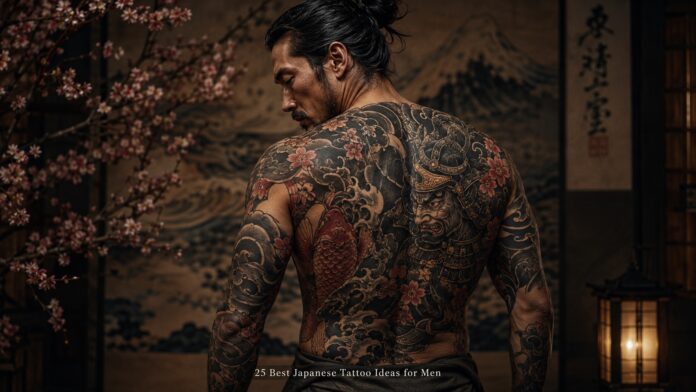
The strongest Japanese tattoo ideas for men combine bold composition with imagery that still reads clearly from several feet away. A coiled dragon, swimming koi, stalking tiger, or Hannya mask can anchor a large piece, while waves, peonies, maple leaves, and cherry blossoms help connect the design naturally across the body.
Japanese-style tattooing rewards planning more than impulse. The best designs treat the arm, chest, back, or leg as part of the artwork rather than as empty space waiting for a picture. This guide focuses on visual balance, traditional-inspired motifs, placement, symbolism, and the details worth discussing with an artist before the stencil goes on.
| Quick Pick | Japanese Tattoo Idea | Best Placement | Overall Feel |
|---|---|---|---|
| Best Overall | Japanese Dragon | Back, sleeve, chest | Powerful and dramatic |
| Best Classic Choice | Koi Fish | Arm, thigh, calf | Flowing and symbolic |
| Best Bold Design | Japanese Tiger | Back, chest, thigh | Fierce and muscular |
| Best Dark Option | Hannya Mask | Forearm, upper arm, thigh | Intense and theatrical |
| Best Full Sleeve | Dragon and Waves | Shoulder to wrist | Cohesive and energetic |
| Best Color Design | Japanese Phoenix | Back, chest, thigh | Bright and expansive |
| Best Floral Option | Peony | Shoulder, forearm, calf | Strong yet decorative |
| Best Smaller Piece | Daruma Doll | Forearm, calf | Compact and recognizable |
| Best Nature Composition | Crane and Cherry Blossoms | Back, upper arm | Calm and elegant |
| Best Black-and-Gray Choice | Snake and Chrysanthemum | Sleeve, thigh | Detailed and moody |
Classic Japanese Tattoo Ideas With Strong Visual Impact
Traditional-inspired Japanese tattoo ideas often work because the main subject has an unmistakable silhouette. Dragons twist, koi swim, tigers stretch across muscle groups, and snakes naturally wrap around limbs. These designs also leave enough room for clouds, wind bars, water, flowers, and other background elements without making the composition feel crowded.
1. Japanese Dragon Tattoo
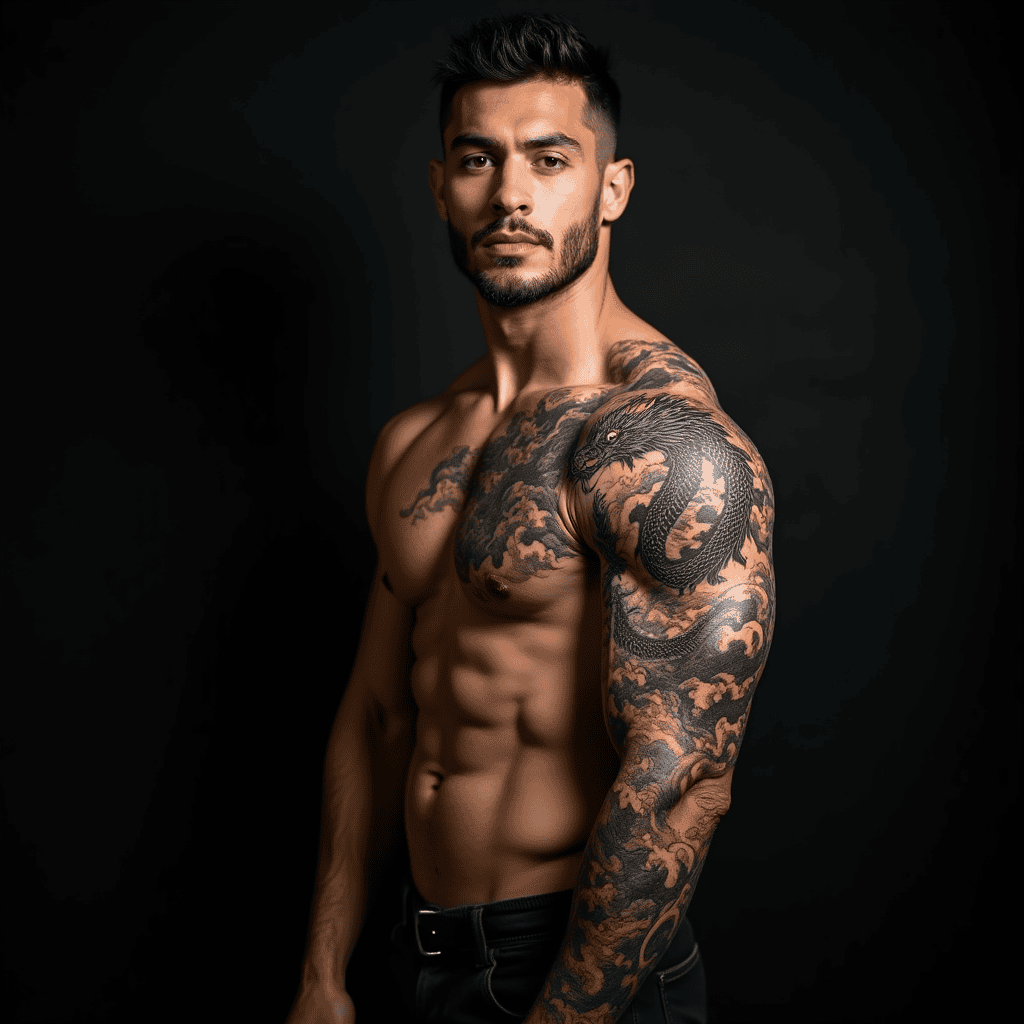
A Japanese dragon makes a strong centerpiece because its long body can follow almost any major line of the body. On a sleeve, the head can sit near the shoulder while the body coils downward through clouds, waves, and controlled areas of negative space. On a back piece, the larger canvas allows the claws, scales, horns, and facial expression to carry much more detail.
This design suits men who want a tattoo that feels powerful without relying on one blocky image. Ask your artist for “a Japanese-style dragon that follows the natural body line, with readable scales and enough background space to keep the head dominant.” The biggest drawback is scale: shrinking a complicated dragon too far can turn the face, claws, and body pattern into visual clutter.
2. Koi Fish Tattoo
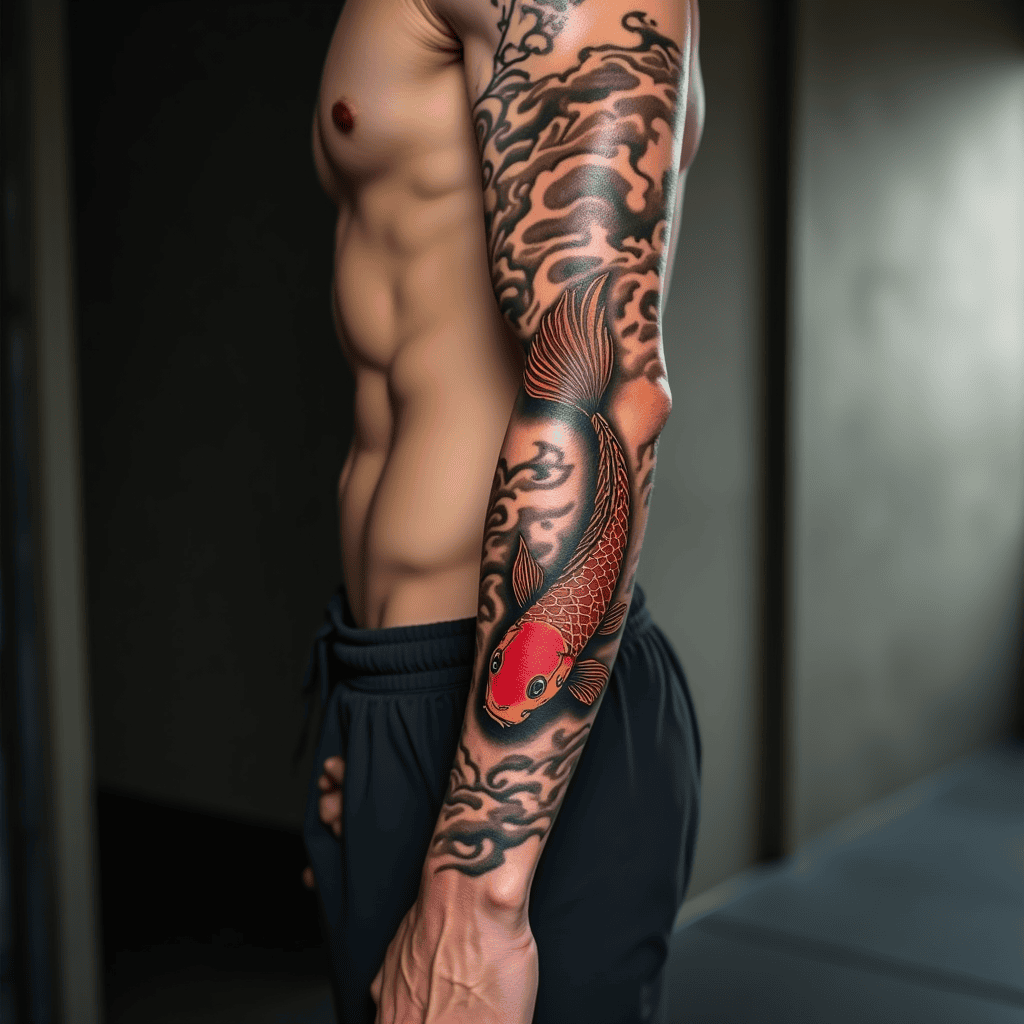
Koi are among the most adaptable Japanese tattoo ideas because their curved bodies naturally create movement. A large koi can swim upward along the forearm, turn across the shoulder, or follow the outer thigh while water currents and small floral elements fill the surrounding gaps. Strong color blocking makes the fish readable even when the design includes detailed scales.
This works especially well for someone who likes symbolic imagery but wants something less aggressive than a tiger or mask. Tell the artist you want “one dominant koi with clean water movement around it rather than several small competing elements.” Orientation matters, so discuss whether the fish should appear to swim upward, downward, or across the body before finalizing the composition.
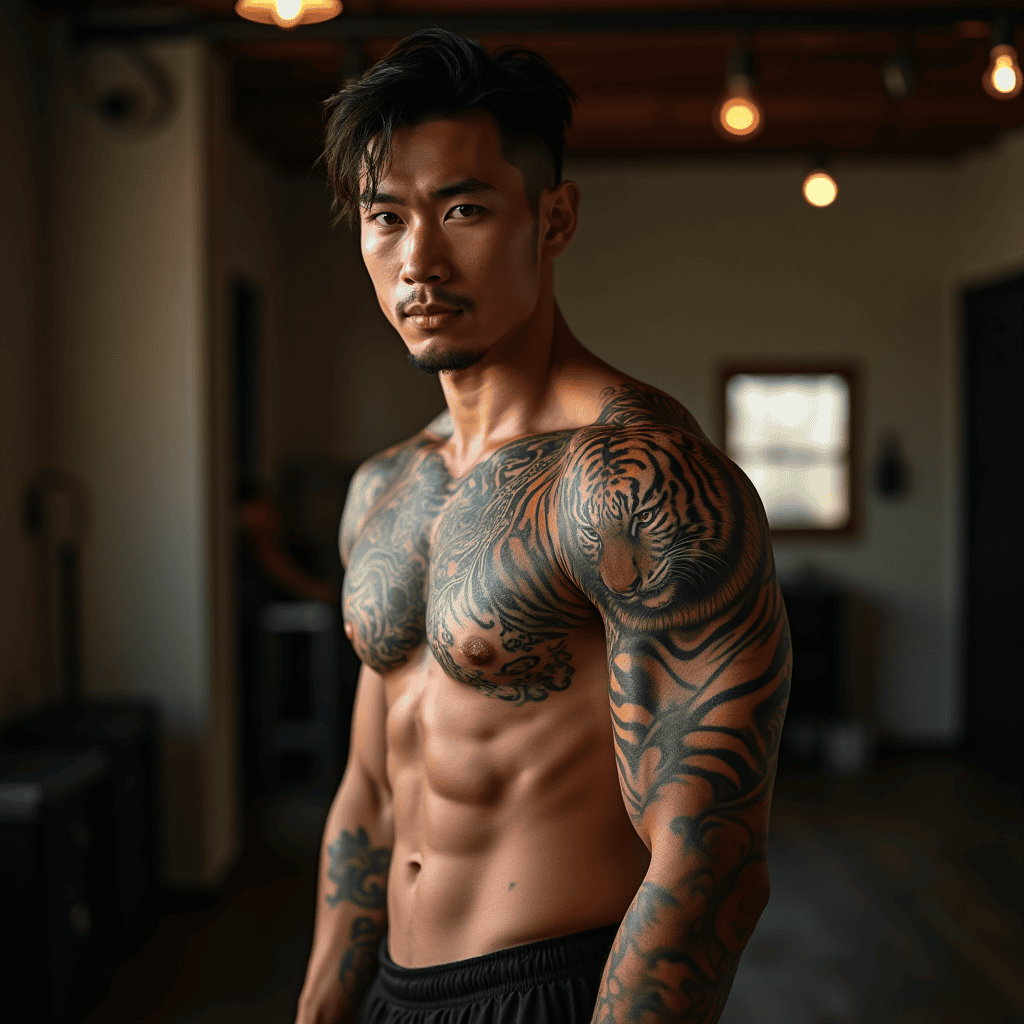
3. Japanese Tiger Tattoo
A Japanese tiger tattoo looks strongest when the body feels alive rather than posed like a static emblem. The shoulders, ribs, and thighs give an artist enough room to show the tiger twisting, crouching, or moving through wind and vegetation. Heavy stripes create instant contrast while the face becomes the visual anchor.
Men who prefer masculine, high-energy Japanese tattoo ideas tend to gravitate toward this subject. Ask for “a moving tiger with the body following the muscle rather than a straight-on tiger head.” The facial expression needs room, which makes tiny versions difficult; if the available area is small, simplifying the design usually looks cleaner than forcing in every whisker and stripe.
4. Hannya Mask Tattoo
The Hannya mask brings an immediately theatrical quality to Japanese tattooing. Strong horns, exaggerated eyes, sharp teeth, and sweeping facial lines create a design that remains readable even when surrounded by darker background work. On the upper arm or thigh, the mask can sit slightly angled instead of facing straight outward, which often gives the composition more movement.
This idea suits someone comfortable wearing an intense image with a complicated cultural history. Ask your tattooer for “a Hannya mask with strong facial readability, controlled shading, and supporting elements that do not compete with the eyes.” Interpretations of Japanese masks are often oversimplified online, so discuss the imagery with an artist who understands the tradition rather than choosing details from random reference pictures.
5. Japanese Snake Tattoo
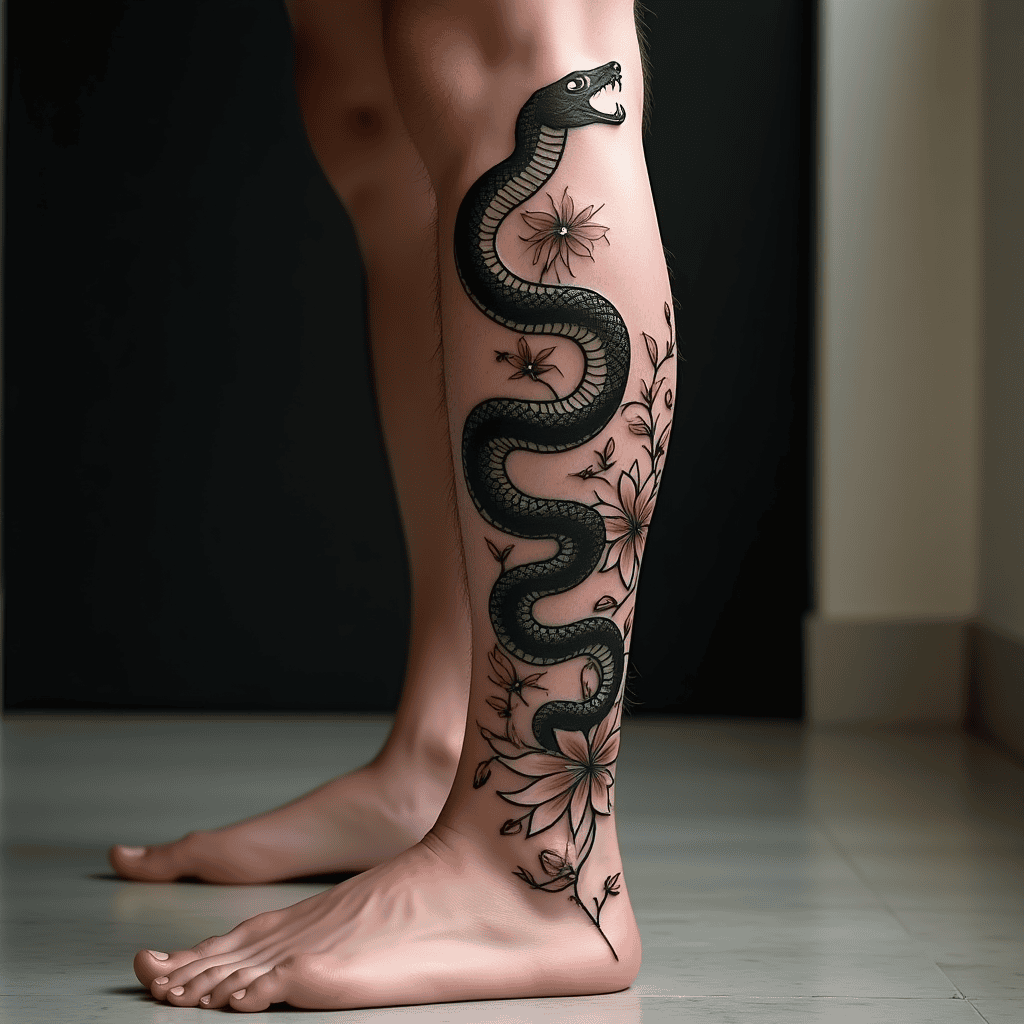
A snake is almost built for arms and legs because the body can wrap naturally instead of sitting inside a rectangular patch of skin. Japanese-inspired snake tattoos often combine smooth curves with chrysanthemums, peonies, wind, or darker background shading. The head can remain relatively large while the body narrows and travels around the limb.
Choose this if you want Japanese tattoo ideas that create movement without needing an enormous back piece. Tell your artist you want “a snake that wraps with the limb and still reads from the front and side.” Excessive coils can become confusing once viewed from normal distance, so a cleaner path around the body is often stronger than trying to show every possible twist.
Japanese Tattoo Ideas Built Around Animals and Mythic Creatures
Animals give Japanese compositions a clear focal subject while allowing the background to carry much of the atmosphere. The strongest versions don’t simply place an animal on the skin. They use the animal’s movement to determine how waves, clouds, flowers, leaves, and open skin move around it.
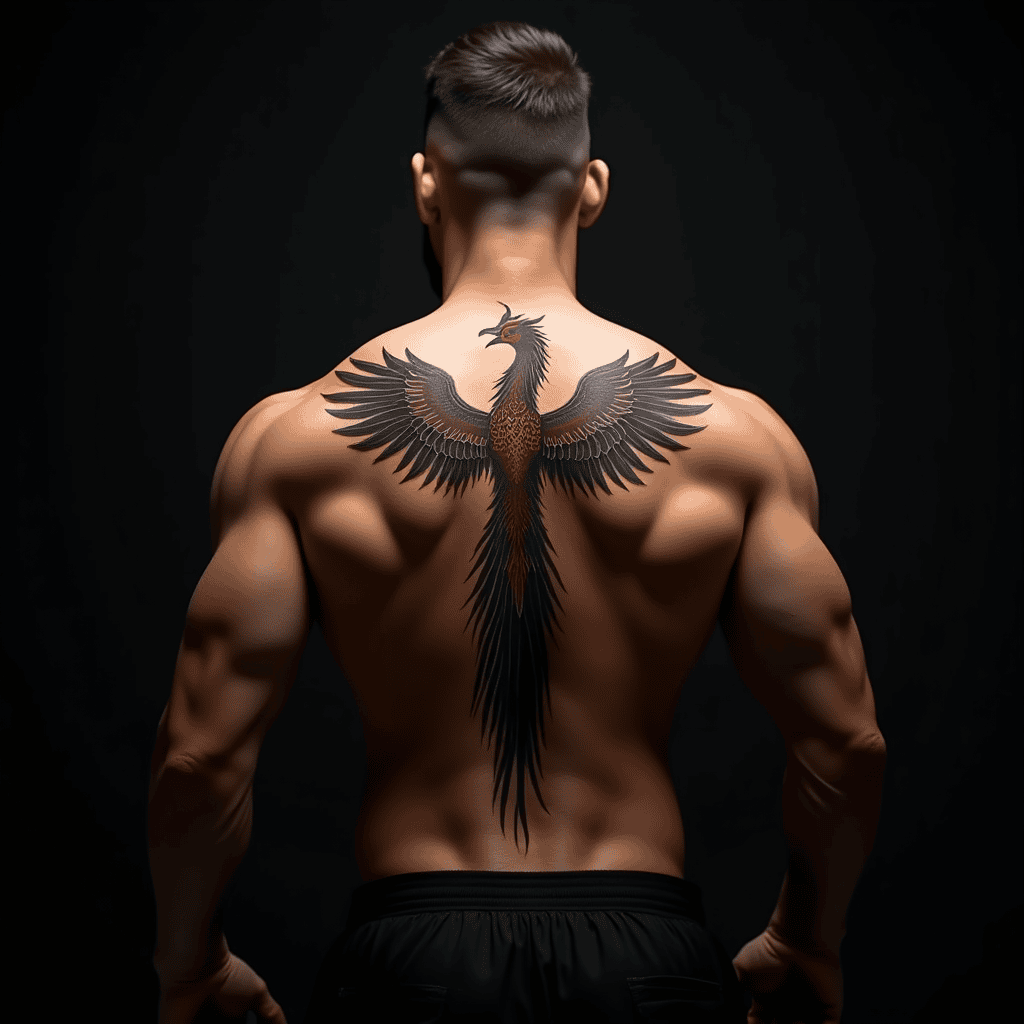
6. Japanese Phoenix Tattoo
A Japanese phoenix works best on a larger canvas because the wings and tail feathers need breathing room. Across the back, one wing can rise toward a shoulder while sweeping feathers travel downward toward the waist. On the thigh or side of the torso, the design becomes more vertical while retaining the bird’s sense of motion.
This choice fits men who want a colorful centerpiece rather than dense blackwork. Ask for “a phoenix with one clear head, open wing structure, and long feathers that follow the body instead of forming a circular logo.” Too many colors can flatten the composition, so keeping the palette controlled often makes the major feather shapes easier to read.
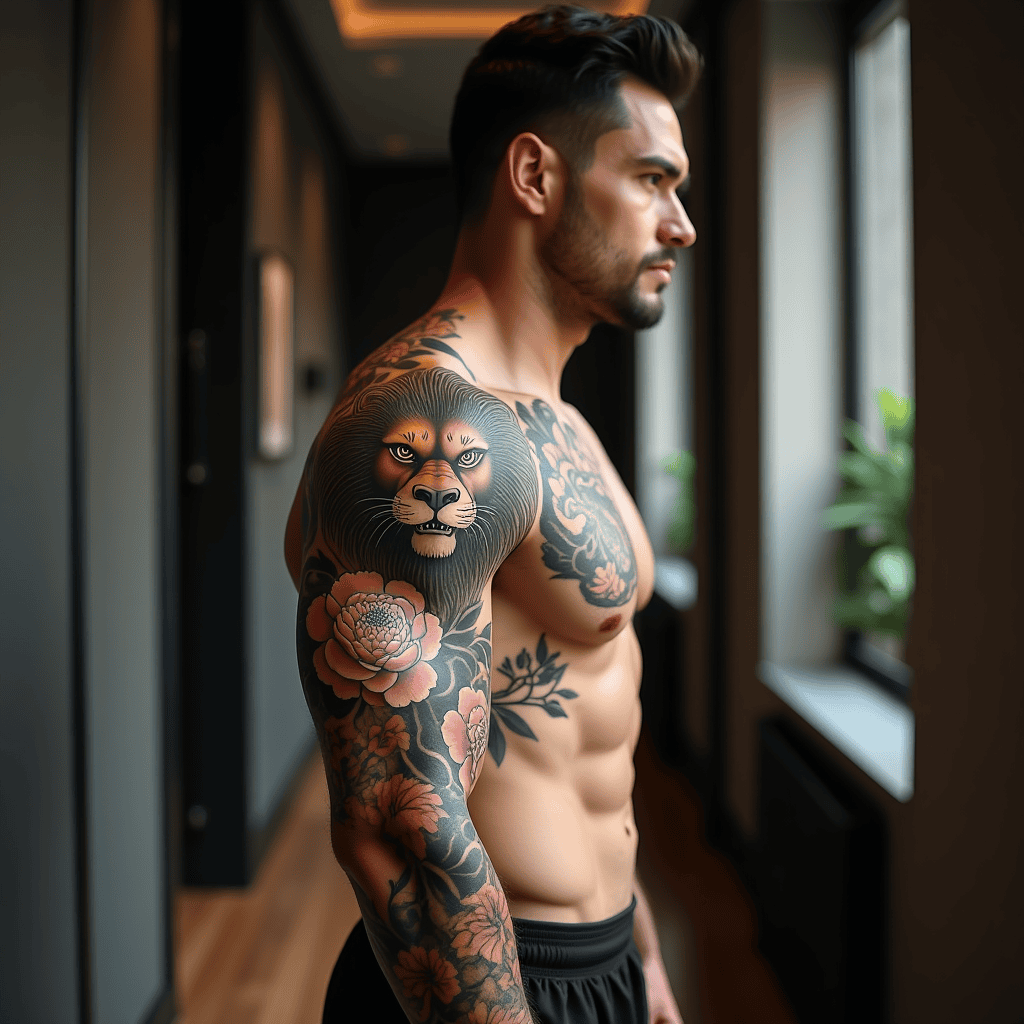
7. Shishi Lion Tattoo
The Japanese shishi, often described as a guardian lion, creates a muscular design filled with curling forms. Its mane, brows, paws, and open mouth can be drawn with repeated circular movement, making the subject particularly effective on a shoulder cap, chest panel, or thigh. Peonies are a familiar visual partner because their softer petals contrast with the animal’s dense texture.
This is a better fit for someone who wants something less common than the standard dragon-and-koi combination. Ask your tattoo artist for “one large shishi with a clearly readable face and a few oversized flowers instead of dozens of tiny fillers.” The mane can become excessively busy, so keep enough plain skin or quieter background around the head.
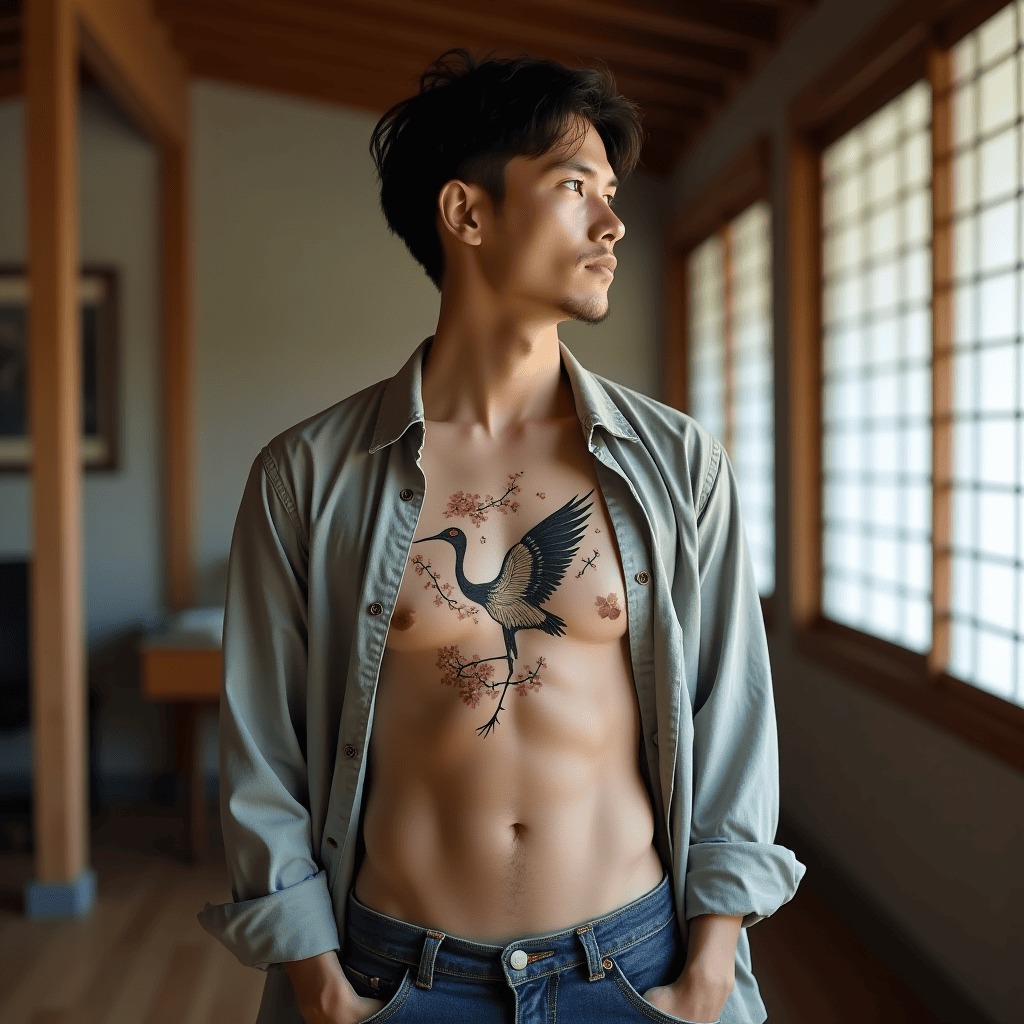
8. Japanese Crane Tattoo
A crane gives Japanese tattoo ideas a lighter, more graceful direction. Long legs, an extended neck, and wide wings create elegant lines that can travel across the ribs, back, upper arm, or thigh. Cherry blossoms, clouds, and open areas of skin can support the bird without turning the whole piece into dense background.
This design suits someone who prefers calm imagery over snarling animals and dramatic masks. Ask for “a crane with a long, clear silhouette and open negative space around the wings.” Fine feathers can disappear visually when the tattoo is made too small, so prioritize the overall shape first and secondary feather detail second.
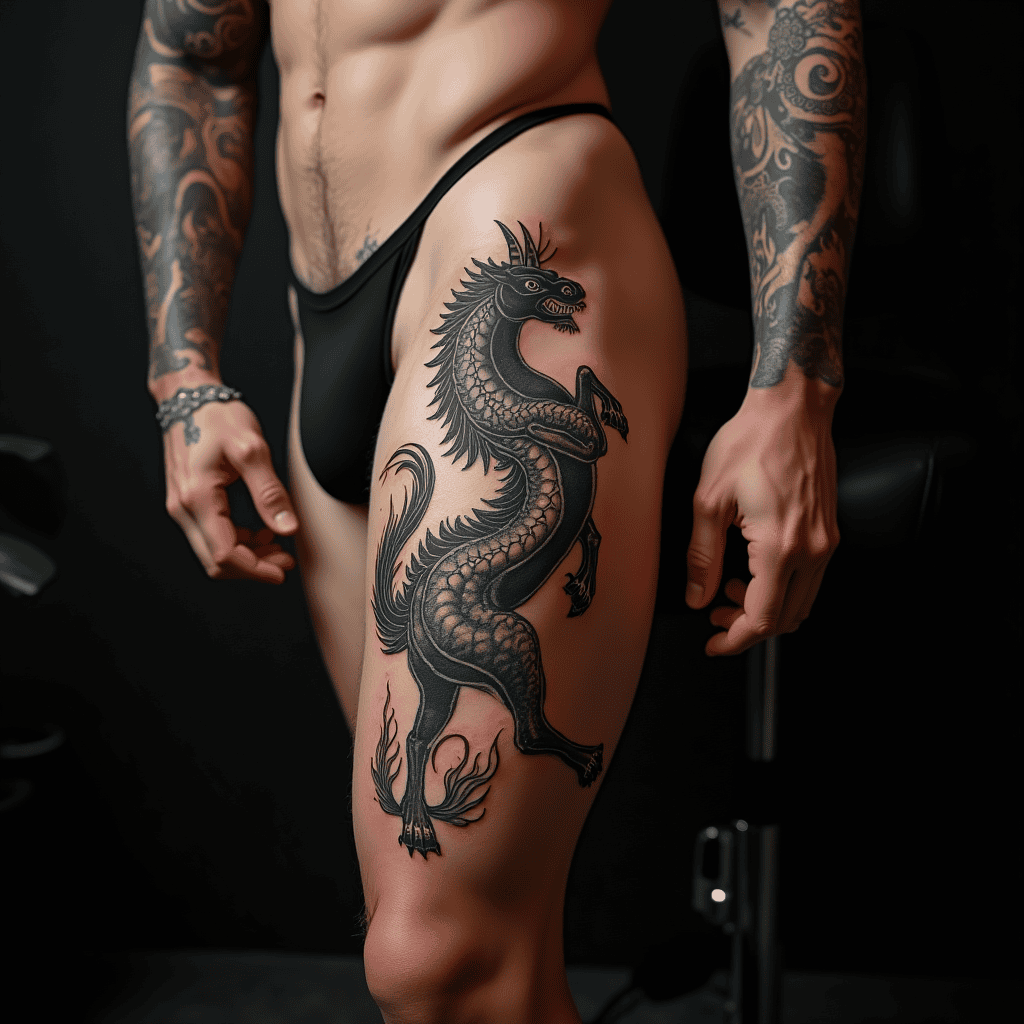
9. Kirin Tattoo
The kirin offers a less predictable mythic subject for a large Japanese-style piece. Its body can combine sweeping animal forms, scaled textures, a dramatic head, and flame-like accents, giving the artist plenty of opportunities to create rhythm through the composition. It works especially well on the thigh, back, or upper arm where the creature can be given room.
For men who want unusual Japanese tattoo ideas, this is one of the more distinctive routes. Ask for “a large kirin with one dominant head and flowing body movement rather than an overloaded collection of background symbols.” Because reference styles vary widely, choosing an artist with a strong Japanese portfolio matters more here than copying a single picture found online.
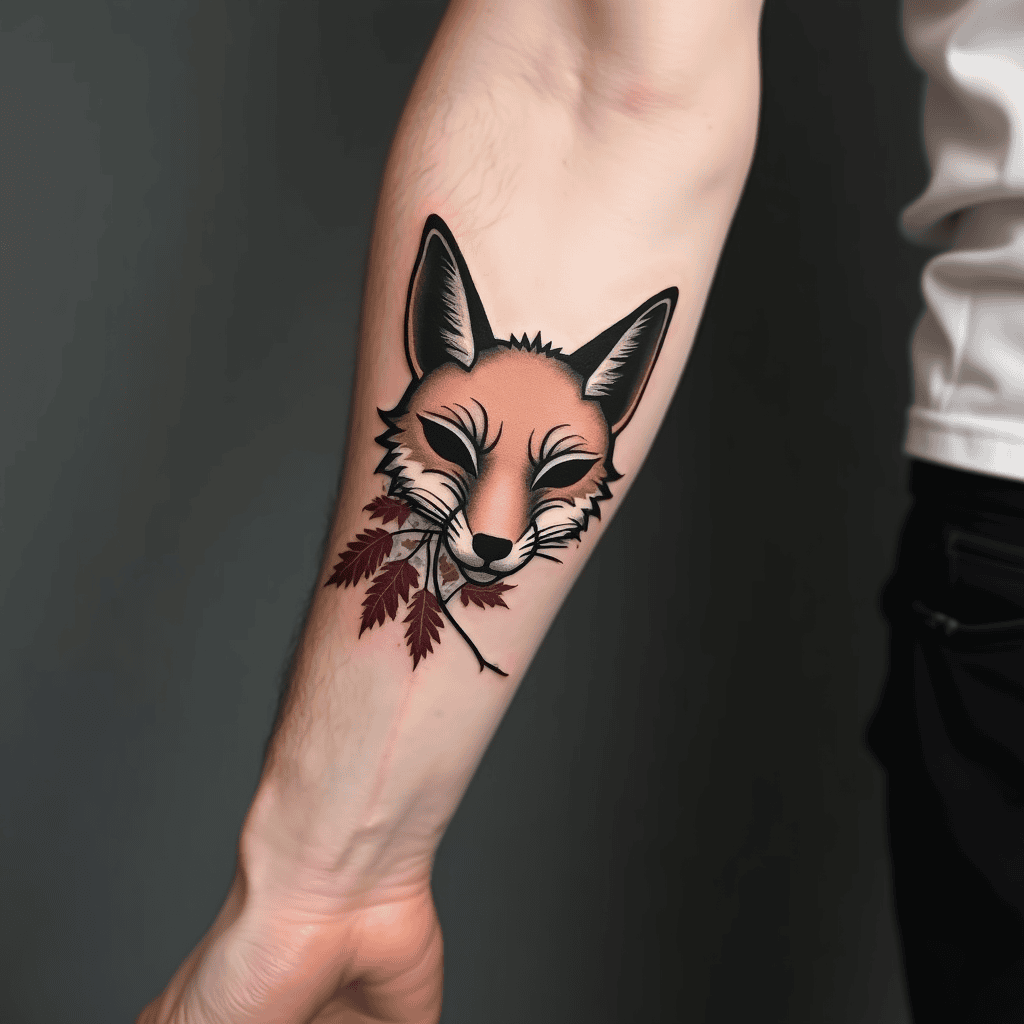
10. Kitsune Mask Tattoo
A kitsune mask has a cleaner shape than many full creature designs, which makes it easier to adapt to the forearm, calf, shoulder, or upper back. Pointed ears, narrow eyes, and graphic facial markings give the tattoo an immediate focal point. Leaves, flowers, cords, or smoke-like background movement can extend the composition without burying the mask.
This works for someone who wants recognizable Japanese-inspired imagery in a medium-sized area. Tell the artist you want “a kitsune mask with a strong outline and restrained supporting elements so the face remains readable.” Avoid adding symbols simply because they appear in other kitsune tattoos; the design becomes more convincing when each element has a deliberate visual role.
Japanese Tattoo Ideas With Flowers, Water, and Natural Movement
Not every Japanese design needs a large animal or mask at its center. Flowers, water, leaves, clouds, and seasonal imagery can carry an entire tattoo when they are composed with enough contrast. These subjects are especially useful for filling curved areas and connecting separate larger motifs into one visual system.
11. Peony Tattoo
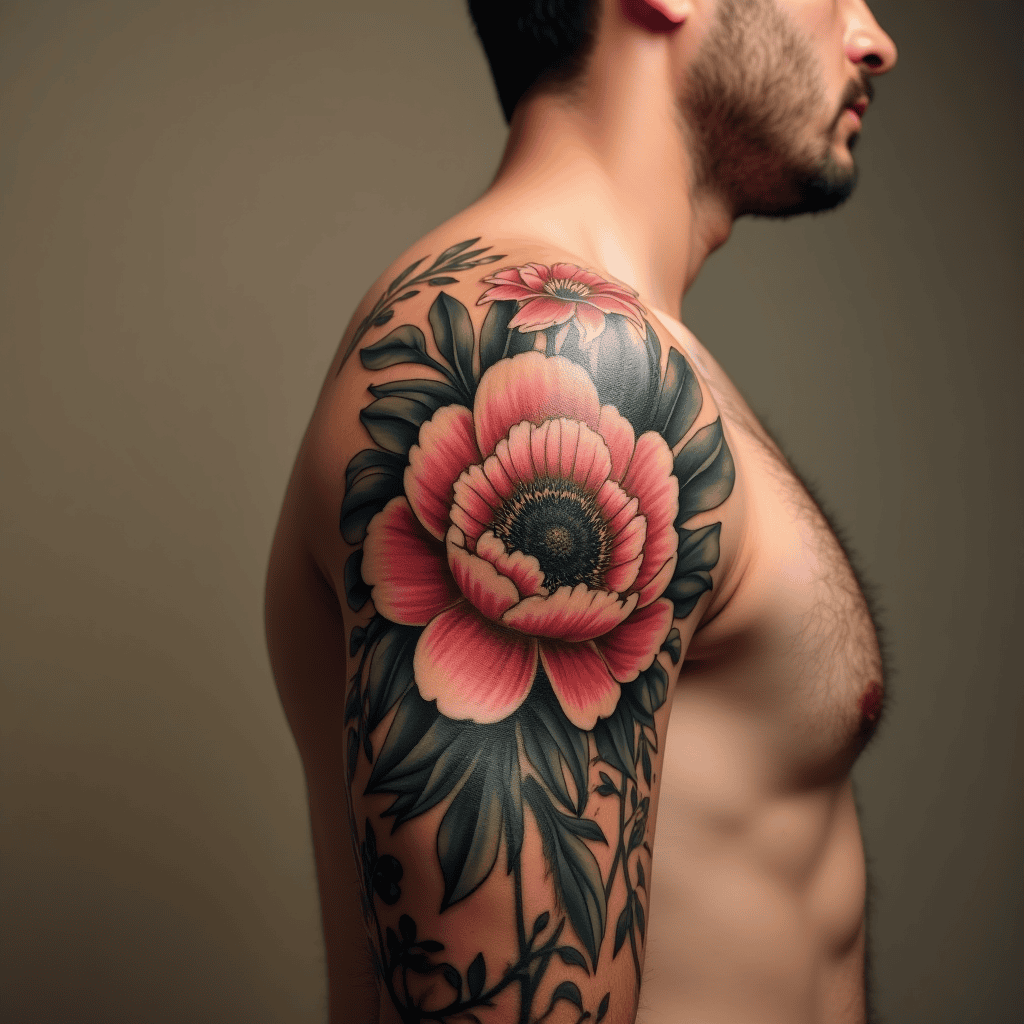
A Japanese peony tattoo relies on large layered petals rather than tiny botanical realism. Strong outer shapes help the flower stay readable from a distance, while darker centers and leaves give the composition depth. One oversized peony can command a shoulder or thigh, while several can work as supporting elements in a sleeve.
Men who like floral Japanese tattoo ideas but still want a bold look often find peonies easier to wear than delicate fine-line flowers. Ask for “large petals, strong contrast, and leaves that help shape the composition instead of filling every empty gap.” The main mistake is shrinking the petals until the flower loses its graphic power.
12. Chrysanthemum Tattoo
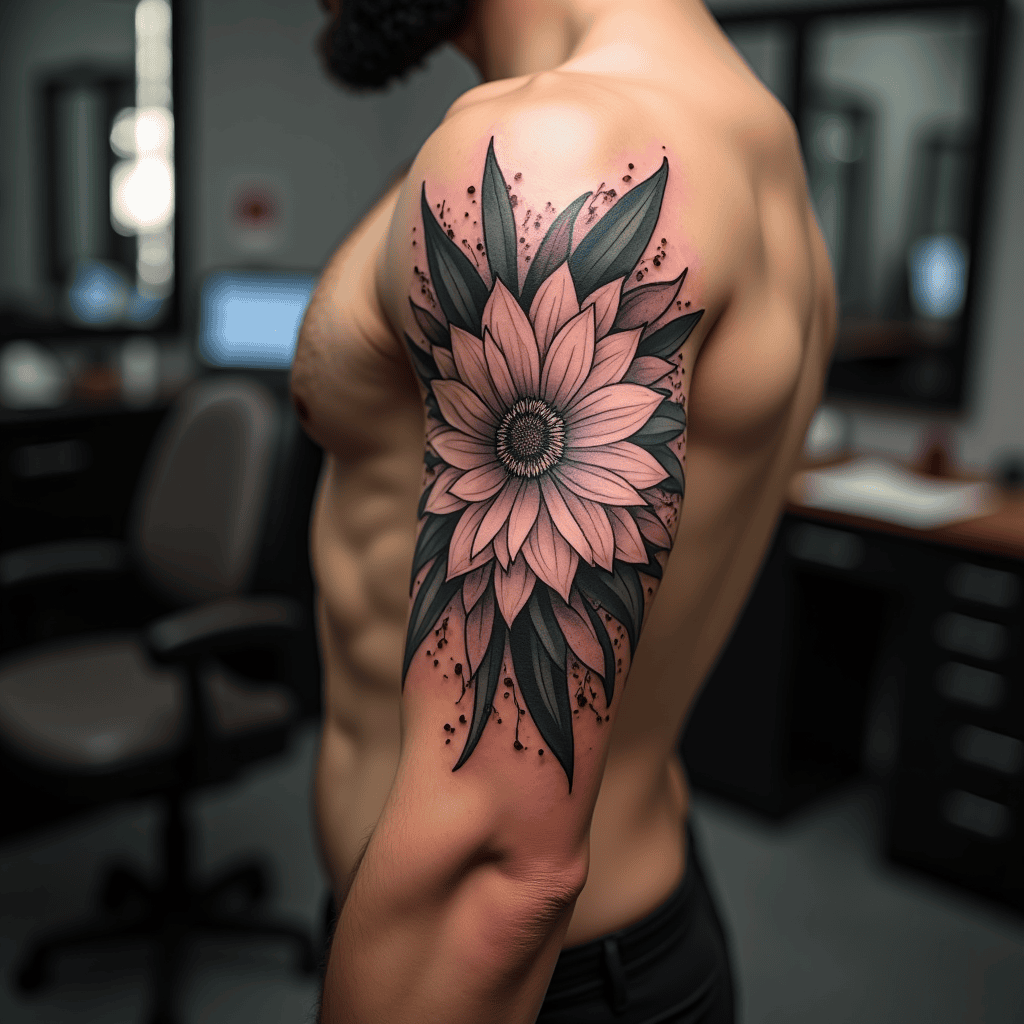
Chrysanthemums offer more radial structure than peonies, creating a dense circular rhythm that looks especially effective on elbows, knees, shoulders, and larger sleeve sections. The many narrow petals can be arranged in sweeping layers, while leaves and darker background work keep the flower from looking flat.
This option suits men who want floral imagery with more geometry and texture. Ask the artist for “one large chrysanthemum designed around the joint or muscle, with petals sized for long-term readability.” Packing too many thin lines into a small area can muddy the design, so the flower generally benefits from generous scale.
13. Cherry Blossom Tattoo
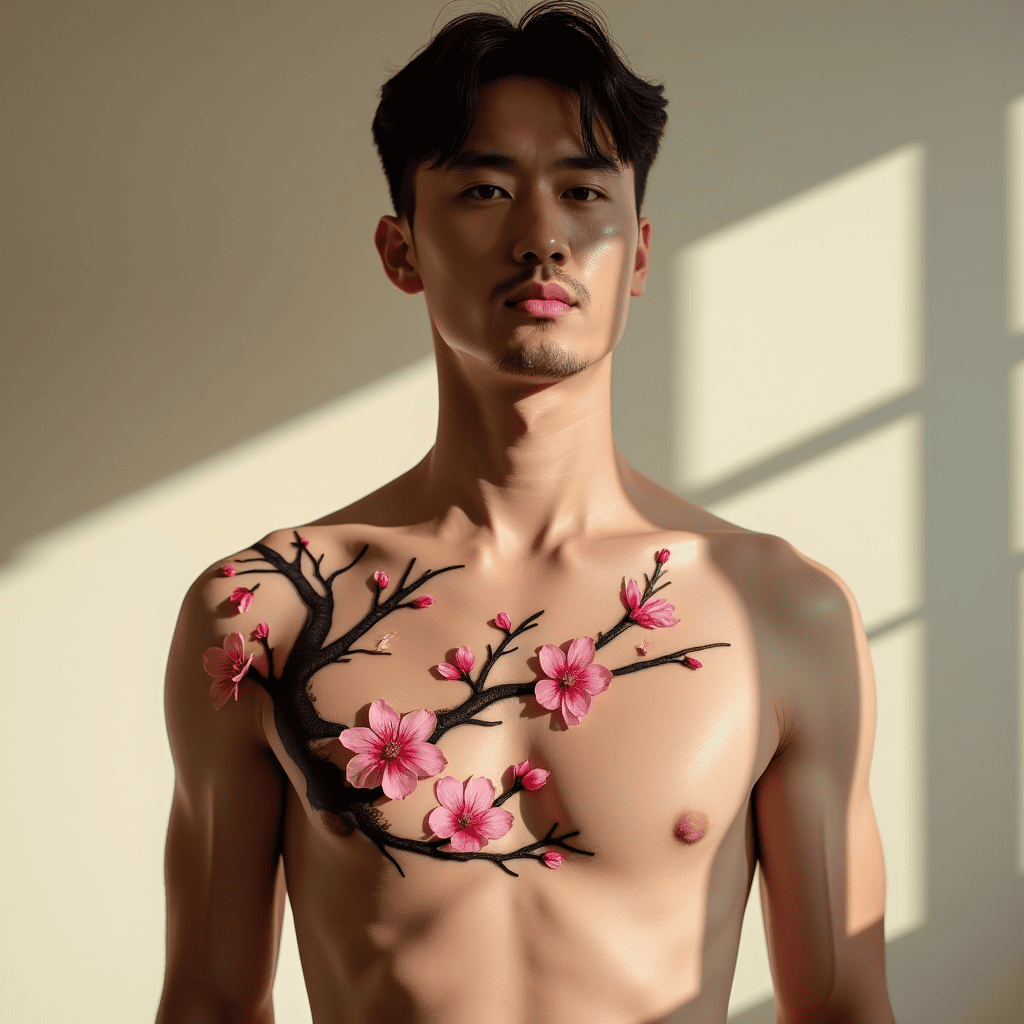
Cherry blossoms work best as movement rather than as isolated decorative stickers. A branch can travel diagonally across the chest, shoulder, arm, or ribs while loose petals create direction around a larger focal image. Pink and muted red tones can add softness without weakening the overall composition.
This is one of the more flexible Japanese tattoo ideas for men who want something lighter or want to connect an existing larger piece. Ask for “a natural branch direction with varied blossom sizes and a few falling petals, not a perfectly repeated flower pattern.” Used alone in a tiny area, the motif can feel generic, so composition matters more than the flower itself.
14. Japanese Wave Tattoo
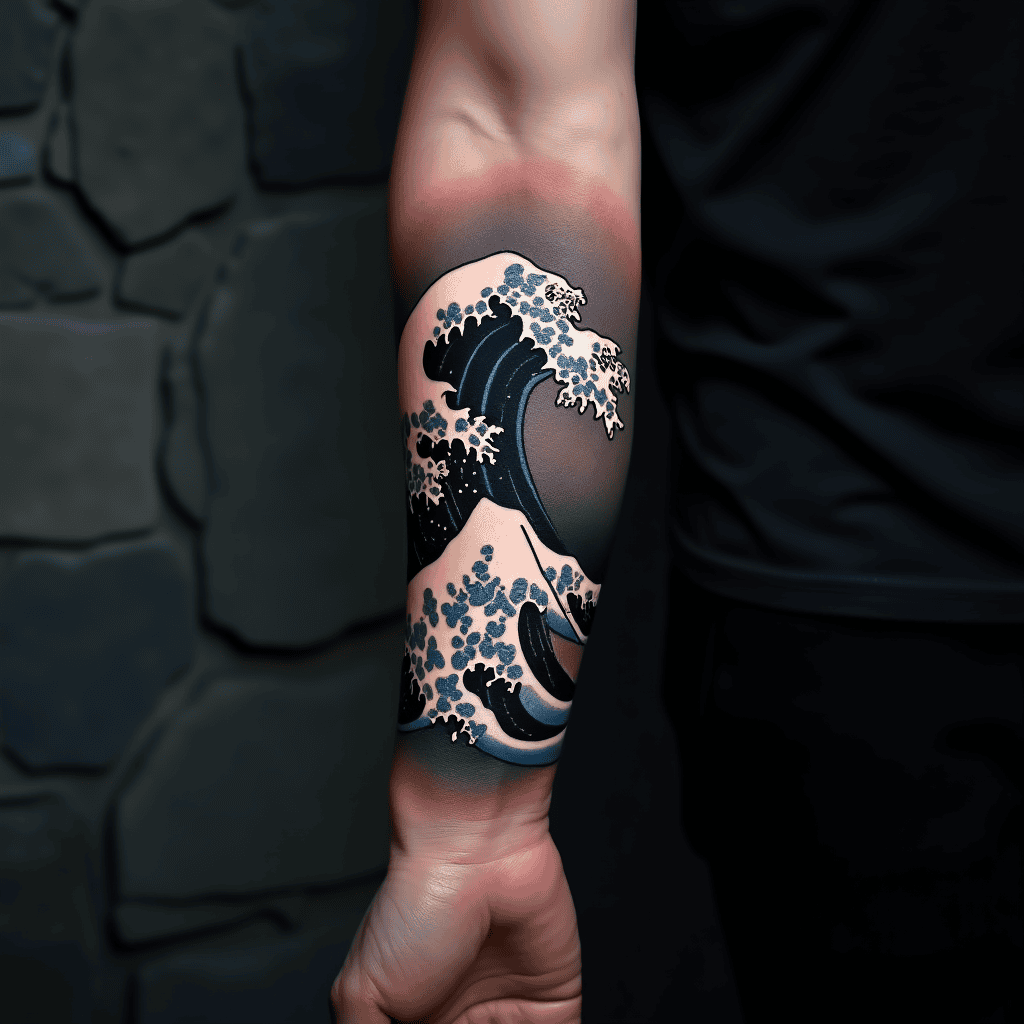
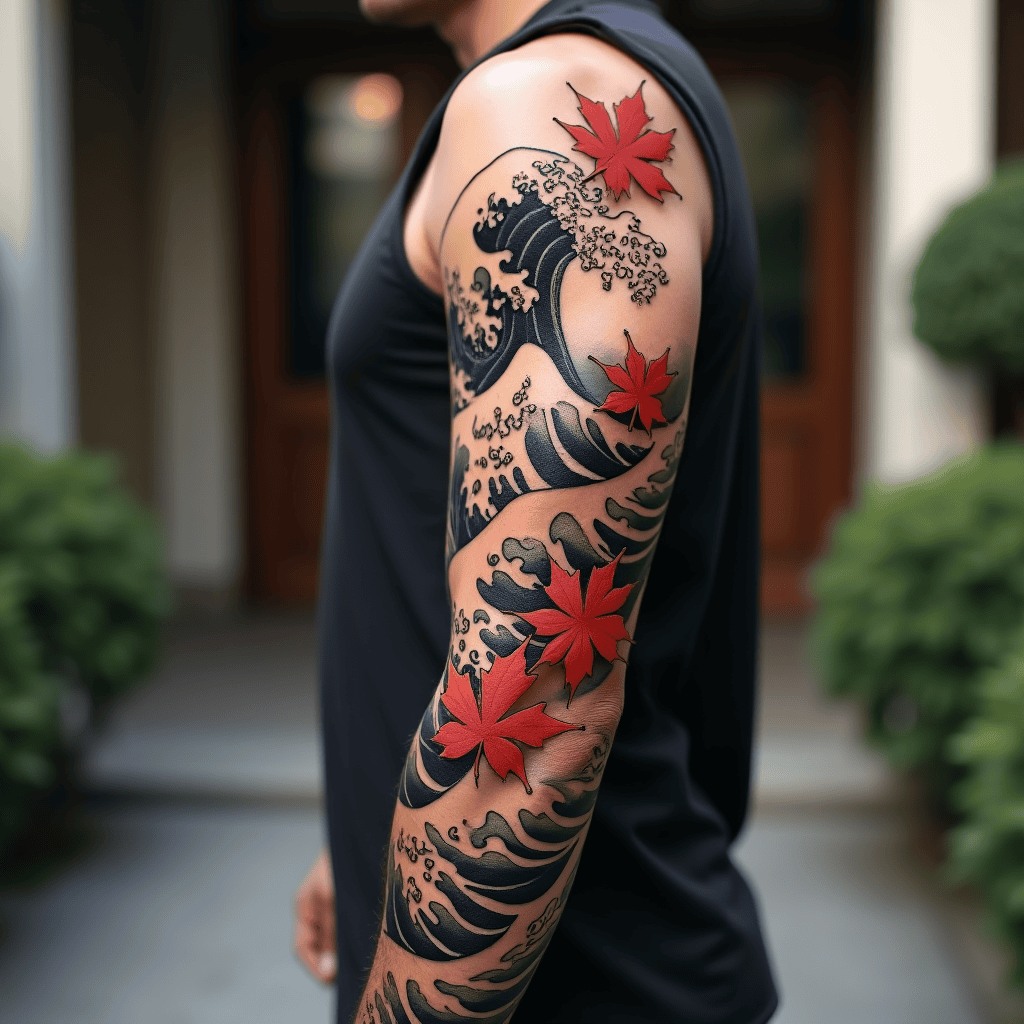
Japanese wave tattoos turn negative space and curved lines into the main attraction. Large crests can wrap around a forearm or calf, while repeated water shapes create a powerful sleeve background. Foam details provide contrast, but the design works best when the major waves remain broad and easy to read.
Pick this if you enjoy Japanese tattoo ideas that feel energetic without depending on a face or animal. Ask for “two or three dominant wave movements with clear open water rather than endless small curls.” Waves are commonly used as filler, so making them the main subject requires an artist willing to give the water real scale and visual hierarchy.
15. Japanese Maple Leaf Tattoo
Japanese maple leaves bring a sharper seasonal character than cherry blossoms. Their pointed shapes work beautifully when scattered through wind bars or water, especially in warm red, orange, and brown tones. On a sleeve, leaves can guide the eye between larger subjects while also occupying awkward narrow gaps.
This style suits men who want nature-based Japanese tattoo ideas with a strong autumn mood. Ask for “maple leaves that vary in angle and scale, carried by visible wind or water movement.” Repeating identical leaves makes the tattoo look patterned rather than organic, so controlled irregularity is part of what makes the composition believable.
Darker Japanese Tattoo Ideas With Masks and Warrior Energy
Masks and warrior imagery create some of the most dramatic Japanese compositions. They also require more restraint. Faces already carry enormous visual weight, so backgrounds should support the expression rather than compete with it.
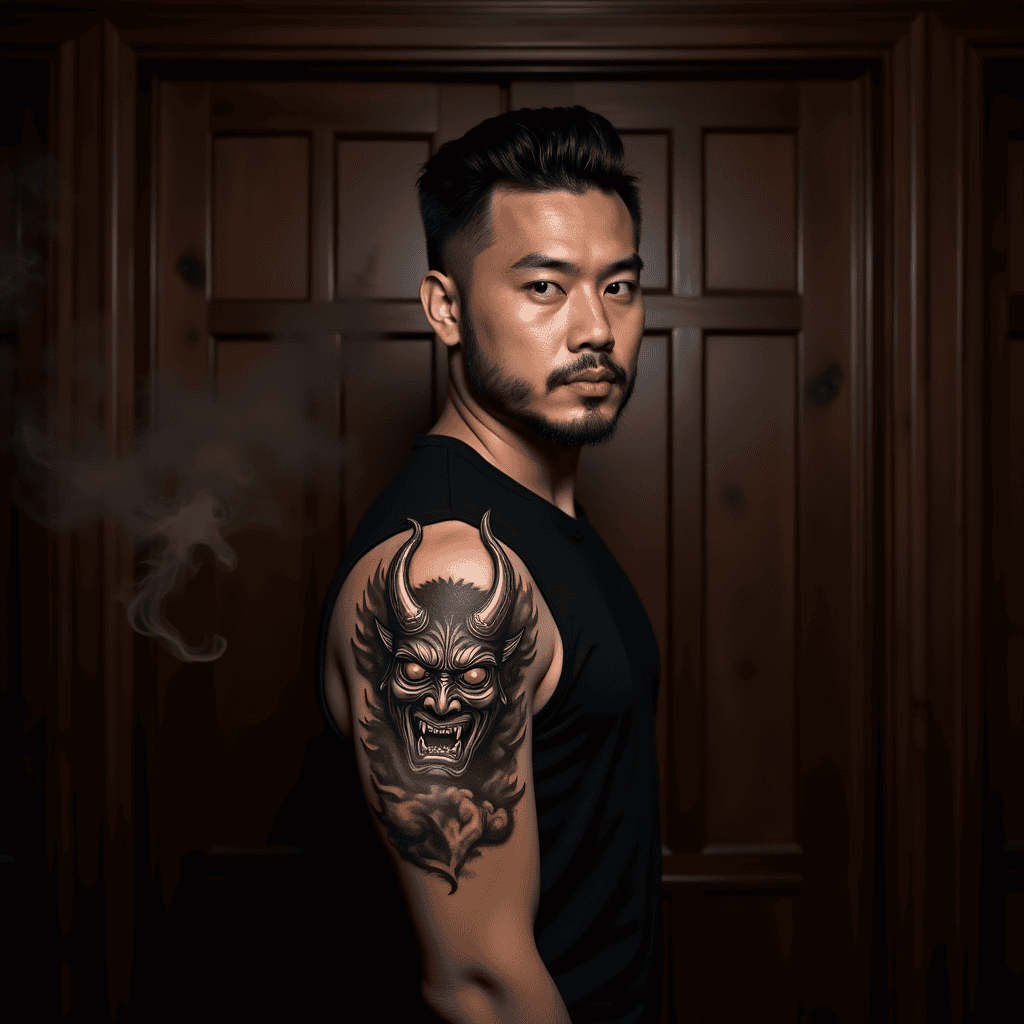
16. Oni Mask Tattoo
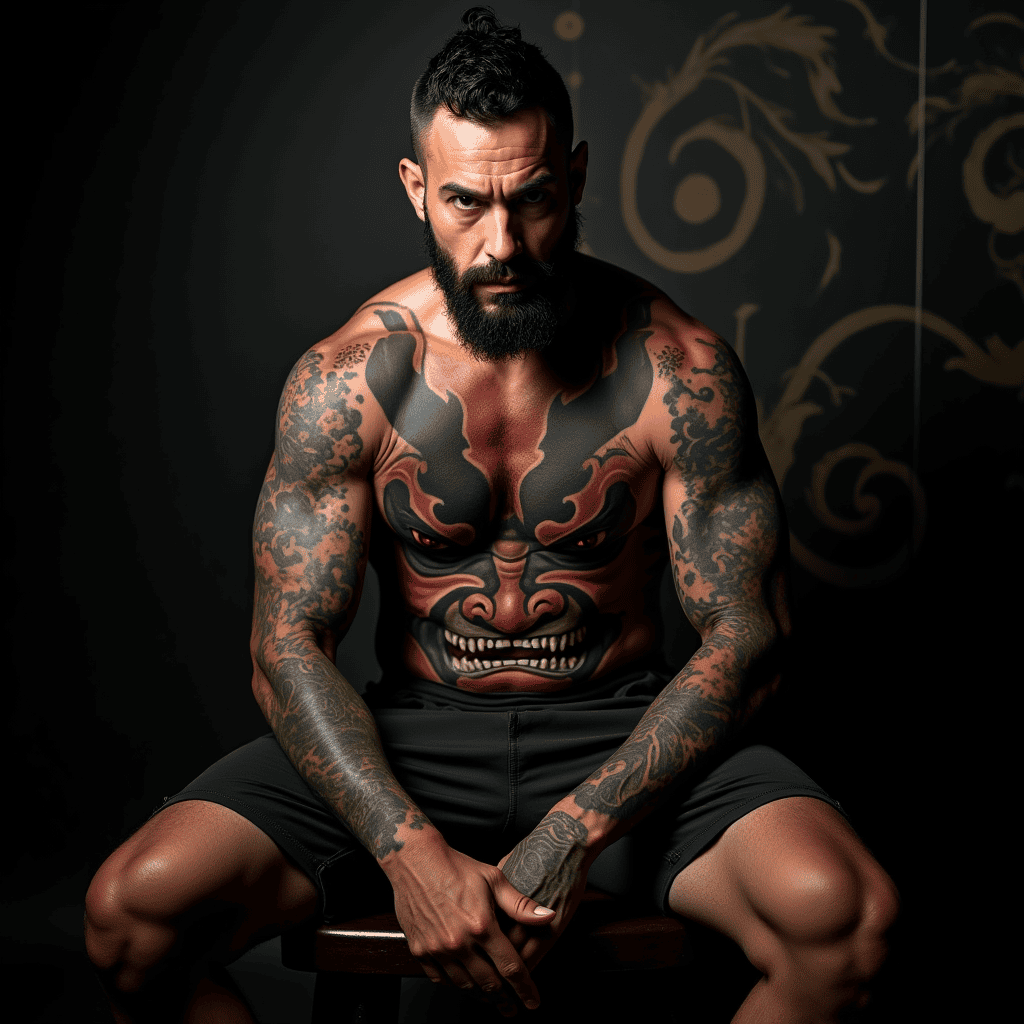
An oni mask tattoo has a broad, aggressive facial structure that lends itself to strong shading and saturated color. Large horns, heavy brows, exposed teeth, and exaggerated eyes can dominate an upper arm, chest panel, thigh, or back section. Smoke, flames, wind, or flowers can frame the mask while keeping the face central.
This is a strong option for men drawn to darker Japanese tattoo ideas. Ask for “one oversized oni face with clear expression and controlled background density.” Oni imagery can carry different meanings depending on the context and presentation, so resist simplistic internet explanations and talk through the specific design with an artist familiar with Japanese visual traditions.
17. Samurai Tattoo
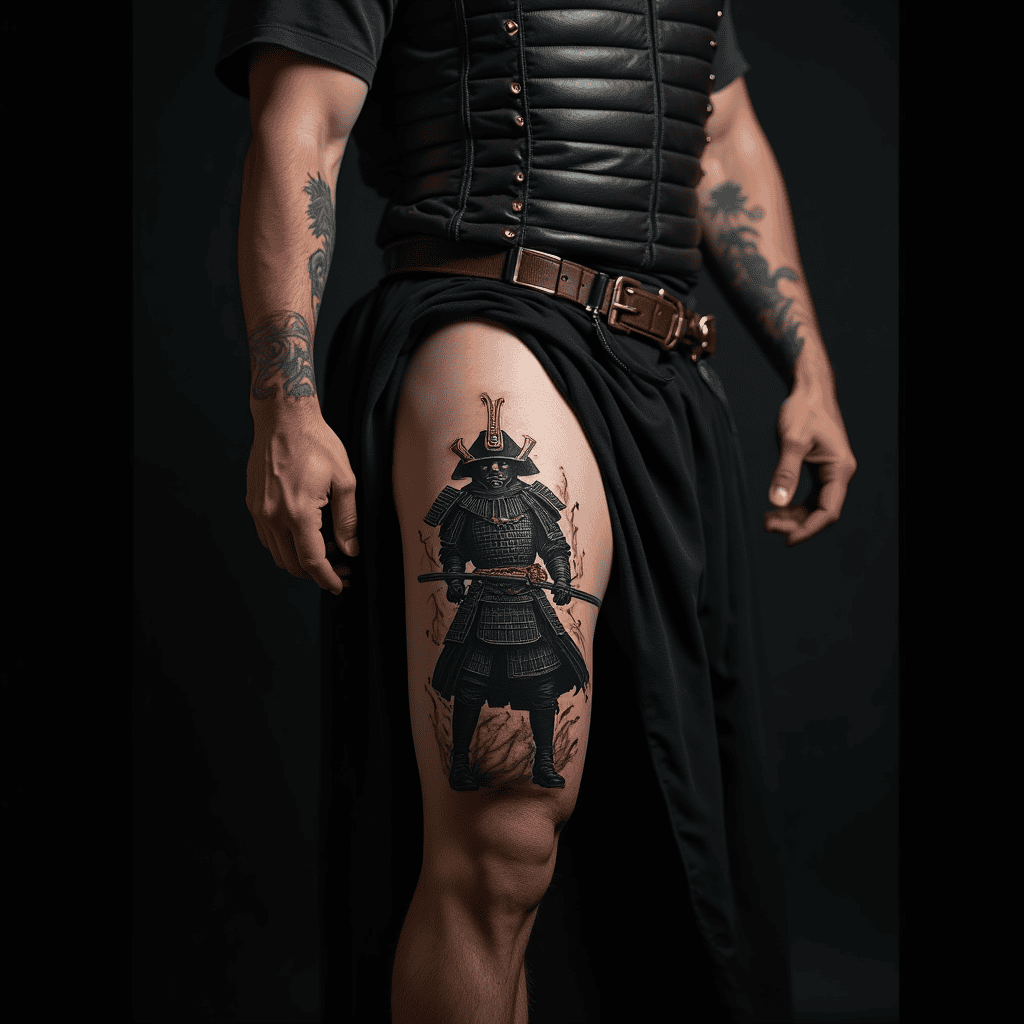
A samurai composition becomes much stronger when it focuses on posture, armor shapes, and movement instead of squeezing an entire battle scene into one patch of skin. A helmeted figure can fill the upper arm or thigh, while a larger back piece can show more armor, fabric, and environmental detail.
Men who want narrative Japanese tattoo ideas may prefer this over a single mask or animal. Ask your artist for “a samurai figure with a clean silhouette, readable armor sections, and one main direction of movement.” Armor contains many small details, so reducing the image too far usually sacrifices the depth that makes the subject visually interesting.
18. Tengu Mask Tattoo
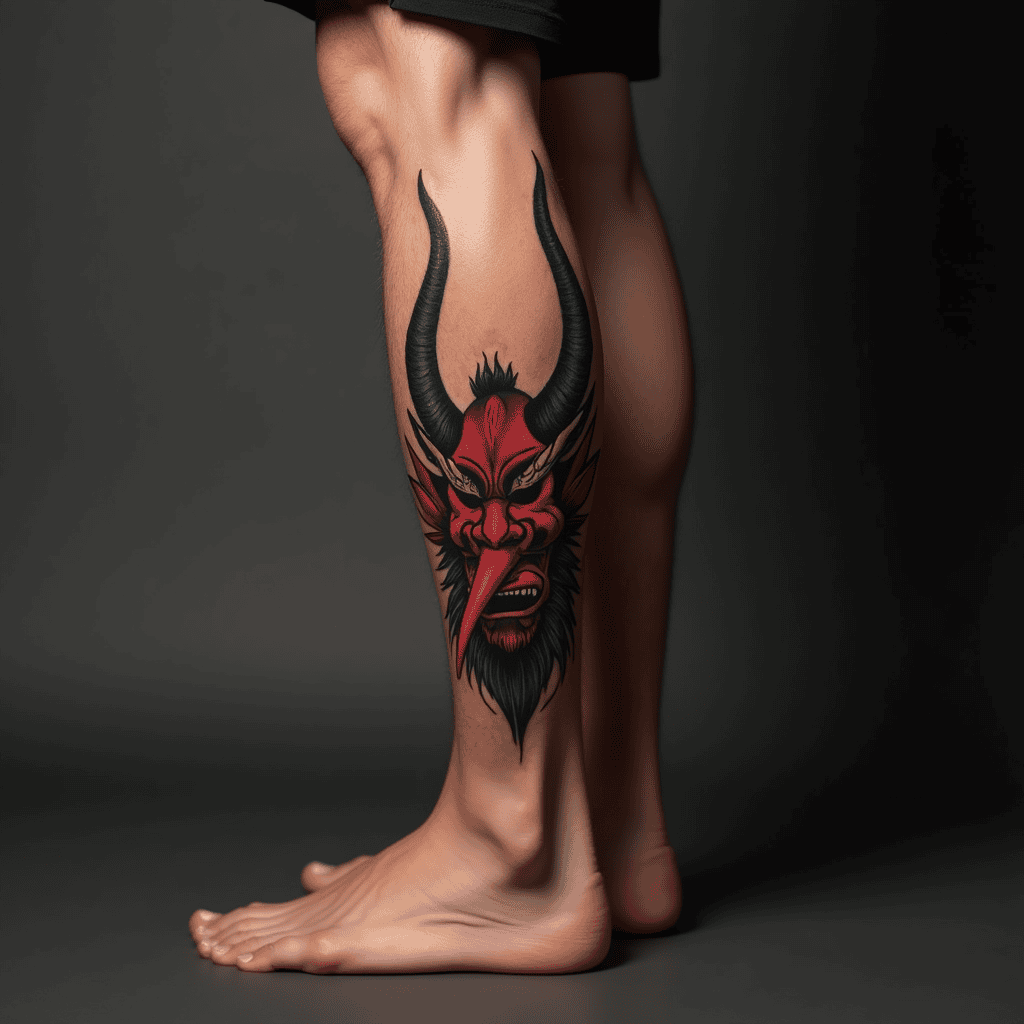
The tengu mask creates a distinctive profile through its long nose, pronounced brows, and stylized expression. That profile can be turned slightly across the bicep, forearm, or calf so the design interacts naturally with the body’s curve. Deep red, black, and muted neutral tones can keep the mask visually strong without excessive decoration.
This fits someone looking beyond the most common Japanese tattoo ideas. Ask for “a tengu mask shown at an angle, with the silhouette kept clean enough to recognize from a distance.” Because the nose extends prominently, placement deserves extra attention; a poor angle can make the face look distorted when the limb turns.
19. Namakubi-Inspired Tattoo
A namakubi-inspired design traditionally involves a severed head motif and can be visually intense even without graphic gore. Strong facial expression, tied hair, a helmet, flowers, leaves, or wind can carry much of the storytelling while keeping the composition focused. The thigh and upper arm offer enough room for the face to remain readable.
This is not a casual choice, and it suits men who already know they want darker Japanese tattoo imagery. Ask for “a dramatic head-and-face composition that relies on expression and traditional framing rather than graphic detail.” Because the subject can be confronting and historically loaded, research the imagery and choose an artist who can explain what they are drawing rather than treating it as shock decoration.
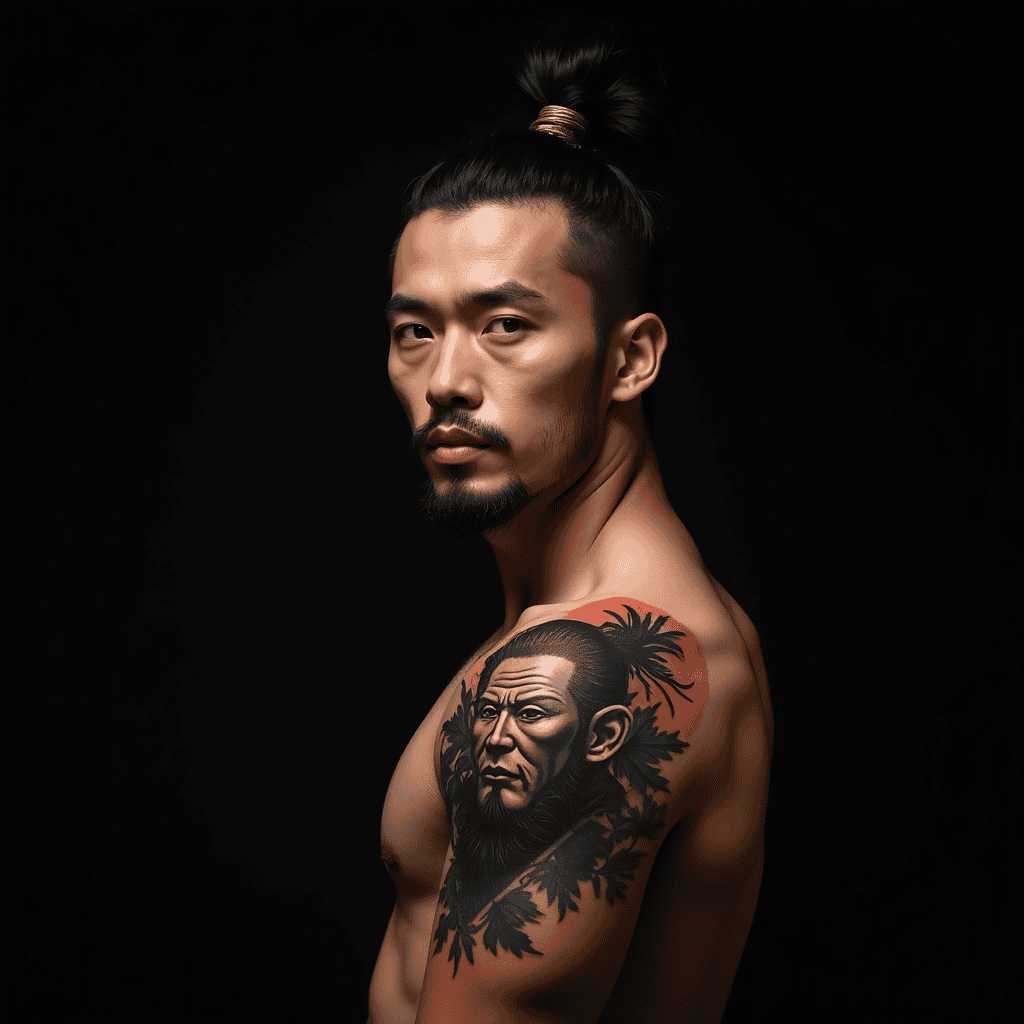
20. Japanese Skull and Flowers Tattoo
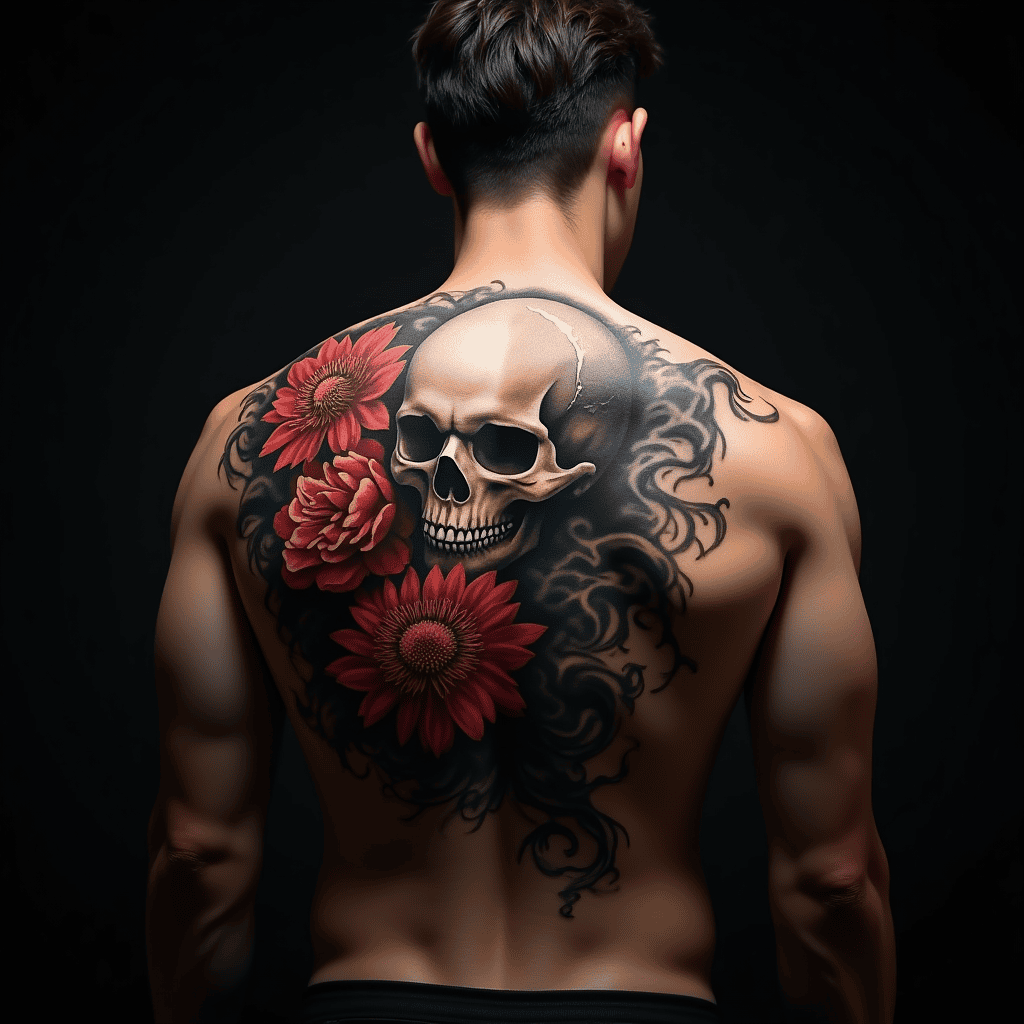
A skull can be worked into a Japanese-inspired composition without turning the piece into generic horror imagery. The strongest versions pair a large skull with peonies, chrysanthemums, wind, or falling leaves so hard bone structure sits against softer natural forms. Deep shadows around the eye sockets give the design weight.
This works best for men who want darker Japanese tattoo ideas but still care about decorative flow. Ask for “one dominant skull integrated into oversized Japanese florals, with the flowers shaping the edges of the composition.” The risk is stylistic confusion, so choose an artist whose portfolio shows they can combine Western skull anatomy with Japanese-inspired background structure coherently.
Larger Japanese Tattoo Ideas for Sleeves, Chest Pieces, and Back Tattoos
Large-scale Japanese tattooing becomes most impressive when the entire body section is planned as one composition. Instead of collecting isolated images, the artist can connect the shoulder, chest, arm, back, or leg through a continuous background. That planning usually creates a stronger result than adding filler after every major tattoo is already finished.
21. Dragon and Wave Sleeve
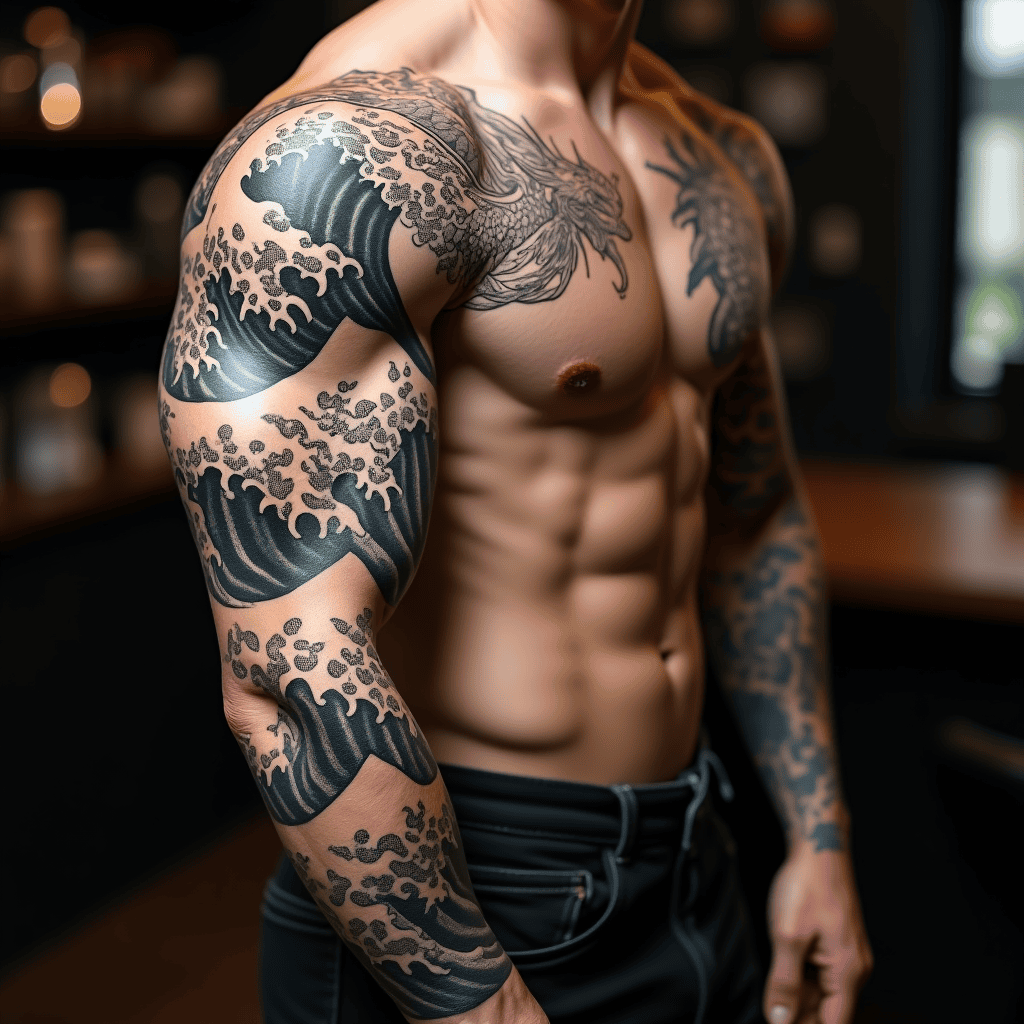
A dragon-and-wave sleeve uses two naturally flowing elements to create continuous movement from shoulder to wrist. The dragon provides the focal points through its head, claws, and coiling body, while waves can turn around the elbow and forearm without making the sleeve feel chopped into separate panels.
For men considering full Japanese tattoo ideas, this is one of the most cohesive arrangements. Ask for “a sleeve planned as one composition, with the dragon head placed high and water movement carrying the eye toward the wrist.” Starting with disconnected small tattoos can make this harder later, so plan the complete sleeve before committing to the first major section.
22. Koi and Peony Half Sleeve
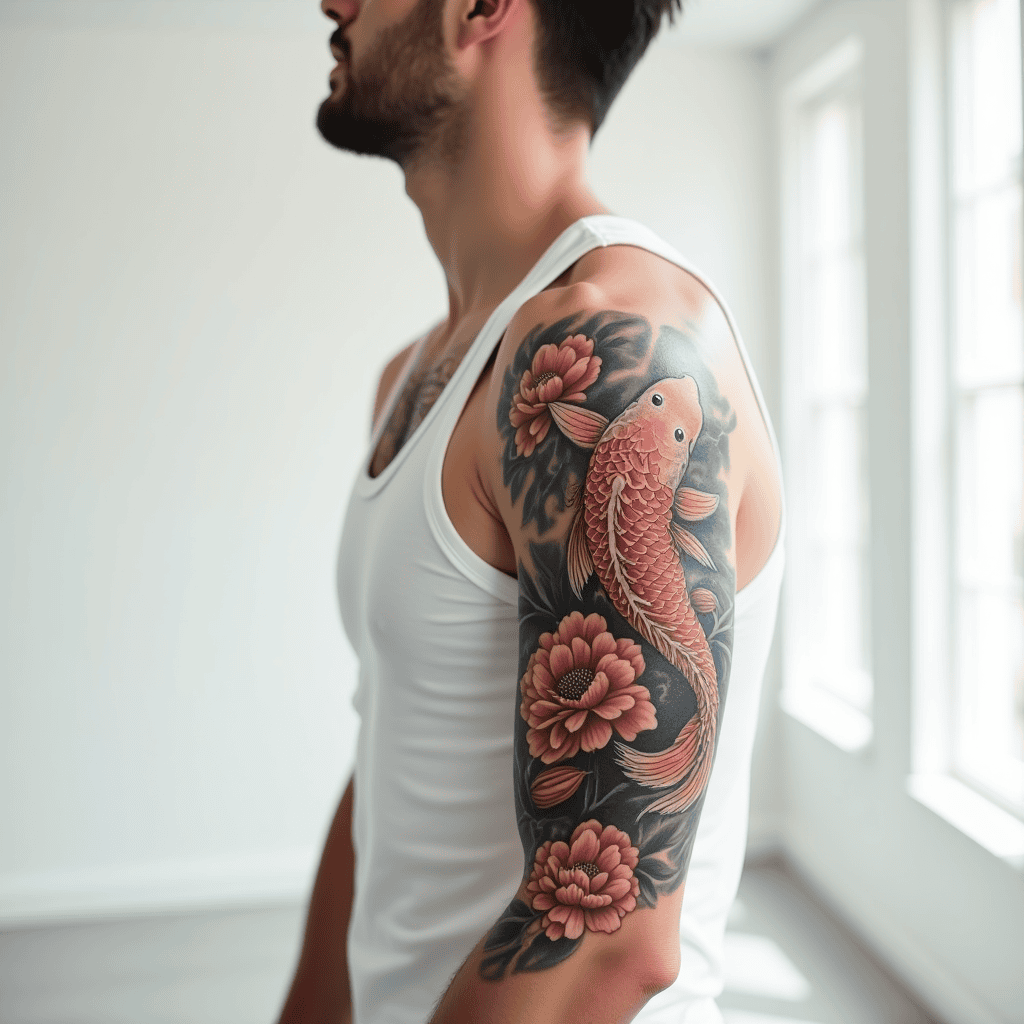
A koi and peony half sleeve balances one moving animal with one heavy floral shape. The koi can angle upward around the upper arm while a large peony sits closer to the shoulder or inner arm, using water to connect both subjects. The contrast between scales and petals gives the design plenty of texture without needing many separate motifs.
This is a practical choice for someone who wants a substantial Japanese tattoo but doesn’t want ink running to the wrist. Tell the artist you want “one koi, one or two large peonies, and water used to tie everything together.” Half sleeves can end awkwardly if the lower edge looks like a straight cutoff, so discuss how the composition will taper toward the elbow.
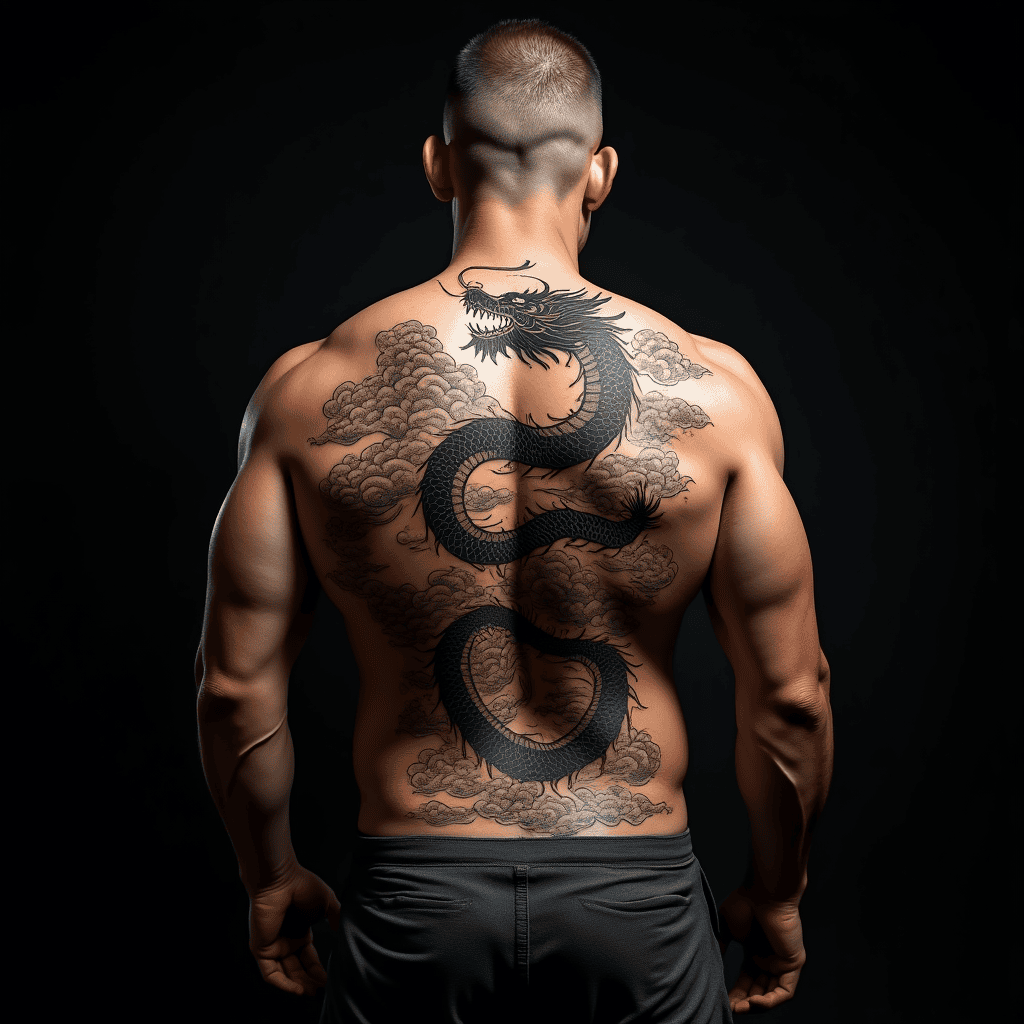
23. Japanese Full Back Dragon Tattoo
The back gives a Japanese dragon enough room to look truly expansive. The head can occupy the upper back while the body twists diagonally across the spine and toward the lower torso, surrounded by clouds or controlled wave patterns. Large scale also lets the artist separate individual claws, scales, and facial features without cramming them together.
If you want a statement piece, few Japanese tattoo ideas compete with a full-back dragon. Ask for “a dragon designed around the shoulder blades and spine, with the face readable first and background kept secondary.” The commitment is substantial, so the entire composition should be drawn with the final borders and future extension in mind before major sections begin.
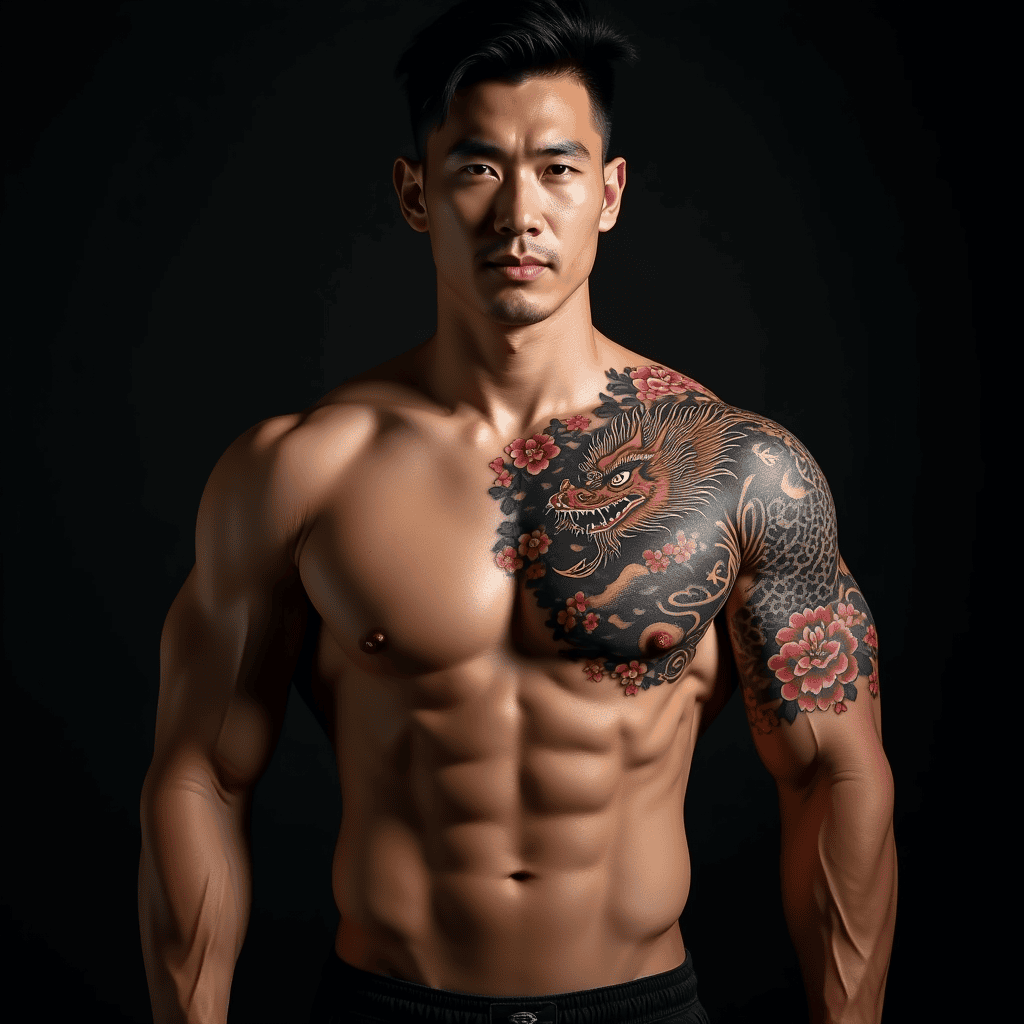
24. Japanese Chest Panel Tattoo
A Japanese chest panel works with the natural sweep from the upper chest toward the shoulder and arm. A dragon head, tiger, Hannya mask, koi, or large peony can occupy the chest while waves, clouds, or wind carry the composition toward an existing or planned sleeve. The shape should follow the pectoral rather than appearing like a rectangular picture pasted onto it.
This placement is ideal for men planning interconnected Japanese tattoo ideas across the upper body. Ask for “a chest panel that flows into the shoulder and leaves a deliberate edge toward the center of the chest.” Symmetry isn’t required, and forcing both sides of the chest to match can make an organic Japanese composition feel unnecessarily rigid.
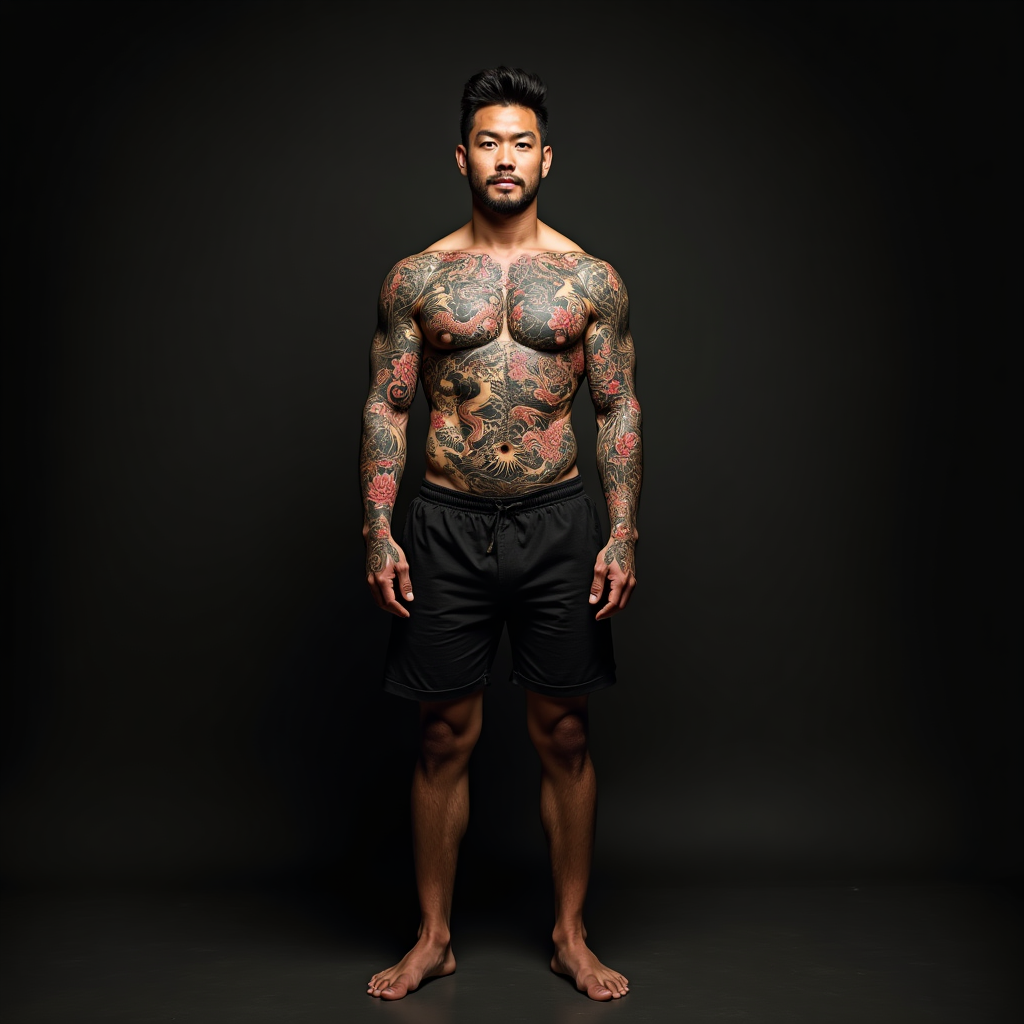
25. Japanese Bodysuit-Inspired Composition
A bodysuit-inspired Japanese tattoo concept treats multiple body areas as one connected artwork. Chest panels, sleeves, back sections, thighs, and background elements can follow a unified visual language while intentional areas of bare skin provide borders and separation. The result feels planned from the beginning rather than assembled one tattoo at a time.
This is the most demanding option among these Japanese tattoo ideas and makes sense for someone committed to a long-term project. Ask your artist for “a complete body map showing the major subjects, background direction, and intentional open areas before individual sections are started.” The drawback is obvious: changing your mind halfway through becomes harder once every piece depends on the larger composition.
How to Choose the Right Japanese Tattoo Idea
Start with placement rather than choosing an image in isolation. Long subjects such as dragons and snakes suit limbs, ribs, and large back compositions because their bodies can travel naturally. Rounder subjects such as masks, peonies, chrysanthemums, and animal heads often sit more comfortably on shoulders, thighs, chest panels, and broad areas of the upper arm.
Think about how much visual intensity you want. Tigers, oni masks, Hannya masks, and dark warrior designs attract attention immediately. Koi, cranes, flowers, leaves, and water can create a softer rhythm while still retaining the bold composition associated with many Japanese tattoo ideas.
Bring references to your appointment, but don’t ask an artist to reproduce another person’s tattoo line for line. Instead, point out what you actually like: the dragon’s body direction, the amount of black background, the size of the flowers, the palette, or the spacing between major elements.
Artist choice matters more than collecting twenty reference images. Look for healed work, full sleeves, back pieces, consistent backgrounds, readable faces, and evidence that the artist understands how Japanese-inspired compositions travel around the body. Ask how they would redesign the concept specifically for your proportions and placement.
Where Japanese Tattoo Designs Can Go Wrong
The most common problem is trying to fit too much meaning into one tattoo. A dragon, koi, mask, sword, lotus, temple, waves, clouds, kanji, blossoms, and flames may all look appealing separately, but combining everything can leave the final piece with no dominant subject.
Random symbolism creates another issue. Japanese imagery is often flattened into one-line explanations online, yet the meaning and context of a motif can depend on the surrounding imagery, artistic tradition, and how it is being presented. If cultural meaning matters to you, discuss it with an artist who studies the tradition rather than relying on social-media captions.
Tiny scale is another compromise worth resisting. Many Japanese tattoo ideas depend on large facial features, layered petals, scales, water movement, or dark backgrounds. Giving those elements room usually produces a stronger design than compressing a sleeve concept into a few inches of skin.
And don’t underestimate the background. Waves, clouds, wind, leaves, and open skin aren’t leftovers. In a well-planned Japanese composition, they determine how your eye moves through the tattoo.
Frequently Asked Questions
What are the most popular Japanese tattoo ideas for men?
Dragons, koi fish, tigers, snakes, Hannya masks, oni masks, phoenixes, peonies, chrysanthemums, waves, and cherry blossoms are enduring choices. Large-scale combinations are also common because Japanese-style compositions work particularly well across sleeves, chest panels, thighs, and backs.
What is the best Japanese tattoo for a first tattoo?
A medium-sized koi, peony, chrysanthemum, wave composition, or mask can be easier to plan than a complete sleeve. Choose enough space for the details to remain readable and discuss future expansion before placing the piece where it could interfere with a larger composition.
What does a Japanese dragon tattoo represent?
Dragon symbolism can vary by artistic and cultural context, so one universal meaning shouldn’t be assumed. Many people associate the imagery with strength, authority, wisdom, or natural forces, but the more useful design question is how the dragon’s movement and surrounding imagery work together.
Are Japanese tattoo ideas suitable for full sleeves?
Yes. Dragons, koi, snakes, tigers, flowers, waves, clouds, and wind can be arranged into a continuous shoulder-to-wrist composition. Planning the sleeve as one piece before tattooing individual sections usually gives the artist more control over scale, background movement, and transitions around the elbow.
Can Japanese tattoos be done in black and gray?
They can. Black-and-gray Japanese-inspired work can emphasize shape, contrast, shading, and negative space without relying on a broad color palette. Snakes, tigers, masks, skulls, chrysanthemums, dragons, and wave designs can all work particularly well when the tonal structure remains bold.
Which Japanese tattoo ideas work best on the forearm?
Koi, snakes, kitsune masks, waves, peonies, chrysanthemums, dragons, and maple leaves adapt well to the forearm. Longer subjects can follow the length of the arm, while masks and flowers usually need to be sized generously enough to remain clear when viewed from several feet away.
What Japanese tattoos work best on the chest?
Dragon heads, tigers, Hannya masks, oni masks, peonies, koi, and connected chest-panel compositions all suit the broader shape of the chest. Designs often look more natural when they follow the pectoral and continue toward the shoulder instead of sitting squarely in the center.
What is a good Japanese tattoo idea for the back?
Dragons, phoenixes, tigers, samurai scenes, large koi compositions, and multi-subject designs make good use of the back’s scale. The extra space allows a tattooer to separate major subjects from background elements while maintaining clear facial features, claws, feathers, scales, and movement.
Do Japanese tattoo ideas always need a lot of color?
No. Color is only one approach. Strong black-and-gray work can create plenty of depth through solid black areas, smooth shading, negative space, and bold outlines. What matters more is whether the major subject remains readable and whether the background supports it rather than overwhelming it.
How do I explain a Japanese tattoo idea to an artist?
Describe the main subject, preferred placement, approximate coverage, color preference, and overall mood. Then explain specific visual details you like from your references. A useful request sounds like, “I want one large koi moving up the arm with broad water and two oversized peonies.”
Should Japanese tattoo symbols be researched before getting tattooed?
Yes. Avoid assuming a symbol has one simple meaning because a social post or image caption says so. Research the motif, ask your artist about its context, and be especially thoughtful with religious figures, written characters, historical imagery, masks, and culturally specific combinations.
Can I combine several Japanese tattoo ideas in one design?
You can, but hierarchy matters. Choose one or two dominant subjects and let flowers, leaves, waves, clouds, or wind support them. If every element is given equal size and contrast, the tattoo can become difficult to read and may feel more like a collage than one composition.
How large should a detailed Japanese tattoo be?
Large enough for the key shapes to remain clear after the artist adds outlines, shading, background, and secondary details. Dragons, tigers, masks, samurai, and phoenixes generally benefit from more room than small symbolic tattoos because faces, scales, armor, and feathers quickly become crowded.
Are Japanese tattoo ideas good for leg sleeves?
Yes. Thighs and calves provide broad surfaces for koi, dragons, snakes, tigers, masks, chrysanthemums, and water backgrounds. A planned leg sleeve can use the knee as part of the composition instead of treating it as an awkward gap between disconnected upper- and lower-leg tattoos.
How should I choose an artist for a Japanese-style tattoo?
Study portfolios rather than relying on a studio’s general reputation. Look for large finished compositions, healed tattoos, convincing backgrounds, consistent linework, readable faces, and body flow. Then ask the artist how they would adjust your reference concept to fit your particular placement and proportions.
A strong Japanese tattoo starts with one clear subject and enough space for the composition to breathe. Don’t rush into collecting disconnected motifs simply because each one looks impressive on its own. Choose the body area you want to develop, decide which image deserves to lead the design, and bring that direction to an artist whose portfolio shows convincing Japanese-style work. Your next step is simple: book a consultation and ask the artist to sketch how the entire composition should flow before committing to the first stencil.
Best Tattoo Design Reports
Explore sleeve, minimalist, Japanese, blackwork and modern tattoo ideas created for men’s style inspiration.