
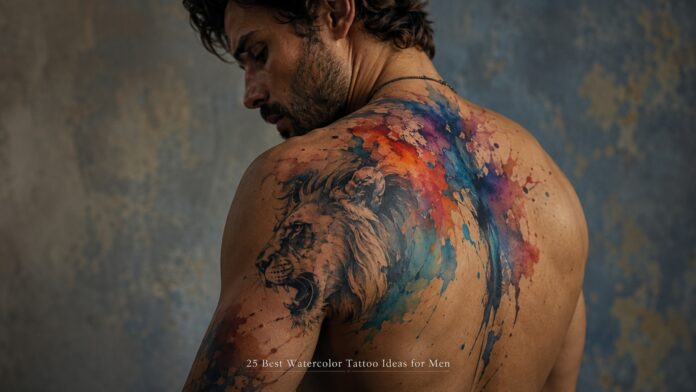
The strongest Watercolor Tattoo Ideas combine loose color, intentional linework, and enough negative space to keep the design readable on skin. A watercolor wolf, abstract mountain scene, koi fish, and brushstroke compass are especially strong starting points because each balances masculine structure with painterly color rather than looking like a conventional tattoo filled with random splashes.
I’ve approached these designs the way an experienced tattoo artist would plan them: placement first, readable structure second, color last. Watercolor work can look effortless, but the designs that age best usually have a clear visual anchor underneath the softer pigment.
| Quick Pick | Best Placement | Visual Character | Color Direction |
|---|---|---|---|
| Watercolor Wolf | Upper arm | Strong and expressive | Blue, black, rust |
| Mountain Landscape | Forearm | Outdoorsy and calm | Blue, green, violet |
| Koi Fish | Calf | Flowing and detailed | Red, orange, blue |
| Brushstroke Compass | Forearm | Graphic and adventurous | Black, blue, teal |
| Abstract Lion | Shoulder | Bold and artistic | Gold, red, black |
| Watercolor Phoenix | Upper arm | Dramatic and energetic | Red, orange, yellow |
| Tree Silhouette | Inner forearm | Quiet and natural | Green, blue, brown |
| Geometric Splash | Upper arm | Modern and clean | Blue, purple, cyan |
| Raven in Ink Wash | Shoulder blade | Dark and atmospheric | Black, indigo, violet |
| Watercolor Wave | Calf | Fluid and minimal | Navy, cyan, turquoise |
Classic Watercolor Tattoo Ideas With Strong Structure
These Watercolor Tattoo Ideas are good entry points if you like the painted effect but still want the tattoo to read clearly from several feet away. Each uses a recognizable subject as the foundation, then adds washes, splashes, or brush textures around it.
1. Watercolor Wolf Tattoo
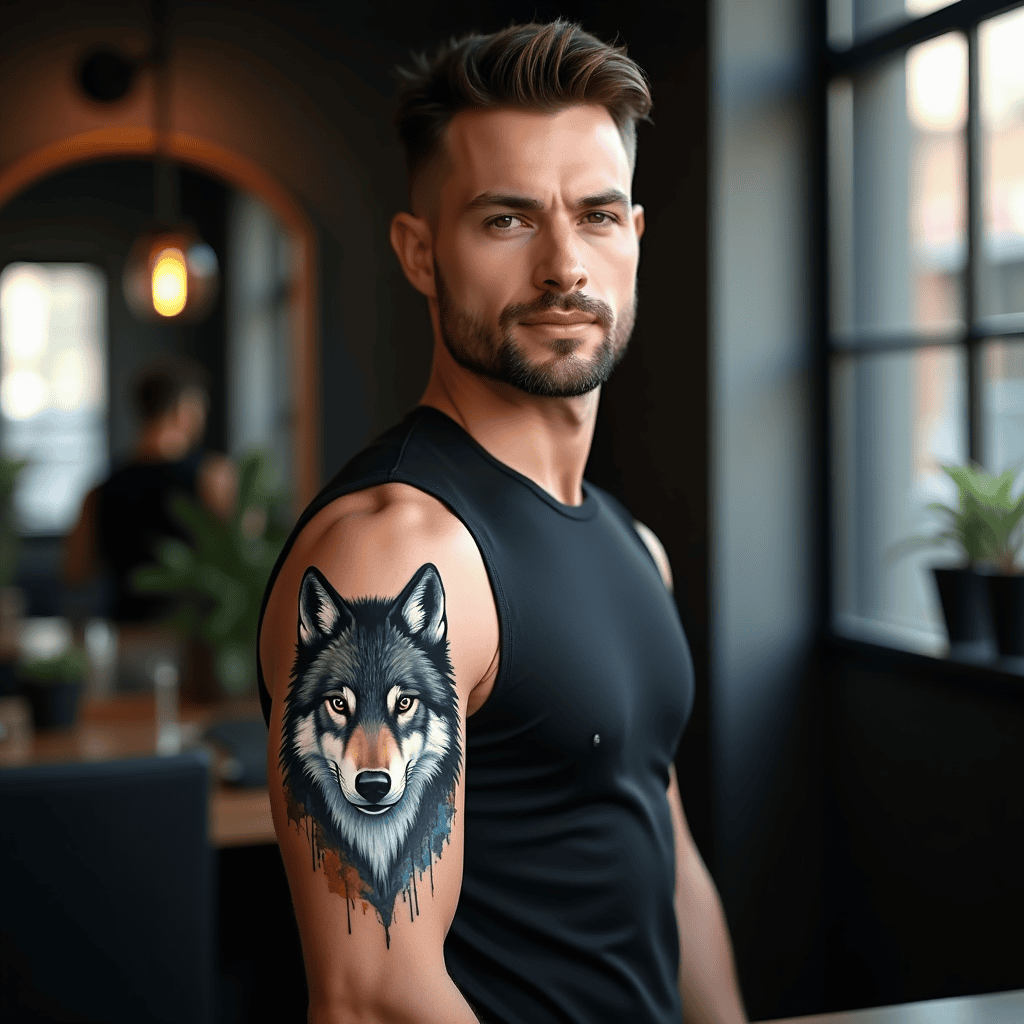
A watercolor wolf works best when the face stays sharply defined while the surrounding color breaks away from the outline. Fine black linework around the eyes, muzzle, and ears gives the design a solid center, while blue, gray, rust, or violet washes can drift through the fur. On the upper arm, the wolf can sit vertically with the head following the natural curve of the shoulder. The contrast between precise facial detail and loose pigment is what keeps the idea looking intentional.
This style suits men who want something recognizable without the weight of a fully shaded black-and-gray animal tattoo. Ask your artist for “a structured wolf portrait with restrained watercolor washes outside the fur, keeping the eyes and muzzle crisp.” Expect the strongest colors to need thoughtful long-term care because lighter watercolor tones can soften faster than heavy black. Skip oversized splatter effects if you prefer a cleaner tattoo that will still feel controlled years later.
2. Watercolor Mountain Landscape Tattoo
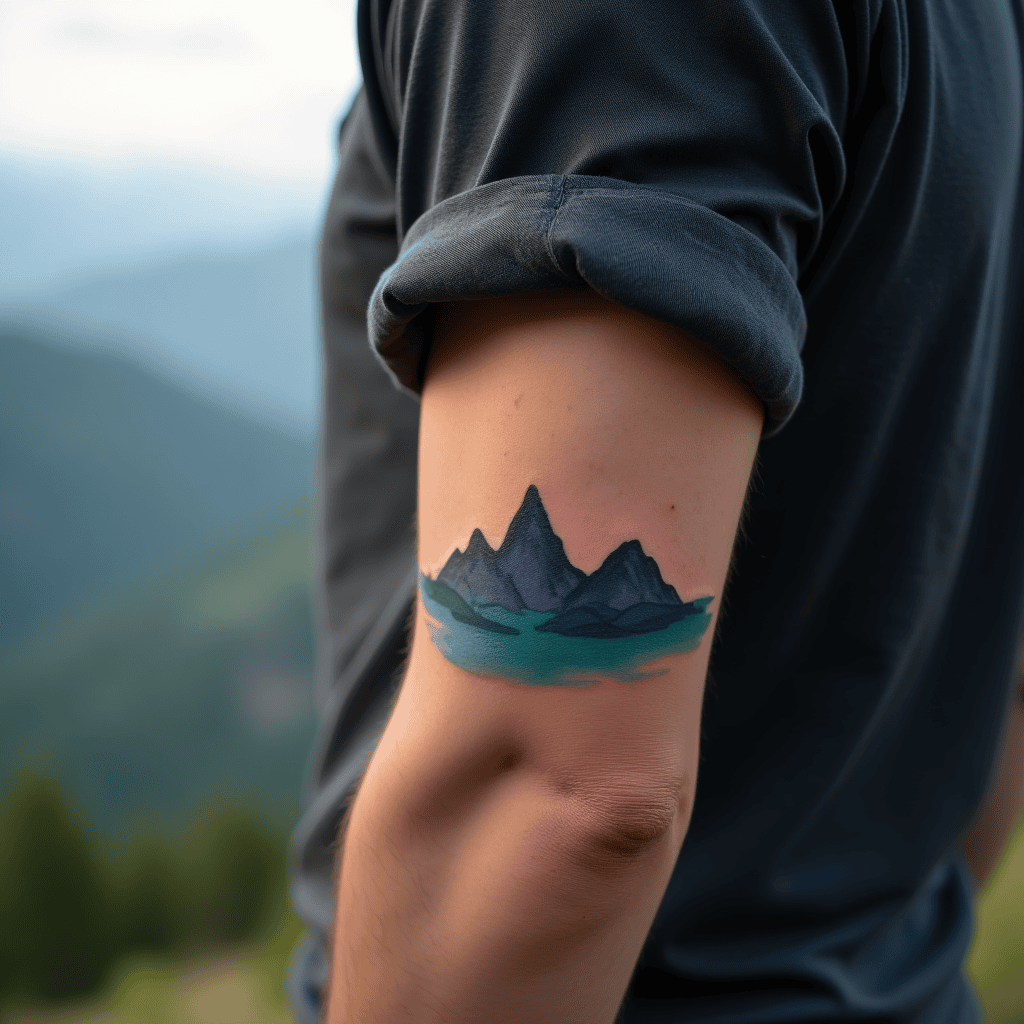
A mountain landscape gives watercolor pigment a natural place to fade, pool, and overlap. Dark peaks can rise through pale blue washes, while muted green and violet tones suggest forests, sky, and distance without filling every inch of skin. A horizontal forearm composition works particularly well because the mountain ridge can stretch naturally toward the wrist. Leaving open skin between the color patches makes the landscape feel larger than its actual dimensions.
Men who spend time outdoors often gravitate toward this one, but the design works equally well as a visual piece without attaching a complicated meaning to it. Ask for “clean mountain silhouettes with transparent watercolor layers and plenty of untouched skin around the horizon.” The drawback is scale: compressing several peaks, trees, clouds, and colors into a tiny area can turn the landscape muddy. Give the artist enough room to let the color breathe.
3. Watercolor Compass Tattoo
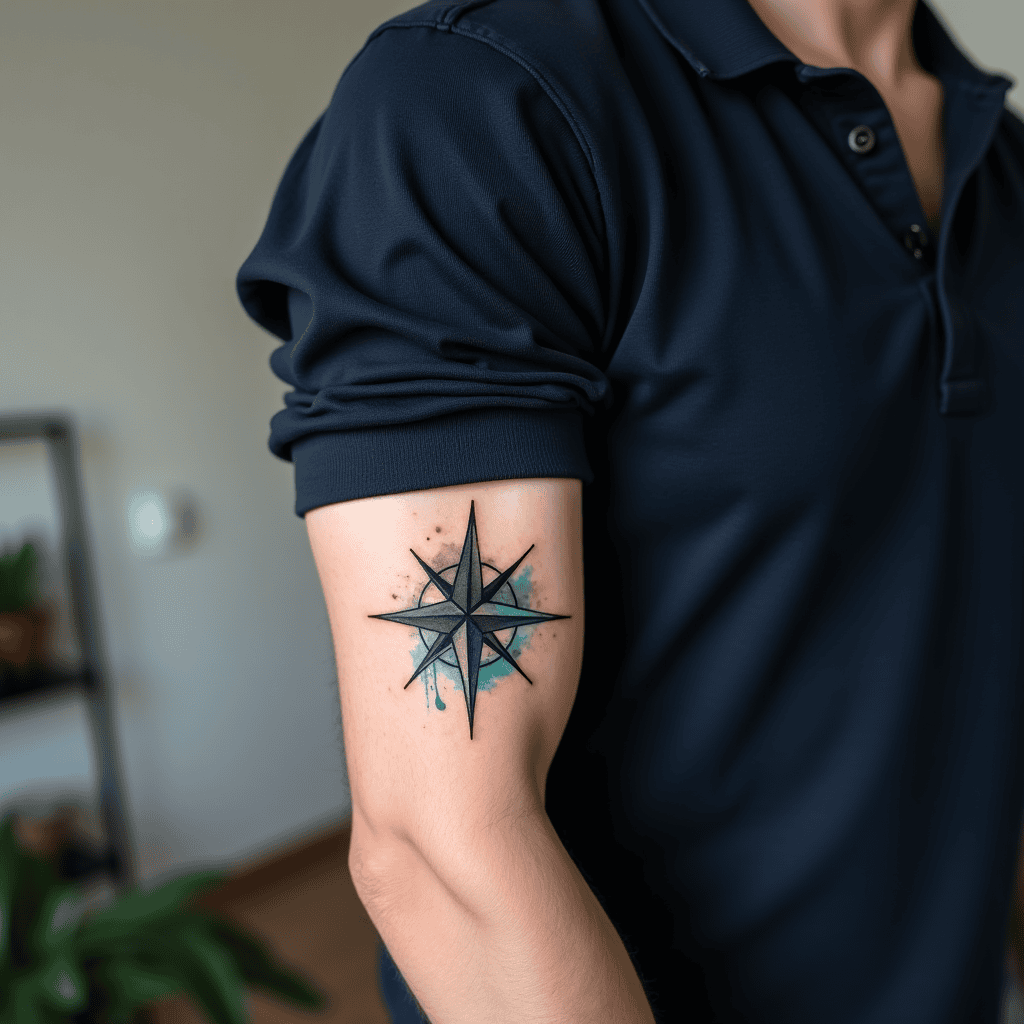
The compass is one of those Watercolor Tattoo Ideas that benefits from keeping the central geometry nearly traditional. A crisp compass rose in black can sit over a sweep of blue and teal brushwork, with small droplets extending toward the wrist or elbow. The straight directional points create tension against the irregular painted background. That mix makes the tattoo feel both technical and handmade.
It works especially well on a medium or longer forearm where the north-south axis has room to stretch. Tell your artist you want “a precise black compass with watercolor placed behind it rather than covering the directional details.” Fine compass markings can become busy if the piece is made too small, so resist turning it into a miniature. If you like rigid symmetry from edge to edge, the unpredictable edges of watercolor may not be your style.
4. Watercolor Tree Silhouette Tattoo
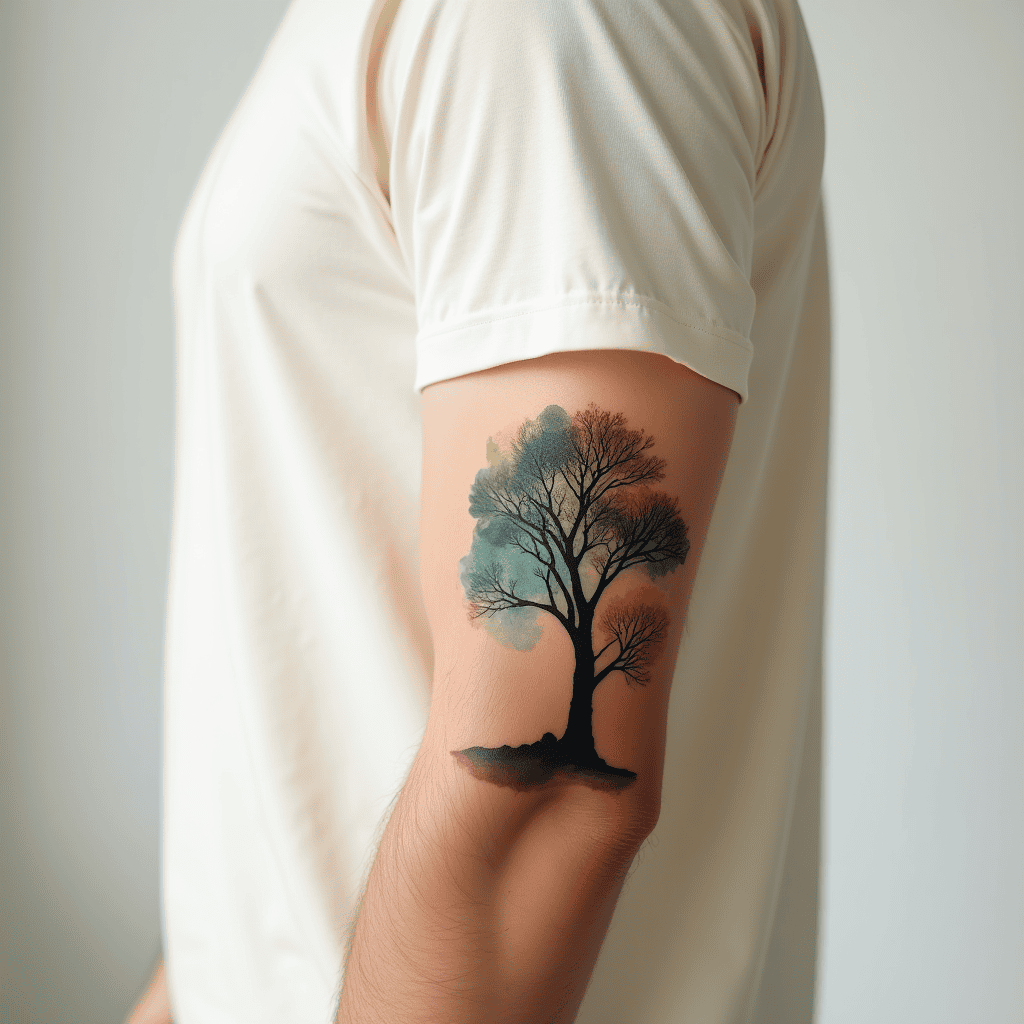
A dark tree silhouette can act like a visual frame for soft watercolor pigment. The trunk and main branches stay nearly black, while transparent green, blue, amber, or burgundy washes float through the canopy instead of forming individual leaves. The outer forearm and upper arm both give enough vertical space for the trunk to look convincing. A few unfinished branches can disappear directly into the color.
This is a good choice for someone who wants nature imagery without a full landscape scene. Ask for “a black tree silhouette with loose transparent color concentrated around the canopy and no hard watercolor border.” The branches need enough thickness to survive visually as the tattoo settles, so hairline twigs everywhere are rarely a smart trade. Too many colors can also make the canopy read more like confetti than paint.
5. Watercolor Arrow Tattoo
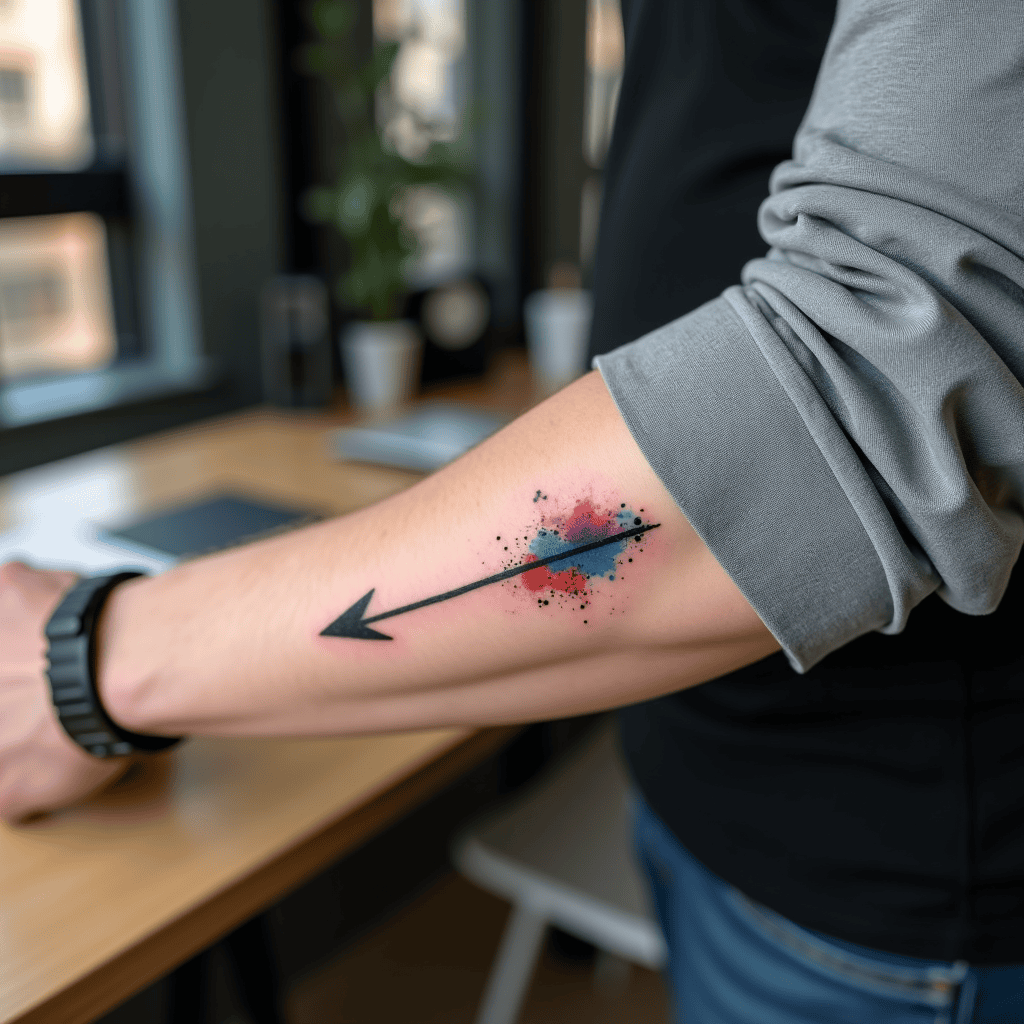
A watercolor arrow keeps the basic form minimal while giving the background enough movement to stop it feeling generic. A thin black shaft can cut through a diagonal streak of blue, red, or ochre pigment, with small broken edges extending beyond the arrowhead and feathers. The inner forearm gives the linear design a natural direction. Keeping the color slightly offset from the arrow creates more energy than filling the arrow itself.
This works for men who want a smaller piece but still want visible color. Ask the artist for “a clean single arrow with one directional watercolor brushstroke crossing behind it and restrained splash texture.” Its weakness is simplicity: if the brushwork lacks movement, the result can look like a standard arrow tattoo placed on top of a random stain. Strong composition matters more here than extra detail.
Nature and Animal Watercolor Tattoo Ideas
Animals, birds, plants, and water naturally suit the irregular edges of painted pigment. These Watercolor Tattoo Ideas can carry more movement than the first group, so they work well when you want the color itself to become part of the subject.
6. Watercolor Koi Fish Tattoo
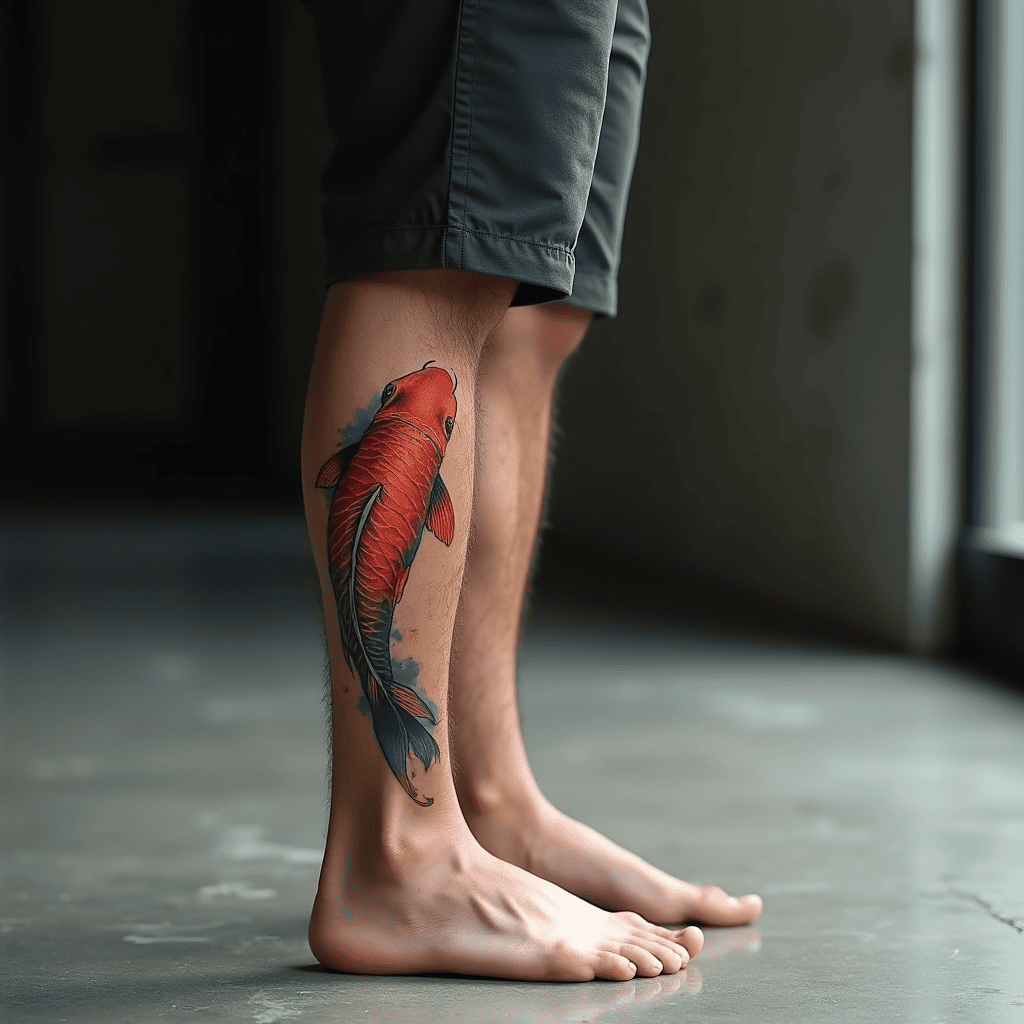
A koi gives the artist permission to make the color move with the body rather than sit behind it. The fish can curve upward along the calf with crisp scales around the head and gradually looser red, orange, blue, or indigo pigment toward the tail. A few water-like sweeps around the body reinforce the swimming motion without needing literal waves. The result should feel fluid before you even notice the watercolor texture.
The calf is one of my favorite placements for this because its longer vertical plane suits the fish’s curved movement. Ask for “a koi with defined head and scale detail, then increasingly loose watercolor toward the fins and surrounding water.” Dense scale patterns require room, so a very small koi usually loses the quality that makes this version interesting. Heavy splashes around every fin can also bury the silhouette.
7. Watercolor Eagle Tattoo
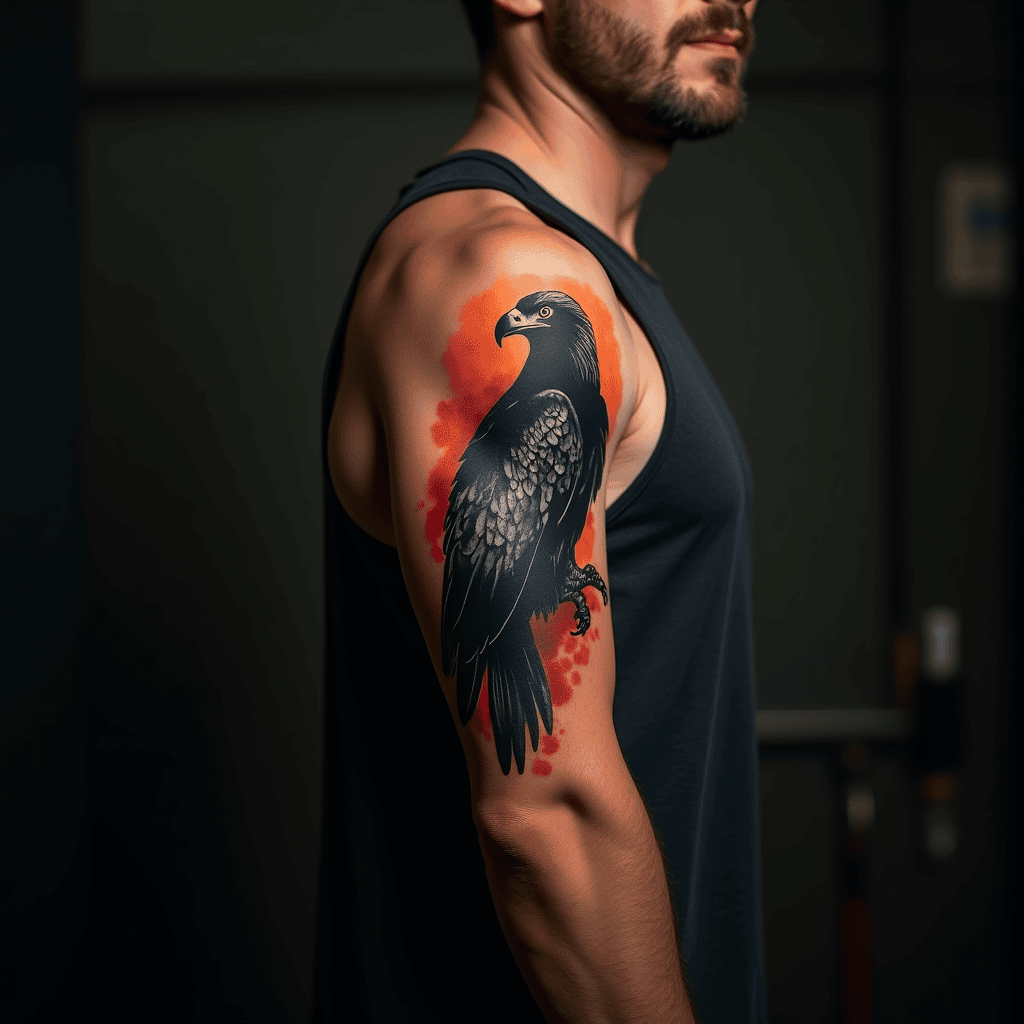
An eagle can look surprisingly modern when the wings remain structurally dark but parts of the feathers dissolve into pigment. Deep navy, gray, burnt orange, and muted crimson work better here than a rainbow palette because the subject already carries plenty of visual weight. Across the upper arm, one wing can angle toward the shoulder while the other drops slightly toward the biceps. Broken color around the wing tips creates movement without making the bird look unfinished.
This is better for someone comfortable with a medium-to-large tattoo than for anyone chasing a tiny symbol. Ask for “a flying eagle with clear head and wing anatomy, using watercolor only around the outer feathers and background.” The biggest risk is detail overload; feathers, splashes, drips, and multiple colors can start competing. A strong tattoo artist will know when to leave skin untouched.
8. Watercolor Fox Tattoo
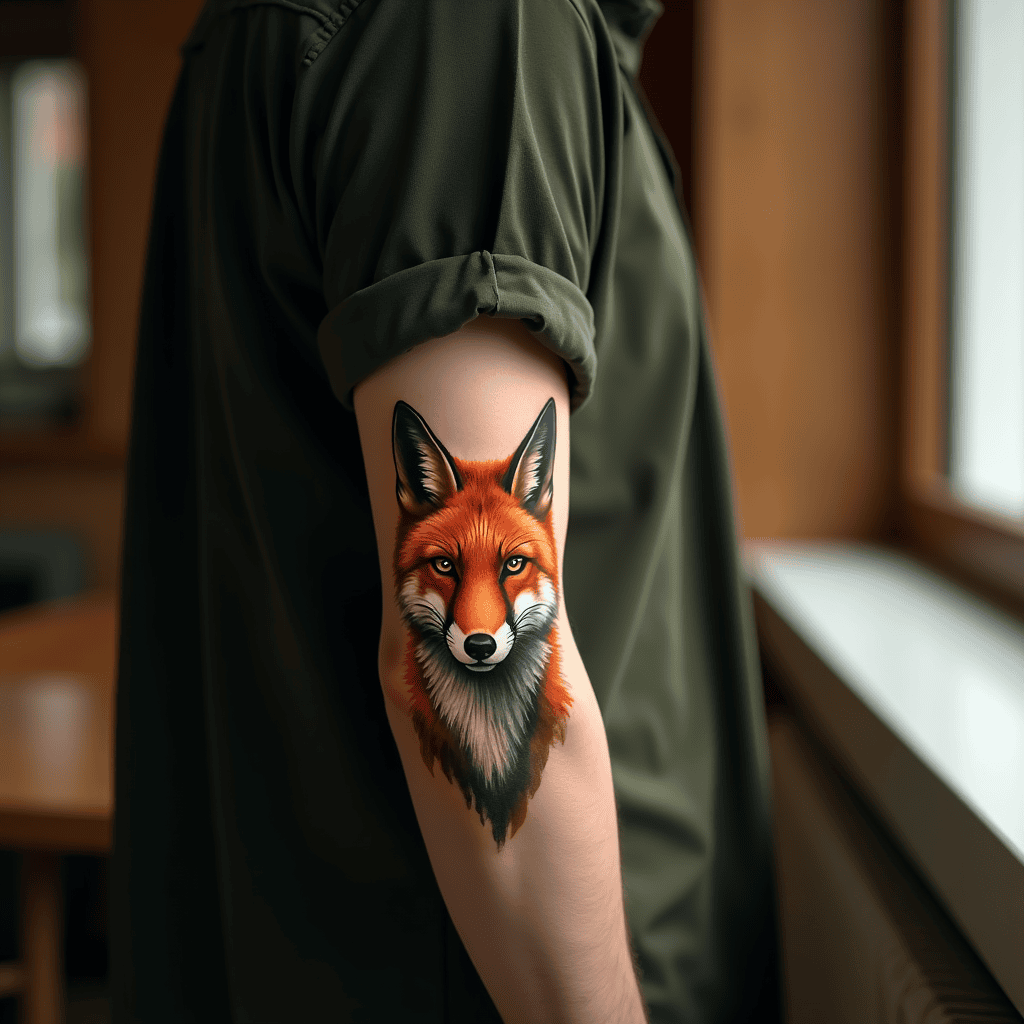
The fox lends itself to a narrower palette, which is often a good thing in watercolor tattooing. Burnt orange can bleed gently beyond the face while black lines define the ears, nose, and eyes, with a small amount of deep blue giving the warm color more contrast. The outer forearm is enough space for a stylized head without forcing every strand of fur into the design. Angular cheek shapes keep the animal from becoming too soft or illustrative.
This suits men who want animal imagery that feels artistic rather than aggressive. Ask for “an angular fox portrait with clear black facial anchors, burnt orange watercolor bleeding outside the fur, and one cool accent color.” Orange pigment can dominate quickly, so restraint around the face is important. If you want photographic animal realism, a watercolor interpretation probably isn’t the best direction.
9. Watercolor Raven Tattoo
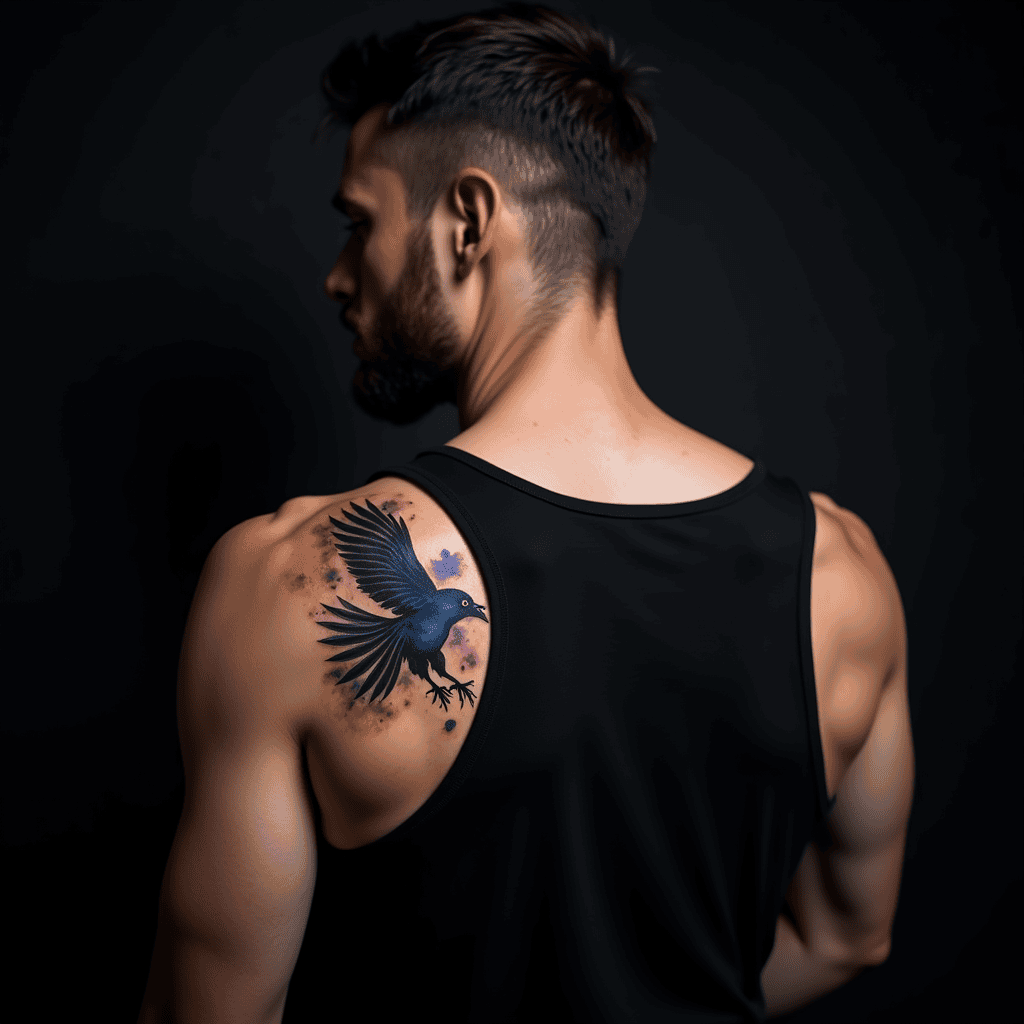
A raven gives watercolor a darker, moodier vocabulary. Instead of bright splashes, the bird can be built from black and charcoal ink with transparent indigo, midnight blue, and violet bleeding around the wings. On the shoulder blade or upper arm, the silhouette can stretch diagonally as if the bird has just lifted into flight. Feather edges can alternate between sharp strokes and smoky pigment.
Men drawn to darker tattoos but bored by solid black silhouettes may like this approach. Ask for “a structured raven in flight with black feather anchors and smoky indigo watercolor fading away from the wing edges.” The danger is making every dark area equally heavy, which removes the transparency watercolor needs. You need a tattooer comfortable using negative space rather than filling every gap.
10. Watercolor Wave Tattoo
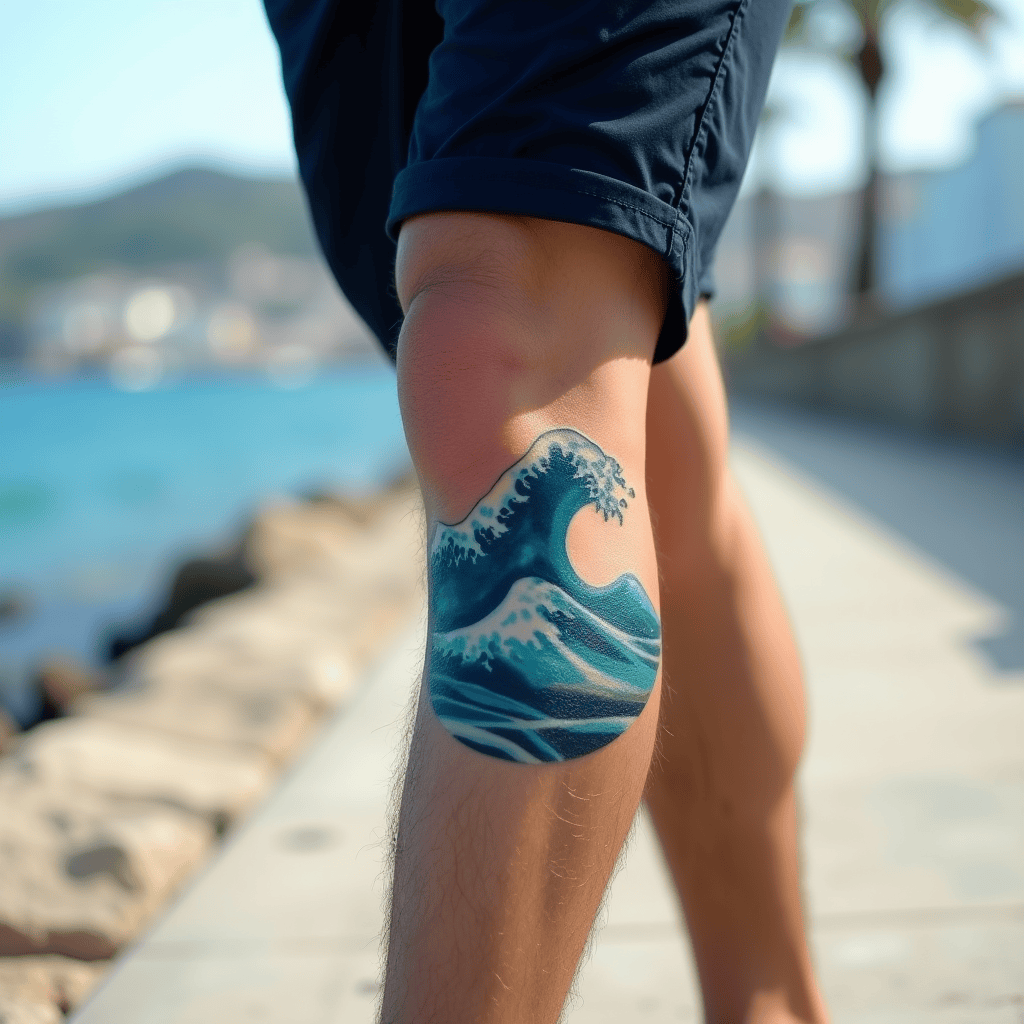
A watercolor wave can sit somewhere between Japanese-inspired motion and contemporary abstract painting without copying a traditional composition. Deep blue curves establish the wave, while turquoise and pale cyan washes break into softer spray around the crest. A vertical calf or outer forearm placement allows the water to curl upward naturally. Small areas of untouched skin within the wave create the brightest highlights.
Ask for “a sweeping blue wave with one clear dark curve, lighter transparent pigment around the crest, and open skin forming the foam.” Men who prefer cooler palettes and flowing movement tend to wear this style well. The weakness is that vague blue splashes can lose the identity of the wave, especially at small scale. Keep at least one strong contour running through the piece.
11. Watercolor Deer Tattoo
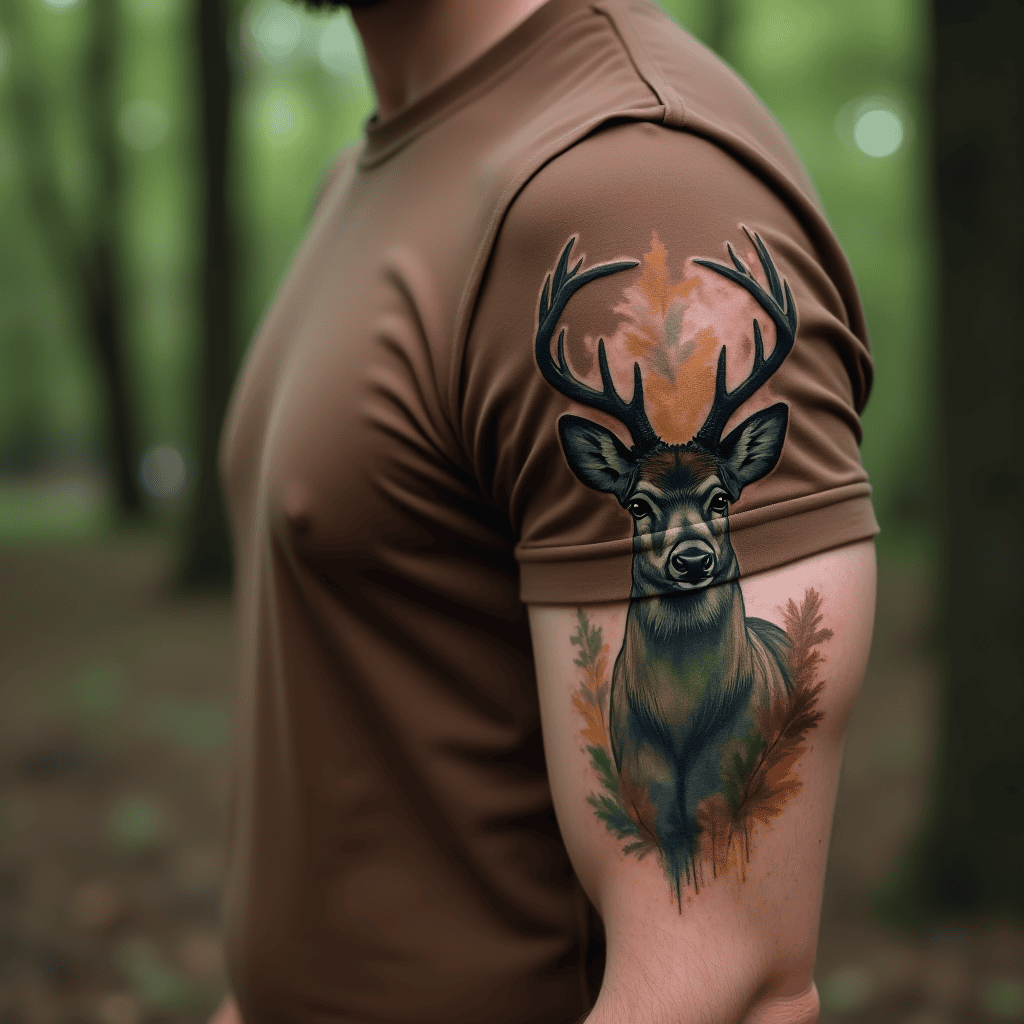
A deer portrait can be surprisingly graphic when the antlers provide the rigid structure and the watercolor stays concentrated around the head. Black or charcoal lines can define the face while forest green, earthy brown, blue, and a little rust drift through the neck and antlers. The upper arm gives the antlers room to spread without turning them into thin needles. A front-facing composition feels calm rather than aggressive.
This version suits someone who likes woodland imagery but wants something more controlled than a full forest scene. Tell your artist, “Keep the deer’s face and antlers readable, then soften the neck and background with transparent watercolor.” Antlers become fragile visually when they are drawn too fine or packed into a tiny space. Let the piece have enough size for the negative space between the points to survive.
Artistic and Abstract Watercolor Tattoo Ideas
This is where Watercolor Tattoo Ideas can move furthest away from traditional tattoo compositions. The key is still structure. Even the most expressive splash or brushstroke needs a focal point, otherwise the tattoo can feel accidental instead of designed.
12. Abstract Lion Watercolor Tattoo
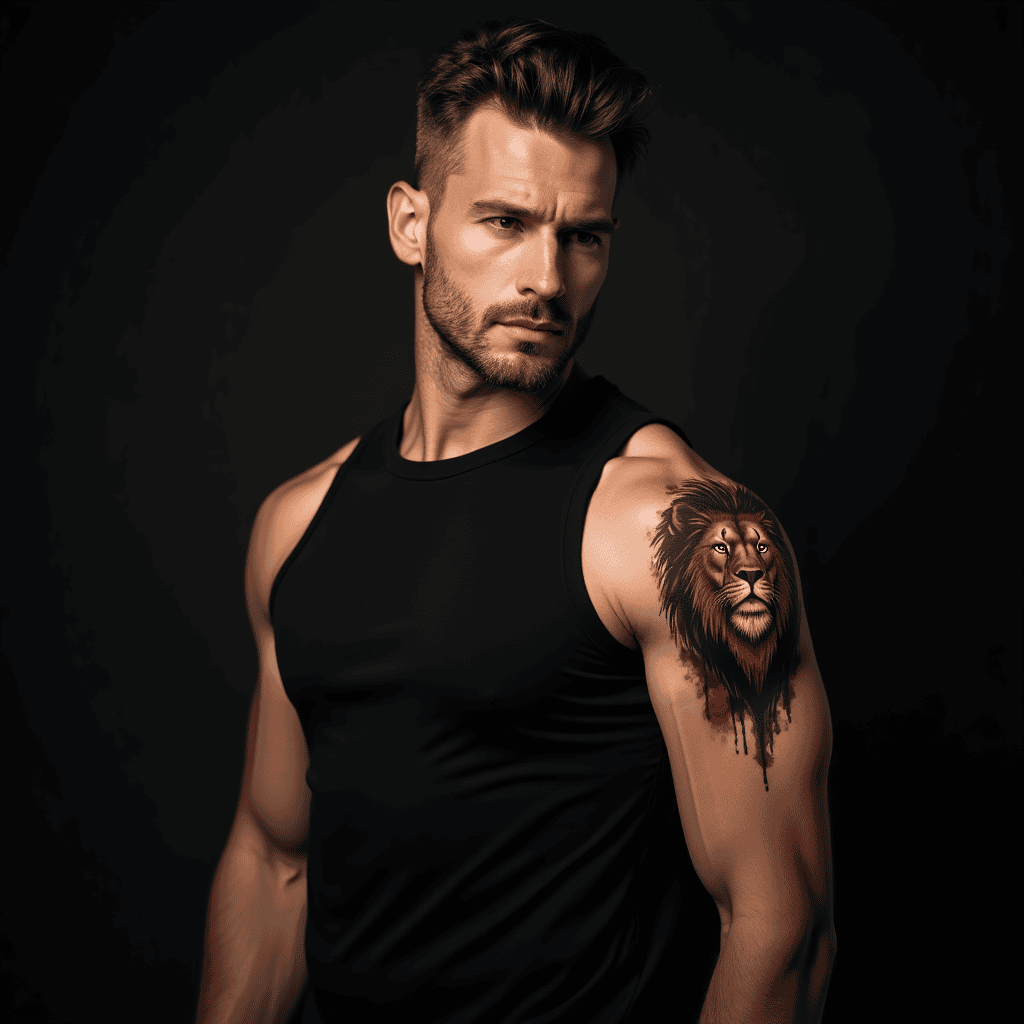
A lion portrait gets more interesting when only part of the mane is literal. The eyes, nose, and center of the face can stay defined while the outer mane breaks into angular red, gold, black, and violet pigment. On the shoulder, the circular spread of the mane naturally follows the deltoid. A few sharp brush edges keep the piece masculine without turning it into a dense block of shading.
Ask for “a lion face with crisp central features and an asymmetrical watercolor mane that dissolves toward the shoulder edges.” This works best for someone comfortable with a noticeable tattoo because the composition needs breathing room. Tiny lion faces rarely hold both facial expression and loose watercolor successfully. The challenge is knowing when the mane is finished; adding one more splash can easily become one too many.
13. Geometric Watercolor Splash Tattoo
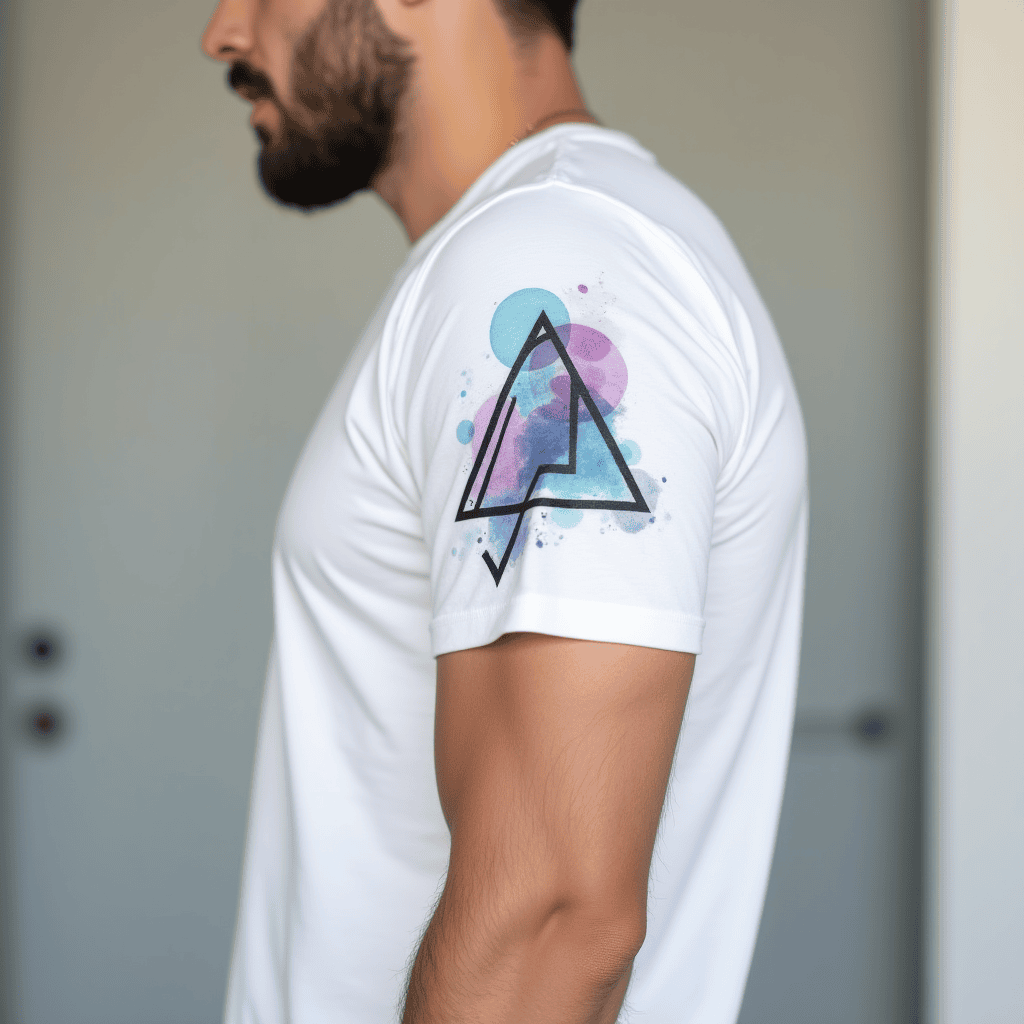
This design starts with clean geometry rather than a recognizable object. Interlocking triangles, circles, or fragmented polygons can sit in black linework while transparent cyan, blue, purple, and magenta pigments appear to spill beyond the boundaries. The upper arm works especially well because the geometry can wrap slightly instead of sitting flat. Keeping some shapes empty prevents the tattoo from becoming visually crowded.
Men who like modern art, architecture, or graphic design often respond to this style. Ask for “precise black geometric forms with watercolor intentionally misaligned behind them, leaving several shapes completely unfilled.” The downside is trend sensitivity; complicated polygon patterns can date faster than simple forms. I would rather use three strong shapes than fifteen tiny ones competing for attention.
14. Watercolor Brushstroke Band Tattoo
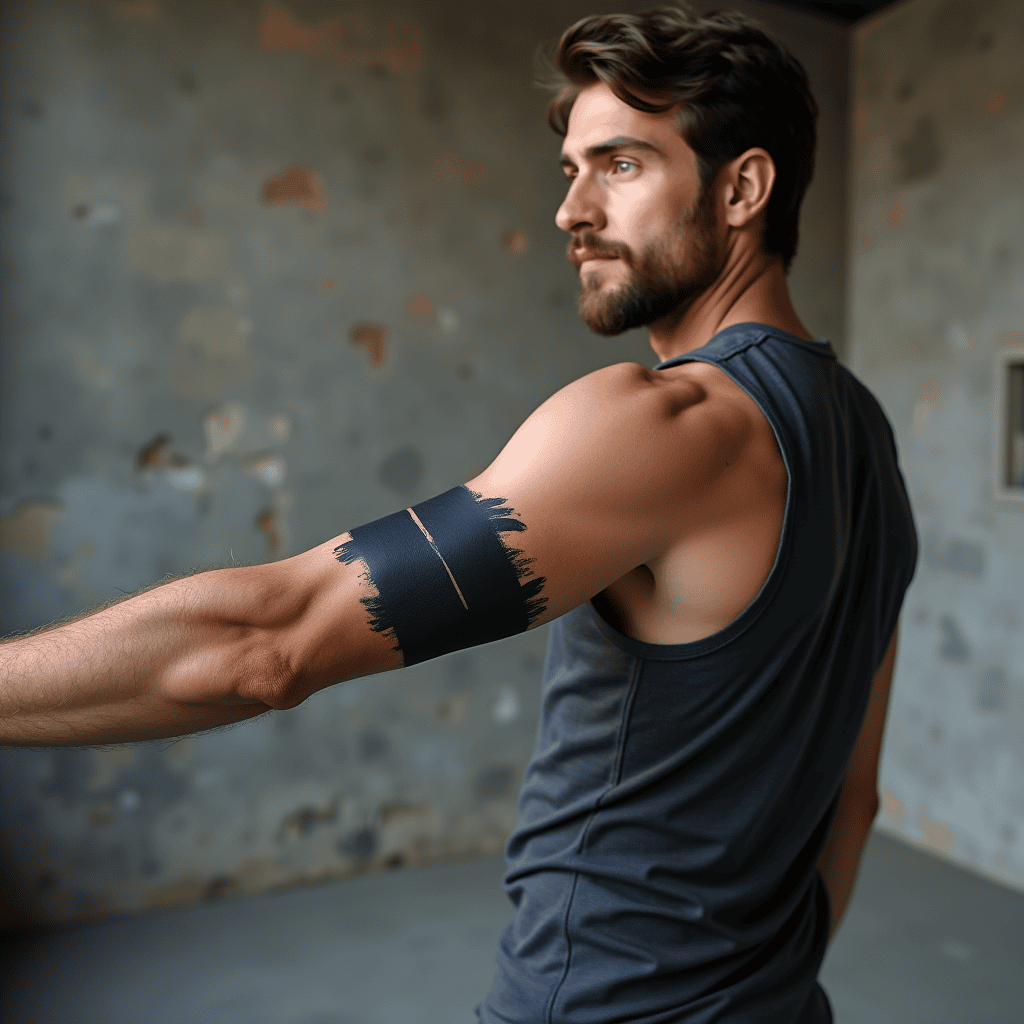
Instead of a conventional solid armband, this version wraps the upper forearm or biceps with an uneven painted stroke. Black can provide the main sweep while blue, rust, or deep red pigment feathers from the edges like a loaded brush dragging across textured paper. Small gaps in the band expose skin and stop it from looking like a fully filled ring. The ends should taper rather than meet perfectly.
Ask your artist for “a broad hand-painted brushstroke band with natural dry-brush gaps, uneven edges, and one restrained accent color.” This is one of the cleaner Watercolor Tattoo Ideas for men who like abstract work but don’t want a detailed subject. Placement has to be measured carefully because an accidental-looking tilt around the arm is hard to ignore. A perfectly straight band would defeat most of the reason for choosing the brushstroke style.
15. Watercolor Soundwave Tattoo
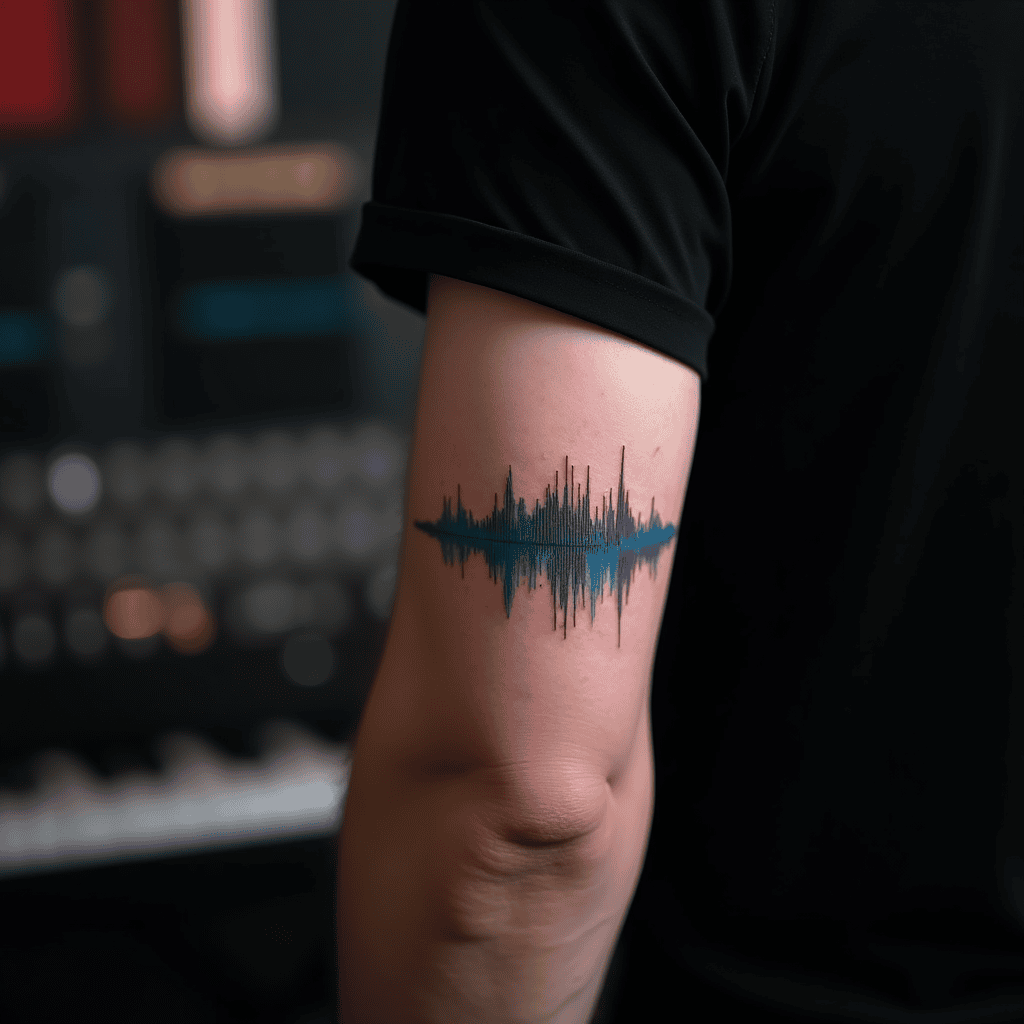
A soundwave gives the color a strong horizontal structure while still leaving room for irregular pigment. A black waveform can run across the inner forearm with blue, purple, or turquoise paint appearing to pulse behind selected peaks. The line itself should remain easy to read, especially if the waveform has personal meaning. A narrow strip of color usually looks stronger than a wide rectangular splash.
This works well for musicians, producers, or anyone who likes audio-inspired graphics, but the waveform should still look good even if nobody knows its backstory. Ask for “a clean black waveform with watercolor concentrated around the strongest peaks rather than filling the entire background.” If you are using an actual recorded phrase or sound, verify the waveform carefully before tattooing it. Once the line is on skin, correcting the pattern is not simple.
16. Watercolor City Skyline Tattoo
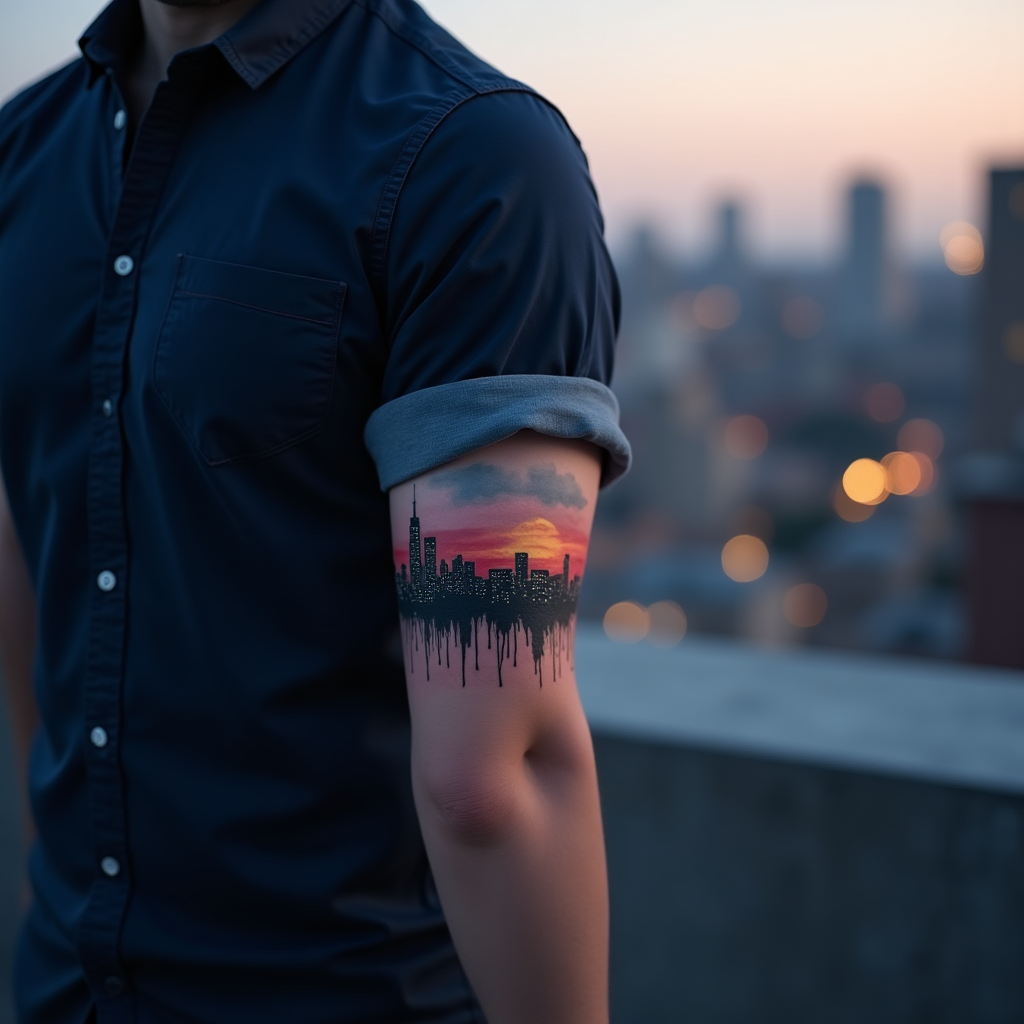
A skyline works best when the buildings stay thin and recognizable while the color represents atmosphere rather than architecture. Black vertical lines can form a simplified city silhouette, with blue, gold, crimson, and gray washes sitting behind it like reflected evening light. The inner forearm gives the horizon a long, clean runway. Slight pigment drips can reinforce the painted look without running through every building.
Ask for “a minimal black skyline with loose evening-color watercolor behind the structures, leaving the building interiors mostly open.” This suits men who want a travel or hometown reference without a detailed architectural tattoo. The drawback is specificity: packing too many famous buildings into one short strip can make the skyline look cramped. Pick a few shapes that actually matter and let the rest stay quiet.
17. Watercolor Clock Fragment Tattoo
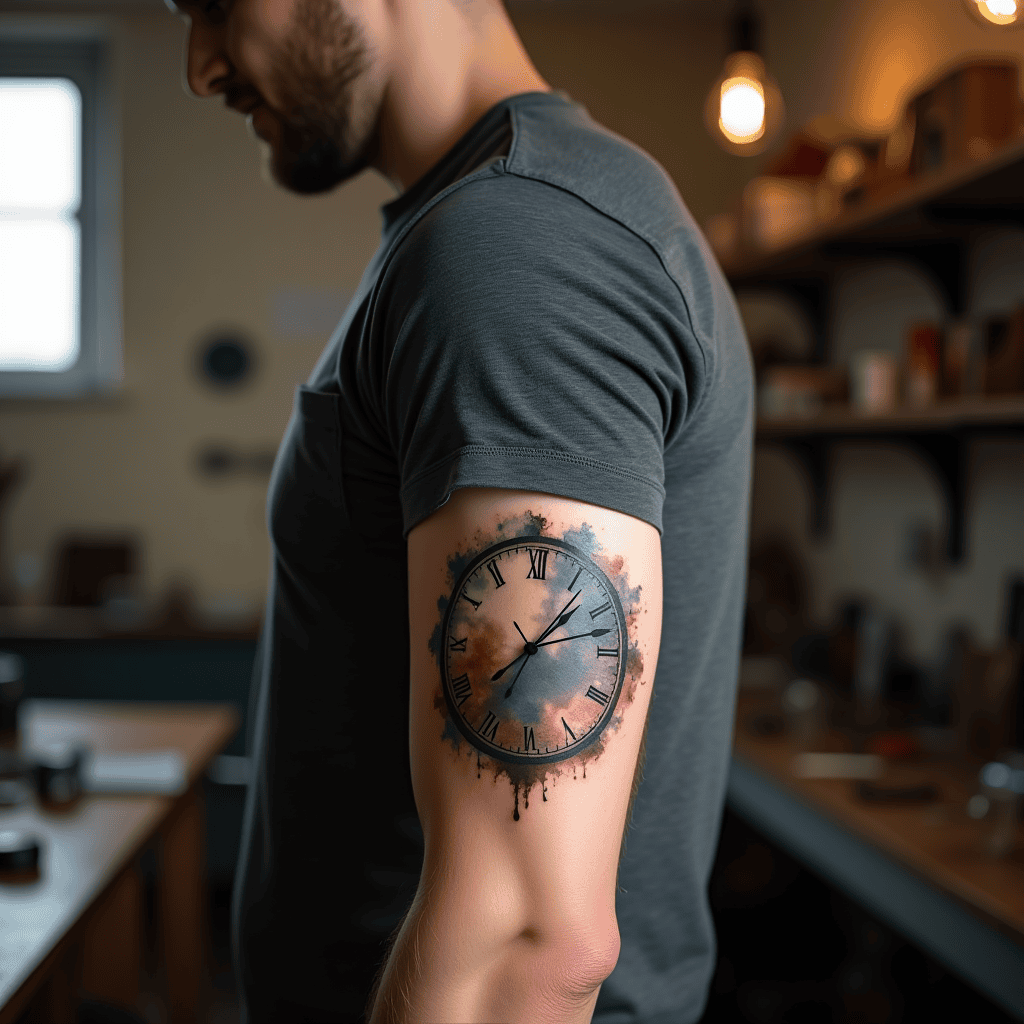
Rather than tattooing a complete clock face, this design can use a partial circle and a few bold hands or Roman numeral fragments. Black structure gives the piece a mechanical center, while faded blue, sepia, rust, or burgundy watercolor can break through the missing sections. The upper forearm gives enough room for circular geometry without needing a full sleeve. The unfinished edges make the piece more interesting than a literal watch face.
Ask for “a fragmented clock face with only selected numerals, visible hands, and watercolor bleeding through the missing outer sections.” Men who like symbolic designs but dislike overly literal imagery may prefer this treatment. The problem comes when too many gears, dates, numbers, splashes, and shadows get added around it. Decide what the focal point is before the stencil goes on.
Symbolic Watercolor Tattoo Ideas for Men
Symbolic tattoos can turn overly serious when every element is treated with equal weight. Watercolor gives these designs a way to keep the symbol clear while letting the surrounding color carry emotion, movement, or atmosphere.
18. Watercolor Phoenix Tattoo
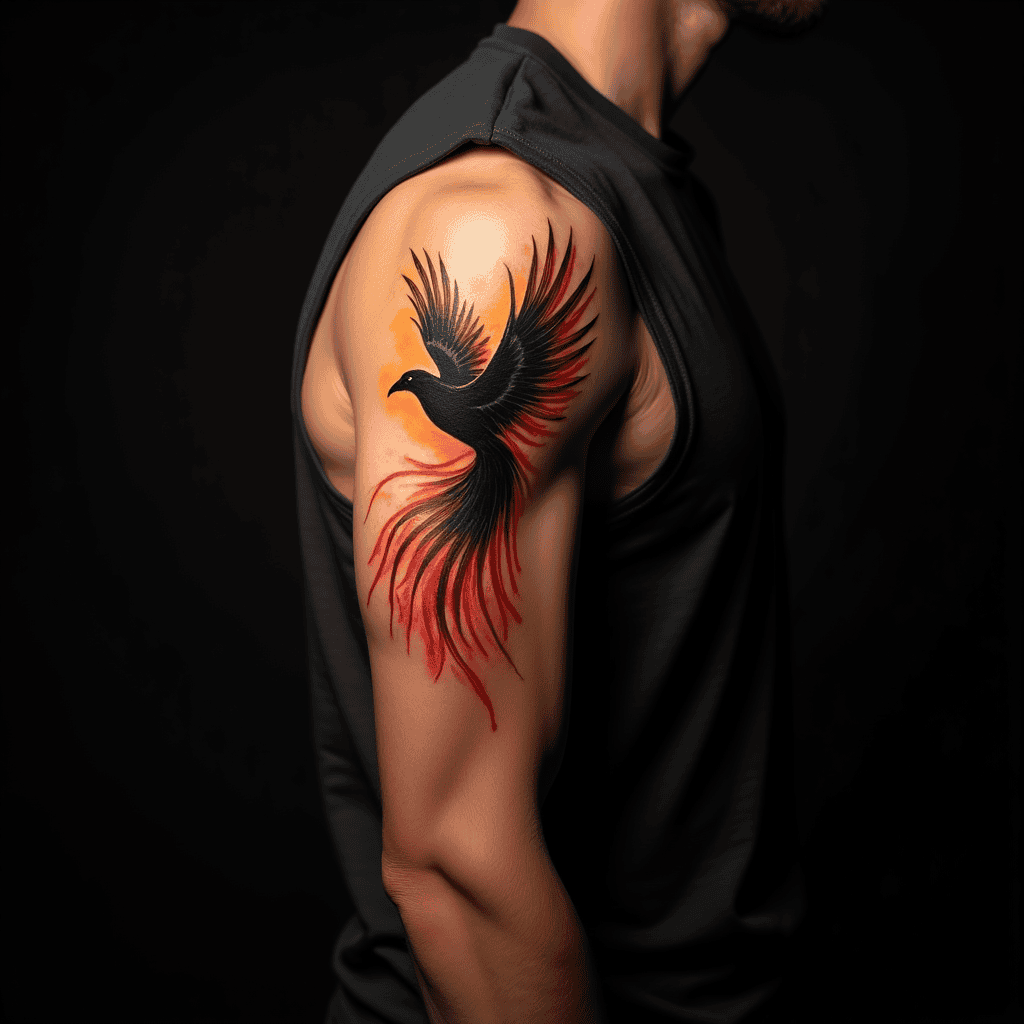
A phoenix is one of the bolder Watercolor Tattoo Ideas because its subject already suggests movement. The head and central wing structure can stay defined in black while red, orange, amber, and small yellow washes flare outward through the feathers. A tall upper-arm composition lets the bird rise toward the shoulder rather than spread awkwardly sideways. Wispy pigment tails can extend downward without becoming literal flames.
Ask for “a rising phoenix with black structure through the head and wings, then loose red-to-orange watercolor moving outward from the feathers.” It fits someone who wants a dramatic tattoo and has enough space to let the wings open up. The downside is obvious: an overpacked warm palette can become one large orange-red mass. Dark anchors between major feather sections help keep the bird readable.
19. Watercolor Hourglass Tattoo
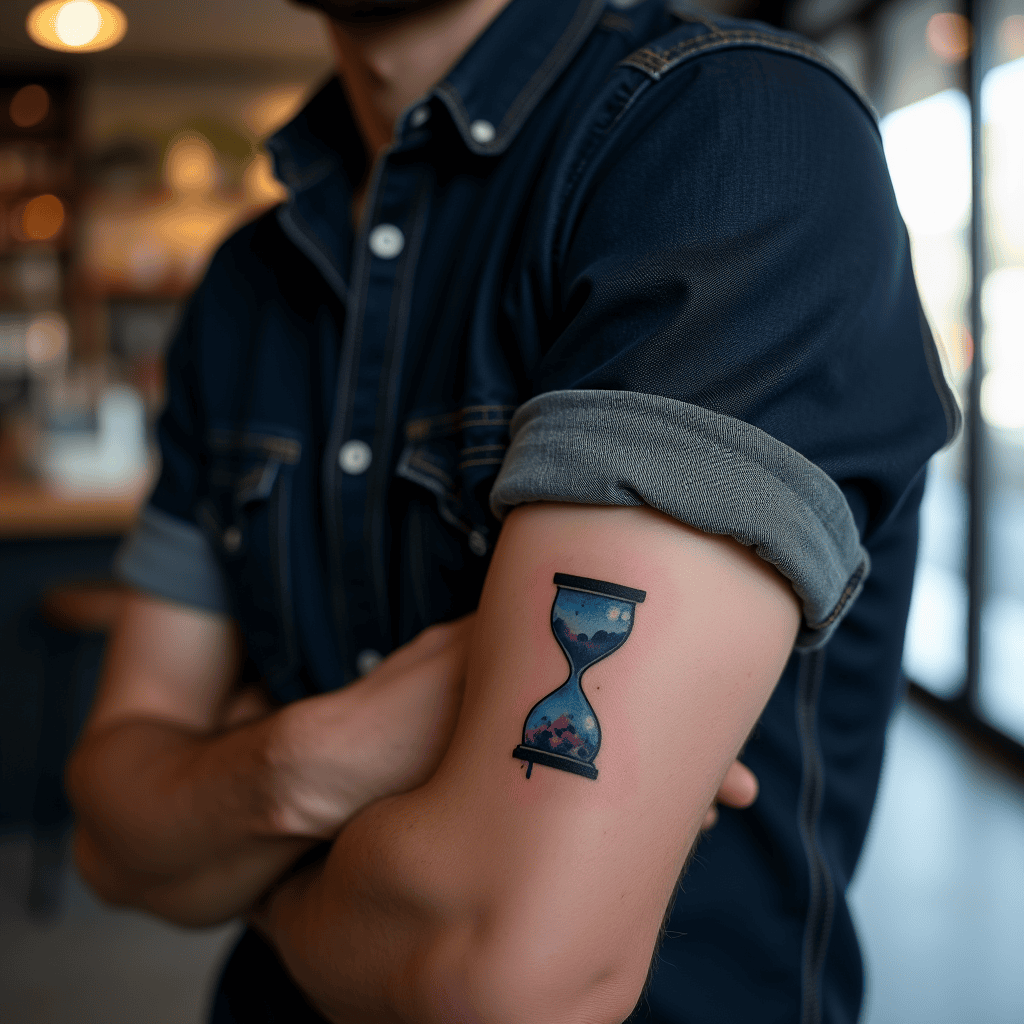
An hourglass gives you a clean symmetrical object that can contrast with loose asymmetric paint. The frame can stay black and narrow while blue or violet pigment appears to pour through the center, replacing ordinary sand with a more abstract wash. On the outer forearm, the shape reads quickly without needing heavy detail. A few pigment fragments outside the lower chamber can suggest motion without spelling out a story.
Ask for “a clean black hourglass with watercolor moving through the glass and only a few escaped pigment marks outside the frame.” This design suits men who like symbolic imagery but want something quieter than a skull, clock, or large script piece. Its drawback is familiarity; hourglasses are common tattoo subjects. The watercolor composition needs enough personality to keep the result from feeling borrowed from a standard flash sheet.
20. Watercolor Skull Tattoo
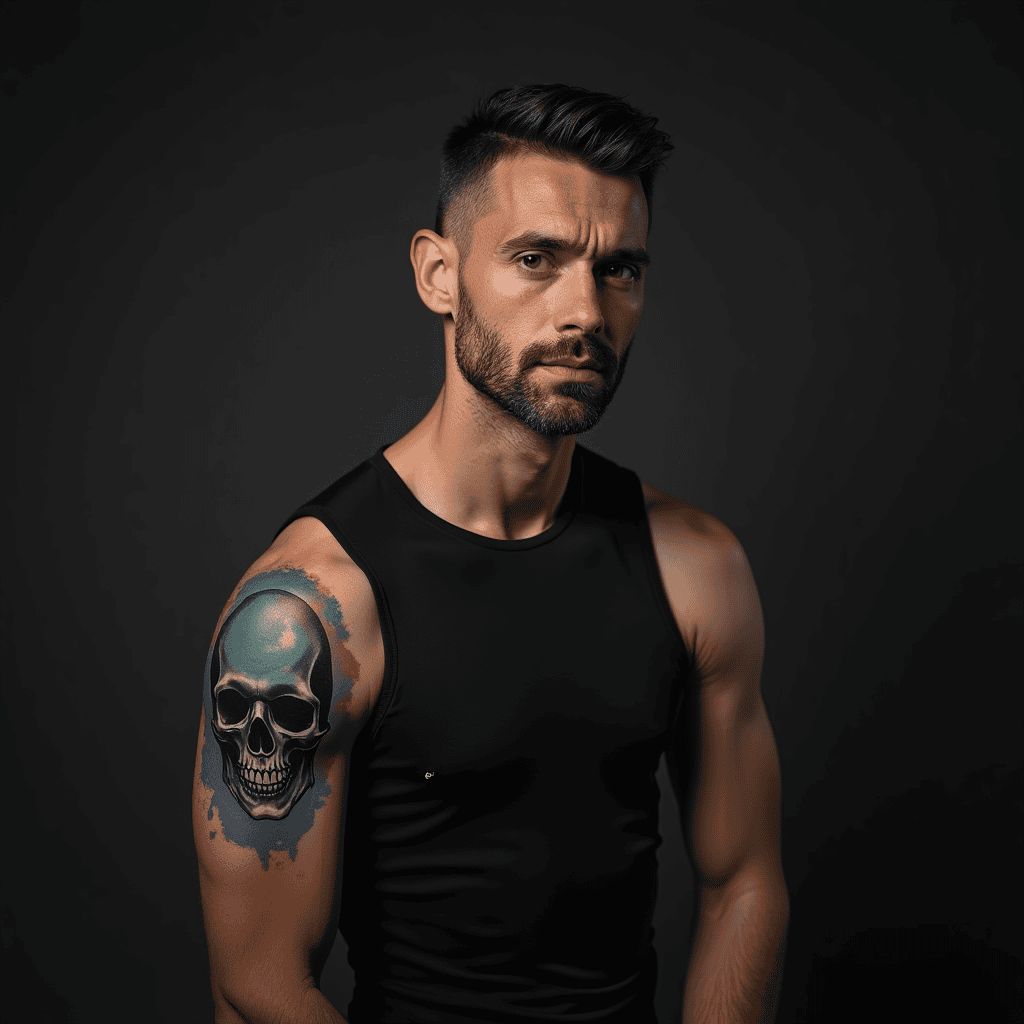
A skull does not need to be dark from edge to edge. Keep the eye sockets, nasal opening, teeth, and main bone structure in controlled black-and-gray, then let blue, red, ochre, or violet watercolor cut through selected areas. The shoulder or upper arm gives the skull enough width to keep the teeth readable. Slightly offset color makes the piece feel more like artwork and less like a conventional shaded skull.
Ask for “a structured skull with readable anatomy and watercolor crossing through only part of the face, not covering every edge.” This can suit men who like heavier tattoo imagery but want a less traditional finish. The obvious drawback is density; tiny teeth plus dark eye sockets plus saturated paint can become cluttered quickly. Larger scale and disciplined color placement solve most of that problem.
21. Watercolor Roman Numeral Tattoo
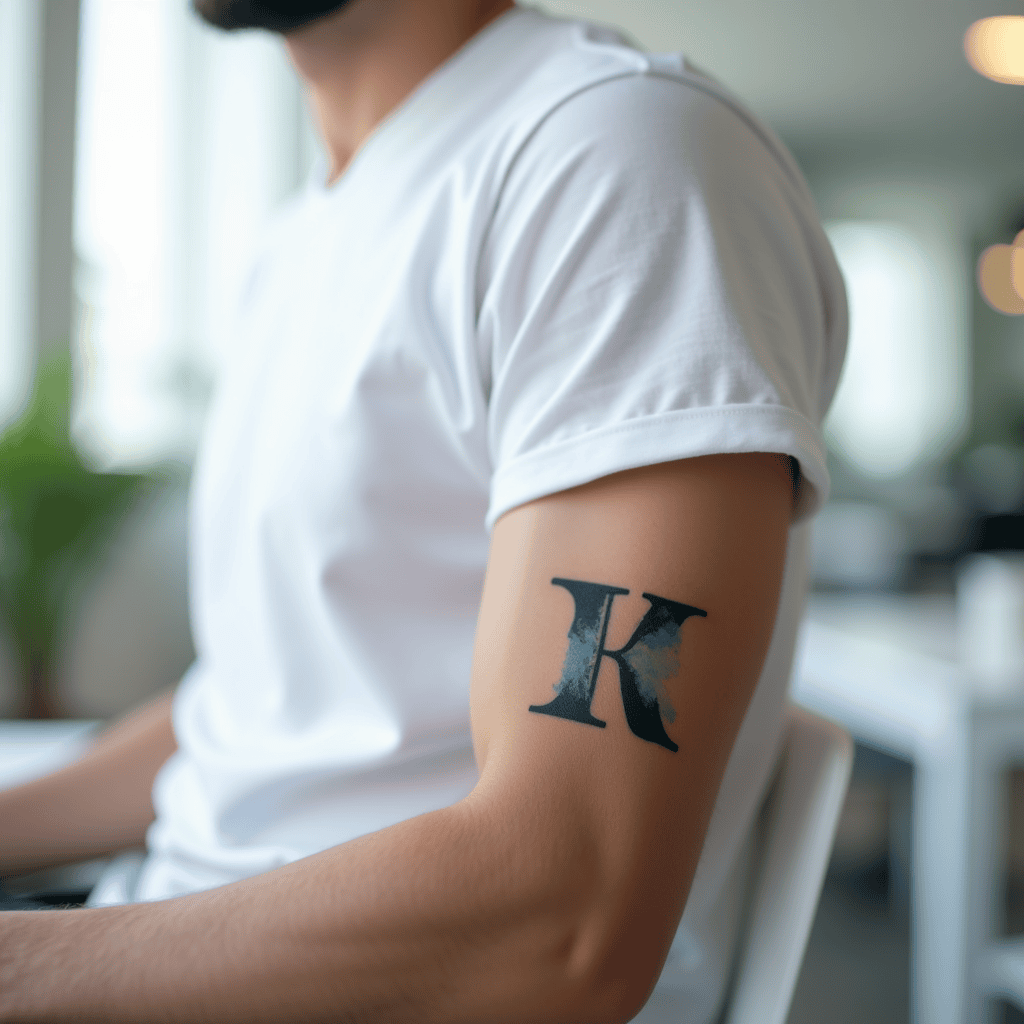
Roman numerals can become much more visual when they sit over a single horizontal brushstroke. The numerals stay dark, evenly spaced, and readable while the watercolor moves behind them in one or two restrained colors. Along the inner forearm, the line of text follows the natural length of the arm. A slightly rough brush edge prevents the result from resembling printed typography floating on skin.
This works for a meaningful date without needing a larger symbolic scene around it. Ask for “clean black Roman numerals over one transparent watercolor stroke, with the date remaining completely readable.” Double-check the numeral conversion before approving the stencil; that part is not something you want to discover later. The idea also loses impact when multiple extra symbols are added around the date.
22. Watercolor Paper Plane Tattoo
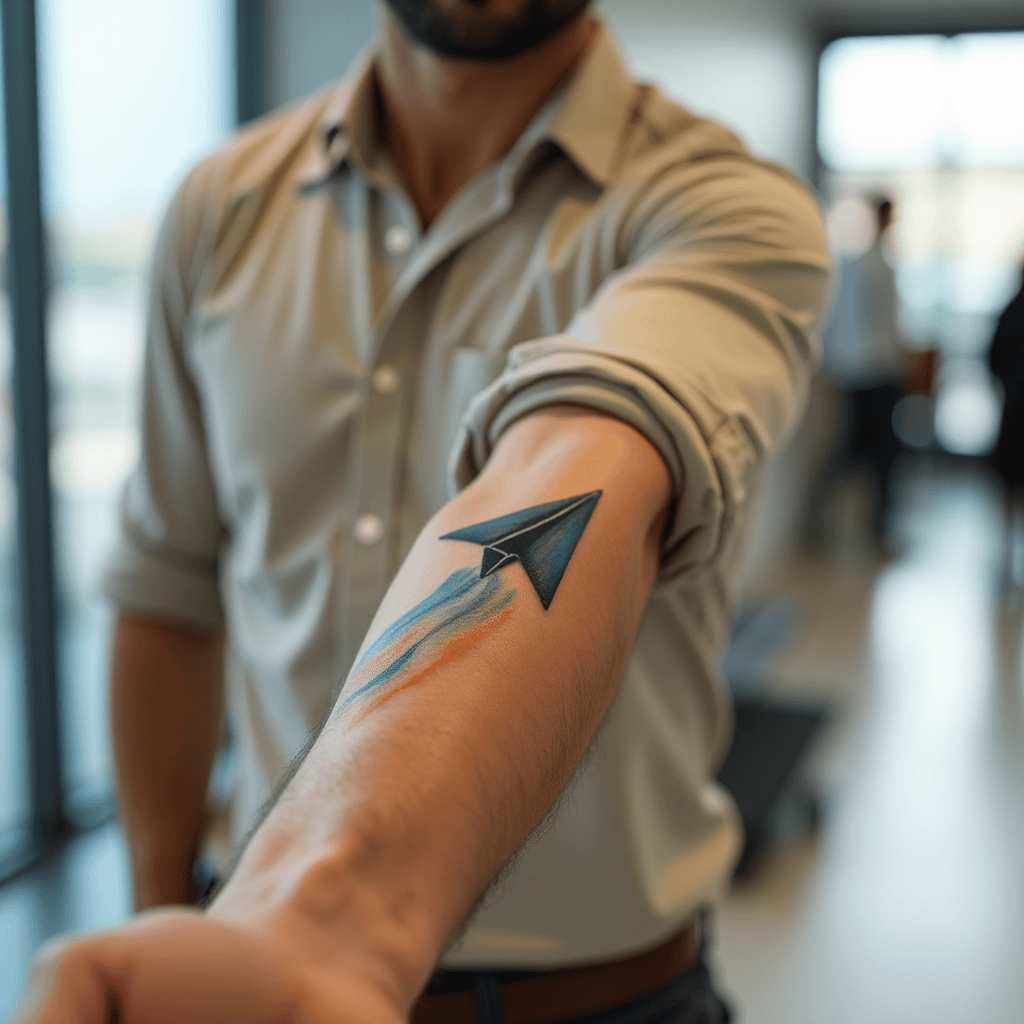
A paper plane can stay almost entirely line-based, with the watercolor acting as the movement trail. A thin black plane near the wrist can angle upward while a loose blue, teal, or orange brush path sweeps behind it toward the elbow. The design feels lighter than many symbolic tattoos because the empty space does most of the work. A few small pigment flecks can break the trail without turning it into a spray pattern.
Ask for “a minimal paper plane with a watercolor flight path that feels painted in one continuous motion.” This is a good fit for men who want travel imagery without using maps, coordinates, or a compass. The drawback is scale: if the plane becomes too small, its folded geometry can blur into a simple triangle. Give the outline enough room to remain obvious.
Bold Watercolor Tattoo Ideas for Larger Placements
The final group pushes watercolor into larger compositions where the paint effect can travel across the body rather than stay behind a single small object. These Watercolor Tattoo Ideas demand stronger planning because a loose composition becomes more obvious as the scale grows.
23. Watercolor Dragon Tattoo
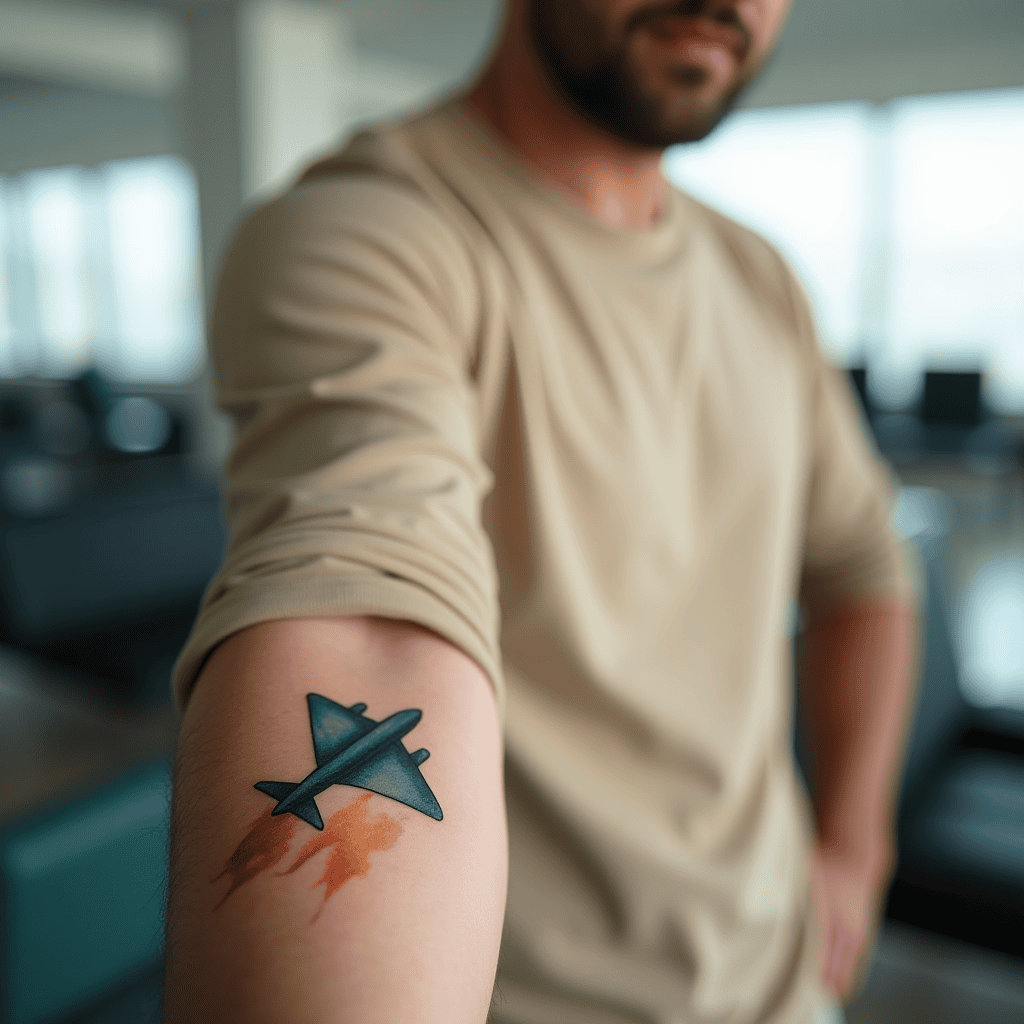
A dragon can move diagonally across the upper arm and shoulder with most of the body defined by black linework rather than dense shading. Deep red, blue, jade green, or violet watercolor can follow the turns of the body and break outward around the claws and tail. The long shape gives the artist several natural places to let the pigment fade. Keeping the head sharper than the tail creates useful visual hierarchy.
Ask for “a long flowing dragon with a clearly defined head, simplified body detail, and watercolor following the direction of the movement rather than sitting behind it.” This is better for a medium or large placement because the anatomy gets cramped fast. The drawback is visual competition: scales, claws, horns, clouds, and four colors can all fight each other. Strip away whatever the composition does not need.
24. Watercolor Forest Sleeve Accent
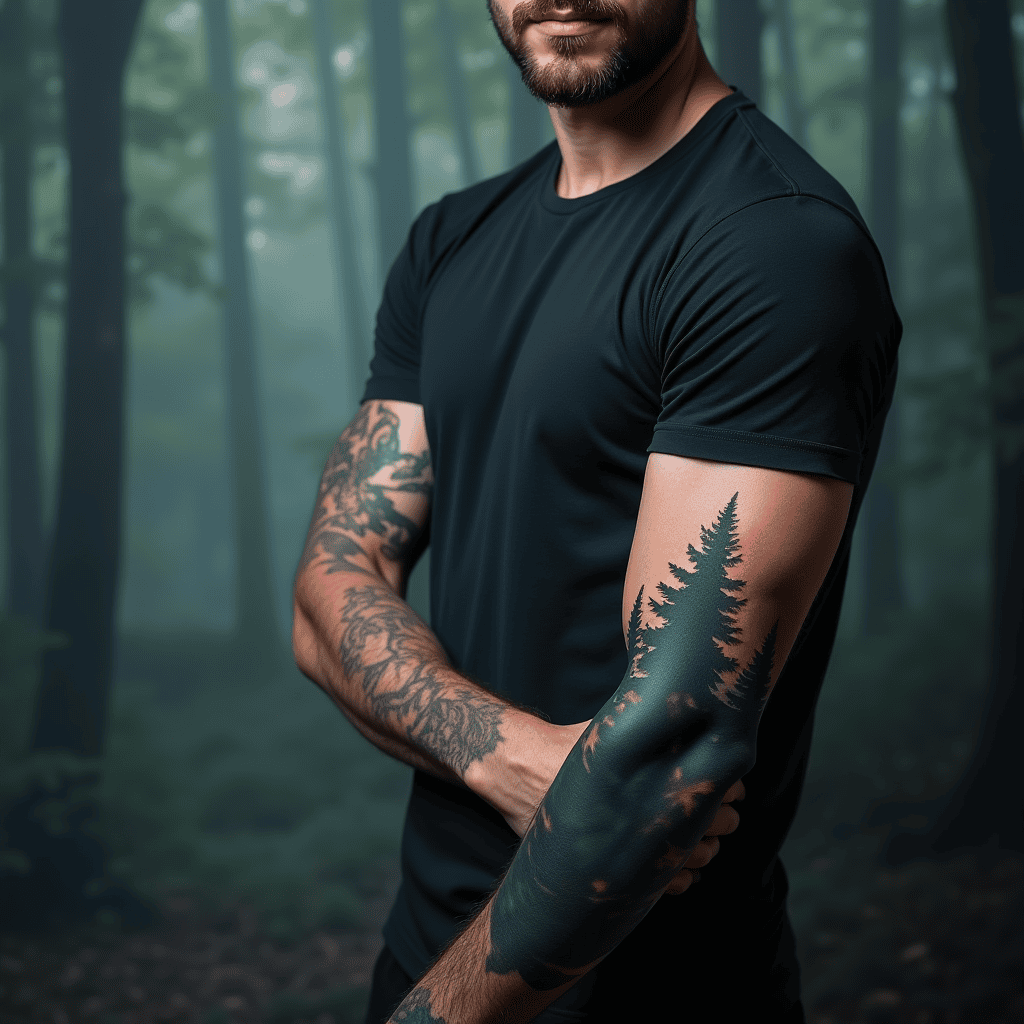
This design stops short of becoming a completely filled sleeve. Dark pine silhouettes can climb from the forearm toward the upper arm while blue, green, charcoal, and violet washes appear in selected bands between the trees. Instead of coloring every area, the pigment can fade into untouched skin around the elbow and outer edges. That interruption makes the tattoo feel more like layered landscape painting than wallpaper.
Ask for “a vertical forest composition with black tree silhouettes, selective watercolor atmosphere, and intentional gaps of bare skin between the main sections.” Men who want a larger nature tattoo without a fully saturated sleeve may find this balance more wearable. The challenge is transition planning; random color patches around the elbow can make the sections look disconnected. Have the full arm composition mapped before starting the first large area.
25. Abstract Watercolor Shoulder Piece
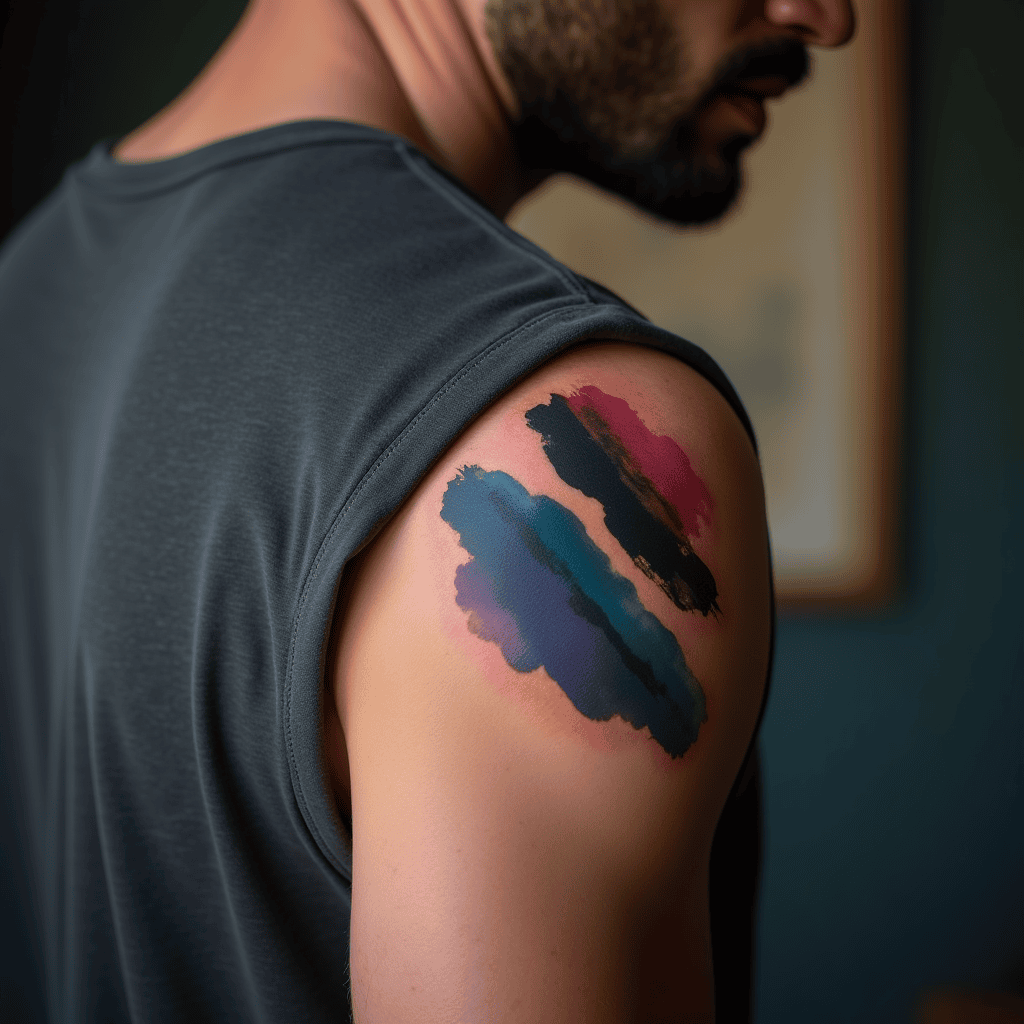
The most expressive option drops the recognizable subject completely. Broad black strokes can move from the upper arm across the shoulder while cobalt, cyan, rust, crimson, or violet pigment intersects them in separate translucent layers. Some edges should look saturated and wet, while others fade into dry-brush texture. The shoulder works because the marks can follow the body’s curve rather than pretending the skin is a flat canvas.
Ask for “an abstract shoulder composition built from two or three strong black strokes, layered transparent color, and deliberate negative space rather than random splatter.” This is one of the Watercolor Tattoo Ideas that depends most heavily on the individual artist’s eye, so choose someone whose healed abstract work already appeals to you. The drawback is also its strength: there is no familiar symbol to hide a weak composition. Every mark has to earn its place.
How to Choose the Right Watercolor Tattoo Idea
The best Watercolor Tattoo Ideas start with placement rather than color. A long forearm favors arrows, skylines, soundwaves, and mountains, while the shoulder gives circular or spreading subjects such as lions, wolves, skulls, and abstract brushwork more room. Calves handle vertical movement well, which is why koi, waves, and longer nature scenes often sit comfortably there.
Match the Design to the Space
Look at the shape of the body area before choosing the subject. Long compositions belong on long spaces, wider faces need wider placements, and highly detailed subjects need enough skin around them to remain readable. Trying to force a large composition into a small patch usually means sacrificing either the structure or the watercolor.
Bring reference images for mood, color, and placement, but avoid asking an artist to duplicate another tattoo line for line. Tell your tattooer what you like about each reference: the transparency, the edge quality, the amount of black, or the way the colors overlap. Those details are much more useful than saying you want “something artistic.”
Decide How Much Black Structure You Want
Watercolor does not automatically mean a tattoo needs zero outlines. In fact, black anchors can be extremely useful when the subject contains a face, geometry, letters, scales, feathers, or directional details. A tattoo built entirely from soft pigment can work, but the artist has less structural material to rely on as the piece ages.
I go back and forth on outline-free watercolor because the right artist can make it beautiful, especially at a larger scale. For many men getting their first watercolor piece, though, a hybrid approach is easier to live with. You still get the painted movement without giving up a readable silhouette.
Keep the Color Palette Controlled
Three strong colors often beat seven average ones. Watercolor tattoos tempt people into requesting every color on the wheel because the format makes it possible, but more pigment does not automatically create more depth. Restrained palettes also make it easier to create contrast between the main subject and the loose painted background.
Bring examples of colors you actually wear and like seeing every day. A man whose wardrobe is mostly black, gray, navy, and earth tones may feel more comfortable with indigo, rust, forest green, or burgundy than fluorescent pink and yellow. The tattoo can still be colorful without fighting everything around it.
Where Watercolor Tattoos Get Oversold
Watercolor tattoos are sometimes marketed as if the style itself makes a tattoo more creative. It does not. Splashes, drips, and blurry pigment can become decoration with no relationship to the subject, and adding more color will not rescue weak drawing underneath.
The other exaggerated idea is that every watercolor tattoo should look completely spontaneous. Good spontaneity usually comes from planning. The artist still has to control where the eye lands, where the color stops, how much skin stays open, and which edges need enough definition to carry the composition.
If the style attracts you mainly because you dislike heavy black outlines, consider a softer illustrative tattoo with selective color before committing to a full splash composition. You can often get much of the airy, artistic effect with fewer competing elements and a clearer long-term structure.
Frequently Asked Questions
Do watercolor tattoos work well for men?
Yes. Watercolor tattoos are not tied to a particular gender or aesthetic. Men often pair the technique with animals, mountains, geometric forms, brushwork, waves, skulls, or abstract subjects. A darker palette and stronger structural linework can create a particularly bold interpretation.
What are the best Watercolor Tattoo Ideas for a first tattoo?
Mountains, a compass, an arrow, a wave, or a simple animal portrait are practical starting points because the subject remains recognizable even with restrained color. Choose a design with one clear focal point rather than beginning with a complicated multi-subject composition.
Where do watercolor tattoos look best on men?
Forearms, upper arms, shoulders, and calves offer some of the easiest surfaces for Watercolor Tattoo Ideas. These areas provide enough room for pigment to spread beyond the main structure without the design feeling cramped. Placement should still follow the shape of the individual composition.
Can a watercolor tattoo have black outlines?
Absolutely. Many strong watercolor pieces use black linework, darker shading, or geometric structure underneath the color. The black does not ruin the painted effect; it can give softer pigment a stable visual anchor and make detailed subjects easier to read.
What colors work best in watercolor tattoos?
Blue, indigo, teal, red, rust, orange, violet, and green can all work beautifully depending on the design. Instead of choosing colors individually, think about the palette as a group. Two or three related colors plus one contrasting accent often feels more intentional.
Are small watercolor tattoos a good idea?
They can be, but the design should stay simple. Small arrows, paper planes, abstract strokes, waves, or minimal symbols translate more comfortably than tiny animal portraits packed with several colors. Watercolor needs enough room for soft transitions and visible negative space.
What should I ask a tattoo artist before booking?
Ask to see healed examples of their watercolor work, not only fresh photographs. Discuss the amount of black structure, intended color palette, placement, size, and how they expect the composition to settle visually over time. Their existing portfolio should already show the style you want.
How do I choose between watercolor and traditional tattoo styles?
Choose watercolor when you prefer transparent pigment, irregular edges, painterly movement, and larger areas of open skin. Choose a more traditional approach when you want strong outlines, heavier saturation, compact shapes, and an intentionally graphic appearance. Hybrid designs can combine both approaches.
Can watercolor be added around an existing tattoo?
Sometimes. A tattoo artist can assess whether painted washes or abstract marks can complement the existing shape without making the area feel crowded. The original tattoo’s placement, darkness, size, and surrounding empty skin will determine how much room there is to work.
Are watercolor animal tattoos popular choices for men?
Animals adapt especially well to the style because the artist can keep important facial or anatomical details sharp while letting fur, feathers, water, or background elements dissolve into color. Wolves, koi, ravens, lions, eagles, foxes, and deer all offer distinct silhouettes.
Should watercolor pigment stay inside the outline?
No. One of the style’s defining visual tools is allowing selected color to move beyond the subject’s formal outline. The effect works best when the overflow follows the composition rather than appearing randomly around every edge. Controlled irregularity usually looks stronger than constant splatter.
How large should a watercolor tattoo be?
Size depends on the amount of detail. A simple brushstroke or arrow can stay fairly compact, while lions, dragons, koi, forests, and detailed animal faces need more space. Your artist should size the design according to its smallest important features rather than the amount of color alone.
Can watercolor tattoos be part of a sleeve?
Yes, and partial sleeves can work especially well because watercolor creates natural transitions between separate subjects. Repeating a limited palette across the arm helps individual tattoos feel connected. Plan major placements before filling every gap so the sleeve keeps breathing room.
What should I bring to a watercolor tattoo consultation?
Bring a few references showing the subject, color mood, level of linework, and placement you like. Explain which element you are responding to in each image rather than requesting an exact copy. Wear clothing that makes the proposed tattoo area easy to view during placement planning.
How do I make Watercolor Tattoo Ideas feel more original?
Start with something specific to your taste, then decide how watercolor supports it. Change the composition, placement, palette, scale, and balance between hard lines and soft pigment with your artist. The strongest result comes from a custom drawing rather than copying another finished tattoo.
Watercolor tattoos work best when the painted effect supports a strong drawing instead of becoming the entire idea. Once you have narrowed your options to two or three Watercolor Tattoo Ideas, compare them against the actual shape and size of your preferred placement. Bring those choices to an artist with strong healed watercolor work and ask which composition they would trust most on that part of the body.
Best Tattoo Design Reports
Explore sleeve, minimalist, Japanese, blackwork and modern tattoo ideas created for men’s style inspiration.