
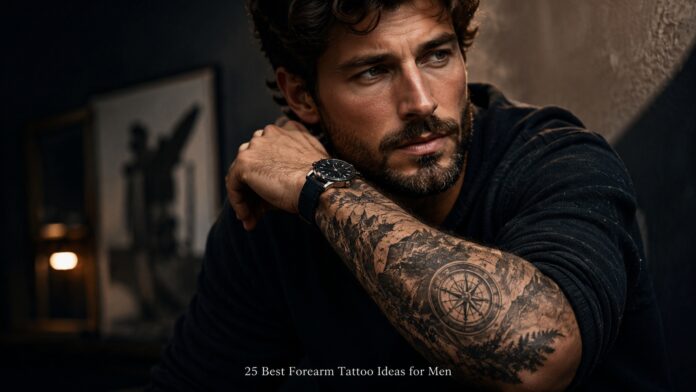
The strongest forearm tattoo ideas balance visibility, shape, and enough detail to still look sharp from a few feet away. Fine-line geometric work, traditional black-and-gray pieces, botanical designs, and wraparound concepts are especially adaptable. The right choice depends less on what looks impressive online and more on how naturally the design follows your arm.
This list judges each idea by composition, readability, placement flexibility, and how convincingly it can age as a finished tattoo. The goal is a forearm piece that works with the body rather than looking like artwork dropped onto an empty patch of skin.
| Quick Pick | Tattoo Style | Best Placement | Visual Character |
|---|---|---|---|
| Fine-Line Compass | Minimal linework | Inner forearm | Clean and directional |
| Blackwork Snake | Heavy blackwork | Outer forearm | Bold and graphic |
| Mountain Landscape | Fine-line realism | Inner forearm | Calm and detailed |
| Japanese Koi | Japanese-inspired | Full forearm | Flowing and expressive |
| Geometric Wolf | Geometric realism | Outer forearm | Structured and masculine |
| Botanical Branch | Fine-line botanical | Inner forearm | Organic and understated |
| Roman Numerals | Minimal lettering | Wrist to mid-forearm | Personal and discreet |
| Traditional Dagger | American traditional | Outer forearm | Classic and high contrast |
| Abstract Brushwork | Contemporary blackwork | Side forearm | Artistic and unpredictable |
| Full Wraparound Band | Geometric blackwork | Mid-forearm | Strong and architectural |
Clean and Timeless Forearm Tattoo Ideas
Some designs work because they don’t fight the natural shape of the arm. These forearm tattoo ideas use controlled lines, recognizable forms, and enough negative space to stay readable without turning the entire forearm into one dense block.
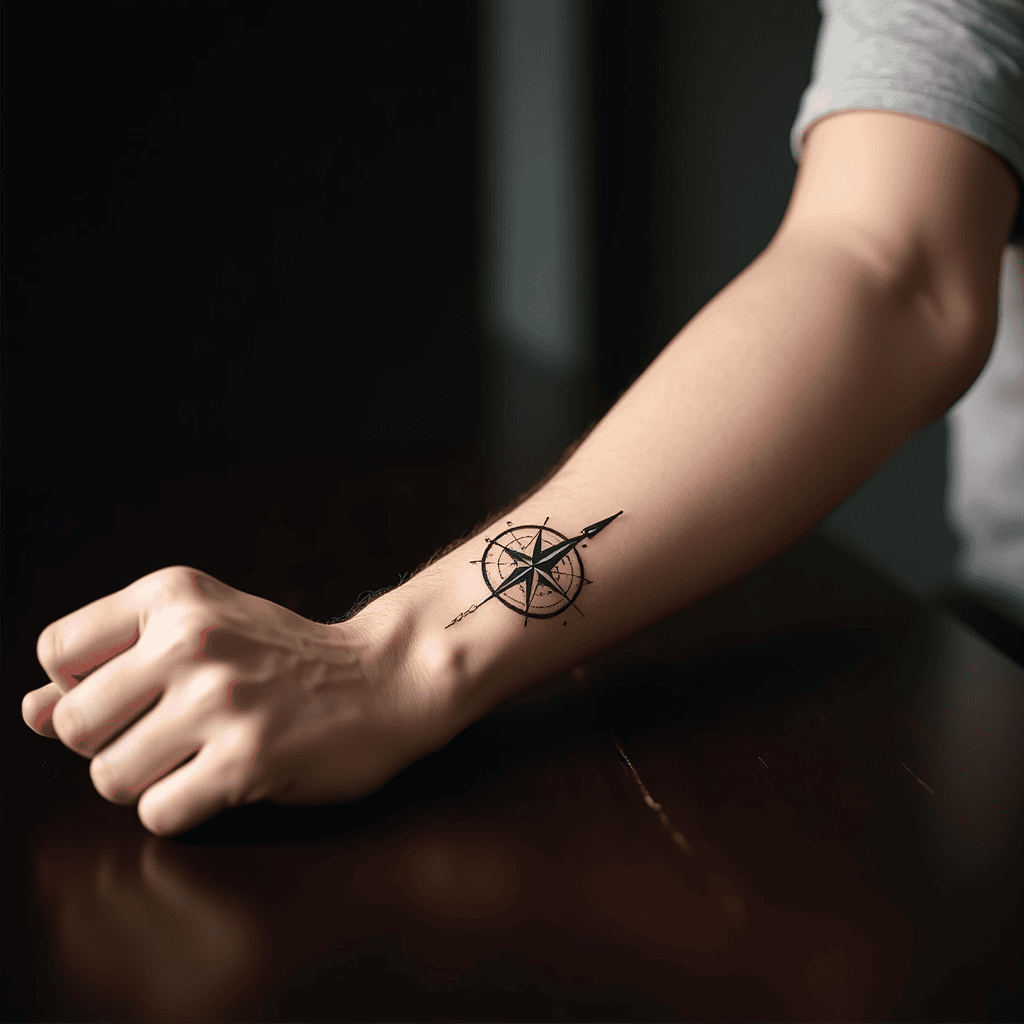
1. Fine-Line Compass Forearm Tattoo
A fine-line compass looks strongest when its center sits along the inner forearm and the longest directional points follow the arm vertically. Thin circles, restrained map marks, and small directional details give the piece structure without making it heavy. Keeping open skin between the needle, lettering, and outer ring helps the tattoo read clearly. It feels precise rather than decorative.
This idea suits someone who wants visible ink without committing to a large dark piece. Ask the tattoo artist for “a fine-line compass with crisp geometry, open negative space, and the main axis running with my forearm.” Extremely tiny markings may soften sooner than larger lines, so don’t shrink every detail purely to make the tattoo feel subtle. A slightly simpler compass often holds together better visually.
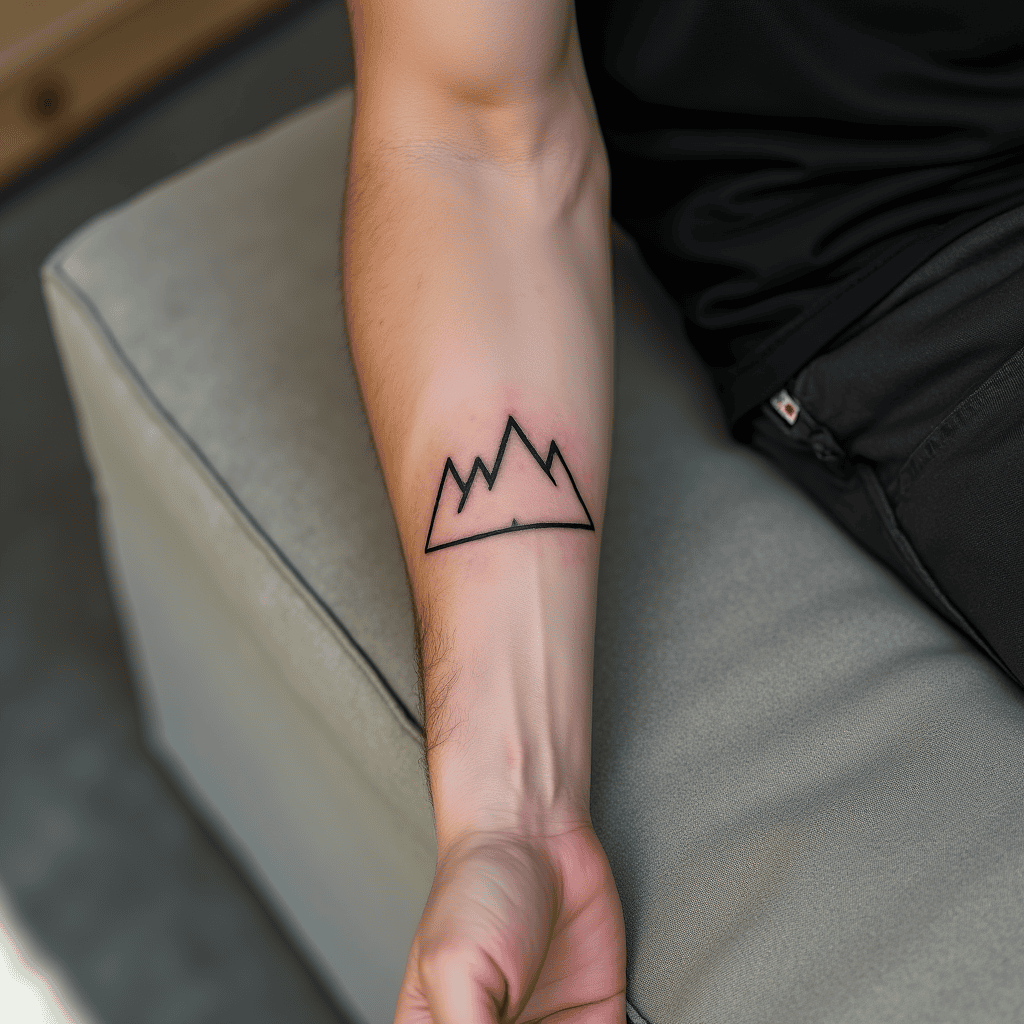
2. Minimal Mountain Outline Tattoo
A mountain outline can run horizontally across the inner forearm or rise diagonally toward the elbow, depending on how much movement you want. The cleaner versions use two or three overlapping peaks instead of an entire illustrated landscape. A thin horizon line underneath can visually anchor the composition. The result feels spacious, calm, and easy to read.
This is one of the more forgiving forearm tattoo ideas for men who prefer restrained artwork. Tell the artist you want “a simple mountain silhouette with varied peak heights and no unnecessary micro-detail.” Long uninterrupted lines make wobbles easy to notice, so artist control matters even though the tattoo appears simple. Leave enough room around it rather than squeezing it against a watch line or existing tattoo.
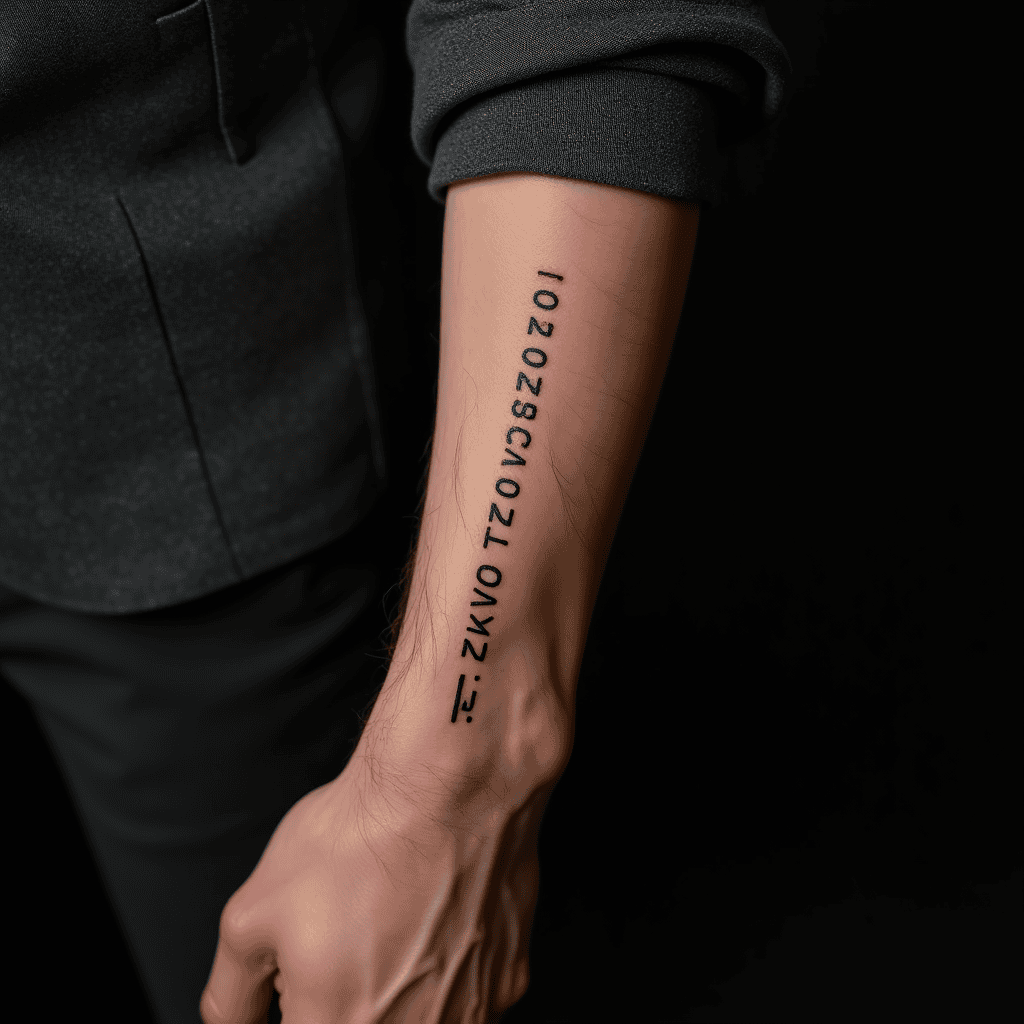
3. Roman Numeral Forearm Tattoo
Roman numerals work well along the length of the forearm because the narrow letterforms create a natural vertical rhythm. They can sit close to the wrist for a quieter piece or extend toward the elbow for more presence. A traditional serif style gives them a formal edge, while thin monoline numerals feel more modern. Spacing matters almost as much as the characters themselves.
Dates carry personal meaning, which makes this design useful for someone who wants a tattoo without explaining an elaborate image. Ask for “evenly spaced Roman numerals sized to remain clearly readable, with no decorative flourishes unless they serve the composition.” Double-check the number conversion before the stencil goes on. A beautifully executed incorrect date is still an incorrect date.
4. Small Arrow Forearm Tattoo
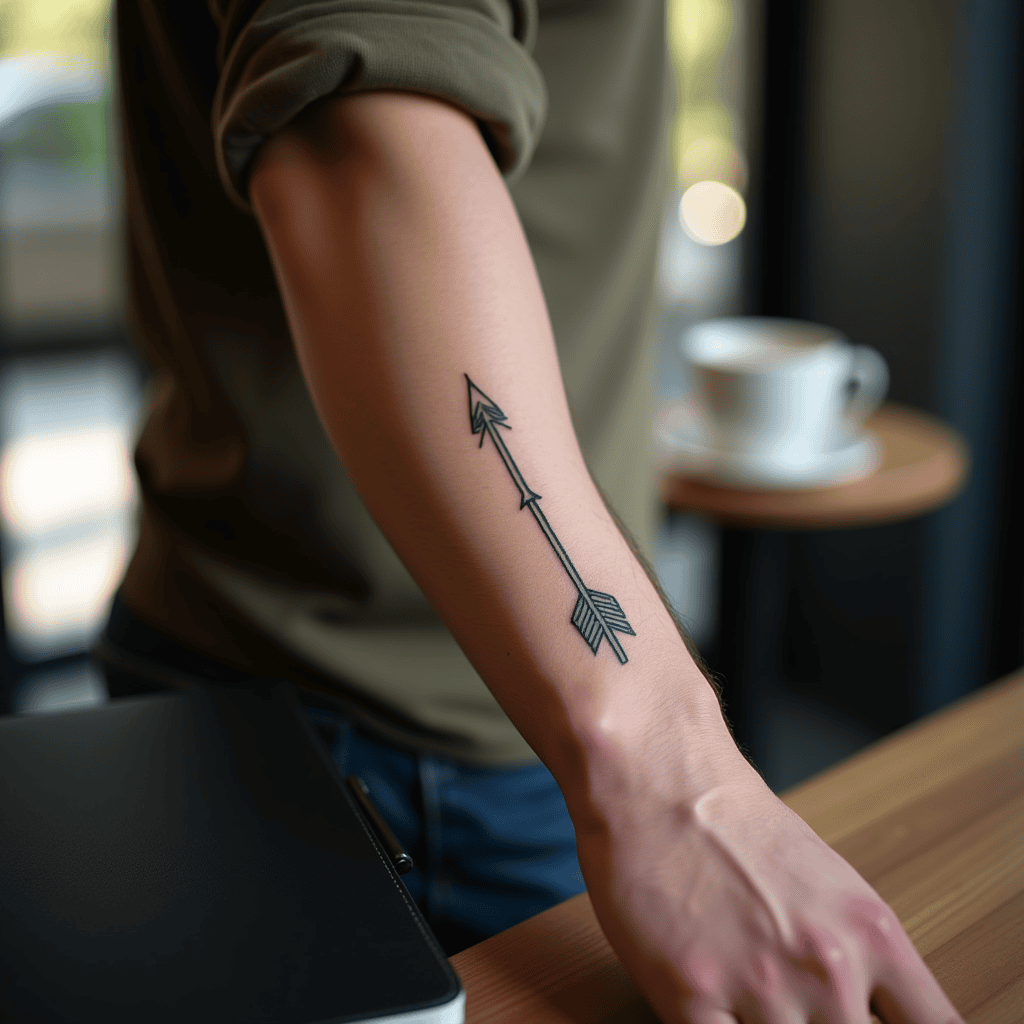
A single arrow makes use of the forearm’s long axis almost automatically. The shaft can follow the center line of the inner arm, while a compact arrowhead and restrained feather detail keep the silhouette recognizable. Black linework gives it clarity without demanding much space. Slight asymmetry in the feathering can make it feel hand-drawn rather than mechanically perfect.
A small arrow suits first-time clients who want something visible yet easy to build around later. Ask the artist for “a slim arrow that follows the natural line of my forearm, with a simple point and readable fletching.” Don’t make the shaft excessively thin if long-term crispness matters to you. The smallest version seen on a phone screen isn’t always the smartest size on real skin.
5. Minimal Cross Forearm Tattoo
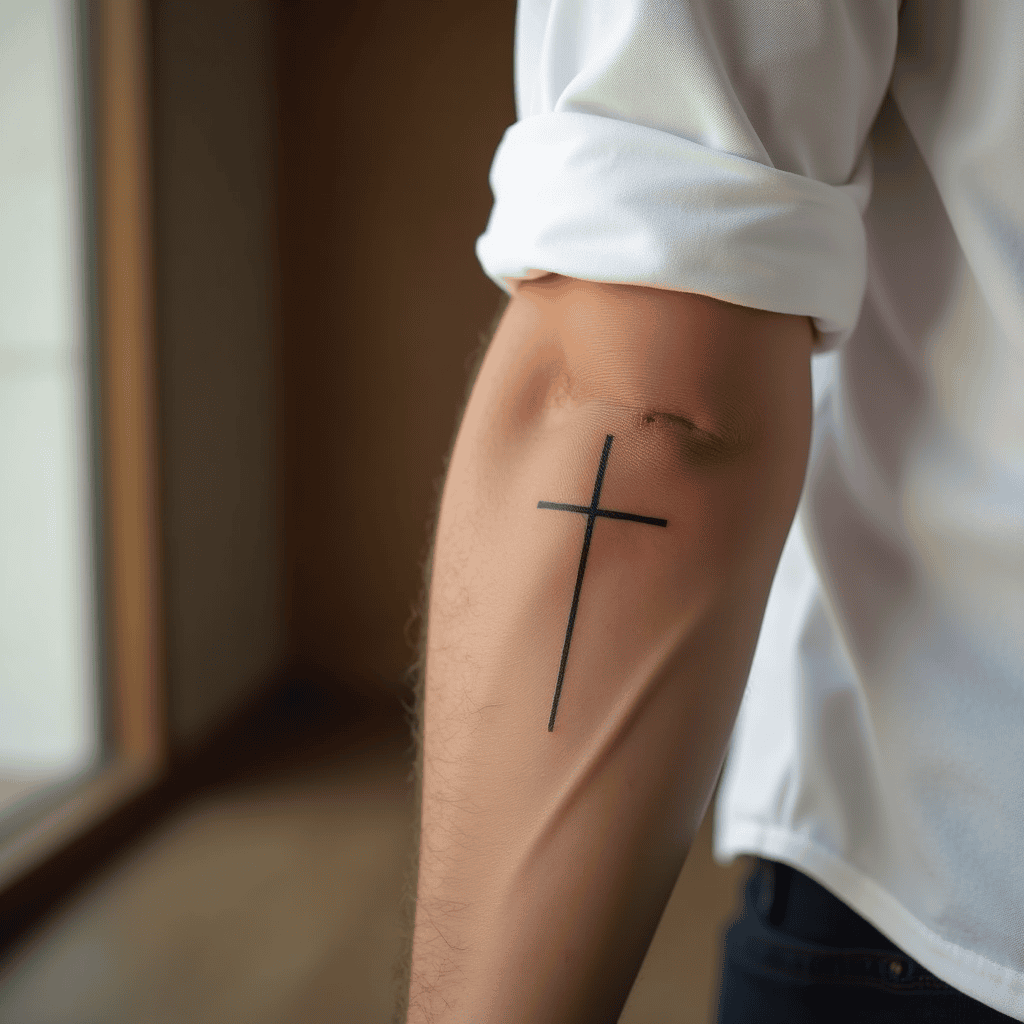
A minimal cross works best when its proportions are intentional rather than simply tiny. A slightly longer vertical stroke gives the symbol a balanced silhouette on the forearm, while medium-fine black lines keep it visually quiet. Placement can range from the inner wrist area to the upper forearm. No extra framing is needed if simplicity is the point.
For men considering symbolic forearm tattoo ideas, this is among the cleanest options. Ask for “a plain black cross with balanced proportions and enough line weight to remain visually clear.” Position deserves thought because symbols can carry personal and cultural importance. Have the artist place several stencil sizes before settling on the one that looks right when your arm hangs naturally.
Nature-Inspired Forearm Tattoo Ideas
The forearm gives natural subjects room to stretch, bend, and follow the body. These forearm tattoo ideas work best when leaves, animals, terrain, or water are drawn around the arm’s movement instead of being forced into a rigid rectangular composition.
6. Botanical Branch Forearm Tattoo
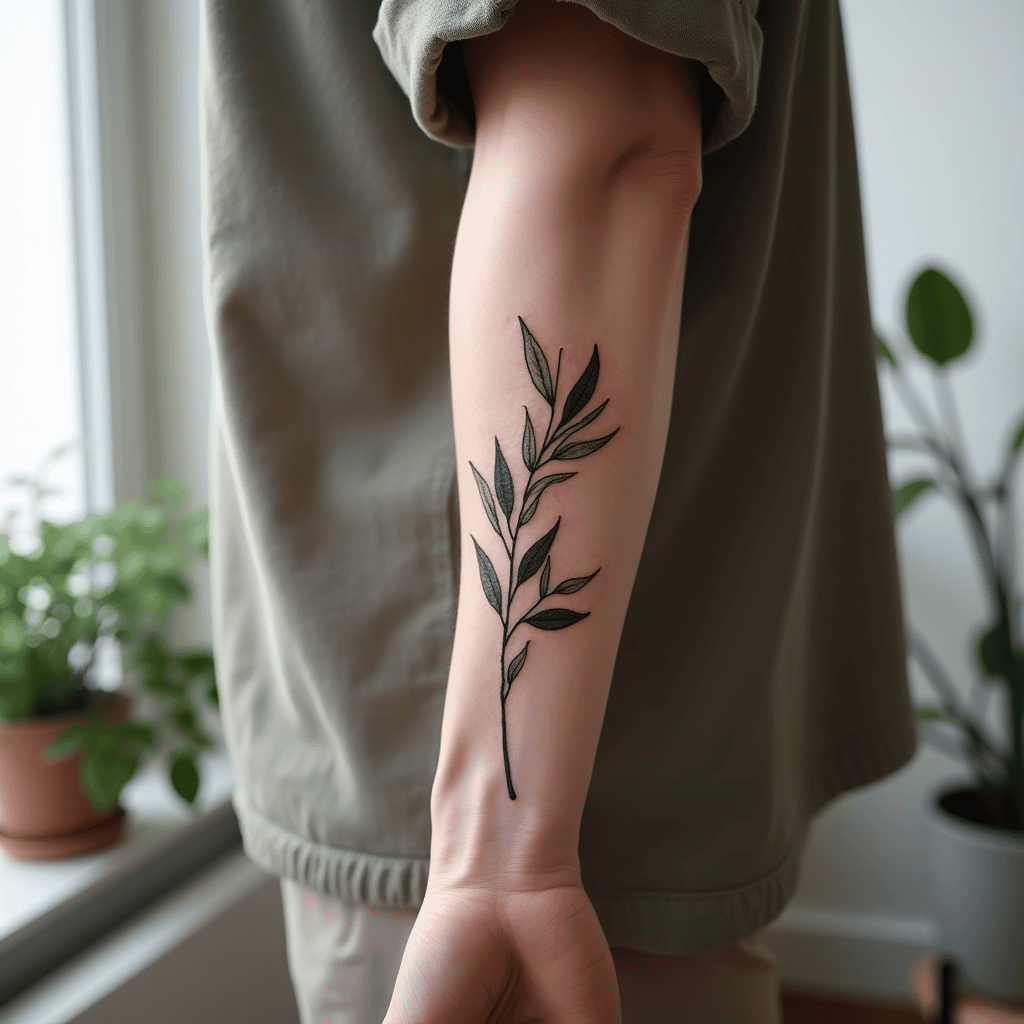
A botanical branch can start near the wrist and gently angle toward the inside of the elbow, letting leaves alternate naturally along the stem. Fine black outlines keep it delicate, while a few darker leaf shadows prevent the whole piece from disappearing at a distance. Irregular spacing makes the plant feel organic. The design should curve subtly with the arm rather than sitting dead straight.
It suits someone comfortable with softer imagery but still works easily within a masculine tattoo collection. Ask for “a black botanical branch with natural leaf spacing, restrained shading, and a stem shaped to follow my forearm.” Packing dozens of tiny veins into every leaf is usually unnecessary. Let the silhouette do some of the work.
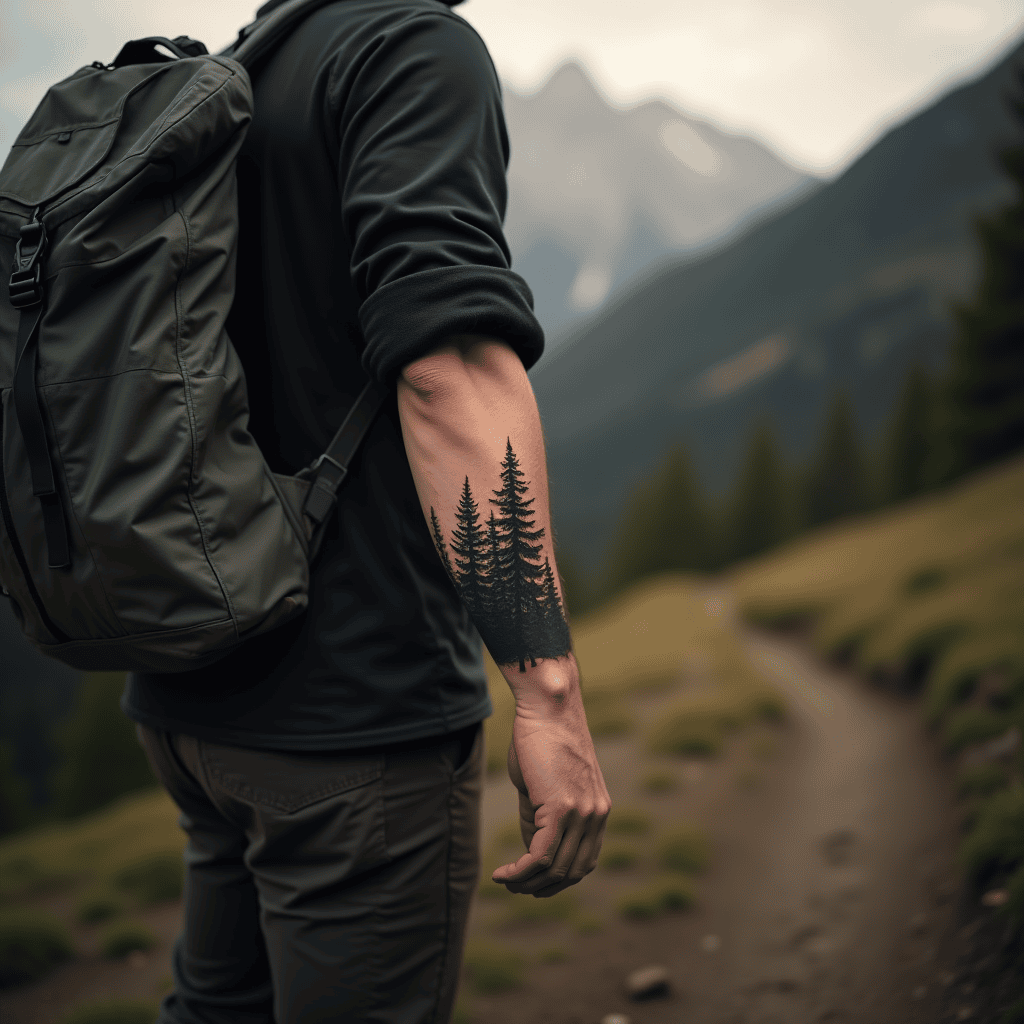
7. Pine Forest Silhouette Tattoo
A pine forest tattoo creates depth by arranging trees at different heights rather than repeating one identical silhouette. Darker trunks in the foreground can sit against lighter, finer trees behind them. The upper edge becomes an uneven skyline that fits naturally across the forearm. A little open space between tree groups keeps the piece from turning into an unreadable black strip.
This style works well for outdoors-oriented men who want recognizable imagery without full realism. Ask for “layered pine silhouettes with different tree heights and enough open skin to keep each level visible.” Heavy black sections will command attention, especially on the inner forearm. If you want the tattoo to stay understated, keep the forest narrow instead of stretching it from wrist to elbow.
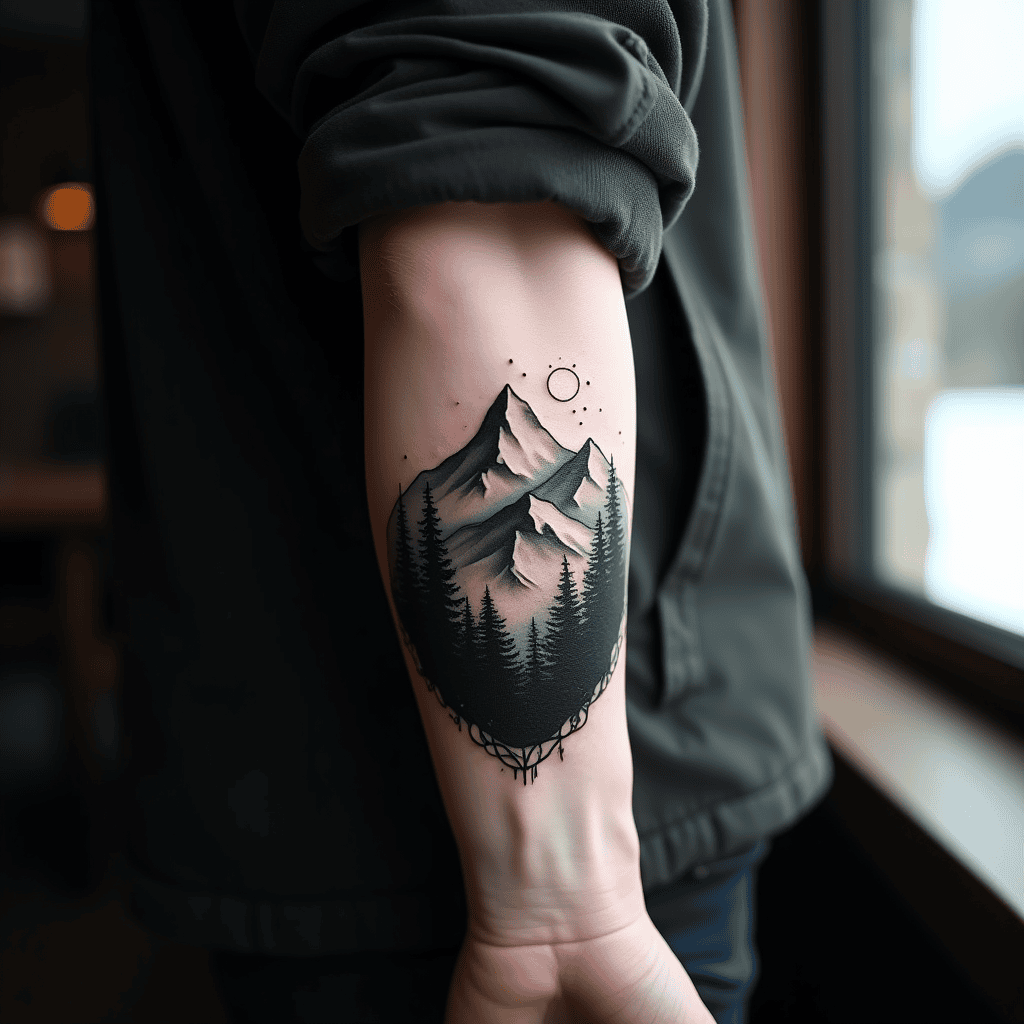
8. Mountain Landscape Forearm Tattoo
A full mountain landscape builds on the simple outline by adding ridgelines, small trees, atmospheric shading, or a moon above the peaks. The inner forearm provides enough width for those layers to breathe. Fine dot shading can create distance without requiring heavy gray fields. A curved lower boundary often fits the arm better than a hard rectangular frame.
Among scenic forearm tattoo ideas, this one rewards giving the artist a little more space. Ask for “a layered mountain scene with clear foreground and background separation, controlled stippling, and no box-shaped border.” Miniaturizing a detailed landscape usually sacrifices readability. If you want trees, snow lines, and sky elements to remain distinct, let the design occupy a meaningful section of the arm.
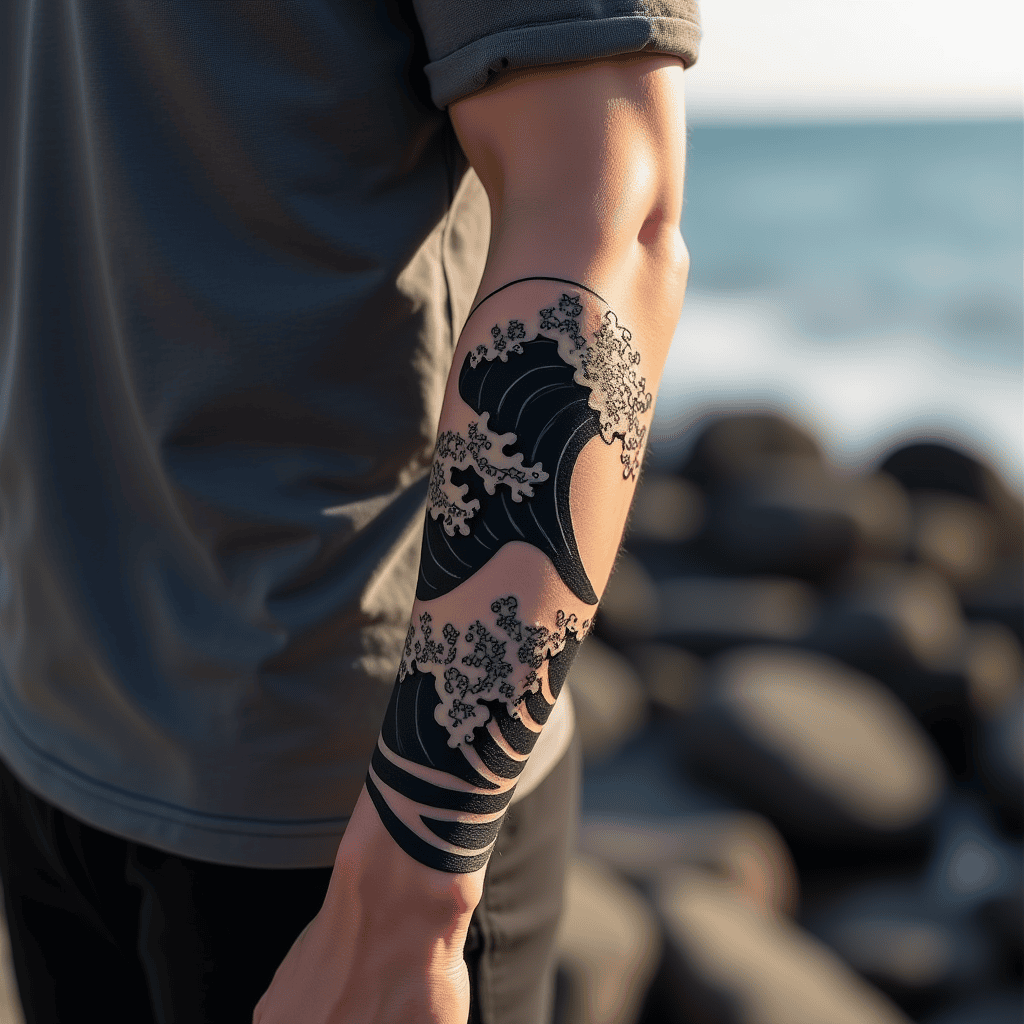
9. Ocean Wave Forearm Tattoo
A wave can curl around the side of the forearm, allowing the crest to create movement instead of presenting the image completely flat. Bold outer lines paired with finer internal foam marks give the water visual hierarchy. Traditional Japanese-influenced waves feel energetic, while simplified linework versions appear calmer. The curve of the arm actually helps the design.
Choose this if you want motion rather than a static centered symbol. Tell the tattoo artist, “I want one dominant wave shaped around the forearm with readable foam and controlled negative space.” Too many tiny water marks can make the image noisy. Decide whether you want graphic impact or delicate detail before the drawing starts because trying to split the difference can weaken both.
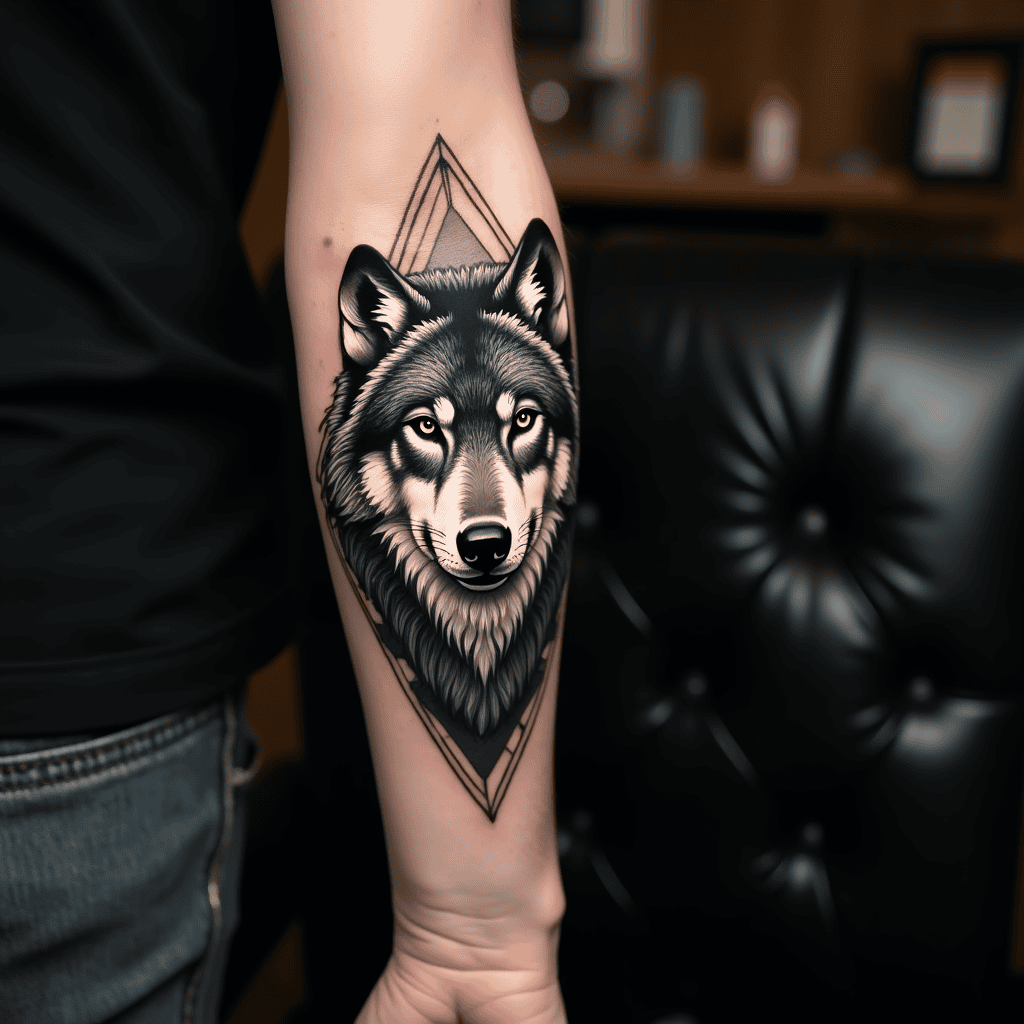
10. Detailed Wolf Forearm Tattoo
A wolf portrait fits particularly well on the broad outer forearm, where the face can sit upright without becoming overly narrow. Strong eyes, simplified fur direction, and controlled shadow beneath the muzzle help establish the expression. Black-and-gray realism creates depth, while geometric framing can push it toward a contemporary style. The head should fill enough space that the facial details don’t collapse together.
This option suits men looking for more commanding forearm tattoo ideas rather than discreet symbols. Ask for “a forward-facing wolf with clear facial structure, readable eyes, and fur rendered in larger directional groups instead of microscopic strands.” Portrait-style animal work demands room. Shrinking a reference designed for a large forearm into a palm-sized tattoo usually removes the qualities that made you like it.
Geometric and Blackwork Forearm Tattoo Ideas
Geometry and blackwork suit the forearm because both styles benefit from clear boundaries. These forearm tattoo ideas can look exceptionally polished when the artist works with the arm’s center line, circumference, and taper instead of treating the skin like flat paper.
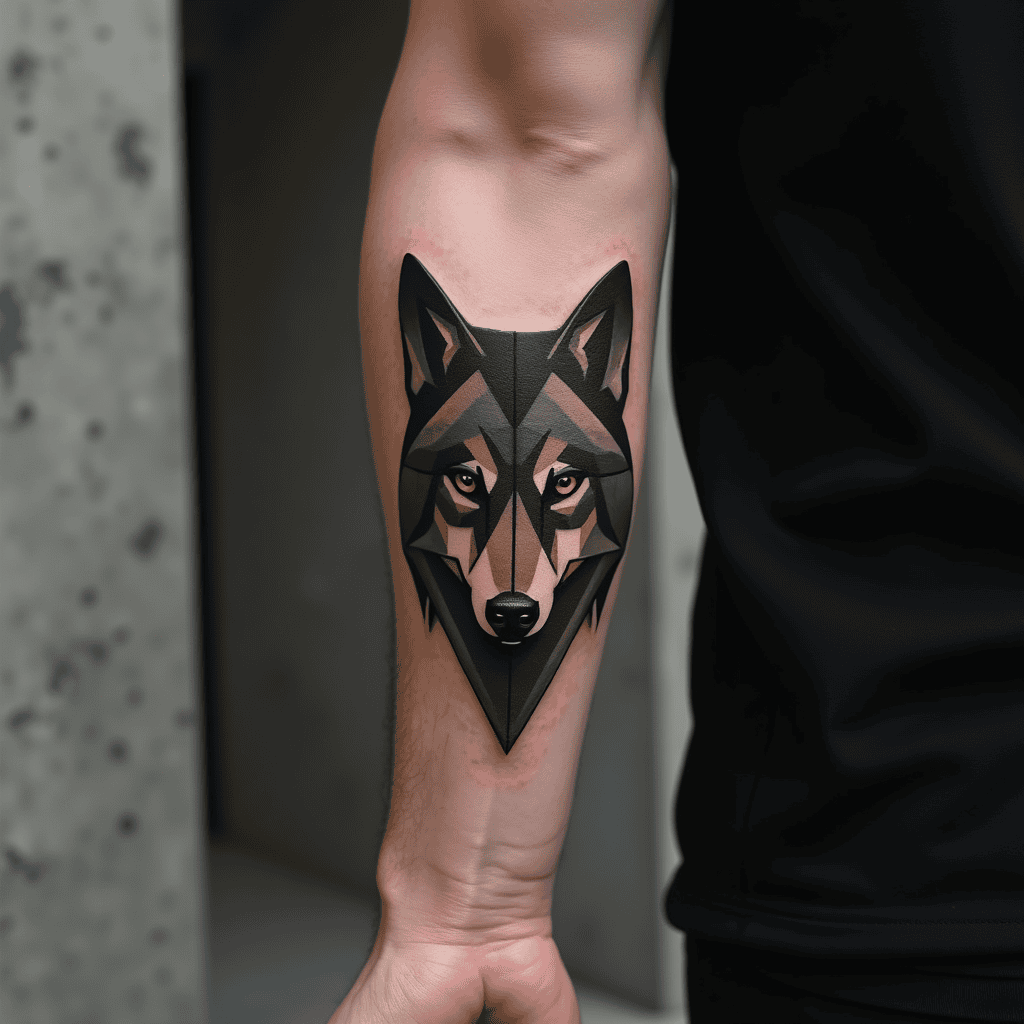
11. Geometric Wolf Tattoo
A geometric wolf reduces the animal into intersecting planes, angular outlines, and symmetrical facial sections. The central line of the face can run directly down the forearm, making the body’s natural symmetry part of the composition. Alternating filled black shapes and untouched skin keeps the image dimensional. Precise edges matter more here than tiny realistic details.
This design suits someone who likes animal symbolism but finds traditional realism too literal. Ask for “a symmetrical geometric wolf built from clean angular planes, with controlled solid-black areas and open negative space.” Geometric work exposes small alignment errors quickly. Study the stencil both with your arm flat and hanging normally before the needle comes out.
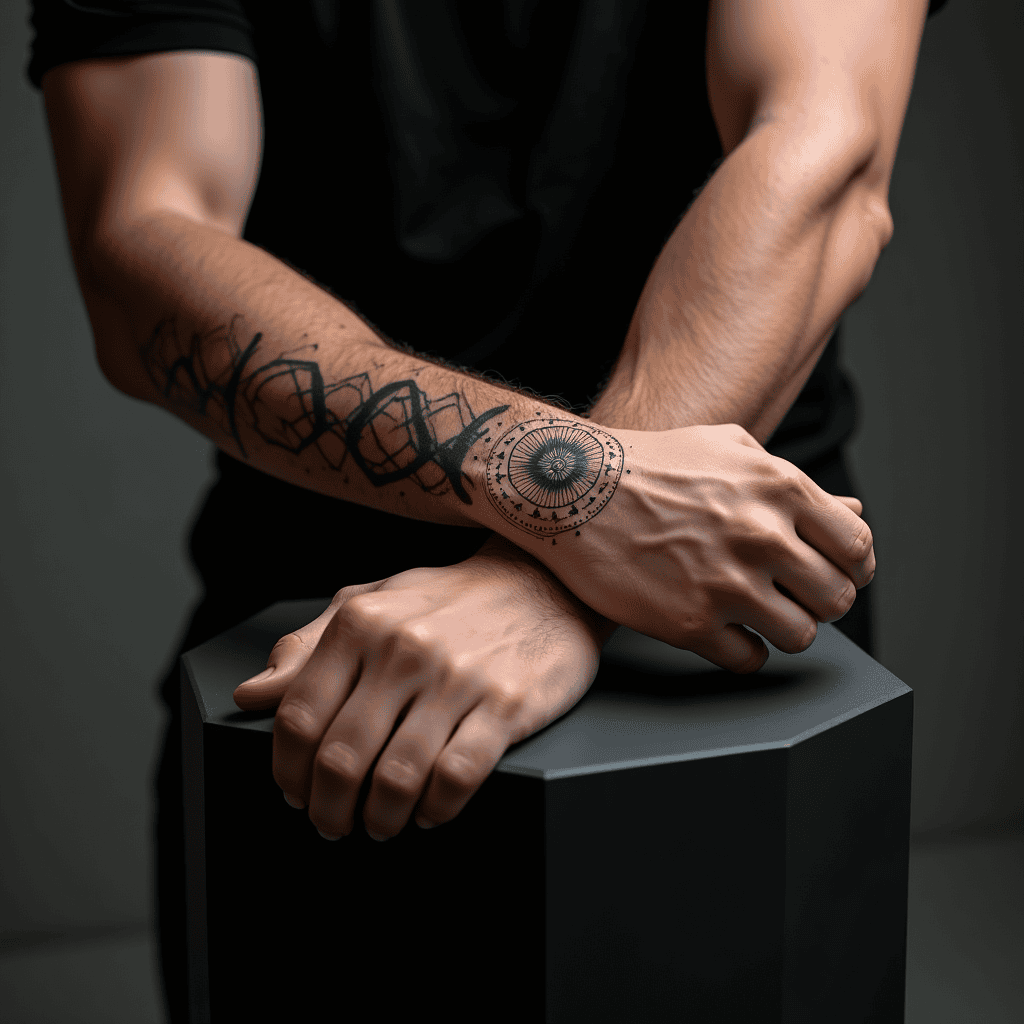
12. Sacred Geometry Forearm Pattern
Interlocking circles, triangles, radial patterns, and repeating line structures can create a highly ordered forearm composition. The most convincing versions establish one visual center and let smaller geometry develop outward from it. Dotwork transitions can soften the shift between dense and open areas. Repetition should feel controlled without turning the tattoo into visual static.
These forearm tattoo ideas appeal to men who enjoy precision and pattern more than literal imagery. Ask for “a geometric composition built around one central focal point, with clean repeated forms and dotwork used only for depth.” Perfect circles and parallel lines demand technical consistency. Pick an artist whose healed geometric work stays sharp, not someone you’re choosing only because their fresh tattoos photograph well.
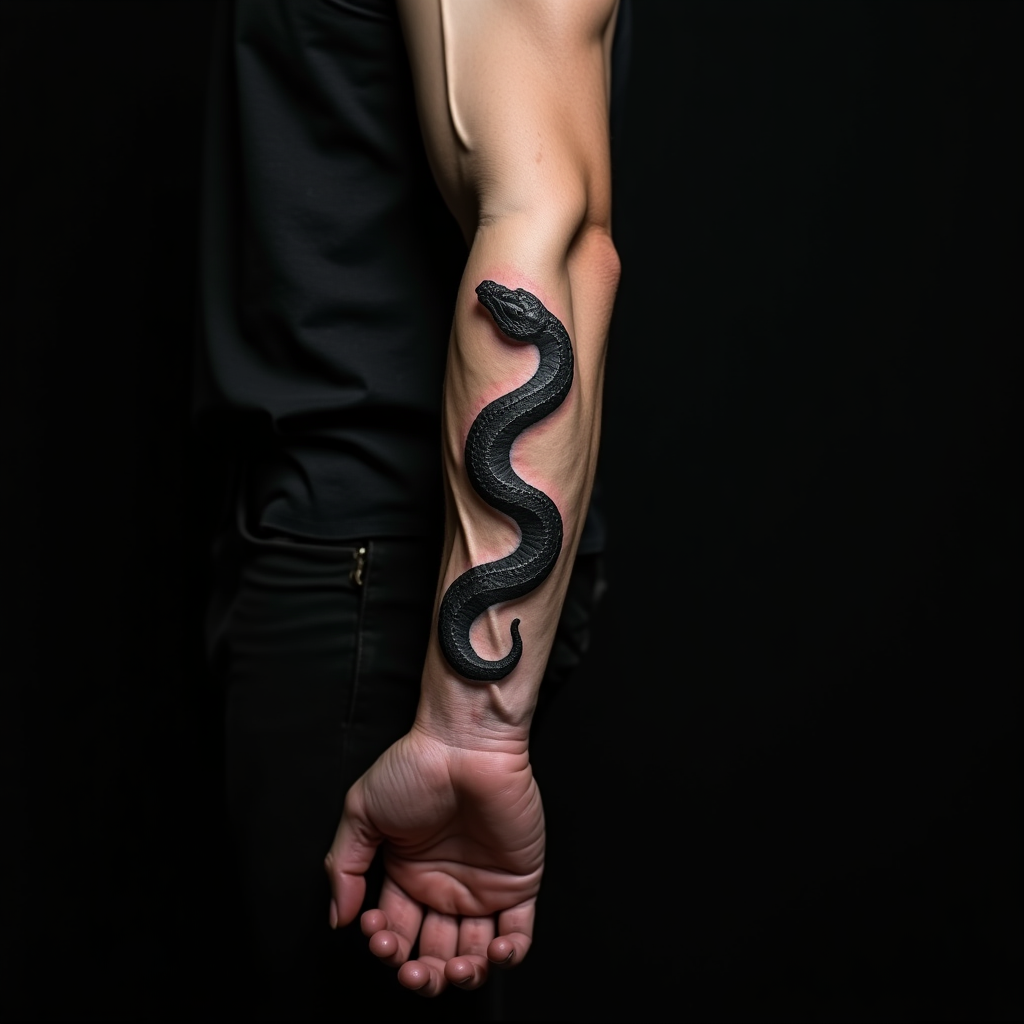
13. Blackwork Snake Tattoo
A blackwork snake can coil down the forearm in an S-shaped path, giving the design movement while using the arm’s narrow proportions efficiently. Dense black scales or solid shadow sections contrast with small areas of untouched skin. The head works well near the upper forearm, where there’s more room for definition. A tapered tail can finish cleanly closer to the wrist.
This is a better choice for someone comfortable with bold ink and strong contrast. Tell the artist, “I want a snake that follows the arm rather than sitting straight on it, using solid black sections and enough negative space to separate the coils.” Heavy blackwork has visual permanence in a way fine line doesn’t. If you’re unsure about dark coverage, scale back before tattooing rather than hoping you’ll grow into it later.
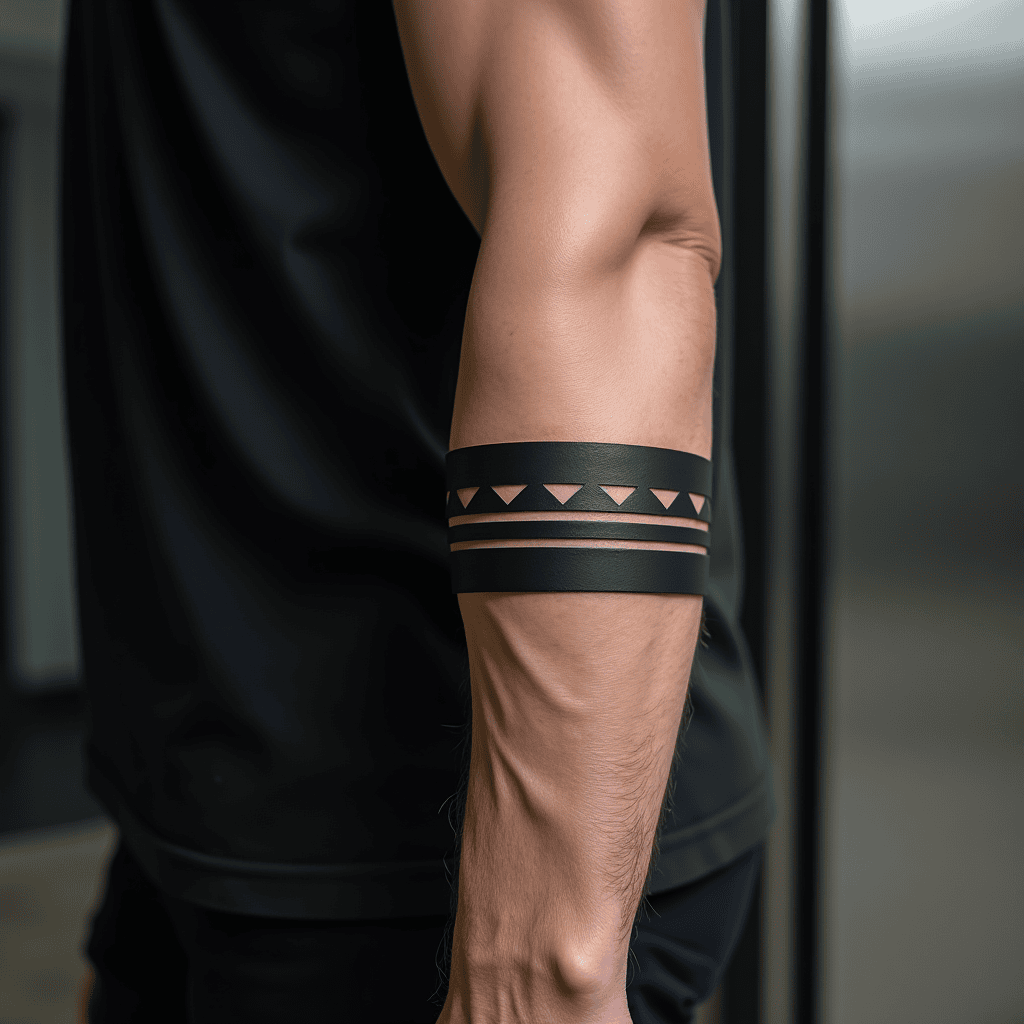
14. Negative-Space Armband Tattoo
A negative-space armband reverses the usual approach by letting bare skin form part of the pattern between strong black sections. Parallel bands can be broken by angular openings, chevrons, or subtle repeating shapes. Wrapping the design around the forearm makes it visible from every angle. Consistent spacing keeps the pattern looking deliberate.
This style suits men drawn to architectural forearm tattoo ideas rather than narrative artwork. Ask for “a full wraparound black band with a clean negative-space pattern and spacing checked around the entire circumference.” Straight bands are harder than they look because the forearm tapers. A good stencil should appear level when your arm hangs normally, not only while it’s twisted into position on the tattoo bed.
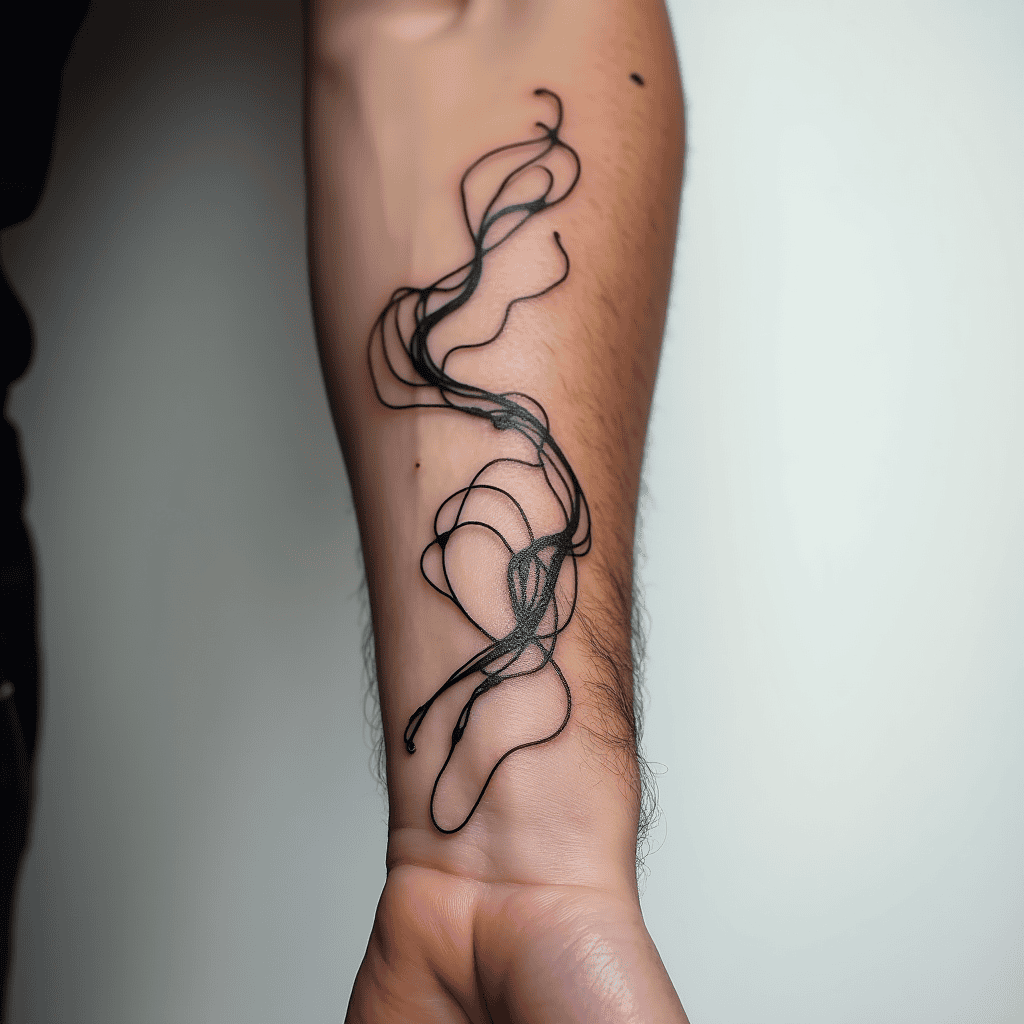
15. Abstract Linework Tattoo
Abstract linework can combine sweeping curves, broken shapes, loops, and isolated marks without needing to depict a recognizable object. The forearm works as a long canvas, so one continuous gesture can travel from the wrist toward the elbow. Varying the weight of selected lines adds depth. Large areas of untouched skin keep the design from looking accidental.
This works best for someone who values composition over an obvious story. Ask for “a custom abstract line piece drawn specifically around the shape of my forearm, with one dominant flowing gesture and smaller secondary marks.” Avoid lifting a random abstract design directly from another person’s tattoo. The strength of this style comes from how specifically it fits your arm.
Symbolic and Story-Driven Forearm Tattoo Ideas
Personal tattoos don’t need to explain an entire life story to everyone who sees them. The strongest symbolic forearm tattoo ideas use one clear visual anchor and let meaning come from the wearer’s connection to it rather than loading the design with endless extra elements.
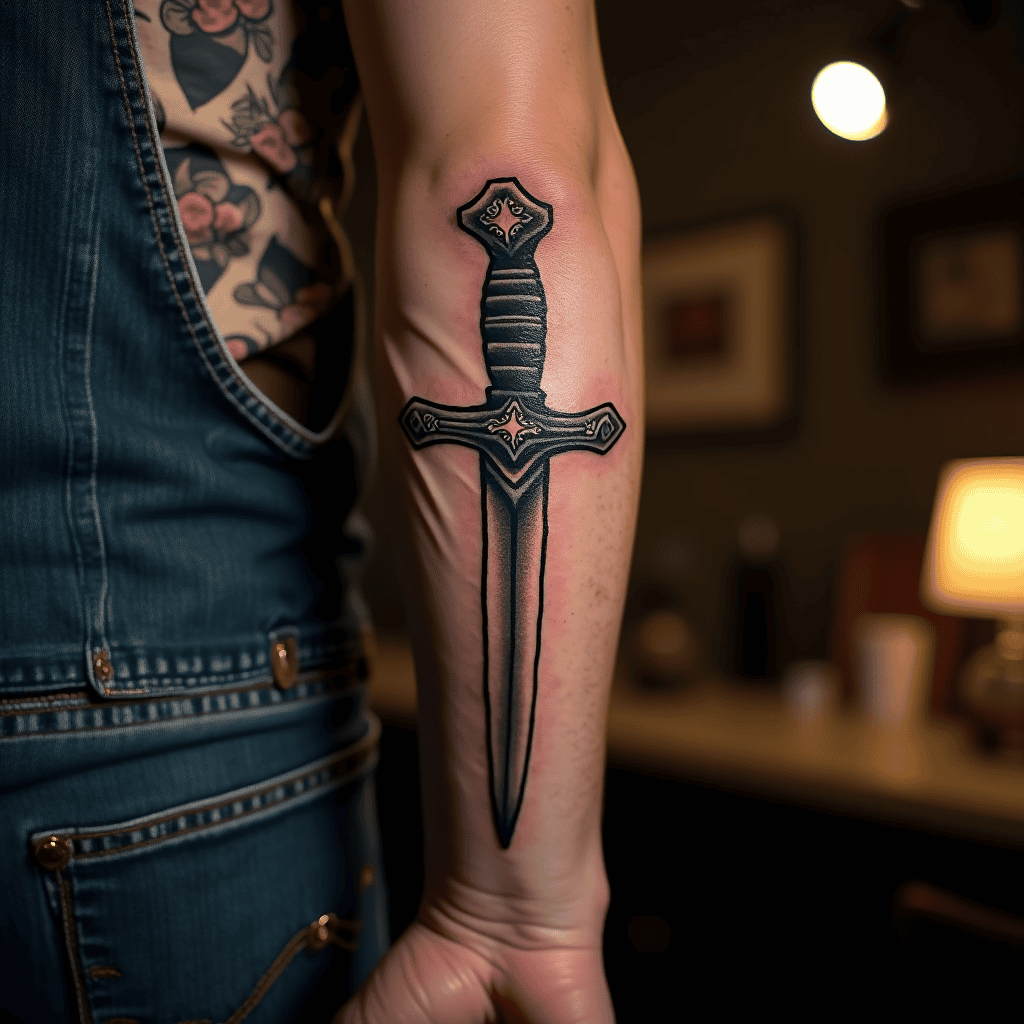
16. Traditional Dagger Tattoo
A traditional dagger makes natural use of the forearm’s vertical length. A bold blade can run down the center while the handle, guard, and ornamental details widen toward the upper arm. Heavy black outlines and deliberately limited shading create the punch associated with traditional tattooing. Small red or muted color accents can be added without overwhelming the structure.
It suits someone who wants a classic tattoo vocabulary rather than soft minimalism. Ask for “a vertically balanced traditional dagger with a bold outer line, readable handle, and limited shading that stays open enough to age clearly.” The straight blade makes alignment noticeable. Check the stencil from multiple angles before approving it, particularly if the design runs nearly the full forearm.
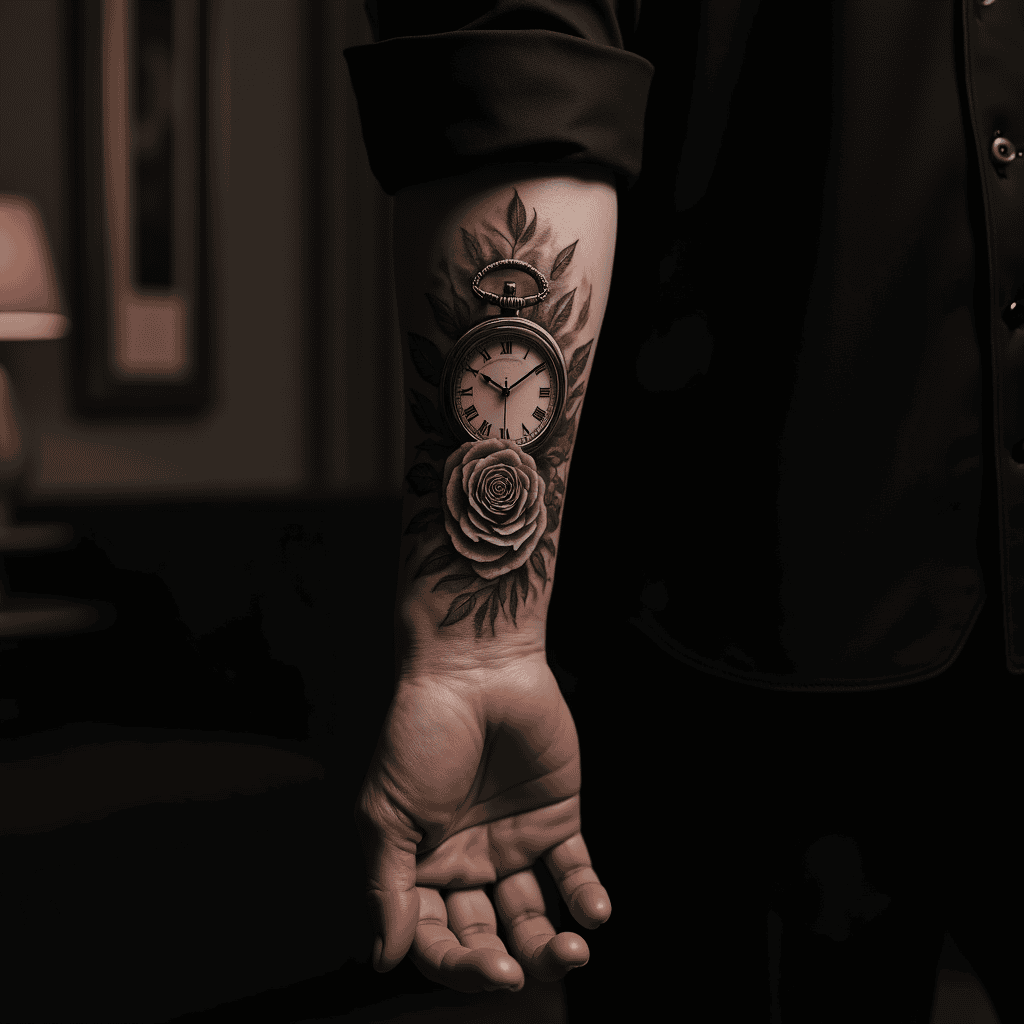
17. Clock and Rose Tattoo
A clock and rose composition combines hard circular geometry with softer overlapping petals. The clock can sit near the wider upper forearm while the rose breaks its lower edge and carries the composition toward the wrist. Black-and-gray shading links the two without requiring a hard frame. Leaves or a small stem can fill awkward gaps without crowding the center.
This works for someone who wants layered symbolism and a more substantial piece. Ask for “a black-and-gray clock with a rose overlapping part of the face, strong separation between the hands, numerals, and petals.” Don’t force six extra symbols into the empty spaces. A clock, rose, and good background flow usually look stronger than a tattoo trying to encode every meaningful date and object you can think of.
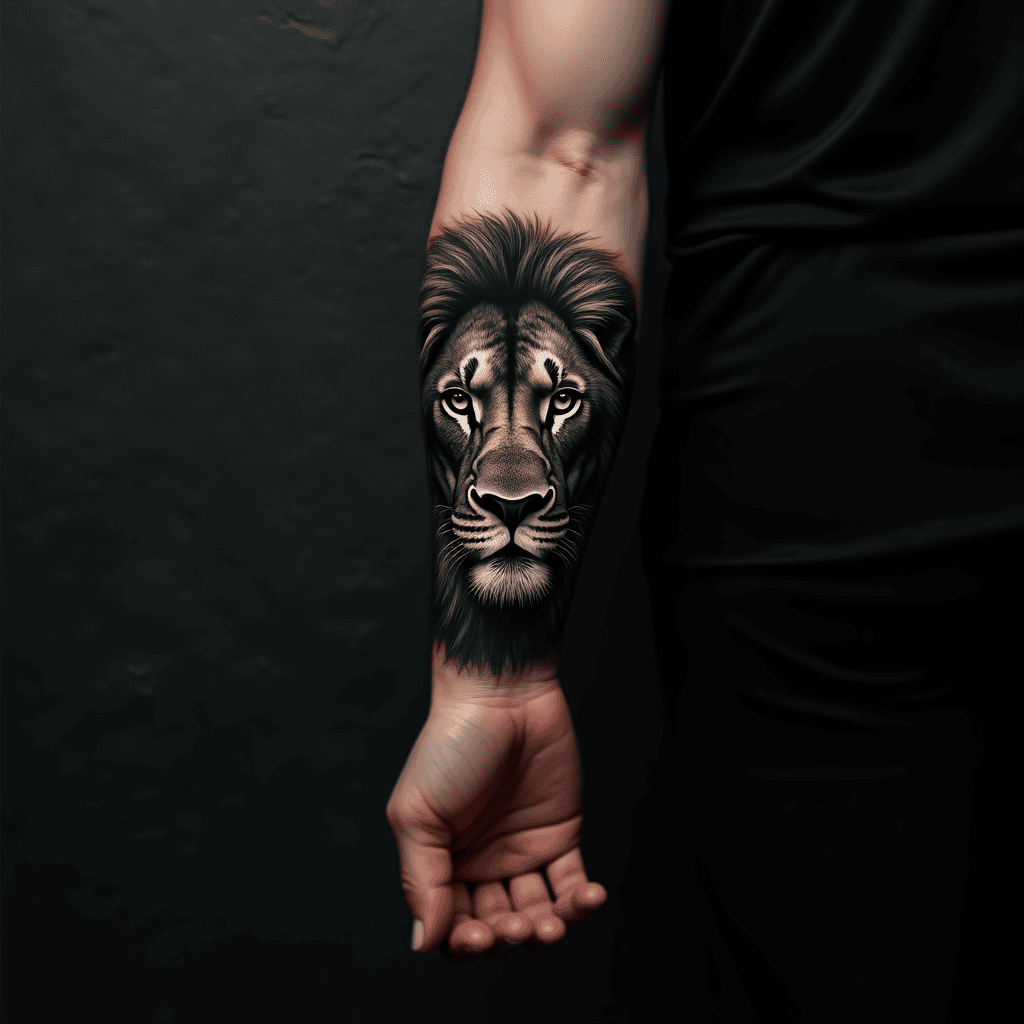
18. Lion Portrait Tattoo
A lion portrait can dominate the outer forearm with the eyes positioned where the arm has enough width to keep them expressive. Rather than rendering every hair individually, larger shadow groups in the mane create clearer depth. The nose and muzzle need solid structural contrast. A subtle fade at the edges prevents the portrait from looking trapped inside an invisible rectangle.
Large animal portraits are among the more demanding forearm tattoo ideas, so this is one to give proper space. Ask for “a black-and-gray lion portrait with sharp facial structure, controlled mane texture, and softly fading edges rather than a hard background.” Avoid shrinking a hyper-detailed face simply because you want room for future tattoos. Portraits usually benefit from claiming their territory.
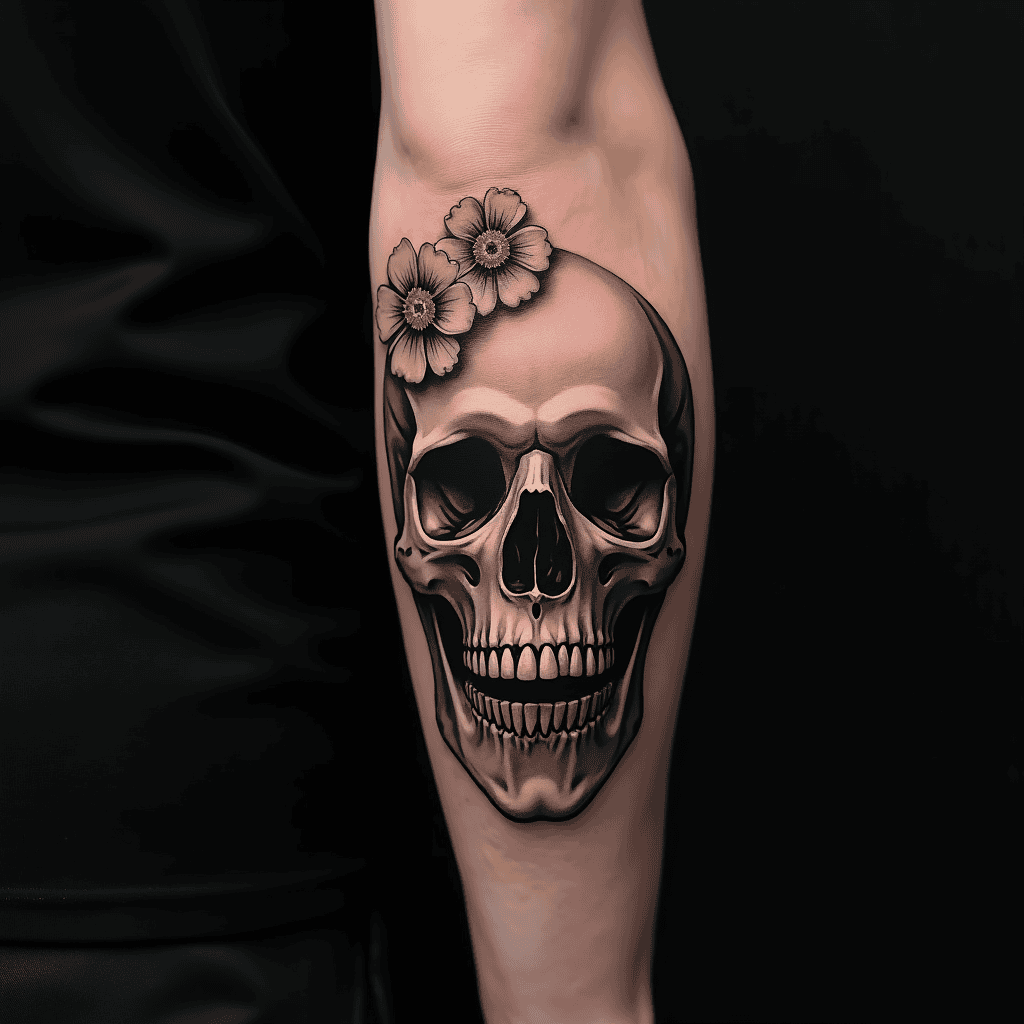
19. Skull and Flower Tattoo
A skull paired with flowers creates immediate contrast between hard bone structure and softer organic shapes. The skull can anchor the upper forearm while petals overlap its side or emerge behind the jaw. Deep black eye sockets create a strong focal point. Keeping some petals lighter stops the entire tattoo from becoming one heavy gray mass.
This design fits men who want darker imagery without making the piece visually flat. Ask for “a realistic skull with one or two botanical elements crossing the silhouette, using deeper blacks in the skull and lighter shading in the flowers.” The common mistake is adding too much filler. Let skin remain visible around parts of the composition so the forms stay separate.
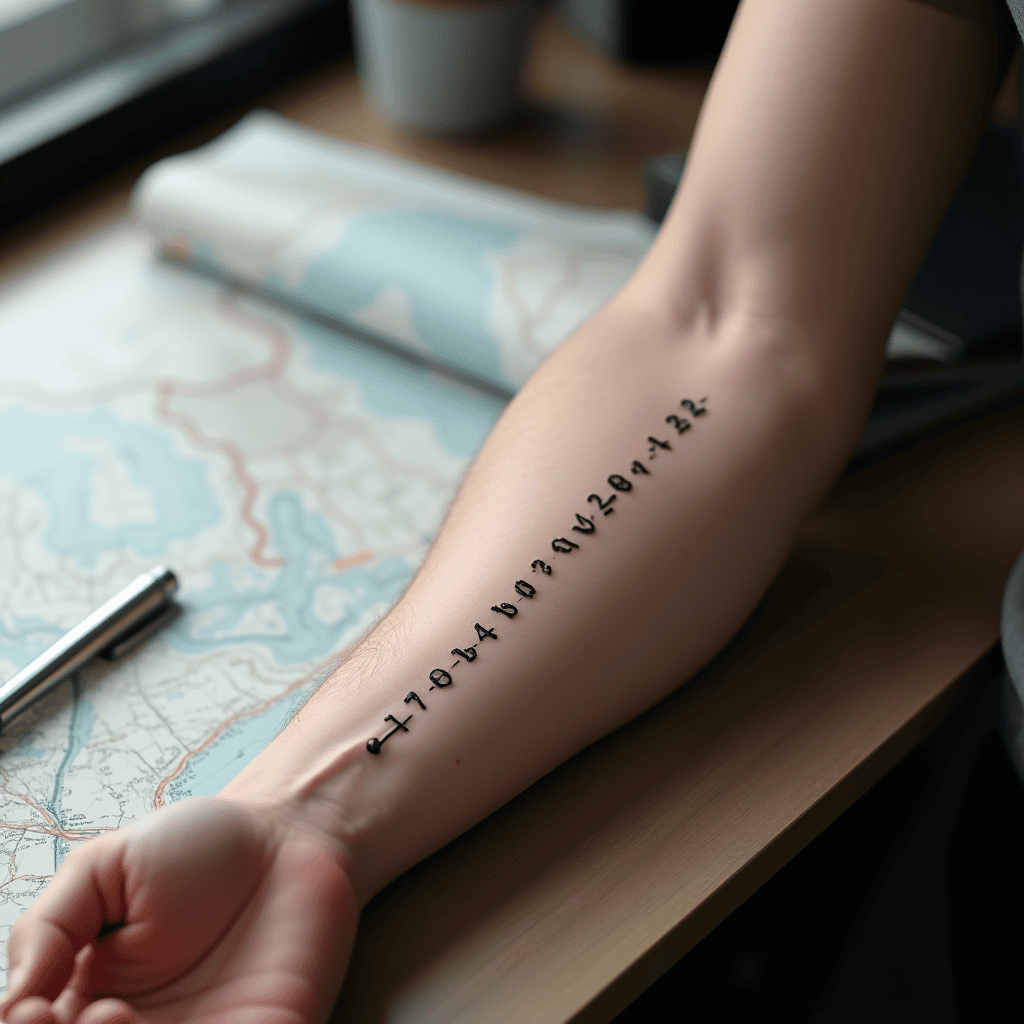
20. Coordinates and Map Line Tattoo
A coordinate tattoo can be paired with a thin route line, simplified map contour, or tiny location marker without needing a full map. The coordinates work well horizontally near the inner wrist or vertically along the inner forearm. A simple geographic outline gives the numbers context while keeping the tattoo restrained. Fine but readable lettering is the priority.
For personal forearm tattoo ideas, this gives you meaning without requiring a large illustration. Ask for “clean coordinates with a simplified map line and enough spacing for every digit to remain distinct.” Verify the coordinates independently before the appointment. Also consider whether you actually want the precise location permanently visible to other people, especially if it points to a private address.
Bold Forearm Tattoo Ideas With More Coverage
Larger forearm tattoo ideas change how the whole arm reads, even when they stop before becoming a full sleeve. They work best when the artist plans the empty areas as carefully as the inked ones and considers how the piece appears from the front, side, and back.
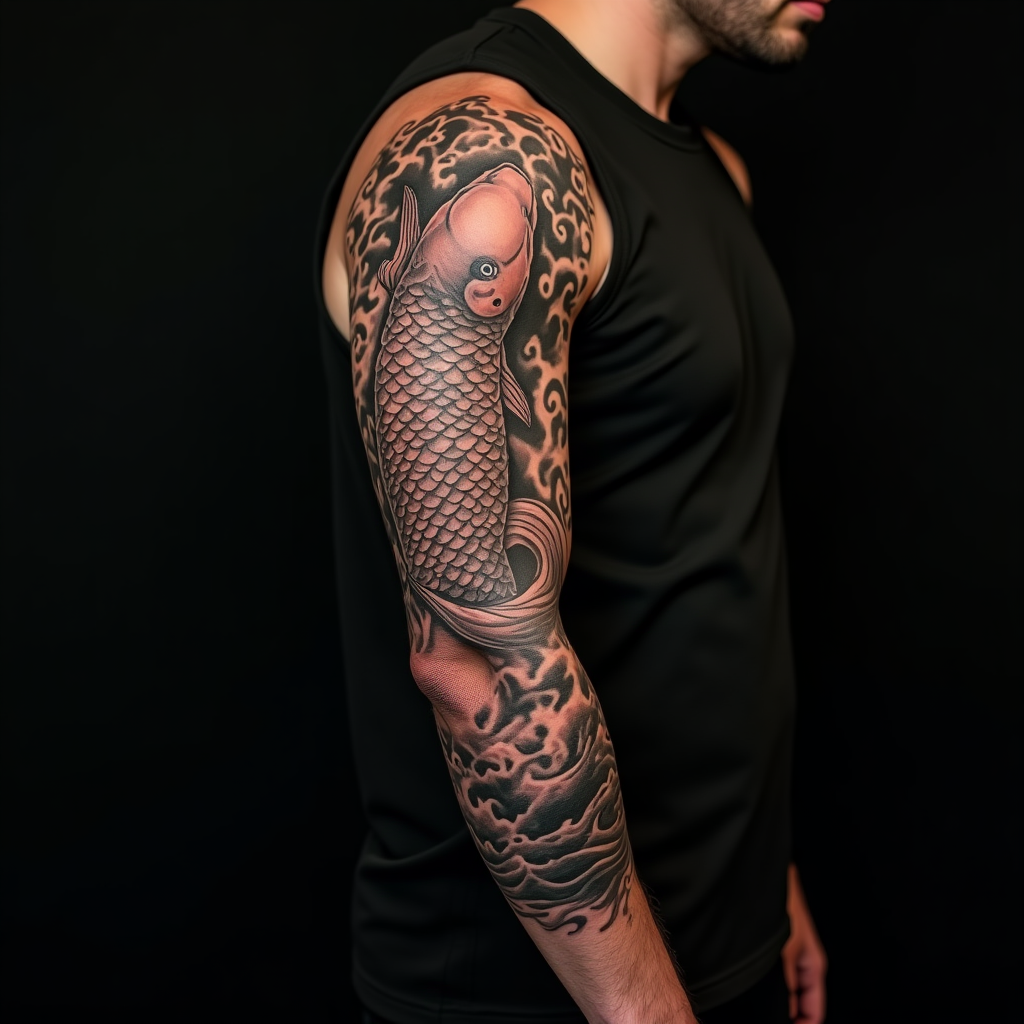
21. Japanese Koi Forearm Tattoo
A koi works naturally as a flowing forearm piece because the body can curve around the arm rather than sitting flat in the center. Scales establish rhythm while fins, water, and small wave shapes create movement around the main fish. The head can sit closer to the elbow, with the tail tapering toward the wrist. Strong black outlines help separate the forms.
This suits someone prepared to give the design real coverage. Ask for “a koi composed to travel with the forearm, with the fish clearly dominant and water used to guide the eye rather than bury it.” Japanese-inspired tattooing has its own visual language, so choosing an artist who understands that composition matters. Randomly combining motifs because they look Japanese can produce a piece with weaker coherence.
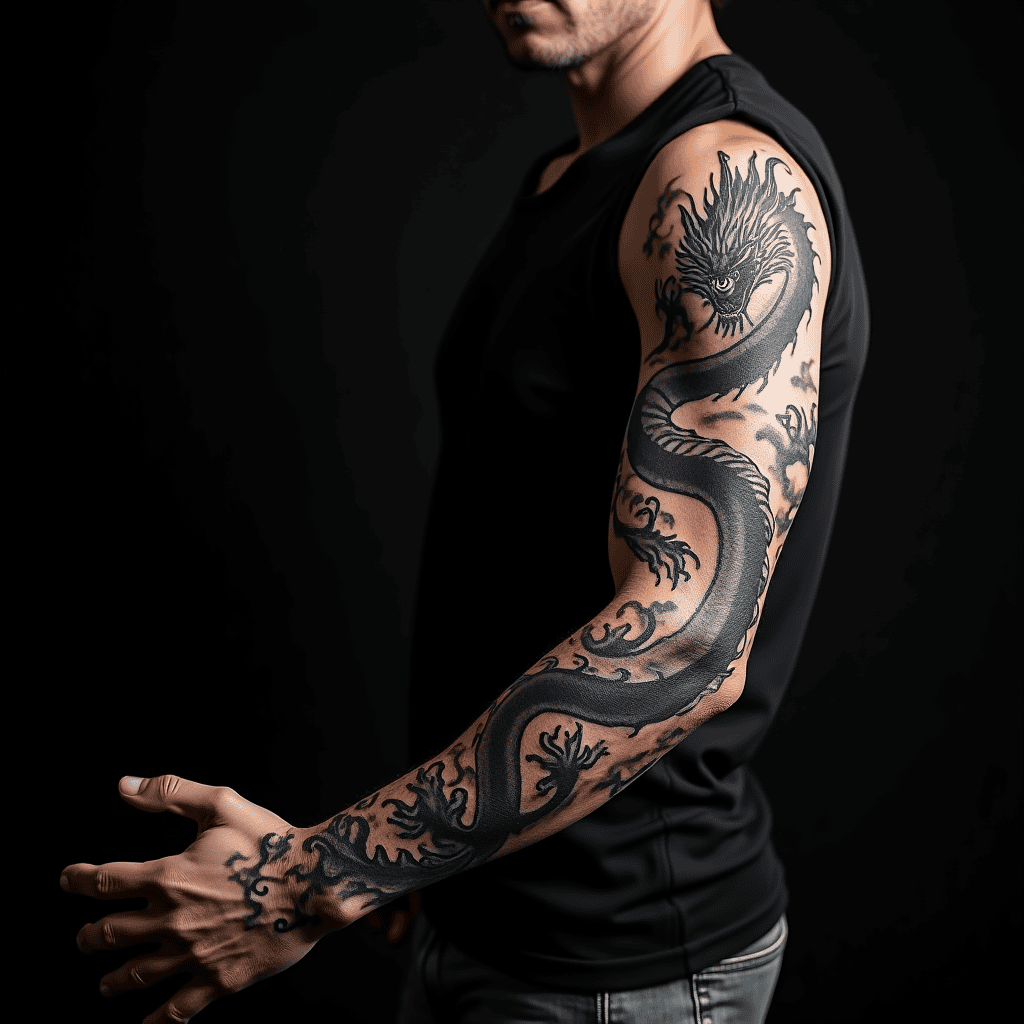
22. Dragon Wraparound Forearm Tattoo
A dragon can spiral around the forearm, allowing its body to appear and disappear as the arm rotates. The head needs a clear viewing angle while claws, scales, and the tail can occupy narrower side areas. Using clouds, smoke, or open skin between sections prevents the long body from becoming visually tangled. The best version rewards looking at the tattoo from several directions.
This is one of the boldest forearm tattoo ideas because the composition controls most of the visible arm. Ask for “a wraparound dragon designed in full rotation, with a clear head focal point and open separation between the body coils.” Don’t approve the design from one flat photograph alone. Have the artist show how the stencil joins around both sides of your forearm.
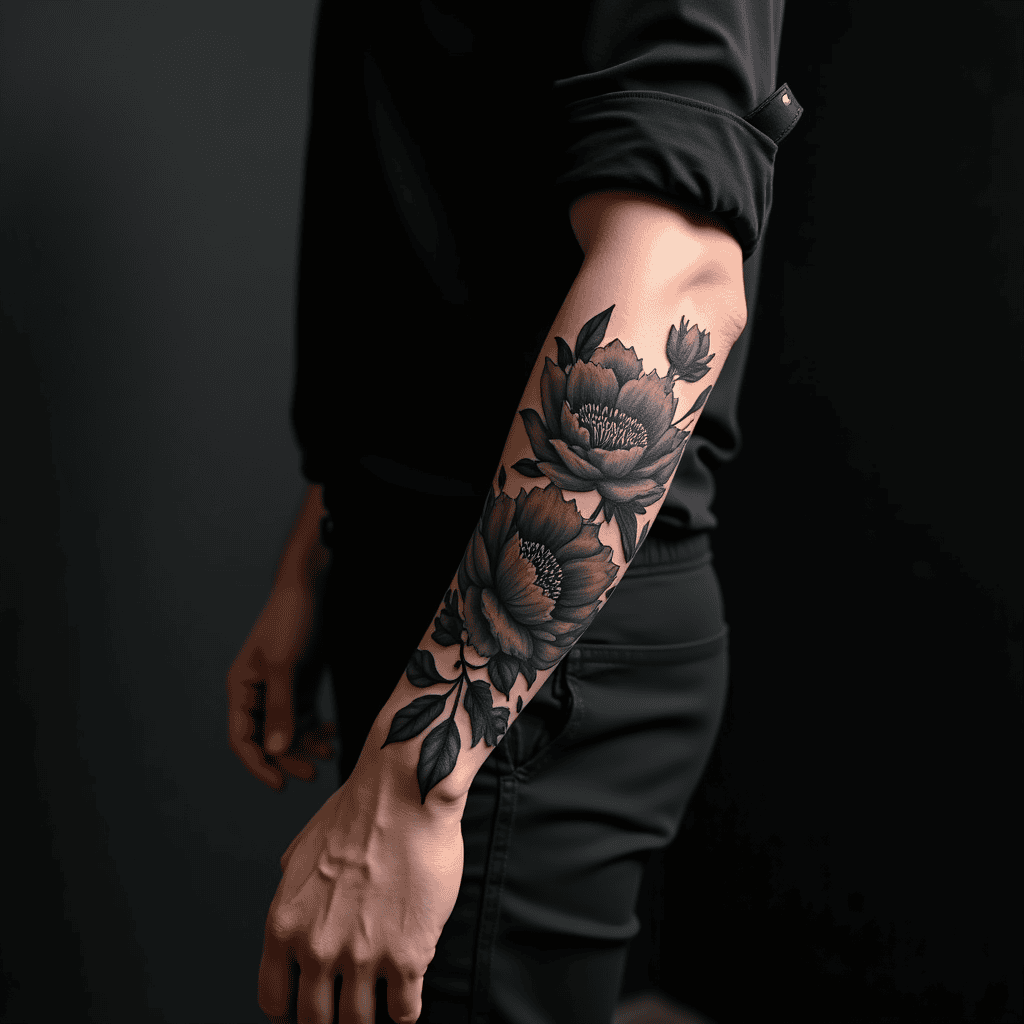
23. Blackwork Floral Forearm Tattoo
Blackwork florals can feel far heavier than fine-line botanical tattoos. Large petals, deep black leaves, and high-contrast shadow sections create a graphic pattern that fills the forearm without requiring realism. Flowers can overlap slightly while still remaining identifiable. Untattooed skin inside selected petals helps break up the darker areas.
This style is a strong option for men who like floral imagery but want more visual weight. Ask for “large blackwork flowers shaped around the forearm, with strong leaf silhouettes and intentional skin breaks inside the petals.” Solid black coverage makes placement changes harder to disguise later. Make sure you’re comfortable with the overall dark-to-skin ratio before starting.
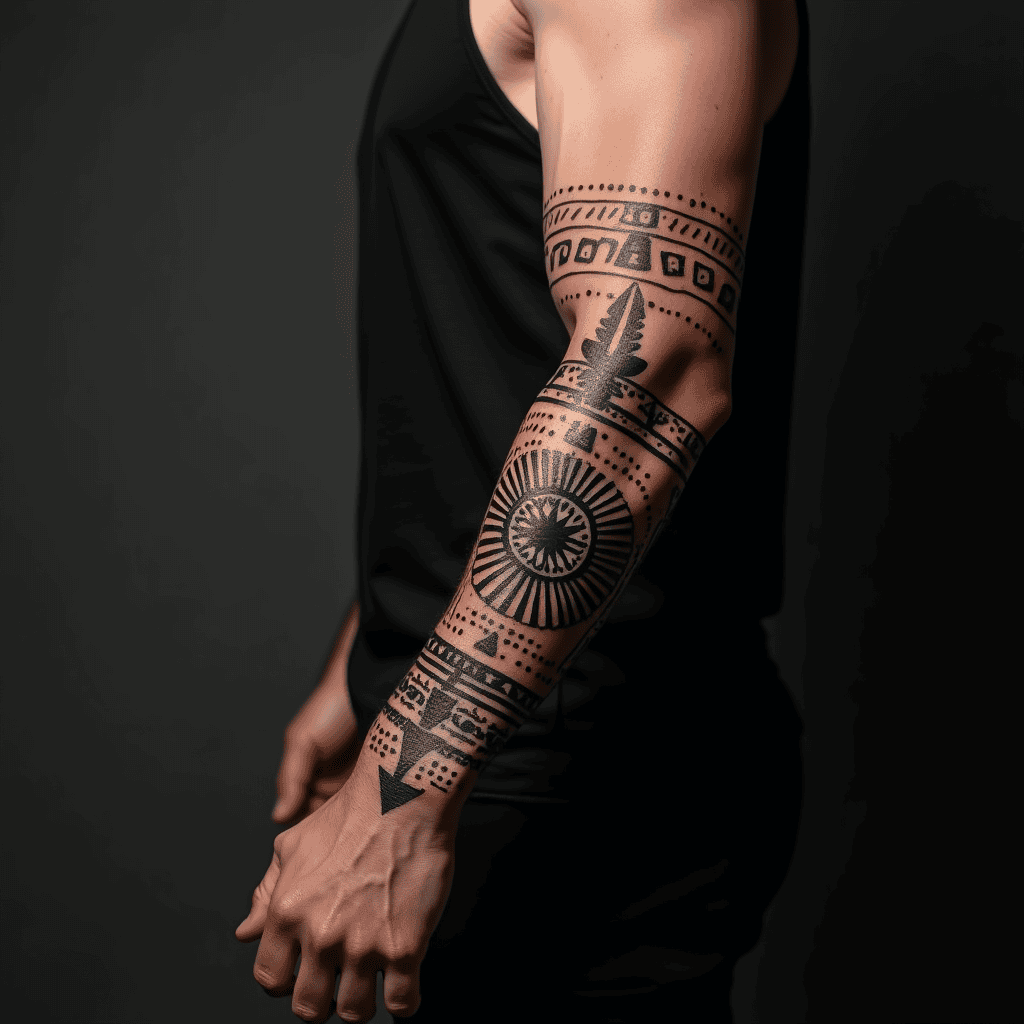
24. Full Geometric Forearm Sleeve
A geometric forearm sleeve can combine radial patterns, bands, dotwork, angular transitions, and large areas of negative space from wrist to elbow. Repeating forms should change in scale as the forearm widens. That prevents the piece from looking like one pattern printed onto a tapered surface. Strong visual breaks help individual sections remain readable.
These high-coverage forearm tattoo ideas work best when planned as one composition from the start. Ask for “a wrist-to-elbow geometric sleeve designed around the taper of my arm, using varied pattern scale and intentional transitions rather than repeating one motif.” Adding disconnected geometric bands over several years can work, but matching spacing and line weight later is harder than planning the framework at the beginning.
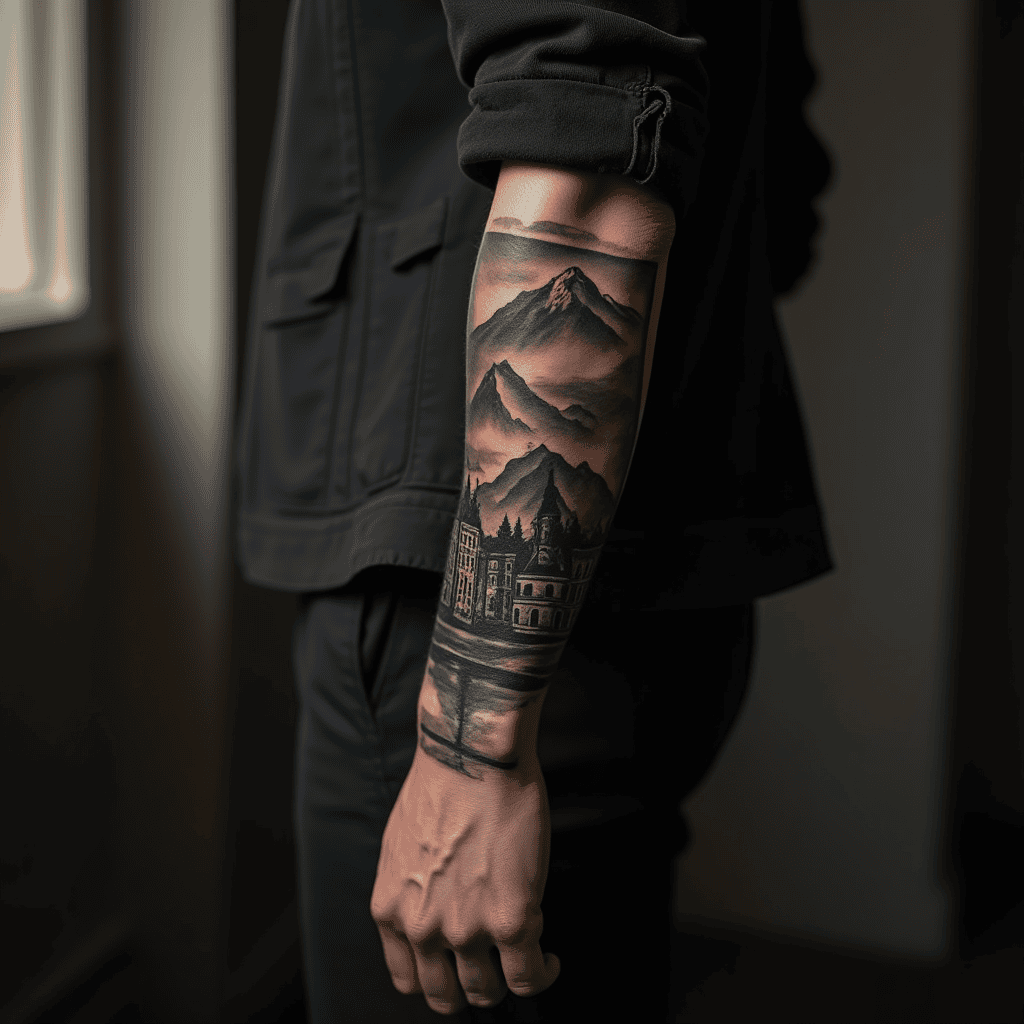
25. Black-and-Gray Story Forearm Piece
A story-based forearm tattoo can combine two or three connected images into one continuous vertical composition. A central portrait, landscape, architectural detail, or symbolic object can act as the main focal point while softer background shading joins the secondary elements. Changing contrast from dark foreground to lighter background creates depth. The piece should still have one obvious visual hierarchy.
This is the most flexible of the larger forearm tattoo ideas, but it also invites overthinking. Ask for “one dominant subject with no more than two supporting elements, composed as a continuous forearm piece rather than separate stickers.” Bring the artist the meaning and references, then allow room for simplification. Trying to fit ten memories into one forearm often makes every part less readable.
How to Choose the Right Forearm Tattoo Idea
Choosing among forearm tattoo ideas starts with deciding how you want the tattoo to behave when your arm is relaxed. Inner-forearm work feels more private because you see it easily while other people usually see it when the arm turns. Outer-forearm tattoos announce themselves more readily and generally offer a broad surface for portraits, animals, and heavier compositions.
Think about scale before detail. Tiny tattoos can look attractive in close photographs, but a design with a wolf face, landscape, clock, or elaborate geometry needs enough physical room for its important shapes to stay distinct. If you’re constantly asking the artist to make the reference smaller, the better move may be simplifying the artwork.
Bring two or three visual references rather than twenty near-identical screenshots. Explain what you like about each one: the darkness, line weight, placement, movement, subject, or amount of open skin. That gives the artist usable direction without asking them to reproduce another person’s tattoo.
Also decide whether future tattoos matter. A centered mid-forearm piece can affect where later work fits, while a well-planned vertical design or wraparound composition may integrate more naturally into a sleeve. If building a larger collection is even a possibility, mention it before the stencil is finalized.
Where Forearm Tattoos Get Oversold
The forearm photographs extremely well, which can make almost any tattoo look stronger online than it does in daily life. Fresh ink is darker, the skin is often prepared carefully, and close-up photography hides how a design reads from normal conversation distance. Choose forearm tattoo ideas based on the healed composition rather than the most dramatic fresh photo you can find.
Micro-detail is another area where expectations can outrun the design. Packing tiny lettering, miniature faces, intricate landscapes, and hair-thin geometry into a small space doesn’t automatically make a tattoo more sophisticated. Often the more confident choice is deleting detail until the important shapes become obvious.
And no, every blank area doesn’t need filler. Stars, dots, smoke, leaves, numbers, lines, and random geometry can weaken a good central image if they’re added only because empty skin feels unfinished. Negative space is part of the tattoo.
Frequently Asked Questions
What are the best forearm tattoo ideas for men?
The best forearm tattoo ideas depend on how much coverage and contrast you want. Fine-line compasses, geometric animals, mountain scenes, traditional daggers, botanical designs, blackwork snakes, and Japanese-inspired pieces all fit the forearm well because their shapes can follow the arm’s natural length.
Is the inner or outer forearm better for a tattoo?
Neither placement is universally better. The inner forearm provides a flatter viewing area and works well for lettering, fine linework, symbols, and detailed compositions. The outer forearm tends to feel more visually prominent and offers excellent space for animals, portraits, traditional pieces, and heavier blackwork.
What forearm tattoos work well for a first tattoo?
Simple mountain outlines, arrows, Roman numerals, botanical branches, and modest geometric designs are approachable choices because their size can be controlled easily. A first tattoo doesn’t need to be tiny. A slightly larger, simpler composition can sometimes look cleaner than an extremely small piece packed with detail.
How big should a forearm tattoo be?
Size should follow the design rather than an arbitrary measurement. Minimal symbols may need little space, while portraits, landscapes, animals, and layered compositions benefit from more room. Have your artist test several stencil sizes on the actual forearm before choosing, since screen references can distort your sense of scale.
Do fine-line forearm tattoos look masculine?
Fine-line work isn’t inherently masculine or feminine. Subject, scale, placement, spacing, and composition influence the overall character more than line thickness alone. A fine-line compass, mountain scene, geometric symbol, or botanical piece can look restrained and sharp without requiring heavy blackwork.
What forearm tattoo ideas age the best visually?
Clear silhouettes, deliberate spacing, readable lettering, and designs that aren’t overloaded with microscopic detail tend to remain easier to interpret as the tattoo matures. Long-term appearance varies with the design, execution, skin, sun exposure, and aftercare, so discuss your specific concept with an experienced tattoo artist.
Should a forearm tattoo face toward me or away from me?
Orientation depends on the subject and your preference. Many figurative designs are placed so they appear upright to another viewer when your arm hangs naturally. Personal symbols and lettering are sometimes oriented toward the wearer instead. Ask to see the stencil from both viewpoints before deciding.
Can a forearm tattoo become part of a sleeve later?
Yes. Many forearm tattoo ideas can serve as the starting point for a larger sleeve if their placement leaves logical routes for future artwork. Tell the artist about your long-term plans so the first piece doesn’t occupy an awkward central area that makes later transitions unnecessarily difficult.
Are wraparound forearm tattoos harder to plan?
They require more attention because the design needs to work across a three-dimensional surface. Bands, snakes, dragons, vines, waves, and geometric patterns should be checked from several angles. A composition that looks perfect from one viewpoint may reveal awkward joins when the forearm rotates.
Should I choose black-and-gray or color for my forearm tattoo?
Choose according to the artwork and the overall collection you want. Black-and-gray creates strong continuity across realism, geometry, lettering, and blackwork. Color can make traditional, Japanese-inspired, botanical, and illustrative designs more expressive. Mixing both can also work when the artist establishes a clear visual hierarchy.
How do I explain my forearm tattoo idea to an artist?
Describe the subject, approximate coverage, placement, darkness, and the qualities you like in your references. Instead of asking to copy a photo, say what matters: “I like this amount of negative space, this heavier outline, and the way the design follows the arm.” That gives the artist useful creative direction.
How many elements should be included in one forearm tattoo?
Usually fewer than people initially imagine. One strong focal subject plus one or two supporting elements often creates a clearer composition than a collage of unrelated symbols. If every element has equal visual importance, the eye has nowhere to settle and the forearm can start looking crowded.
Can minimalist forearm tattoo ideas still stand out?
Yes. Minimalism relies on proportion, placement, and confident linework rather than complexity. A single arrow, compass, geometric symbol, short numeral sequence, or mountain outline can command attention when it sits naturally on the forearm and has enough empty space around it.
What should I bring to a forearm tattoo consultation?
Bring a few references showing the visual direction you like, plus examples of placement and approximate coverage. Explain which parts are essential and which can change. Wear clothing that gives easy access to the whole arm so the artist can assess how the design will sit from wrist to elbow.
How do I avoid choosing a forearm tattoo I’ll quickly outgrow?
Separate the subject from the trend surrounding it. Ask yourself whether you still like the underlying image after removing the fashionable framing, typography, or social-media styling. Then let the tattoo artist develop an original composition around that subject rather than tracing a currently popular reference.
The best forearm tattoo rarely comes from finding the busiest reference image and reproducing every detail. Start with one idea you genuinely want to keep looking at, decide how boldly you want it to occupy your arm, and give the composition enough room to work. Strong forearm tattoo ideas become stronger when an experienced tattoo artist adapts them to your individual proportions. Take your top two references to a consultation and build the final design around your actual forearm.
Best Tattoo Design Reports
Explore sleeve, minimalist, Japanese, blackwork and modern tattoo ideas created for men’s style inspiration.