

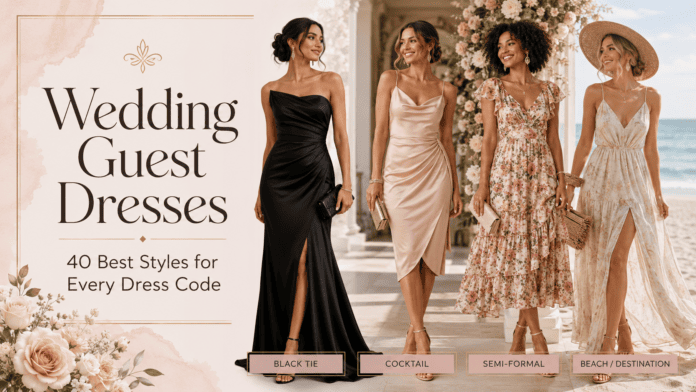
A wedding guest dress has to solve more than one problem. It needs to respect the invitation, suit the venue, survive several hours of sitting and dancing, and still feel like something you would willingly wear again. The best wedding guest dresses start with the dress code, then adjust for season, setting, fabric, and time of day.
Formal language on invitations matters. Black tie sits near the top of the traditional dress-code scale, while semi-formal and informal weddings allow progressively more flexibility. Venue and cultural or religious expectations can change what is appropriate even within the same dress code.
Current fashion also gives guests more room to move beyond the predictable floral midi. Wedding-guest dressing in 2026 includes clean ’90s-inspired silhouettes, delicate lace, draping, saturated color, rich satin, and seasonally heavier textures such as velvet.
The trick is knowing which version belongs at which wedding.
White-Tie and Black-Tie Wedding Guest Dresses
White tie and black tie call for the strongest level of formality. A floor-length evening gown remains the clearest choice for white tie, while black tie permits formal gowns and, depending on the event, exceptionally polished cocktail dresses.
1. Floor-Length Column Gown
A column gown creates formality through length and clean proportion rather than oversized volume. The silhouette falls almost vertically from the shoulders or hips, which gives it a controlled evening look.
Crepe, silk, satin, and substantial jersey work particularly well because the fabric needs enough weight to hang smoothly. Deep navy, burgundy, emerald, chocolate, aubergine, and black are reliable colors for evening ceremonies.
This style works especially well when you want black-tie polish without looking as though you borrowed a bridesmaid gown. Add a sculptural earring and small evening bag instead of piling on accessories.
2. Classic A-Line Evening Gown
An A-line gown remains one of the easiest formal silhouettes to wear for a long wedding day. The bodice is shaped through the torso before the skirt gradually widens, leaving more movement around the hips and legs.
For black tie, look for a floor-length version in satin, crepe, chiffon, velvet, or another fabric with an unmistakably evening finish. A heavily gathered cotton A-line dress belongs to a different dress code even if the hem reaches the floor.
The silhouette also accommodates many necklines, from square and bateau to V-neck and halter.
3. Draped Jersey Gown
Draping changes a simple stretch fabric into something far more formal. Look for gathered waistlines, asymmetric ruching, twisted necklines, or fabric pulled diagonally across the body.
A well-cut jersey gown has another practical advantage: it tolerates sitting, dinner, and dancing better than highly rigid formalwear.
Keep the finish refined. Dense, matte or subtly lustrous jersey reads differently from thin casual knit fabric. This distinction matters under evening lighting, where inexpensive clingy material can expose every seam and undergarment line.
4. One-Shoulder Crepe Gown
An asymmetric neckline provides enough visual interest that the rest of the dress can stay restrained. A one-shoulder gown in heavyweight crepe is particularly effective because the fabric holds its line without requiring sequins, crystals, or elaborate embellishment.
Keep the hem long for black tie. A fitted waist with a straight or gently flared skirt makes the strongest case for formal dressing.
Because the neckline already creates a focal point, skip a necklace. Earrings or a cuff usually look cleaner.
5. Velvet Evening Gown
Velvet makes the most sense when the temperature supports it. For late-autumn and winter weddings, its depth and pile can make a relatively simple silhouette look substantially more formal.
Current autumn styling has also brought velvet and other tactile fabrics back into wedding-guest wardrobes alongside satin and richer seasonal colors.
Choose a column, wrap, draped, or softly fitted shape rather than adding too much volume. Velvet already has visual weight. Forest green, blackberry, wine, midnight blue, espresso, and black tend to suit the material particularly well.
6. Black Satin Maxi Dress
Black is no longer limited to funerals and cocktail parties. At many modern Western weddings, a well-chosen black dress is completely workable, particularly for an evening or black-tie celebration.
A satin maxi keeps the idea celebratory. Look for a clean neckline, fluid skirt, fitted waist, or subtle open back rather than severe office-style tailoring.
Black also gives you more room with accessories. Metallic shoes, colored stones, a textured clutch, or sculptural jewelry can stop the outfit from feeling flat.
For culturally specific weddings, however, local expectations should take priority over generic fashion rules.
7. Jewel-Tone Halter Gown
A halter neckline naturally directs the eye upward and exposes the shoulders, which can balance the visual weight of a floor-length skirt.
Sapphire, emerald, garnet, plum, and deep teal work particularly well at formal evening weddings because the colors retain depth under artificial lighting.
Fit deserves attention here. The bodice should stay secure without constant adjustment, and the fabric around the neck should not pull once you have been wearing it for several hours. Formalwear that looks good only while standing still becomes frustrating surprisingly quickly.
8. Cape-Sleeve Evening Gown
A cape sleeve gives a gown movement without requiring a large skirt. Fabric falls from the shoulders or upper bodice and moves separately from the main silhouette, creating drama when you walk.
It is useful for guests who want arm coverage without wearing a blazer or wrap throughout the reception.
Keep the rest of the design simple. A cape combined with heavy beading, oversized ruffles, and a dramatic train can cross from guest attire into performance costume. The best version relies on proportion rather than decoration.
Formal and Black-Tie Optional Styles
Black-tie optional and formal weddings create more flexibility. A floor-length dress still works, but a polished midi or tea-length design can also make sense when its fabric and construction carry enough formality.
9. Bias-Cut Satin Maxi Dress
The bias cut is one reason ’90s-style dresses have remained useful rather than disappearing after a single trend cycle. Cutting fabric diagonally across the grain gives it a softer, closer drape without requiring complicated tailoring.
Vogue has highlighted the continuing ’90s influence in 2026 wedding-guest dressing, including pared-back, slinky dresses that can be restyled beyond weddings.
For a formal event, choose substantial satin and a midi-to-maxi hem. Minimal does not mean underdressed when the fabric, fit, shoes, and jewelry are deliberate.
10. Structured Tea-Length Dress
A tea-length hem usually lands somewhere between the lower calf and ankle. That exposed section of leg makes the silhouette less ceremonial than a floor-length gown, while a structured fabric restores much of the formality.
Faille, mikado-style fabrics, jacquard, and heavier satin are particularly effective.
This shape suits daytime formal weddings, historic venues, hotel ceremonies, and events where a full gown feels excessive. It also lets a strong shoe become part of the outfit rather than disappearing under the skirt.
11. Sculpted Midi Dress
A sculpted midi depends on construction: shaped seams, defined shoulders, controlled pleating, strategic folds, or a fitted bodice that gives the dress architecture.
Because the silhouette does the work, it can stay in a single color.
Try wine, cobalt, plum, dark green, chocolate, rust, or saturated pink. A strong solid shade often feels more formal than a busy print, especially when the dress has a precise cut.
12. Draped Cowl-Neck Maxi Dress
A cowl neckline softens a long, relatively narrow dress by allowing fabric to fall naturally across the chest.
The effect works particularly well in silk-like fabrics because the folds catch light differently as you move. Pair it with a low bun or swept-back hair if you want the neckline to remain visible.
Avoid extremely loose cowl designs that collapse into the bodice. There should still be enough shape through the waist and hip to keep the dress from reading like sleepwear.
13. Long-Sleeve Satin Gown
Coverage does not automatically make a dress conservative or plain. A fluid satin gown with long sleeves can look particularly strong at cool-weather evening weddings.
The key is balancing fabric. Long sleeves, a high neckline, and a completely straight skirt can create too much uninterrupted material. A defined waist, open neckline, cuff detail, or controlled slit gives the silhouette some relief.
Long sleeves are also convenient at venues where you would otherwise spend half the reception carrying a shawl.
14. Pleated Chiffon Maxi Dress
Fine pleating creates movement without the heaviness of a full gathered skirt. Chiffon keeps the overall impression lighter, making this a useful option for spring and summer formal weddings.
Look for a lined design with a clearly shaped bodice. Sheer fabric should be an intentional outer layer, not an accidental transparency problem.
Soft blues, berry tones, greens, botanical colors, and darker pastels can work well when you want color without relying on a print.
15. Off-the-Shoulder Formal Gown
An off-the-shoulder neckline gives a formal gown a wide horizontal line across the collarbone. That makes it particularly effective with column, mermaid, and controlled A-line skirts.
Before committing, test the dress while sitting and raising your arms. Some versions look excellent in a fitting room but migrate upward every time you move.
For religious ceremonies or conservative venues, bring a proper wrap or choose another neckline if exposed shoulders conflict with the setting. Emily Post specifically notes that houses of worship and cultural traditions may impose additional clothing expectations.
Cocktail and Semi-Formal Wedding Guest Dresses
Cocktail dressing sits between casual daytime clothing and full evening formalwear. Knee, tea, and midi lengths are traditional territory, although contemporary versions can play with asymmetry, tailoring, texture, and color.
16. Classic Cocktail Midi Dress
Start with the most useful option: a fitted or gently shaped midi with a clean neckline and defined waist.
The hem makes it easier to wear than a gown, yet the extra length feels more occasion-specific than an everyday short dress. Crepe, satin, jacquard, lace, and finely woven fabrics all work.
A simple cocktail midi also gives accessories somewhere to go. Add a metallic sandal for evening, a slingback for daytime, or a small structured bag when you want a more tailored finish.
17. Asymmetric Midi Dress
An uneven neckline or hem gives a relatively simple cocktail dress a sharper identity.
One-shoulder necklines, diagonal draping, asymmetric pleats, and angled hems all create movement without requiring embellishment.
Choose one asymmetrical feature rather than several. A diagonal neckline plus a dramatically uneven skirt plus cutouts can make the design visually restless. One strong line is usually enough.
18. Jewel-Tone Wrap Dress
A wrap dress has earned its place in occasion dressing because the diagonal closure naturally defines the waist while leaving movement through the skirt.
For weddings, fabric determines whether the design looks polished or everyday. Matte jersey works for relaxed semi-formal events; velvet, silk blends, crepe, and satin move the same silhouette higher on the formality scale.
Watch the neckline while sitting. Fashion tape or a small hidden snap can prevent a deep wrap front from becoming a distraction.
19. Square-Neck Fit-and-Flare Dress
A square neckline works particularly well with a fitted bodice because it creates a clean frame around the collarbone.
Pair that bodice with a softly flared midi skirt and you have a dress that suits afternoon weddings, country venues, estate ceremonies, and semi-formal receptions.
The shape does not need vintage styling. Solid colors and minimal accessories keep it current, while a subtle floral or jacquard can take it in a more romantic direction.
20. Draped Midi Dress
Draping is one of the easiest ways to make an uncomplicated dress feel considered. Current wedding-guest selections have leaned into artful gathered and draped silhouettes alongside brighter seasonal colors.
Look for ruching concentrated around one area rather than the entire dress. A draped waist or hip can define the silhouette; excessive gathering everywhere often adds bulk without creating a clear shape.
This style is especially useful when you want a fitted dress that does not cling uniformly from shoulder to hem.
21. Delicate Lace Midi Dress
Lace is prominent in current occasionwear, but wedding guests need to use it selectively because lace also has a strong bridal association.
Choose an unmistakably non-bridal color such as navy, plum, rust, forest green, black, blue, or pink. Colored lining also helps separate the dress visually from bridalwear.
Avoid white, ivory, cream, champagne, and very pale lace combinations unless the couple has specifically requested that palette.
22. Jacquard Cocktail Dress
Jacquard creates pattern through the woven structure of the fabric rather than relying only on a printed surface. That extra texture makes even a relatively simple silhouette feel substantial.
It works particularly well for cooler-season weddings and evening cocktail receptions.
Because jacquard can be stiff, fit matters around the waist and hips. The material does not always collapse softly when sitting, so a little ease is more useful than an aggressively tight fit.
23. Little Black Midi Dress
A black midi is the wedding equivalent of a reliable reserve player: easy to restyle, appropriate for a wide range of evening venues, and unlikely to look dated after one season.
The wedding version should differ from an office dress. Try an open neckline, draped bodice, lace detail, satin finish, asymmetric cut, or shaped skirt.
Color can come from accessories. Emerald earrings, burgundy shoes, a metallic bag, or a patterned wrap changes the whole look without requiring another dress.
Dressy Casual and Daytime Wedding Styles
“Casual wedding” does not usually mean whatever you wear on an ordinary Saturday. The invitation still marks a celebration. Dressy casual sits between everyday clothing and cocktail wear, while venue and time of day determine how far you can relax the outfit.
24. Floral Midi Dress
The floral midi remains useful because it naturally fits gardens, daytime ceremonies, vineyards, restaurants, and outdoor spring weddings.
The difference between fresh and predictable lies in the print. Oversized botanicals, abstract florals, watercolor effects, scattered micro-flowers, and dark-ground florals each create a different level of visual weight.
Current summer wedding dressing continues to feature delicate florals, so the idea is not disappearing; it is simply being styled with cleaner shoes and less fussy accessories.
25. Printed Wrap Midi Dress
A printed wrap dress works when the celebration calls for more ease than cocktail attire but still requires clear effort.
Botanical, geometric, abstract, and softly patterned fabrics all work. Avoid prints so small and casual that the dress starts to resemble daytime errands rather than event dressing.
Finish it with a proper shoe and bag. A dressy casual invitation gives you freedom, but worn-out flats and an oversized everyday tote can drag even a good dress down a full level of formality.
26. Linen-Blend Midi Dress
Linen earns its place at hot outdoor weddings because its open weave and dry hand feel more comfortable than many dense, glossy fabrics.
Pure linen wrinkles aggressively, which is part of its character but not always ideal for a ceremony. A linen blend can maintain more structure while keeping much of the breathable feel.
Choose a shaped bodice, full midi skirt, halter neckline, or tailored waist rather than a loose beach cover-up silhouette. The fabric may be relaxed; the cut should still acknowledge the occasion.
27. Puff-Sleeve Midi Dress
A controlled puff sleeve introduces volume high on the body, so the rest of the dress generally benefits from cleaner lines.
A fitted waist and A-line or straight midi skirt create the easiest balance.
This works particularly well for garden, farmhouse, estate, and daytime weddings where a severe cocktail dress might feel disconnected from the surroundings. Keep the sleeve proportional. Huge theatrical sleeves quickly become inconvenient at dinner tables and crowded receptions.
28. Halter-Neck Midi Dress
The halter midi bridges daytime and evening particularly well. In cotton blends or linen it can suit a warm garden wedding; in satin or crepe it moves closer to cocktail territory.
Because the shoulders are exposed, the silhouette already has a strong upper-body line.
Try it with hair pulled back and medium-size earrings rather than adding a necklace that competes with the neckline.
29. Tiered Chiffon Dress
Tiered skirts are most successful when the material is light enough to move. Chiffon lets each layer fall rather than sticking out rigidly.
A midi or ankle-skimming length works for garden weddings and warm-weather venues where a fitted cocktail dress may feel overly severe.
Avoid excessive tiers combined with ruffles at the neck, sleeves, and bodice. Once everything moves, nothing becomes the focal point.
30. Polished Shirt Dress
A shirt dress can attend a wedding, but it needs to be several steps removed from office wear.
Look for silk-like fabric, a defined waist, pleated skirt, asymmetric hem, dramatic cuff, or saturated color. A longer midi hem also helps.
This option is particularly useful for daytime restaurant weddings, courthouse celebrations, city ceremonies, and events where a cocktail dress would look overdressed at noon.
31. Belted Full-Skirt Midi
A fitted waist and generous midi skirt create a strong occasion silhouette without requiring fragile fabric.
The style works well in poplin blends, faille, jacquard, and structured cotton, making it practical when temperatures are too high for heavy satin.
Shoes matter because they remain visible. Slingbacks, low heels, pointed flats, and block heels can all work depending on the venue.
32. Soft Pastel Midi Dress
Pastels belong naturally to spring weddings, but color choice requires some judgment. Dusty blue, lavender, sage, soft peach, muted yellow, and cool pink can read distinctly non-bridal.
The risky zone is not “light color” in general. It is a dress so close to white, ivory, cream, or bridal champagne that photographs make the distinction disappear.
When you find yourself explaining, “It only looks white in certain lighting,” choose another dress.
Beach, Garden, Destination and Outdoor Wedding Dresses
Venue affects more than the mood of an outfit. Sand, grass, humidity, heat, wind, travel, and uneven ground all change what remains practical after the ceremony starts.
33. Lightweight Chiffon Maxi Dress
A chiffon maxi gives destination weddings the movement of a gown without the density of traditional formal fabrics.
For seaside or tropical settings, look for a restrained skirt rather than several meters of fabric. Wind turns dramatic volume into something you have to manage continuously.
Printed chiffon can suit a less formal destination wedding, while a solid jewel or bright color pushes the same basic shape toward evening formality.
34. Bright-Colored Slip Dress
Tangerine, cobalt, raspberry, turquoise, sunny yellow, and vivid green are particularly effective when the silhouette itself is pared back.
Bright color has been a noticeable feature of recent summer wedding-guest styling, where simple dresses gain impact through hue instead of extra decoration.
Balance is important. A saturated slip dress already commands attention, so neutral or metallic shoes and a compact bag usually do enough.
35. Botanical-Print Maxi Dress
A botanical maxi is a natural fit for garden, vineyard, resort, and outdoor estate weddings.
Large-scale leaves and florals tend to look more intentional on a long skirt than tiny repetitive motifs, although the fabric and color palette matter as much as pattern size.
Check the base color. A heavily white or ivory floral can still photograph as predominantly white, even when half the surface is covered by flowers.
36. One-Shoulder Resort Maxi
A lightweight one-shoulder maxi works especially well at destination weddings because the shape feels polished without relying on layers.
Viscose blends, silk blends, light crepe, and airy woven fabrics travel more easily than highly structured gowns.
Before packing it, hang the dress overnight and test your steaming plan. Destination dressing gets less glamorous when a delicate fabric emerges from a suitcase looking like folded paper.
37. High-Low Hem Dress
A high-low hem solves a practical outdoor problem: the front stays away from grass, sand, and steps while the back retains some of the movement of a longer dress.
The difference between sophisticated and dated lies in how dramatic the height difference becomes. A subtle diagonal or graduated hem generally feels cleaner than an extremely short front paired with a floor-sweeping back.
Block heels or polished flats make the most sense on soft ground.
38. Garden-Party Fit-and-Flare Dress
For a true garden-party dress code, a knee-to-midi-length fit-and-flare shape can be more appropriate than a satin gown.
Choose botanical color, texture, embroidery, or a print, then keep the silhouette easy enough to move outdoors.
The overlooked decision is footwear. Heel shape can matter more than heel height on lawn. A comfortable narrow heel can sink into soft ground, whereas a modest block heel gives a wider contact point. Venue surface deserves to be part of the outfit decision.
39. Beach Wedding Halter Maxi
Beach attire works best when it responds to actual beach conditions rather than simply adding tropical flowers to a formal dress.
A halter maxi in a light woven fabric keeps the shoulders open and allows air movement around the body. An ankle-length hem may be easier than a true floor-length design if the ceremony takes place directly on sand.
Skip heavy beading. Weight, heat, humidity, and salt air give you enough to deal with already.
40. Sunset Satin Midi Dress
For destination ceremonies that begin in late afternoon and move directly into an evening reception, a satin midi is one of the strongest compromises.
It looks polished after dark yet avoids the heat and physical bulk of a full evening gown during the ceremony. Warm coral, terracotta, bronze, olive, berry, turquoise, and deep blue all respond well to changing evening light.
Pair it with a stable sandal if the venue includes stone, grass, decking, or uneven outdoor paths. The dress should make the event easier to enjoy, not turn every walk between spaces into a balancing exercise.
How to Match a Dress to the Wedding Dress Code
The invitation comes first. A beautiful dress that ignores “black tie” is still the wrong dress, and an elaborate gown can feel equally misplaced at a casual noon ceremony.
A practical hierarchy looks like this:
| Dress Code | Safest Dress Direction |
|---|---|
| White Tie | Floor-length evening gown |
| Black Tie | Formal floor-length gown or exceptionally dressy cocktail option |
| Black-Tie Optional | Gown, polished maxi, formal midi or tea-length dress |
| Formal | Long dress, dressy midi or elevated cocktail style |
| Cocktail | Knee, tea or midi cocktail dress |
| Semi-Formal | Cocktail dress, polished midi or dressy separates |
| Dressy Casual | Midi, wrap dress, shirt dress or elevated daytime dress |
| Casual Wedding | Refined sundress, printed dress or relaxed polished midi |
| Beach | Breathable midi or maxi with practical footwear |
| Garden | Floral, botanical, linen-blend or structured daytime dress |
Traditional etiquette also gives time of day some weight. Evening events generally support darker colors and higher formality, while daytime celebrations allow lighter fabrics and more relaxed styling.
Which Colors Should Wedding Guests Avoid?
White remains the easiest color to avoid unless the couple specifically requests it. Extend the same caution to ivory, bridal cream, and dresses that photograph as almost entirely white.
Red requires more cultural awareness. It may be acceptable at many Western weddings, but red carries bridal significance in some Chinese and Indian wedding traditions, so the same dress can be appropriate at one celebration and inappropriate at another.
Black is generally far easier to wear at modern evening weddings than old etiquette stereotypes suggest, although cultural and family expectations still deserve consideration.
The wedding-party palette is another clue. If you know the bridesmaids will all wear sage satin, choosing an almost identical sage satin gown may make you look unintentionally assigned to the bridal party.
Let the Venue Change Your Shoes, Fabric and Hem
A dress code tells you how formal to look. The venue tells you whether your outfit will function.
Grass favors wedges, block heels, wider heels, or flats over narrow stilettos. Sand makes long dragging hems and formal pumps harder to manage. Historic buildings may involve stairs. Outdoor receptions can become much colder after sunset than they felt when guests arrived.
Weather changes fabric too. Lightweight chiffon, linen blends, cotton blends, light crepe, and airy silk-like fabrics make more sense in heat than dense velvet or heavy satin. Cooler weddings give you more room for sleeves, velvet, jacquard, substantial crepe, and layered styling.
This practical layer is one reason there is no universal “best wedding dress.” Even Vogue’s current wedding-guest guidance treats dress code and climate as separate problems that need to be solved together.
Choosing a Wedding Guest Dress You Will Actually Wear Again
The most useful wedding guest dresses are not necessarily the loudest ones. A well-cut slip dress can return for dinners. A black midi can handle several different invitation types. A printed wrap dress works for showers, parties, vacations, and daytime events. A clean formal gown can change significantly when you switch jewelry, shoes, hair, and outerwear.
That approach also fits the current move toward simpler ’90s silhouettes and pieces that can be restyled after the wedding rather than existing for one photograph.
Start with the invitation. Then check the venue, time, weather, culture, and surface under your shoes. Only after those questions are answered should trend enter the conversation.
A wedding guest outfit succeeds when you look appropriately dressed without spending the entire celebration thinking about the dress.