
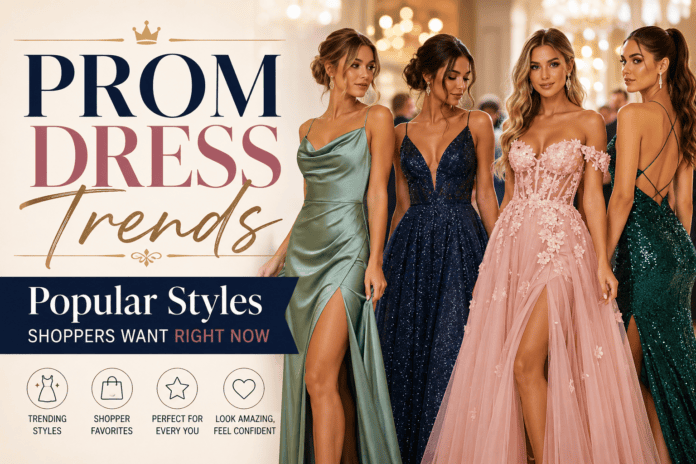
Prom fashion is moving in several directions at once. Shoppers are still drawn to fitted gowns, corset bodices, off-the-shoulder necklines, sparkle, and dramatic color, but there is no single dress dominating the season. That lack of one runaway look is important: current prom dress trends are giving shoppers more room to choose by silhouette, personality, venue, and the kind of entrance they actually want to make. Vogue Business described 2026 as unusually “trendless,” while Teen Vogue’s conversations with high school students found strong interest in corsets, sleek floor-length shapes, off-the-shoulder dresses, gems, ruffles, custom pieces, and bold colors.
The wider fashion picture is feeding into prom as well. Spring and summer 2026 collections have brought renewed attention to drop waists, asymmetric draping, fluid fabrics, fringe, sheer layers, strong color, and more expressive dress shapes.
That creates a better shopping environment than a season ruled by one viral gown. The question is no longer simply, “What dress is trending?” It is, “Which current trend looks convincing on me?”
Corset Bodices Are Still One of Prom’s Strongest Looks
Corset-inspired dresses remain easy to spot because the bodice gives a gown instant structure. Boning, shaped cups, panel seams, basque waists, lace-up backs, and fitted torsos create definition before the skirt even begins.
Teen Vogue’s March 2026 reporting from New York City students specifically identified corset dresses as a style young shoppers were seeing and requesting for prom.
The most current versions do not all resemble traditional princess gowns. A corset top can sit over a straight satin skirt, a stretch crepe column, a high-slit skirt, layers of tulle, or a fuller ball-gown shape.
That difference matters.
A structured bodice with a slim skirt feels sharper and more contemporary. Pair the same bodice construction with a wide tulle skirt and the effect becomes romantic and theatrical.
Basque Waists Give Corsets a More Defined Shape
A basque waist extends the bodice downward into a V-shaped or curved point rather than stopping at a straight horizontal waistline. The construction visually lengthens the torso and makes the transition into the skirt more noticeable.
It works especially well when the skirt has volume because the pointed bodice creates separation between the fitted upper half and fuller lower half.
For shoppers who like corset dresses but find some versions too familiar, the waistline is one of the details worth examining. Two gowns can share almost the same neckline and fabric yet look completely different because one ends at the natural waist and the other drops lower.
Exposed Boning Creates a More Fashion-Driven Finish
Visible corset channels make the construction part of the design rather than hiding it underneath the fabric. In satin, mesh, lace, or embellished gowns, that can produce a sharper look than a softly molded bodice.
Fit matters more here than photographs suggest. A corset that sits correctly should feel secure without forcing the neckline, waist, or bust into an awkward position. Formal dresses are often photographed while the model stands still. Prom includes dinner, stairs, sitting, photos, and hours of dancing.
A dramatic bodice that constantly needs adjusting stops feeling dramatic fairly quickly.
Sleek Floor-Length Dresses Are Competing With Full Ball Gowns
The classic full prom gown has not disappeared, but fitted and streamlined dresses have become equally important.
Students interviewed by Teen Vogue described seeing long, tight, ankle-length, and sleek dresses alongside more elaborate options. That fits the larger formalwear shift toward cleaner column shapes, body-skimming construction, and dresses where fabric and fit do more of the work.
A sleek gown can still have plenty of presence.
The effect might come from a sculpted neckline, open back, thigh slit, low waist, metallic fabric, strong color, or concentrated embellishment rather than a large skirt.
Column Dresses Keep the Silhouette Clean
A column dress falls in a relatively straight line from the body toward the floor. Some versions skim rather than cling, while others use stretch fabric for a closer fit.
This shape suits shoppers who want their jewelry, hairstyle, neckline, or fabric to carry the look. Satin columns can feel minimal. Jersey versions are softer and easier to move in. Beaded columns become evening-heavy without adding significant skirt volume.
The weakness of a simple column dress is also obvious: poor fit has nowhere to hide.
Check the back as carefully as the front. Fabric pulling horizontally across the hips, bunching at the lower back, twisting seams, or a hem that collapses around the feet can make an expensive gown look poorly cut.
Bodycon Formal Dresses Are Becoming More Refined
Bodycon does not automatically mean a thin stretch dress.
Current dress trends are revisiting fitted silhouettes in more polished forms, with Harper’s Bazaar noting a renewed interest in bodycon shapes for summer 2026. For prom, that translates well into heavier stretch crepe, structured jersey, lined mesh, satin-backed fabric, and fitted gowns with stronger internal construction.
A long body-skimming dress with a high neckline can look more restrained than a huge ball gown with a plunging bodice. Silhouette alone does not determine how revealing or formal a dress feels.
Off-the-Shoulder Necklines Are Back in Prom Rotation
Off-the-shoulder dresses sit between classic formalwear and contemporary styling. They expose the collarbone and shoulders without requiring the deeper neckline used on many strapless gowns.
Teen Vogue’s student reporting specifically called out off-the-shoulder dresses among current prom preferences.
The detail can take several forms: folded satin bands, gathered sleeves, draped chiffon, fitted arm cuffs, or sculpted portrait necklines.
A cleaner folded neckline works well with fitted dresses. Softer draped sleeves suit romantic gowns. Wider portrait shapes create more visual weight around the shoulders and balance a fuller skirt.
There is one practical issue shoppers should test before buying: arm movement.
Raise your arms. Sit down. Reach forward. Dance for a minute in the fitting room if space allows. Some off-the-shoulder designs look flawless while standing and become restrictive as soon as the arms move.
Sparkle Has Shifted From Simple Sequins to Surface Detail
Prom has never been shy about shine, and shoppers are still asking for it. Teens interviewed by Teen Vogue mentioned bling, gems, glitter, and rhinestone embellishment among the details they wanted in their prom outfits.
The more interesting change is where the shine appears.
Instead of covering every inch of a gown in identical sequins, designers and formalwear brands can use crystals around a neckline, scatter stones over mesh, bead a corset pattern, concentrate sparkle at the waist, or fade embellishment gradually down a skirt.
These placements affect the way a dress photographs.
Dense embellishment reflects more direct flash. Scattered crystals give smaller points of light. Metallic satin creates broad highlights rather than individual sparkles.
Rhinestone and Crystal Details Work Well on Simpler Silhouettes
A clean fitted gown can handle a crystal neckline or embellished bodice without becoming visually crowded.
This is particularly useful for shoppers caught between minimal and glamorous styling. Start with a simple silhouette, then let one area carry the decoration.
A rhinestone-covered bodice paired with an undecorated satin skirt, for example, makes the waist a clear visual dividing line. A gown covered from neckline to hem reads completely differently.
More embellishment is not automatically more formal.
Placement counts.
Beaded Mesh Creates Shine Without Heavy Visual Bulk
Mesh gives designers a base for crystals, sequins, embroidery, and beadwork while leaving areas of the dress visually lighter.
Lining changes everything. Nude-colored lining can create an illusion effect, while matching-color lining turns the same beading into a more solid design.
Always look closely at the actual construction rather than relying on product images. Strong studio lighting can make embellishment appear denser than it looks under ordinary indoor lighting.
Ruching and Draping Make Simple Dresses Look More Designed
Ruching is having a wider fashion moment. Harper’s Bazaar highlighted artful ruching and asymmetry among notable spring 2026 dress directions.
Prom dresses are a natural place for the technique because gathered fabric creates shape without requiring heavy embellishment.
Diagonal ruching through the waist can alter the visual proportions of a fitted dress. Gathered fabric at the hip creates asymmetry. Draping across the bust softens a structured bodice. A twisted or knotted detail can turn otherwise plain jersey into a focal point.
Ruching is also forgiving in movement. A perfectly flat satin surface shows nearly every crease. Controlled gathering already contains folds, so the fabric changes less dramatically when the wearer sits or dances.
That does not mean more gathering is always better. Too much fabric concentrated at one point can add bulk exactly where a shopper does not want it.
Drop-Waist Dresses Are Giving Formalwear a Longer Line
The drop waist has moved back into current dress fashion, with spring 2026 collections showing lowered waistlines combined with softer draping and elongated proportions.
For prom, the shape offers an alternative to the familiar fitted-bodice-and-skirt formula.
Instead of the skirt beginning directly around the natural waist, the fitted section extends closer to the upper hip. This creates a longer torso line before the skirt opens.
A dropped waist looks particularly dramatic with a fuller skirt because the volume starts lower on the body. In a slim dress, the effect is subtler.
Proportion determines whether it works.
Someone with a long torso may find an extreme drop waist pushes the skirt too low. A petite shopper may prefer a shallow dropped seam that creates the idea without swallowing the frame.
Alterations can also be trickier than shortening a conventional hem. If the defining waist seam sits in the wrong place, simply taking up the bottom of the dress will not fix the proportion.
Bold Color Is Replacing the Idea of One “Correct” Prom Shade
Prom color is unusually open right now.
Teen shoppers interviewed in New York mentioned red, black, purple, and green, often choosing colors because they worked with their skin tone, prom theme, or desired level of impact.
The runway palette is equally broad. Spring 2026 fashion has pushed vivid chartreuse, saturated blue, mauve and blush tones, mint green, primary colors, and candy-like shades.
That does not mean every runway color will become a major prom seller. It does suggest shoppers have more permission to move beyond the predictable rotation of navy, burgundy, emerald, pink, and black.
Cerulean and Saturated Blue Photograph Strongly
Cerulean became a visible spring/summer 2026 runway color, appearing across designer collections.
For formalwear, clear blues have one immediate advantage: they deliver noticeable color without the neon quality of some brighter shades.
A saturated blue gown can support silver jewelry, clear crystals, metallic shoes, or a nearly bare accessory plan. Satin increases the visual intensity because light moves across its surface; matte crepe makes the same color feel calmer.
Chartreuse Is the Riskier Statement Color
Chartreuse has also been prominent in spring 2026 fashion, including collections from Prada, Valentino, and Balenciaga.
For prom, it is less conventional than red or royal blue, which is precisely why some shoppers will like it.
The color sits between yellow and green, and different versions can change dramatically under artificial lighting. Trying the dress near a window and under indoor light is useful before deciding.
Do not buy a difficult color only because it photographs well online. Your reaction in the mirror matters more than the trend report.
Mauve, Blush, and Mint Offer a Softer Direction
Not every current color direction is loud.
Mauve and blush appeared across spring/summer 2026 fashion, while mint green was especially visible during spring couture.
These shades work naturally with chiffon, tulle, satin, floral appliqué, and fine beading. They also leave room for stronger accessories because the dress itself is quieter.
The challenge is contrast. A pale shade that looks distinctive on a hanger can lose definition against certain skin tones or bright photography backgrounds. Try it in several lighting conditions.
Sheer Layers and Chiffon Add Movement Without a Huge Skirt
Transparency in formalwear does not have to mean an almost-bare dress.
Sheer chiffon sleeves, translucent overskirts, mesh corset panels, layered skirts, and illusion necklines allow designers to play with opacity while preserving the structure of a full-length gown.
Spring and summer 2026 fashion has continued that interest in sheer and fluid dressing, including chiffon and relaxed transparent layers.
Movement is the real attraction.
A narrow satin dress moves largely as one piece. Add a chiffon overlay and the outer layer responds separately as the wearer walks. That can make even a relatively simple gown feel more dramatic entering a room or crossing a dance floor.
Check how translucent fabrics behave with flash photography. A lining that looks opaque in ordinary room light may appear different under strong camera lighting.
Fringe Is Moving Beyond Costume Territory
Fringe is another current dress detail showing up in 2026 fashion. Harper’s Bazaar identified refined fringe and movement-focused detailing among spring dress trends, while its summer coverage continued to highlight fringe dresses.
For prom, fringe works best when the designer controls where it moves.
A completely fringed gown creates maximum motion but can become heavy. Fringe around the skirt or hem gives movement while preserving a cleaner bodice. Beaded fringe around a neckline or open back creates a smaller, more controlled effect.
This is a trend worth testing while walking rather than judging from a static product photograph.
Fringe can tangle, catch on jewelry, and feel heavier after several hours than expected. The dress needs to survive the night, not merely the fitting-room mirror.
Volume Is Still Relevant, but the Shape Is Changing
Anyone hoping full skirts are finished can ignore that idea.
Spring 2026 runways included exaggerated volume and larger dress shapes, particularly around the skirt and hip. Prom remains one of the few events where wearing a genuinely large gown does not need much explanation.
What is changing is the shape of that volume.
Traditional layers of evenly distributed tulle remain available, but shoppers can also find bubble hems, low-waisted fullness, gathered hip volume, sculptural ruffles, tiered skirts, and asymmetric construction.
A dramatic skirt needs practical testing.
How wide is it when seated? Can it fit comfortably in the car? Will the hem survive stairs? Does the wearer need to carry it while walking outside?
Prom photos last longer than the inconvenience of a large skirt, but there is a limit. A dress should not require its own logistics team.
Custom-Looking Details Matter More Than Following Every Trend
One of the more revealing comments in Teen Vogue’s 2026 student interviews was the interest in custom-made and distinctive dresses.
That does not mean shoppers need a completely custom gown.
Small changes can make a widely available dress feel much more individual: adjusting the straps, changing the hem, adding a wrap or removable sleeve, selecting unexpected jewelry, altering the back fit, choosing contrasting shoes, or having the waist professionally tailored.
Fit is often what separates a dress that appears custom from one that looks mass produced.
A moderately priced gown fitted closely to the wearer’s proportions can look more deliberate than a much more expensive gown worn straight from the rack.
Shoppers Are Thinking Differently About Buying, Renting, and Reselling
The dress itself is not the only part of prom fashion changing.
Vogue Business reported growing interest in rentals and peer-to-peer prom shopping during 2026, alongside strong demand for traditional boutique shopping. It also found that established formalwear labels remained highly visible in prom-related social media engagement even as younger shoppers explored e-commerce and resale channels.
That gives shoppers several ways into the same aesthetic.
A heavily embellished designer gown may be realistic through rental. A previous-season dress may appear through local resale. A simple satin column can come from a mainstream retailer and then be altered. Traditional prom boutiques still offer one advantage online shopping cannot fully duplicate: trying several silhouettes back-to-back.
For a first serious formal dress purchase, that comparison is useful.
Someone may enter a store convinced they want a fitted mermaid gown and discover that an A-line dress gives them the proportion they were actually chasing.
How to Choose a Trend Without Looking Dated Later
Prom pictures tend to survive.
That is not an argument for choosing a boring dress. It is an argument for separating a trend you genuinely like from a detail you only like because you have seen it repeatedly for three weeks.
Start with silhouette.
Do you prefer a long uninterrupted line, a defined waist, a huge skirt, or something body-skimming?
Then choose the neckline.
After that, decide how much surface detail the dress needs. Sequins, rhinestones, ruffles, fringe, lace, prints, and metallic fabric all compete for attention.
Color comes next.
A strong dress usually has a hierarchy. Maybe the color is the point. Maybe the corset is. Maybe it is the sculptural skirt.
When five competing details are all demanding to be the star, the dress often loses clarity.
The current absence of one dominant prom look actually makes this easier. Vogue Business found that major prom sellers were not seeing a single defining style take over 2026. You do not need to buy the same silhouette as everyone else to look current.
What Matters Most When Trying On a Prom Dress
Turn away from the fitting-room mirror for a moment.
Walk.
Sit.
Use stairs if the store permits it.
Raise both arms.
Check the back.
Look at the dress from several feet away.
Take a phone photo with and without flash.
Notice where the hem falls while wearing shoes close to the height you plan to use.
These tests expose problems that posing does not.
A strapless bodice that slips half an inch every few minutes will become irritating. A slit that looks controlled while standing may open much farther when sitting. A fitted skirt may shorten when walking. Beading can rub under the arms. A beautiful train can collect everything on the floor.
Fashion matters. Construction matters too.
The best dress is the one that still feels right several hours after the first photograph.
Frequently Asked Questions
What prom dresses are trending right now?
Current prom shoppers are showing interest in corset bodices, off-the-shoulder necklines, fitted floor-length dresses, sparkle, rhinestones, ruffles, and strong colors. Wider 2026 fashion trends are also bringing drop waists, draping, sheer layers, fringe, and more experimental color into formal dressing.
Are ball gowns still popular for prom?
Yes. Full skirts remain relevant, but they now compete with sleek column dresses and fitted gowns rather than dominating prom by themselves. Current fashion also includes newer types of volume, such as dropped waists, sculptural skirts, ruffles, and exaggerated hip shapes.
Are corset prom dresses still in style?
Corset dresses remain one of the visible current prom directions. Structured bodices can be paired with satin column skirts, mermaid silhouettes, tulle ball gowns, or heavily embellished designs, so the corset itself does not determine the entire aesthetic.
What colors are popular for prom dresses?
Red, black, purple, and green have been mentioned by current prom shoppers, while broader 2026 fashion is highlighting cerulean blue, chartreuse, mauve, blush, mint, and bright primary shades. The best choice still depends on skin tone, fabric, lighting, and personal preference.
Are simple prom dresses fashionable?
Yes. Sleek fitted dresses and cleaner silhouettes are part of the current prom mix. A simple gown can rely on strong tailoring, a dramatic neckline, an open back, rich color, or carefully placed embellishment instead of a large skirt or head-to-toe decoration.
Should a prom dress be floor length?
Floor-length gowns remain a major prom choice, but length should match the event, dress code, personal style, and practical needs. Even among long dresses, shoppers can choose fitted columns, A-lines, mermaid shapes, dropped waists, or full ball gowns.
How early should I shop for a prom dress?
Popular boutiques can become busy well before prom season. Vogue Business reported that some specialist prom shopping begins as early as November, with peak fitting activity at certain boutiques beginning around January. Starting early also leaves more time for ordering and alterations.
How do I know whether a trendy prom dress actually suits me?
Ignore the trend label during the final fitting. Check the silhouette, bodice position, waist placement, movement, hem, back fit, and comfort while sitting and walking. A current detail only works when the underlying dress fits correctly.
Choosing a Prom Look That Feels Current Without Looking Copied
The strongest prom look does not need every current detail. A corset, rhinestones, fringe, ruffles, a dropped waist, a bold color, and an enormous skirt can all be fashionable separately; putting them together does not guarantee a better dress.
Current prom dress trends are useful because they expand the choices available to shoppers. Corseted shapes remain strong. Sleek long gowns are holding their own against ball gowns. Off-the-shoulder necklines have returned to attention. Sparkle is getting more strategic, while draping, sheer layers, fringe, and stronger color are giving formal dresses different kinds of movement and personality.
More importantly, there is no single silhouette shoppers have to chase. Recent industry reporting suggests prom fashion is unusually open rather than controlled by one viral design.
Use that freedom.
Find the shape that works first. Then decide which trend deserves space on the dress. The gown people remember is rarely the one that checked the most trend boxes. It is the one that looked as though the wearer chose it on purpose.