
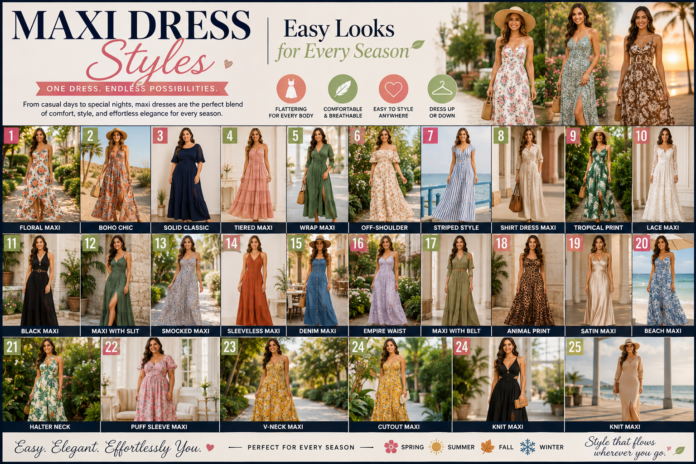
A maxi dress can move through far more of the year than its breezy reputation suggests. The hem stays long, but almost everything else can change: fabric weight, sleeve shape, neckline, footwear, outer layers, and the amount of structure in the silhouette.
The most wearable maxi dress styles are not tied to one temperature or occasion. A cotton poplin dress worn with flat sandals in July can take on an entirely different character from a long-sleeve knit version paired with boots in December. Even one dress may cover several seasons when its fabric and cut leave enough room for thoughtful layering.
The trick is to dress for the conditions rather than treating the maxi length as a season by itself. Warm weather calls for airflow and lighter construction. Cooler months demand better layering, denser fabrics, and hems that work with closed shoes. Once those differences are understood, a maxi dress becomes one of the easier pieces to keep in regular rotation.
Start With a Maxi Dress That Can Handle More Than One Season
Seasonal styling becomes much simpler when the dress itself has the right foundation. Certain cuts adapt well to changing temperatures, while others are clearly designed for a narrow part of the year.
A sleeveless linen maxi with an open back, for example, is difficult to turn into practical winter clothing without covering nearly all of its defining features. A short-sleeve cotton dress with a moderate neckline has more range. It works alone in warm weather and still leaves space for a cardigan, jacket, or lightweight base layer once temperatures fall.
Fabric determines more than the color or print
Fabric weight changes how a maxi dress hangs, moves, and responds to heat.
Cotton poplin tends to hold a clearer shape, which works well for shirt dresses and tiered designs. Linen and linen blends feel especially natural in hot weather because their textured construction suits loose silhouettes and casual styling. Lightweight viscose or rayon can create a softer drape, though individual garments vary considerably in thickness and quality.
Dense knits, corduroy, heavier jersey, velvet, and substantial woven fabrics belong more naturally in cool conditions. They visually balance boots and heavier outerwear instead of looking like a summer dress hidden beneath winter pieces.
Sheer or semi-sheer fabrics need another consideration: lining. A heavily lined lightweight dress may feel hotter than its outer material suggests, while an unlined woven dress may require a slip. Fabric choice should account for the whole garment, not merely the fiber printed on the tag.
Silhouette changes how easily you can layer
Loose A-line and column-shaped dresses leave room for a thin sweater or fitted top underneath. Shirt-style maxis make temperature control simpler because buttons can adjust the neckline and create different proportions.
A defined-waist dress behaves differently. Adding a bulky sweater underneath can distort the bodice, so outer layering usually works better. Belted maxis provide another option because the waist can be redefined after a cardigan or jacket is added.
The same principle applies to sleeves. Sleeveless and short-sleeve shapes have strong warm-weather value, but three-quarter and relaxed long sleeves often cover a wider portion of the calendar.
Spring Maxi Dresses Work Best With Light, Removable Layers
Spring rarely delivers consistent dressing conditions. A mild afternoon may follow a cold morning, and sunshine can disappear behind rain within hours. A spring maxi outfit needs layers that can come off without leaving the dress looking unfinished.
Soft woven fabrics, lighter denim, cotton jersey, poplin, and fluid midi-to-maxi constructions fit that requirement well. Floral prints are familiar spring choices, but solids, stripes, muted checks, and small geometric patterns work equally well.
Pair fluid dresses with cropped jackets
A long dress already creates a strong vertical line. Adding an equally long, bulky jacket can overwhelm the proportions, especially on fuller skirts.
Cropped denim jackets, short utility jackets, lightweight bombers, and waist-length knit cardigans expose more of the dress and keep the waist visually recognizable. A fitted jacket can also add structure to a loose tiered maxi that might otherwise feel overly relaxed.
For a casual weekend look, try a cotton maxi with a denim jacket and clean low-profile sneakers. Replace the sneakers with loafers or ankle boots and the same outfit becomes better suited to a cooler day.
Rain changes the equation. Long hems and deep puddles are a poor combination, so ankle-length designs can be more practical than dresses that nearly touch the ground.
Use spring color without depending on pastels
Spring styling does not require an entire wardrobe of pale pink, lavender, and mint.
Olive, cream, rust, navy, soft blue, warm white, and medium-wash denim can all feel appropriate when paired with lighter fabrics and accessories. A dark floral dress, for instance, can transition beautifully out of winter when worn with a cream cardigan instead of a heavy black coat.
Shoes provide another seasonal cue. Ballet flats, loafers, slim sneakers, clogs, and low boots all work before sandal weather fully arrives.
Summer Calls for Airflow, Easy Shapes, and Less Layering
A floor-skimming hem can sound counterintuitive on a hot day, yet a loosely cut maxi may feel less restrictive than close-fitting shorts or pants. The difference lies in construction.
A summer dress needs room for air to circulate. Tight synthetic fabric pressed against the body can trap warmth regardless of hem length. A loose cotton or linen-blend dress allows more movement between the fabric and skin.
Keep the silhouette loose without losing proportion
Tiered dresses are common in summer because their gathered panels create movement without requiring close tailoring. Empire-waist shapes move the fitted point higher on the torso, leaving the skirt free. Straight column maxis offer an even simpler profile.
Volume still needs some control. A dress with a wide skirt, oversized sleeves, and a high neckline can create more fabric than a hot day needs. Choosing one dominant source of volume often produces a cleaner outfit.
A full-skirted sleeveless dress, for example, already has movement. Simple flat sandals and a compact shoulder bag are enough. There is little reason to add layers solely to make the outfit seem more complete.
Let the occasion decide how polished the dress should feel
Beachwear and dinner outfits may both include long dresses, but the details separating them are substantial.
For casual daytime use, cotton, gauze, linen blends, flat sandals, woven totes, and simple jewelry feel natural. A summer evening outfit can move toward smoother draping, narrower straps, more defined necklines, metallic accessories, or a refined flat sandal.
Length deserves attention at outdoor gatherings. A dramatic floor-length hem may photograph well, yet it can drag through grass, sand, wet pavement, or crowded patios. A maxi that clears the ground by a small margin is easier to wear in real conditions.
Fall Is the Easiest Season for Layered Maxi Dress Styles
Early fall provides an ideal bridge between summer dresses and cold-weather clothing. Many lightweight pieces can remain useful once sandals are replaced by boots and a jacket is introduced.
Color is only part of the change. Texture carries just as much seasonal weight. Suede accessories, leather footwear, denim, knitwear, brushed fabrics, and substantial belts make a lightweight dress feel more grounded.
Put fitted layers beneath sleeveless dresses
A sleeveless maxi does not have to disappear when the first cool mornings arrive.
A close-fitting crewneck top or lightweight turtleneck can sit beneath a roomy sleeveless dress without adding excessive bulk. This works particularly well with square-neck, V-neck, pinafore-inspired, and button-front designs.
Fit matters here. If the dress is already tight through the chest and armholes, adding another layer underneath may pull at seams or make movement uncomfortable. In that situation, put the knitwear over the dress instead.
A cropped sweater worn over a maxi can create the appearance of a separate skirt. Choose a sweater ending near the natural waist rather than a long style that hides most of the dress and shifts the visual weight downward.
Boots change the character of the entire outfit
Footwear becomes especially influential when most of a maxi dress is visually uninterrupted fabric.
Ankle boots give floral, shirt, and tiered dresses a stronger fall finish. Knee-high boots can sit invisibly beneath a long hem while adding warmth. Sleeker boots work with narrow or softly draped skirts, while chunkier footwear balances heavier knits and relaxed silhouettes.
Watch the point where the dress and shoe meet. A hem that repeatedly catches on the top of a boot is inconvenient. Dresses that expose a few inches above the ankle often behave better with substantial footwear.
Winter Maxi Dresses Need Warmth Built Into the Outfit
Winter styling works best when the dress is chosen as part of the layering system rather than treated as a summer piece that happens to have a coat over it.
Long-sleeve knit maxis are an obvious starting point. Ribbed knits create visible vertical texture, while heavier jersey can provide movement without the stiffness of structured woven fabric. Sweater dresses are another option, particularly when they leave enough space for tights or thermal layers underneath.
Build warmth where it will not create bulk
Thin layers are often more useful than one oversized layer.
Depending on the dress, a fitted thermal top can sit underneath without changing the silhouette. Tights or leggings add warmth below the waist and remain hidden under most maxi lengths. Socks can be chosen according to the boot rather than the dress.
A tailored wool coat gives a knit maxi a cleaner finish, while puffers make more sense for genuinely cold or wet conditions. Coat length affects proportion: a coat ending around the knee leaves part of the dress visible, while a long coat creates a nearly continuous silhouette.
There is no requirement that the dress and coat hems align perfectly. Practical warmth matters more than forcing two garments to end at precisely the same point.
Use accessories as functional winter pieces
A wide belt can restore shape when several layers make the middle of an outfit feel indistinct. Scarves bring warmth close to an open neckline, and tall boots protect more of the lower leg than low-profile shoes.
Winter also accommodates deeper colors and stronger textures particularly well. Chocolate brown, charcoal, burgundy, forest green, navy, black, camel, and cream can sit beside ribbed knits, leather, suede, and wool without requiring complicated styling.
Be careful with very long hems in snow or persistent rain. Once fabric becomes wet along the bottom edge, the dress grows less comfortable and may collect road salt or dirt. An ankle-skimming winter maxi is often more useful than one designed to pool around the shoes.
Shoes Can Make the Same Maxi Look Completely Different
A dress may stay unchanged while the footwear moves it from one season to another.
Minimal sandals emphasize summer. Sneakers create a casual transitional look. Loafers and ballet flats work well in mild spring or fall weather. Ankle boots add weight and structure, while taller boots make long dresses considerably easier to wear during cold months.
Proportion matters more than following a fixed shoe rule. A delicate slip-style maxi can look visually bottom-heavy with an extremely bulky boot unless another substantial element, such as a jacket, balances it. A thick sweater dress may look disconnected from barely visible delicate sandals.
Heel height is secondary to the hem. If changing from flats to heels causes the dress to hover awkwardly above the shoe, or switching from heels to flats makes it drag, that garment may not be as footwear-flexible as it first appeared.
For a dress intended to work throughout the year, an ankle-length hem gives considerably more freedom.
Accessories Should Change With the Season, Not Overload the Dress
Maxi dresses cover a large visual area, particularly when they carry prints, tiers, pleats, or dramatic sleeves. Accessories do not need to compete for attention.
Summer combinations can stay sparse: sunglasses, a woven bag, small earrings, and sandals may be enough. Fall can handle leather belts and structured bags. Winter allows scarves and more substantial footwear because those pieces serve a practical purpose as well as a visual one.
Spring sits somewhere between them. A lightweight scarf, compact crossbody bag, and removable jacket suit days when the temperature changes quickly.
Printed dresses usually need fewer competing details. With a solid maxi, accessories can do more of the work. A black column dress can move through several seasons simply by changing from flat sandals and a straw bag to boots, a leather belt, and a wool coat.
A Small Maxi Dress Wardrobe Can Cover Most of the Year
Owning a different long dress for every weather change is unnecessary. A few distinct constructions provide more flexibility than a closet full of near-identical pieces.
One breathable cotton or linen-blend maxi can cover the hottest part of the year. A fluid short-sleeve or sleeveless dress with enough room for layering can bridge spring and fall. A long-sleeve knit or substantial jersey dress handles cooler conditions without requiring complicated styling.
Neutral colors extend mixing options, but versatility does not require everything to be beige, black, or navy. A patterned dress can be highly repeatable when several jackets, shoes, and bags already coordinate with colors inside the print.
Before buying, think beyond how the dress looks by itself. Check whether a jacket sits comfortably over the sleeves. Consider whether boots work beneath the hem. Look at the fabric against light if transparency could be an issue. Sit down to see how the skirt behaves, and walk far enough to notice whether the hem catches under the shoes.
Those details determine whether a dress becomes a regular part of the wardrobe or remains an outfit that only works under ideal conditions.
Choosing Maxi Dresses for Your Own Year-Round Wardrobe
The strongest seasonal wardrobe does not rely on constantly replacing one style with another. It uses clothing that can respond to temperature, setting, and daily routines without becoming difficult to wear.
That makes maxi dress styles especially useful when the fabric and cut are chosen carefully. Lightweight woven dresses handle warm months. Transitional designs gain range from jackets, sweaters, loafers, and boots. Knitted versions carry the long silhouette into colder weather without pretending winter feels like summer.
Start with the conditions you actually dress for. Someone living through long, humid summers needs more breathable fabrics than a person dealing with extended cold weather. A commuter may care about hems that stay clear of wet sidewalks, while someone who drives most places can tolerate more length.
The dress itself is only the foundation. Fabric, layering room, hem position, shoes, and outerwear determine how many months it will genuinely earn a place in your rotation.