

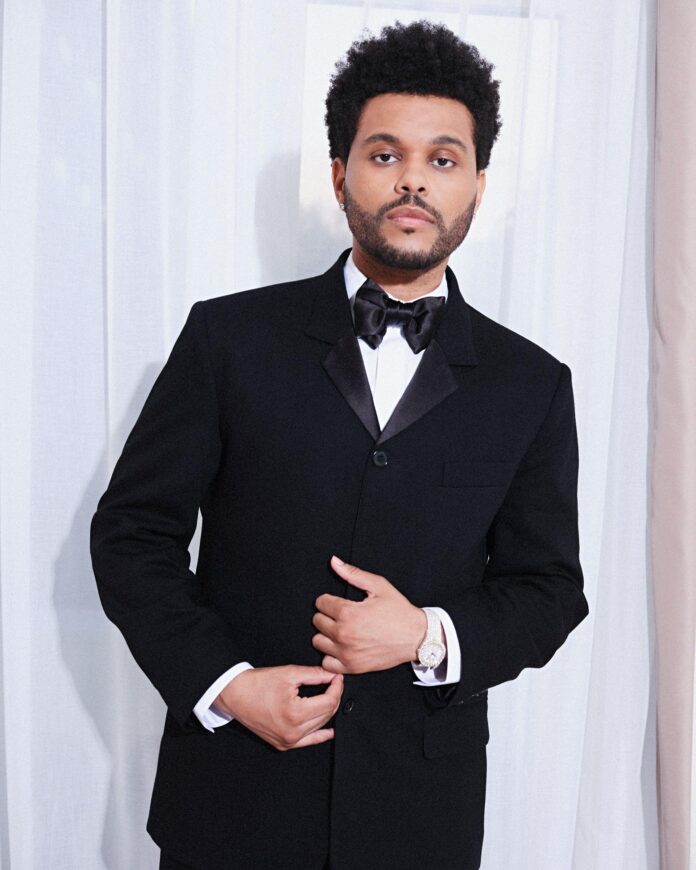
The Weeknd has treated clothing as part of the performance rather than decoration added after the music is finished. His signature menswear, tailored fits, and standout accessories often signal the mood of an album before he explains its story. A red jacket can represent a damaged celebrity character. Dark sunglasses can create distance. A sharply cut tuxedo can show that Abel Tesfaye has stepped outside the shadowy figure who first appeared online.
Born in Toronto and raised in Scarborough, Tesfaye developed from an anonymous R&B voice into one of the largest touring and streaming artists of his generation. His public wardrobe changed with that growth. Early black jeans, long T-shirts, bombers, and sneakers gave him a controlled streetwear uniform. Later eras introduced patterned suits, narrow ties, polished eveningwear, leather gloves, colored lenses, high-jewelry watches, and the red Givenchy tailoring attached to After Hours.
The most useful part of The Weeknd’s style is not the price of his clothes. It is the discipline behind them. He repeats colors, fits, accessories, and grooming choices until they become visual language. That approach explains why his outfits remain identifiable even when individual garments change.
The Weeknd Biography, Age & Background
Abel Tesfaye’s background helps explain why image control has mattered throughout his career. He entered public life with little biographical information, few photographs, and no traditional celebrity launch. That distance allowed listeners to form an idea of The Weeknd before they knew the man behind the voice. As his career expanded, biography, clothing, album characters, and cinematic references became more closely connected.
From Scarborough Bedrooms to a Global Pop Identity
Abel Makkonen Tesfaye was born on February 16, 1990, in Toronto, Ontario. He is 36 years old in 2026. His parents were Ethiopian immigrants, and he was raised mainly by his mother and maternal grandmother in Scarborough after his parents separated. He has spoken about growing up without a regular father figure in the home and watching his mother work several jobs.
Amharic was the first language in which he formed sentences because his grandmother spoke it at home. English and French followed through Canadian television, daily life, and French-immersion schooling. Ethiopian vocal traditions, American R&B, pop music, horror films, and television all entered his creative vocabulary early. He later identified Ethiopian singer Aster Aweke as an influence on his vocal approach.
This background produced an artist with more than one cultural reference point. His music could sound American, his visual direction could borrow from European cinema, and his emotional phrasing could still carry traces of East African music. His wardrobe developed in a similar way, mixing streetwear, classic tailoring, glam-rock details, and nightclub imagery without belonging fully to one fashion category.
Why Mystery Was Part of the Original Brand
Tesfaye left school as a teenager and pursued music during a difficult period of unstable living and experimentation. His early songs began appearing online around 2010, often without clear photographs or detailed credits. Listeners were not always certain whether The Weeknd was one singer, a producer collective, or a band.
The 2011 mixtapes House of Balloons, Thursday, and Echoes of Silence built his reputation through atmosphere rather than celebrity access. Support from Drake helped the music travel beyond Toronto, while Tesfaye’s limited public presence encouraged people to focus on the falsetto, production, and dark subject matter. The three projects were later packaged as Trilogy.
That period shaped his future fashion behavior. Instead of dressing to reveal personality, he often dressed to protect or invent one. Black layers, covered eyes, heavy jackets, and controlled photographs preserved distance. Even after he became recognizable, he continued using clothes as a screen between Abel Tesfaye and the audience.
Abel Tesfaye at 36: A Persona Nearing Its Final Frame
At 36, Tesfaye is no longer the unknown young singer hiding behind grainy online images. He is a recording artist, songwriter, producer, actor, label founder, stadium performer, and filmmaker whose work moves between music and cinema. His career has grown large enough that The Weeknd now functions as both a stage name and a fictional character.
The 2025 album Hurry Up Tomorrow completed the trilogy that began with After Hours and continued with Dawn FM. Tesfaye has described the project as a possible ending for the persona, explaining that he no longer wants to remain permanently identified with something he created as a young man. He has not said that he plans to stop making music. The change concerns identity more than retirement.
That distinction matters for his clothing. A future Abel Tesfaye wardrobe may be less tied to album costumes and more connected to adult personal taste. His recent tailoring already suggests that shift: cleaner tuxedos, softer shoulders, restrained colors, and luxury accessories worn without the exaggerated damage or theatrical blood associated with After Hours.
Height, Weight & Body Measurements
Public curiosity about celebrity measurements often produces numbers that appear more certain than the evidence permits. Tesfaye has not built his reputation around an athletic physique, and no official profile supplies a regularly updated weight, chest measurement, waist size, or shoe size. His clothing choices offer more useful information: he has a compact, balanced frame that responds well to precise garment length and controlled proportions.
Why His Reported Height Remains an Estimate
The Weeknd is commonly listed at approximately 5 feet 8 inches, or 173 centimeters. IMDb includes that figure, but Tesfaye has not publicly verified it through an official biography or detailed interview. It should therefore be treated as a reported estimate rather than a confirmed measurement.
A reliable current weight is not publicly available. Online celebrity databases often publish figures, yet they rarely explain when the person was weighed or how the information was obtained. Weight can also change during tours, filming, travel, and ordinary life. Giving a fixed number would create false accuracy.
His public appearances suggest a medium, relatively lean build rather than a heavily muscular one. That body type supports both narrow rock-inspired tailoring and modern suits with a little more room. The key is not size. It is the relationship between jacket length, shoulder width, trouser break, and the visual weight of shoes or accessories.
A Compact Frame That Rewards Precise Jacket Length
Shorter and medium-height men often lose proportion when a jacket extends too far below the seat or when wide trousers collect heavily over the shoes. Tesfaye’s stronger formal looks usually avoid those problems. His jackets sit close to the body without pulling, while the hem remains short enough to keep his legs visually present.
The black Loewe tuxedo worn at the Cannes premiere of The Idol is a useful example. Its narrow lapels, compact front, restrained shoulders, and controlled waist created a long vertical line without requiring an exaggerated heel or cropped trouser. The jacket drew attention upward toward his face and bow tie.
Men with similar proportions can borrow the principle without copying the designer. Choose a jacket that ends near the natural seat, ask a tailor to clean up excess fabric around the waist, and keep the trouser break modest. A monochrome shirt-and-suit combination can also extend the body line because the eye meets fewer sharp color divisions.
How His Silhouette Changes With Each Era
Early in his career, Tesfaye often wore slim black jeans beneath longer T-shirts and boxy bombers. The top layer gave his shoulders presence, while the narrow trousers prevented the outfit from overwhelming his frame. GQ described this repeated combination as a personal uniform built around black denim, extended tees, practical jackets, and elevated sneakers.
The After Hours period replaced casual layers with slim formalwear. Black trousers, dark shirts, ties, leather gloves, and the bright red jacket created a sharper, more theatrical outline. The narrow silhouette made the red more intense because there was little loose fabric to soften it.
His later suits have often allowed more ease through the body. Navy tailoring, wider lapels, and relaxed shirt choices feel less like a stage costume and more like adult eveningwear. This progression shows that fit does not have to remain frozen. A personal style can mature while keeping familiar anchors such as dark colors, clean trousers, textured hair, watches, and tinted eyewear.
Wife, Girlfriend & Family
Fame has made Tesfaye’s songs emotionally exposed while his family life remains guarded. That contrast often causes gossip to fill gaps in the public record. A factual profile should separate established relationships from online speculation and avoid treating every photograph as a formal announcement. His family history is relevant because it shaped his independence, cultural identity, and cautious approach to publicity.
His Relationship Status Is Public but Closely Guarded
Tesfaye has never announced a marriage, and no reliable public report confirms that he has a wife. Biography.com has described him as being in a relationship with DJ and beauty entrepreneur Simi Khadra, with the pair linked publicly since 2022. They have shared few formal statements about the relationship, so claims about an engagement, wedding, separation, or private plans should not be treated as established fact.
His best-documented past relationships were with model Bella Hadid and singer Selena Gomez. Tesfaye and Hadid dated at different points between 2015 and 2019, while his public relationship with Gomez lasted during 2017. Later names attached to him have often come from sightings or rumor rather than confirmation.
He appears to prefer a narrow boundary around his current personal life. That restraint fits his wider image: he may build albums around desire, heartbreak, and damaged romance, but he rarely turns an active relationship into constant promotional content.
The Mother and Grandmother Behind His Early Life
Tesfaye has spoken more openly about his mother and grandmother than most other relatives. They raised him in Scarborough, with his mother working several jobs and his grandmother maintaining a strong Ethiopian and Amharic-speaking presence at home. He described his mother as protective and cultured, while recalling the loneliness of growing up without siblings or a father figure in the household.
Those circumstances help explain the tension running through his public identity. His music often presents freedom without supervision, yet it also circles isolation, guilt, dependence, and the desire to return home. The confident nightclub figure and the guarded son exist beside each other.
His public fashion can be read through that contrast. Stage clothing is often bold, controlled, and cinematic, while his off-duty wardrobe has historically relied on protective layers and repeated dark pieces. One identity performs. The other avoids unnecessary exposure.
Ethiopian Heritage as a Quiet Creative Thread
Tesfaye’s Ethiopian heritage is not a decorative detail added to his biography. Amharic was part of his home life, Ethiopian voices shaped his ear, and his family connected him to a culture beyond the Toronto environment in which he grew up. The ending of “The Hills,” for example, incorporates Amharic, bringing a childhood language into one of his largest international songs.
He does not often display relatives at awards shows or build a public family brand. The influence appears in less direct forms: vocal movement, memory, language, themes of displacement, and the emotional distance between home and fame.
That approach offers a useful lesson about cultural style. Heritage does not have to appear as costume. It can shape color, sound, attitude, grooming, and storytelling without being announced in every outfit. Tesfaye’s strongest work often allows those influences to sit beneath the surface.
Career, Income & Net Worth
The commercial story of The Weeknd is far larger than album sales. His income can come from touring, streaming, publishing, recorded music, merchandise, licensing, film, television, brand partnerships, and his interests around XO. Yet public revenue figures do not reveal his personal bank balance. Tour grosses, property purchases, and streaming records show scale, not exact net worth.
The Mixtape Run That Rewired Modern R&B
The Weeknd’s career began to accelerate after his anonymous songs attracted online attention and Drake shared his work. House of Balloons arrived in March 2011, followed by Thursday and Echoes of Silence. Their hazy production, damaged romantic narratives, and mixture of R&B, electronic music, indie textures, and pop melody helped change the direction of contemporary R&B.
A Republic Records relationship brought the early mixtapes into the commercial release Trilogy. Kiss Land followed in 2013, while Beauty Behind the Madness pushed Tesfaye into mass pop recognition through songs including “Can’t Feel My Face,” “The Hills,” and “Earned It.” Starboy, After Hours, Dawn FM, and Hurry Up Tomorrow expanded the sound into electronic pop, stadium music, concept albums, and cinematic storytelling.
The striking part of this career is how little of the early mood was discarded. He learned to place dark ideas inside larger melodies rather than replacing them with safer material.
Records, Awards and the Scale of “Blinding Lights”
The Recording Academy lists four Grammy wins and 14 nominations for The Weeknd. His wins include recognition connected to Beauty Behind the Madness, “Earned It,” Starboy, and “Hurricane.” He has also accumulated 22 JUNO Awards, a record total for a male artist according to Guinness World Records.
“Blinding Lights” became the defining commercial recording of his career. Billboard placed it first on its recap of Hot 100 performance during the first 25 years of the twenty-first century. The song spent 57 weeks in the chart’s top 10 and 90 weeks on the Hot 100.
In August 2025, Guinness confirmed that “Blinding Lights” had become the first track on Spotify to reach five billion streams. Tesfaye had previously become the first artist to cross 100 million monthly Spotify listeners in 2023. These milestones show reach across years rather than a brief release-week peak.
Where His Money Comes From and Why Net Worth Lists Mislead
Touring is one of the clearest visible sources of Tesfaye’s commercial power. Live Nation reported that the After Hours Til Dawn tour had passed $1 billion in gross ticket revenue after selling about 7.55 million tickets across 153 dates. The tour was scheduled to continue through September 2026. Gross revenue must cover production, venues, staffing, transport, promoters, taxes, commissions, and other expenses before an artist receives personal income.
Recorded music and publishing provide additional revenue through streaming, sales, radio use, synchronization, and songwriting credits. His XO operation, merchandise, acting work, production credits, and past fashion partnerships broaden the business base. H&M, for example, released a menswear selection built around his preference for mixing bombers and hoodies with shirts and blazers.
No official financial filing confirms a precise The Weeknd net worth. Media estimates may offer context, but they cannot account accurately for private contracts, ownership percentages, debts, taxes, property values, and expenses. His career supports the conclusion that he is exceptionally wealthy. A single exact figure would still be an estimate.
House, Cars & Luxury Lifestyle
Luxury is visible in Tesfaye’s real estate and accessories, but his lifestyle coverage requires restraint. Property transactions create public records and can be reported with reasonable confidence. Car collections are harder to verify because vehicles may be rented, borrowed, used for filming, or owned through companies. Watches worn in clear public photographs provide stronger evidence than anonymous lists of supposed possessions.
The $70 Million Bel Air Property That Became a Set
In 2021, Architectural Digest reported that Tesfaye purchased a Bel Air mansion for $70 million. The property covers roughly 33,000 square feet and includes an indoor pool, outdoor infinity pool, gym, movie theater, music studio, sauna, hammam, and sports court. The transaction ranked among the largest Los Angeles home sales of that year.
The scale is extravagant, yet the property also served a working purpose. Architectural Digest later reported that much of The Idol was filmed at his Bel Air home. A personal residence therefore became part of the production infrastructure for his acting and television project.
No private address is needed to understand the design message. The house reflects his attraction to cinematic environments, dramatic space, privacy, and facilities that allow work and entertainment to exist on the same property.
A Real-Estate Trail From Hidden Hills to Westwood
Before Bel Air, Tesfaye owned a large Hidden Hills home purchased in 2017 for close to $20 million. Madonna acquired the property from him in 2021 for $19.3 million. Its modern-farmhouse design included a main residence, guesthouse, theater, gym, basketball court, infinity pool, and extensive entertaining areas.
He also purchased a full-floor Westwood penthouse for $21 million in 2019. The residence occupied the eighteenth floor of Beverly West and offered broad views through floor-to-ceiling windows. After listing it for $22.5 million, he sold it in 2023 for a reported $19 million.
These transactions reveal an overlooked point about celebrity property. Expensive homes do not automatically produce profits. Tesfaye appears willing to change residences when the new space better supports his privacy, scale, or creative needs, even when the previous property does not deliver a dramatic financial return.
Cars, Watches and the Difference Between Image and Ownership
Cars are central to The Weeknd’s videos and songs, especially within the neon-night world of After Hours. Yet reliable ownership records do not support every online claim about McLarens, Lamborghinis, Bentleys, and other vehicles supposedly in his garage. A car seen in a video, promotional photograph, or public arrival should not automatically be described as his personal property.
His watches are better documented. British GQ identified a gold Rolex Datejust with a black onyx dial during the After Hours period. GQ later highlighted a vintage Patek Philippe Aquanaut worn with formal tailoring and a rare gem-set Piaget Limelight Gala worn at Cannes.
Those choices show why accessories matter in his wardrobe. The watch is rarely isolated from the character of the outfit. Gold and onyx reinforced the damaged red-suit persona. The smaller Piaget introduced diamonds and sapphires into a restrained tuxedo. He uses the wrist as a controlled point of surprise rather than covering every surface with visible luxury.
Celebrity Fashion & Personal Style
Clothing has been one of Tesfaye’s clearest storytelling tools. Each major era carries a recognizable silhouette, palette, and grooming direction. He rarely depends on uncontrolled trend mixing. Instead, he chooses a narrow visual system and repeats it until an album, tour, or character becomes inseparable from the clothes.
The Early Uniform: Black Denim, Long Tees and Boxy Jackets
The Weeknd’s early wardrobe relied on a formula that was easy to recognize and practical to repeat. GQ described it as slim black jeans, an extended T-shirt, a boxy jacket, and elevated sneakers. Bombers, denim jackets, and military-inspired outerwear gave shape to the upper body, while the narrow trousers preserved a lean outline.
Black supported the mystery surrounding his first releases. It also allowed his hair and face to carry more visual weight. The clothes did not compete with the unconventional locs that had become his most identifiable physical feature.
The formula still works for men who prefer understated streetwear. The jacket should finish near the hip rather than hanging toward the knee. The T-shirt may extend slightly below it, though excessive length can shorten the legs. Dark jeans need enough room through the thigh to avoid strain. Clean sneakers finish the outfit without changing its mood.
Why the After Hours Red Suit Became Bigger Than an Outfit
The red After Hours jacket was not a one-night styling choice. Tesfaye wore variations of the look across music videos, award appearances, promotional images, performances, and the 2021 Super Bowl halftime show. The repeated uniform included a red jacket, black shirt, dark tie, slim trousers, leather gloves, and black-and-white shoes. His Super Bowl version was designed by Givenchy and covered with crystals.
Repetition turned the suit into a character. The color suggested Las Vegas neon, danger, blood, romance, and old entertainment hosts at the same time. Facial bandages and staged injuries developed the story of a celebrity damaged by attention, vanity, and excess.
The practical lesson is not that every man needs a red suit. It is that one strong color becomes more memorable when the rest of the outfit stays disciplined. Tesfaye usually grounded the red with black rather than adding several competing shades. The consistent shirt, trousers, gloves, and shoes made each change to the jacket easier to notice.
Tailored Fits and Standout Accessories in His Mature Era
Tesfaye’s formal style extends beyond the red suit. At the Uncut Gems premiere, he wore a gray plaid suit with a red tie, matching pocket square, burgundy shoes, orange-tinted sunglasses, rings, and a period-inspired mustache. The outfit leaned into late-1970s and early-1980s references without becoming a costume because the suit remained properly structured.
For the Cannes premiere of The Idol, he moved in a cleaner direction with a bespoke black Loewe tuxedo designed by Jonathan Anderson and styled by Matthew Henson. Its smaller lapels and compact fastening drew from the shape of a leather jacket. A high-jewelry Piaget watch added the unexpected element.
His navy suits show another useful path. A dark crew-neck shirt beneath navy tailoring removes the formality of a white shirt without collapsing into streetwear. Sunglasses and a pendant can supply identity. The outfit works because the jacket fit remains exact even when the styling becomes relaxed.
Hair, Beard & Grooming Style
Hair and facial hair have carried as much narrative weight as Tesfaye’s clothes. He understands that changing grooming can reset the public’s view faster than buying a new wardrobe. Locs created the original silhouette, the 2016 cut announced Starboy, a horseshoe mustache introduced a retro phase, and later wigs or character grooming helped separate acting roles from his musical identity.
The Basquiat-Inspired Locs That Made Him Instantly Recognizable
The Weeknd’s early locs became one of the defining celebrity hairstyles of the mid-2010s. He grew the style upward and outward, creating an asymmetrical form that looked different from every angle. Tesfaye told GQ that artist Jean-Michel Basquiat influenced the look, which he had developed over several years.
The hair worked because the rest of his image was controlled. Dark jackets and simple T-shirts gave the shape a clean background. Had he worn equally complicated patterns and accessories, the outfit could have looked crowded.
The style also protected his mystery until it became too recognizable. People who knew little about his biography could identify the silhouette. Hair had achieved what a logo normally does, creating instant recognition without printed branding.
Cutting His Hair to Escape the Brand
Tesfaye removed the famous locs in 2016 as he prepared the Starboy era. He later explained that the vision behind the style was gone and that cutting it made him feel lighter, sleep better, perform more comfortably, and wear hats again. He also enjoyed being able to enter public places with less immediate recognition.
The haircut carried symbolic force because the “Starboy” video presented the destruction of his previous identity. A shorter, sculpted crop made his face more visible and shifted attention toward jackets, jewelry, and cleaner tailoring.
This is a useful grooming principle. A recognizable hairstyle can become limiting when the person feels obligated to preserve it for everyone else. Changing it does not erase identity. In Tesfaye’s case, the haircut allowed clothing, facial hair, and album direction to carry more of the visual work.
Short Curls, Sculpted Beards and Strategic Character Grooming
After the locs, Tesfaye moved through short afros, higher textured shapes, trimmed curls, full beards, stubble, and the precise horseshoe mustache worn around the Uncut Gems period. The mustache changed the balance of his face by exposing the chin and emphasizing the upper lip, while his larger hair created a retro frame.
His more familiar modern grooming combines short natural texture with a shaped beard. The beard is usually kept close enough to reveal the jaw rather than creating a heavy lower face. Clean edges around the cheeks and neck keep the look compatible with formal clothing.
Some dramatic styles belong to characters rather than his daily grooming. The braided rattail seen in The Idol, for example, was developed as part of the Tedros character and involved a wig. Readers should copy the grooming logic, not every theatrical detail: preserve natural texture, choose facial hair that keeps the face visible, and adjust the haircut when it begins controlling the entire identity.
Fitness, Diet & Body Transformation
His body has remained relatively consistent across years of touring, filming, and promotional work, but Tesfaye does not market himself as a fitness authority. Reliable interviews do not provide a fixed weekly training plan, verified calorie intake, supplement schedule, or detailed body-transformation program. The strongest evidence comes from the physical demands of his performances and the stable way his clothing fits over time.
Stage Endurance Matters More Than a Gym Persona
A stadium performer needs enough cardiovascular capacity to sing, move, manage stairs, cross large stages, and maintain timing for a long set. The After Hours Til Dawn production has covered more than 150 dates and millions of ticket holders, making recovery and endurance professional requirements rather than optional appearance goals.
That does not prove that Tesfaye follows a specific running, cycling, or strength program. No reliable source has published one in his own words. Claims about exact sets, personal trainers, and weekly splits should therefore be treated cautiously.
His build suggests that the goal is functional consistency rather than bodybuilder size. A leaner frame also suits his wardrobe. Slim formal trousers, shorter jackets, layered bombers, and close-fitting stage clothing allow movement while preserving the desired silhouette.
What Can Be Said About His Diet Without Guessing
Tesfaye has not released a detailed current diet plan. A past report discussed plant-based restaurant orders, vegan burgers, smoothies, pasta, and desserts, but delivery history does not prove that every order was for him or that it represented a permanent diet. It should not be converted into a strict celebrity meal plan.
No reliable evidence confirms exact calorie totals, fasting schedules, supplements, food restrictions, or daily meals. His private choices may also change between touring, recording, filming, and time at home.
Readers searching for “The Weeknd diet” should therefore avoid websites that present precise menus without direct sourcing. The honest answer is that his current eating pattern is not publicly documented in enough detail to recreate safely or accurately.
The Practical Fitness Lesson Behind His Consistent Build
The useful lesson comes from consistency rather than secret exercises. Tesfaye has maintained a similar general frame while handling rehearsals, travel, filming, and large live productions. That suggests attention to repeatable habits, even though the details remain private.
For an ordinary man, a balanced plan could include regular walking or cardio, full-body strength work two or three times per week, mobility, adequate sleep, and meals built around protein, vegetables, fruit, and suitable energy intake. That is general fitness guidance, not a claim about Tesfaye’s personal routine.
Clothing fit can serve as one practical measure of change. A jacket beginning to pull at the button, trousers tightening through the seat, or lost shoulder shape may signal that tailoring or habits need adjustment. The goal should be comfort, health, and energy rather than copying a celebrity’s estimated measurements.
Conclusion
The Weeknd’s visual identity works because it is built with the same discipline as a concept album. Black streetwear protected the mystery of his first recordings. Sculptural hair made an unknown singer recognizable. Sharper Saint Laurent pieces reflected his move into mainstream pop. The red Givenchy suit turned an album character into a cultural image. Loewe tuxedos, tinted glasses, unusual watches, and quieter navy tailoring now suggest an artist separating mature personal taste from the persona that carried him through fifteen years of fame.
His wardrobe also proves that memorable style does not require constant change. Tesfaye repeats a small set of ideas: dark foundations, clean trousers, purposeful outerwear, one strong accessory, controlled grooming, and a clear relationship between the outfit and the occasion. The garments may cost more than most readers would spend, but the method is accessible.
Choose a silhouette that suits your proportions. Keep the background simple. Add one detail people will remember. Repeat the combination long enough for it to become yours.
The Weeknd’s strongest fashion statement has never been a designer label. It is his refusal to wear an outfit without giving it a role.
Frequently Asked Questions
How old is The Weeknd in 2026?
He is 36 years old. Abel Makkonen Tesfaye was born on February 16, 1990, in Toronto, Ontario, Canada. His age should be calculated from that confirmed birth date rather than copied from older profiles that may not have been updated.
What is The Weeknd’s real name?
His full name is Abel Makkonen Tesfaye. The Weeknd began as the name attached to his anonymous music project and later became an international stage identity. He has discussed moving beyond that persona, although his 2026 tour continues to use The Weeknd branding.
How tall is The Weeknd?
He is commonly reported to be around 5 feet 8 inches, or 173 centimeters. That number appears in entertainment databases, but no official profile or direct statement has confirmed it. It is safer to describe the figure as a widely published estimate.
Is The Weeknd married or dating anyone?
No confirmed public record shows that he is married. Biography.com reports that he has been in a relationship with Simi Khadra since 2022, although the pair keep their personal life private. Recent engagement, wedding, and breakup claims have not been reliably confirmed.
Does The Weeknd have children?
No reliable public information confirms that he has children. In a GQ interview, Tesfaye said he wanted a family and children at some point, but discussing a future wish is different from announcing that he has become a parent.
What is The Weeknd’s net worth?
No official figure is available. Online estimates vary because private contracts, taxes, property, expenses, publishing ownership, and business stakes are not fully disclosed. His billion-dollar tour gross shows major commercial power, but gross ticket revenue is not the same as personal wealth.
What clothing brands does The Weeknd wear?
He has been photographed in Givenchy, Loewe, Saint Laurent, Louis Vuitton, Celine, Prada, Gucci, and other luxury labels. His best-known looks include the red Givenchy After Hours jacket and a bespoke Loewe tuxedo worn at Cannes.
What is The Weeknd’s signature hairstyle?
His original signature was a high, asymmetrical loc style influenced by Jean-Michel Basquiat. He cut it in 2016 and has since worn short curls, shaped afros, fades, beards, and a horseshoe mustache. Grooming changes usually mark a new album or character.