
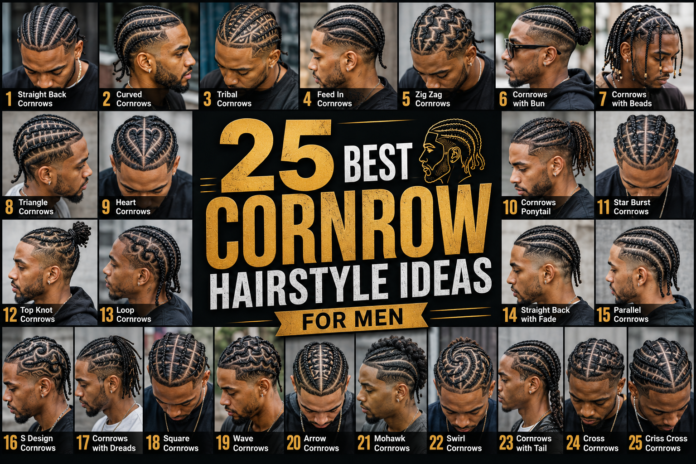
The strongest cornrow hairstyle ideas for most men start with Classic Straight-Back Cornrows, Clean Feed-In Cornrows, Cornrows With a Low Fade, and Zigzag Pattern Cornrows. Those four cover the range from understated and easy to wear through sharp, graphic, and attention-grabbing without making the style harder than it needs to be.
Good cornrows depend less on chasing complicated patterns and more on clean parting, sensible tension, hair density, and a design that fits the head shape. From a barbering and braiding standpoint, the styles that age best are usually the ones planned around the natural hairline rather than forced into a design that looked better in a reference photo than it does on the wearer.
I put these cornrow hairstyle ideas together by looking at four things that matter in real life: how the pattern reads from normal conversation distance, how neatly it grows out, how much daily maintenance it asks for, and whether the style still works with a fade, beard, casual clothes, or smarter outfits.
| Quick Pick | Best For | Main Visual Feature | Upkeep Level |
|---|---|---|---|
| Classic Straight-Back Cornrows | First-timers | Clean parallel rows | Low |
| Feed-In Cornrows | Natural-looking finish | Gradual braid thickness | Medium |
| Low-Fade Cornrows | Sharp barbered look | Braids over faded sides | Medium |
| Zigzag Cornrows | Statement style | Angular parting | Medium |
| Two Large Cornrows | Simple styling | Bold center-separated braids | Low |
| Cornrow Bun | Longer hair | Braids gathered at the back | Medium |
| Curved Cornrows | Rounder head shapes | Sweeping braid lines | Medium |
| Cornrows With Box Braids | More length | Tight roots with loose braids | High |
| Spider Pattern Cornrows | Graphic designs | Radiating sections | High |
| Small Detailed Cornrows | Dense hair | Many narrow rows | High |
Clean and Classic Cornrow Hairstyle Ideas
The easiest place to start is with patterns that follow the natural shape of the head. These cornrow hairstyle ideas rely on proportion and neat sectioning rather than complicated geometry, which makes them easier to combine with different wardrobes, beard lengths, and barbered finishes.
1. Classic Straight-Back Cornrows
Classic straight-back cornrows create a clean series of parallel braids running from the front hairline toward the nape. The strongest version uses sections wide enough for each braid to remain visible without leaving huge strips of scalp between them. From the front, the hairline stays simple; from above, the repeated lines give the entire style a deliberate, ordered look.
This works especially well on dense coily or tightly curled hair and suits men who want cornrow hairstyle ideas that don’t compete with their clothes or facial hair. Ask the braider for “even straight-back sections with medium-width cornrows and natural tension around the edges.” Upkeep is manageable, though frizz eventually softens the crisp parting. Skip extremely tight sections if your hairline feels pulled as soon as the braiding starts.
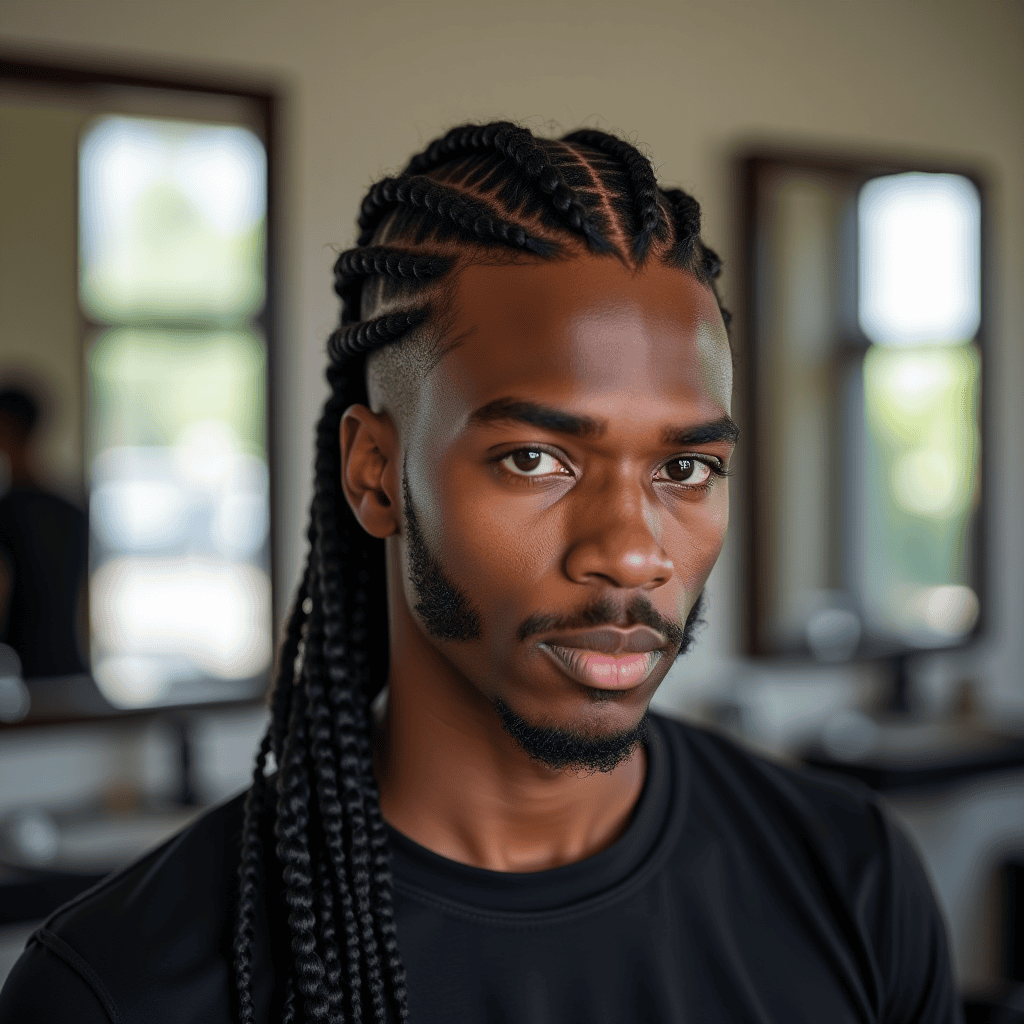
2. Two Large Cornrows
Two large cornrows divide the hair straight through the center and turn the whole style into a bold, simple shape. Each braid begins near the forehead and follows the curve of the skull toward the back, creating far more visual weight than a head full of narrow rows. The center part becomes the main design element, so it needs to be clean.
Men with enough length and density to build substantial braids tend to get the strongest result. Ask for “two symmetrical center-parted cornrows, full but not overly tight, following the head shape all the way back.” It is one of the easier styles to cover at night and refresh, but shorter pieces may escape sooner because each braid carries more hair. Fine or heavily layered hair may not hold the same bold shape.
3. Four Thick Straight Cornrows
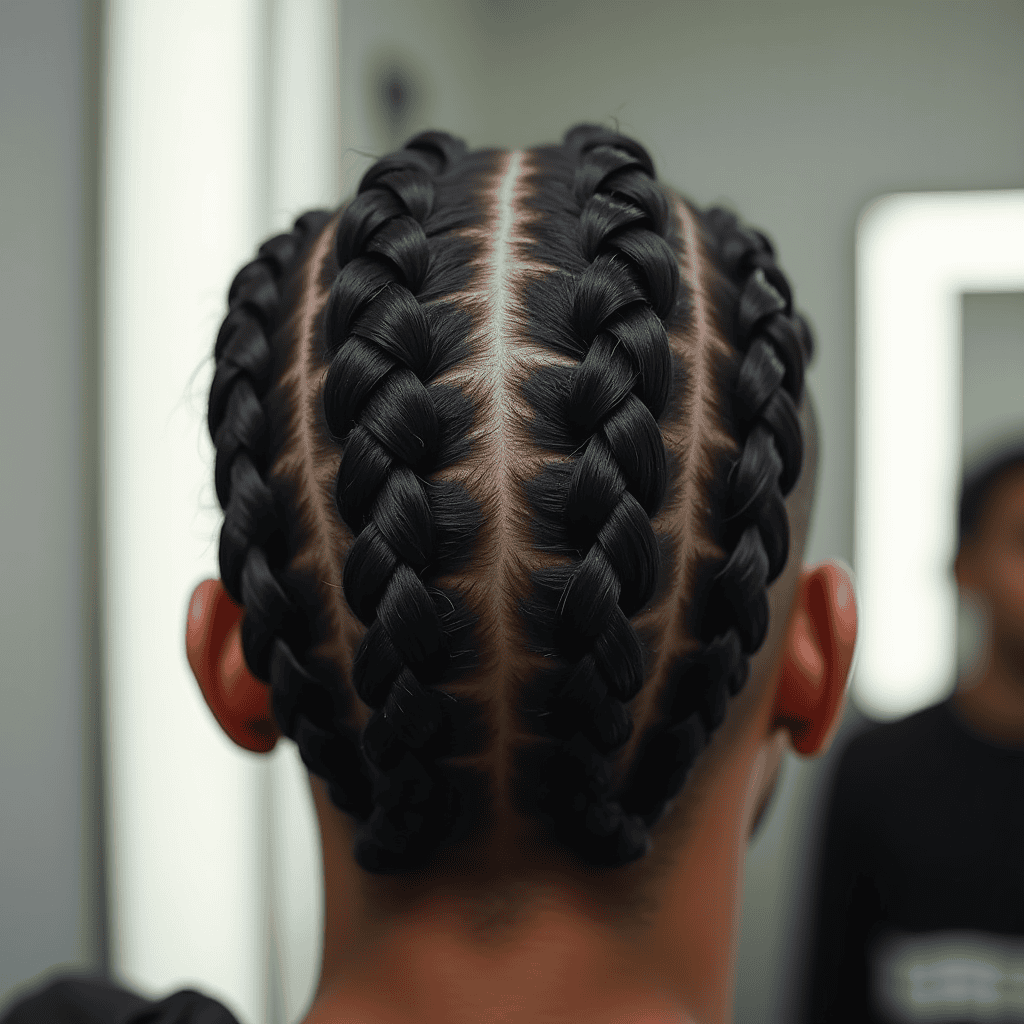
Four thick rows sit between the simplicity of two braids and the finer detail of traditional multi-row cornrows. The sections look especially strong when their widths stay consistent from the hairline through the crown. Because there are only four major lines, each one becomes part of the silhouette instead of disappearing into a dense pattern.
This is a practical choice for men with medium to thick hair who like substantial braids without the heavier visual effect of only two. Tell your braider, “four equal straight cornrows with balanced sections and a clean finish around the perimeter.” It usually feels easier to manage than many tiny braids, although obvious regrowth can make the wide parts look less crisp sooner. Sparse areas are harder to disguise in this layout.
4. Six Medium Straight-Back Cornrows
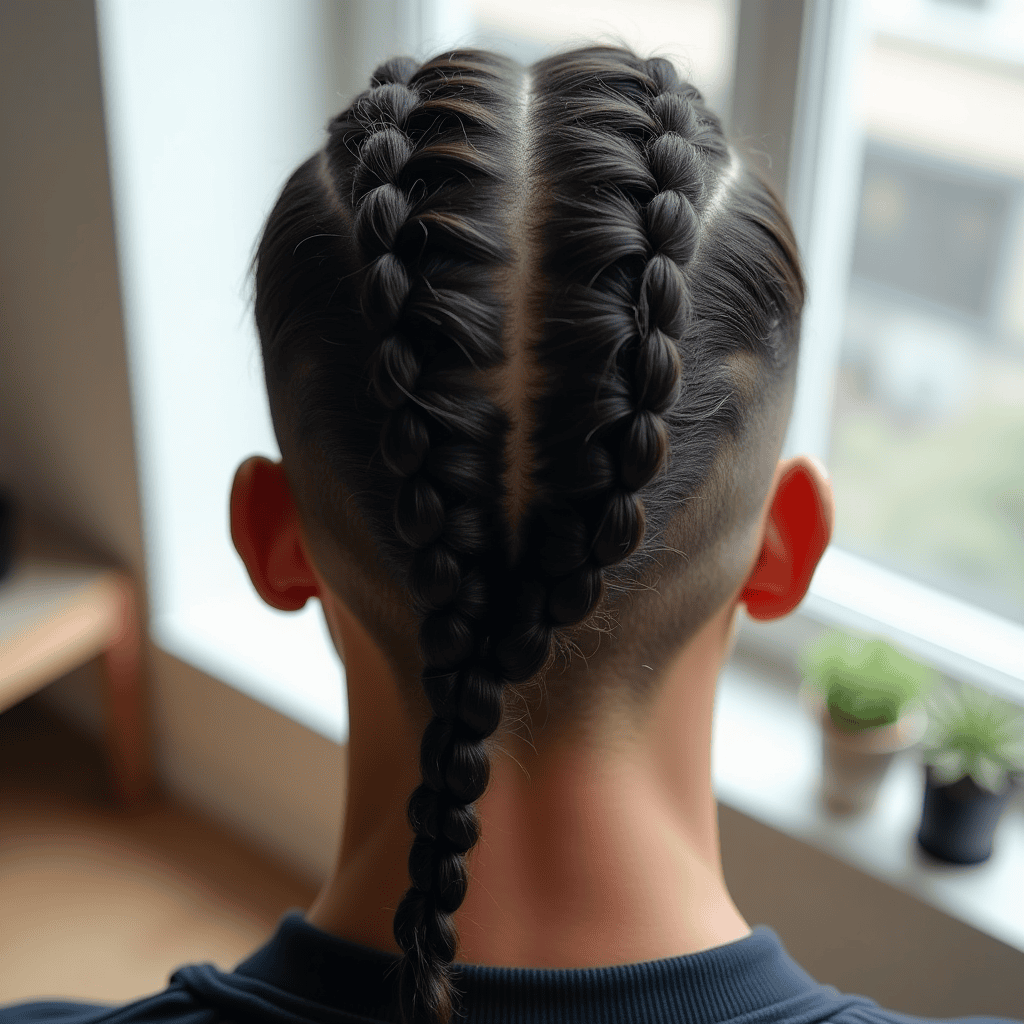
Six medium cornrows give the head enough pattern to feel detailed while keeping every braid easy to see. The rows can narrow slightly as they move toward the back, which follows the skull more naturally than forcing identical widths from front to nape. It is a balanced design rather than a showpiece, and that is exactly why it works.
Among straightforward cornrow hairstyle ideas, this one suits men who want more texture than four large braids without moving into tiny, time-consuming sections. Ask for “six clean straight-back cornrows, medium thickness, with proportionate spacing around the crown.” The look handles casual and polished outfits easily. Its weakness is that any uneven part becomes noticeable because the layout is so orderly.
5. Center-Part Cornrows
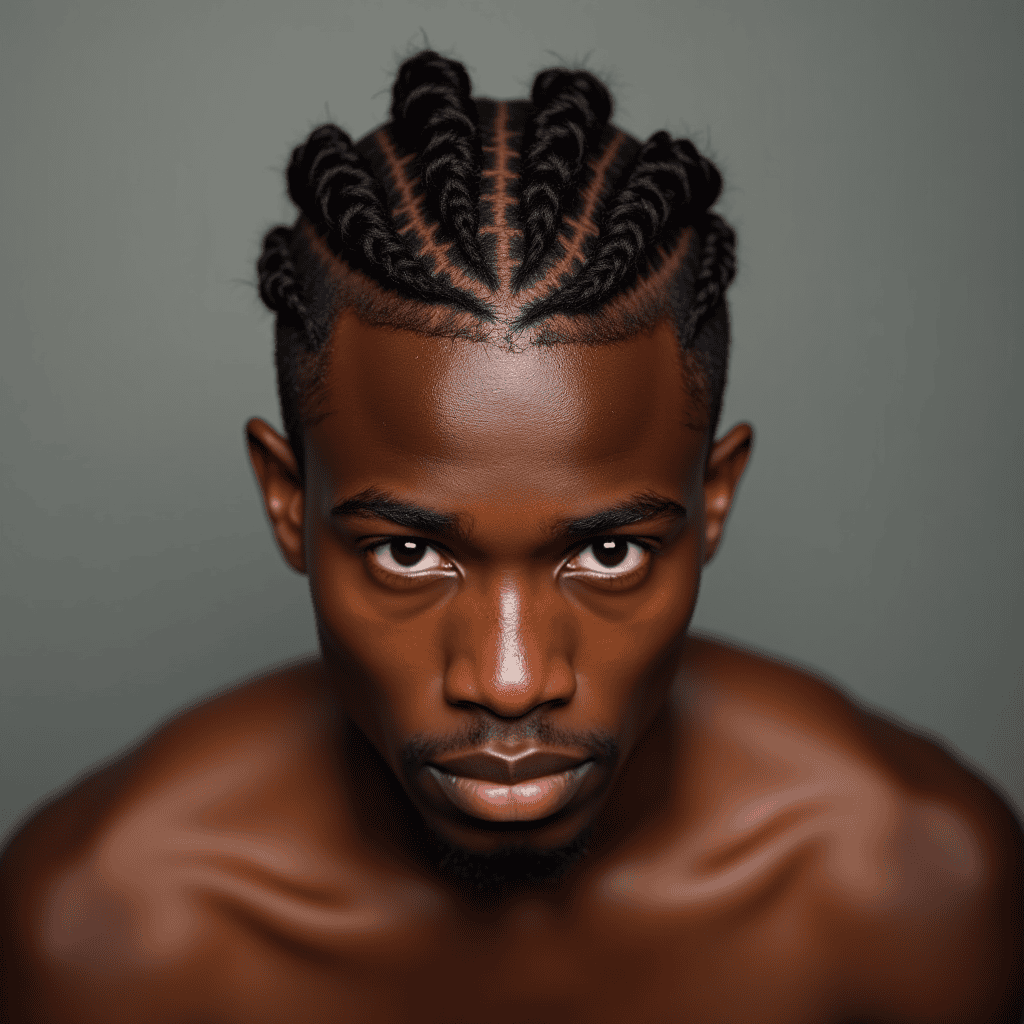
Center-part cornrows use symmetry differently from two-braid styles. Instead of forming only two large braids, several rows branch away from a strong center line and move backward on each side. Viewed from above, the part behaves like the spine of the design and creates a neat mirrored layout.
This shape works well for oval, longer, and balanced face shapes because the central line visually organizes the hair without adding extra height. Ask the braider for “a clean center part with matching cornrow sections mirrored on both sides.” The symmetry requires careful execution, so slight inconsistencies are easier to notice than they are in an intentionally irregular pattern. Men with uneven density may prefer a curved design instead.
Fade and Taper Cornrow Hairstyles
Cornrows and barbered sides work because they divide the hairstyle into two different textures. The braided top brings pattern while the taper or fade cleans up the outline. These cornrow hairstyle ideas look best when the braided area has enough width to feel intentional rather than squeezed into a narrow strip.
6. Cornrows With a Low Fade
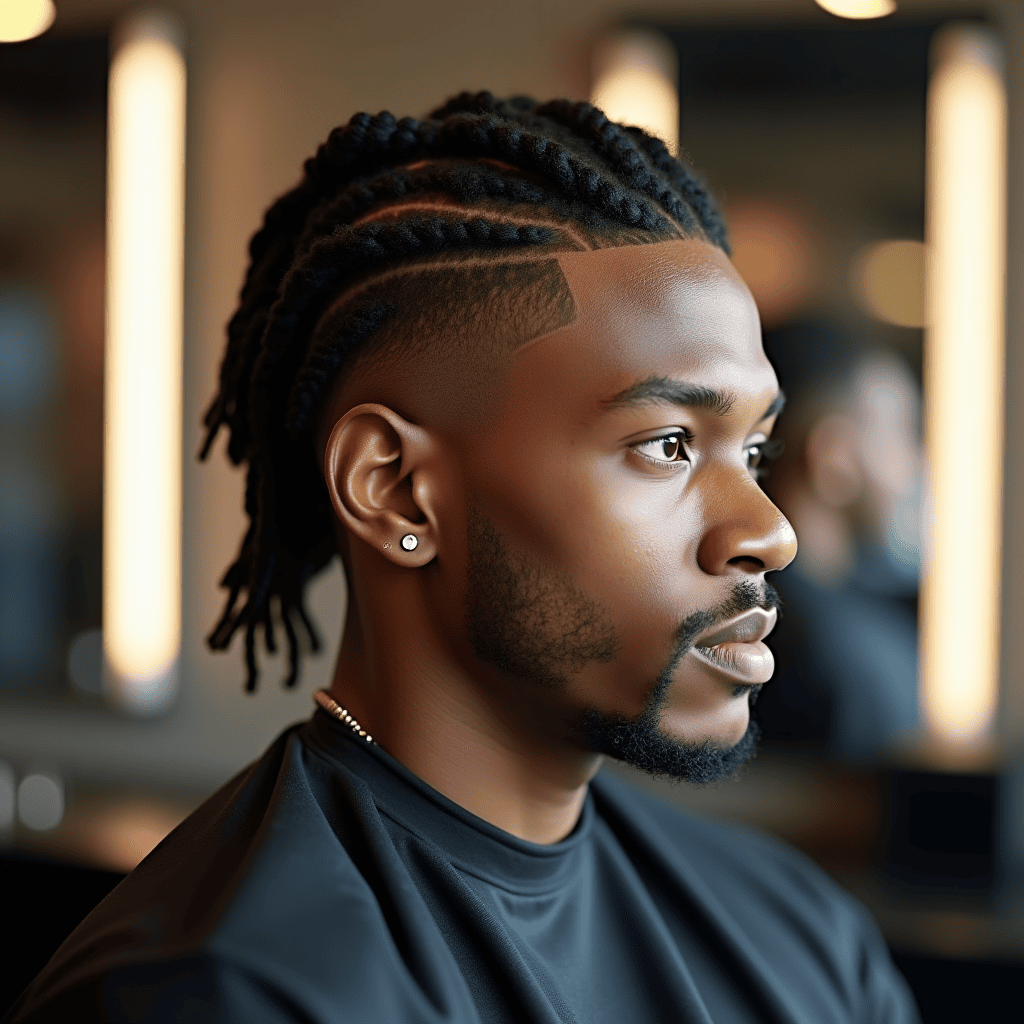
Low-fade cornrows keep most of the hair’s natural presence while cleaning up the area near the ears and neckline. The braids start from a full top section, and the fade sits low enough that it does not swallow the outer cornrows. That small difference makes the hairstyle look braided first and faded second, which is usually the better balance.
This suits men who like regular barber appointments and want a crisp perimeter around their cornrows. Ask for “medium cornrows on top with a low fade that stays beneath the braid sections.” The fade can make grown-out sides obvious before the braids themselves need redoing, so you may end up visiting the barber between braiding appointments. Men who dislike frequent lineups should keep the sides fuller.
7. Cornrows With a Mid Fade
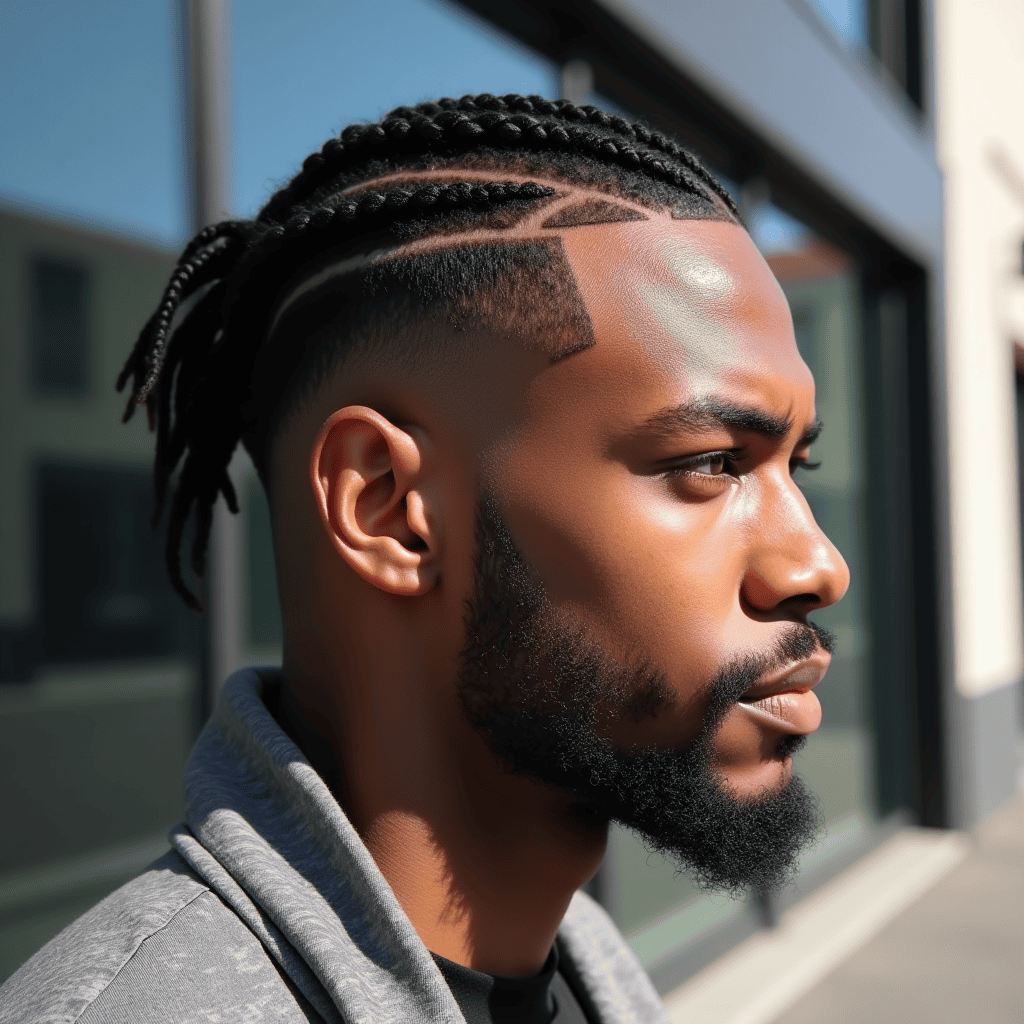
A mid fade creates stronger contrast because the transition begins higher around the sides. The braided section therefore reads as a defined top panel, especially when the outer rows follow the border of the fade. From the side, the scalp pattern sits above a smooth gradient that makes each braid appear heavier.
Men with thick hair usually carry this combination best because there needs to be enough density on top after the sides are reduced. Ask for “a mid fade under the braided section with the outer cornrows following the fade line.” It is sharper than the low-fade version, but it leaves less room for future braid patterns along the temples. Once the fade rises too far, certain designs become impossible until the sides grow back.
8. Cornrows With a High Fade
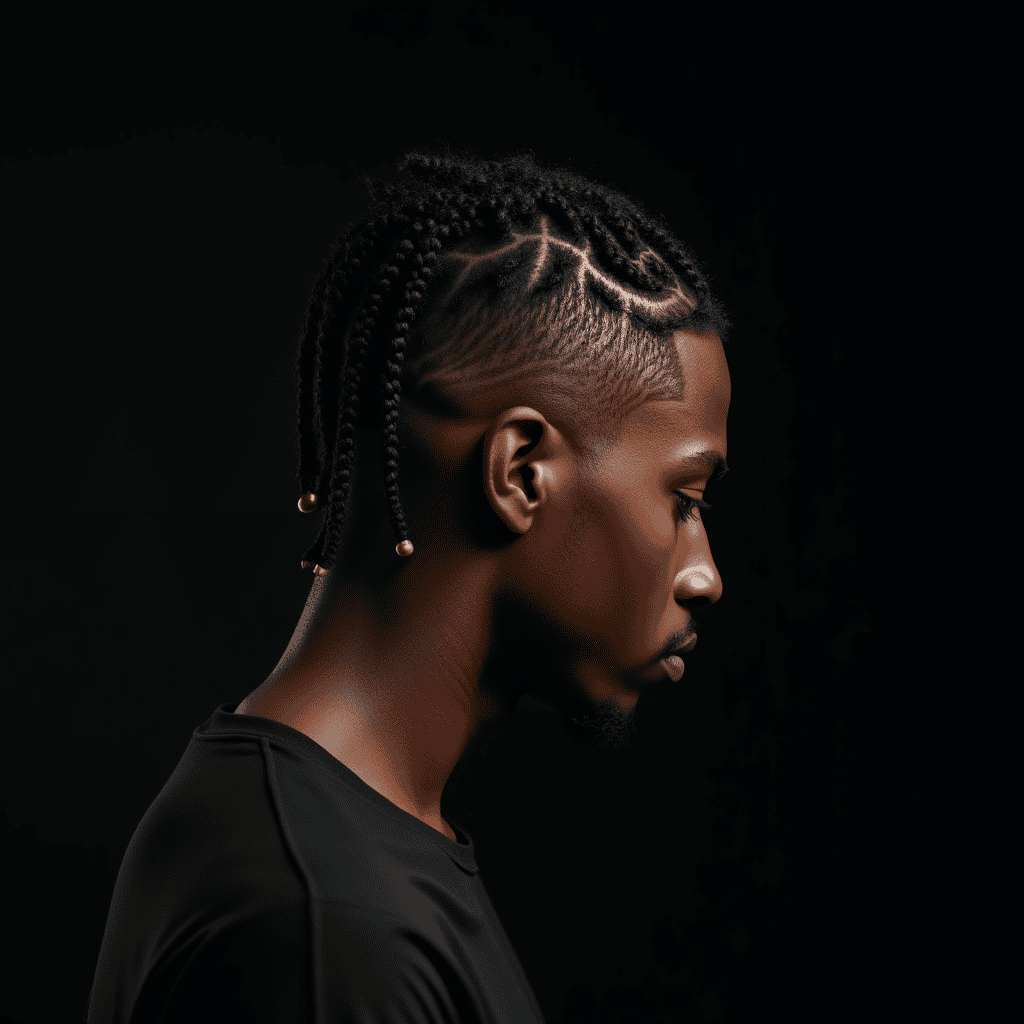
High-fade cornrows create one of the strongest contrasts in the entire list. Most side hair disappears into the fade, leaving the braids concentrated across the upper head almost like a braided crop. The result is graphic from every angle, particularly when the cornrows are medium or thick instead of extremely narrow.
This is better for men who already know they enjoy high fades because growing the sides back takes patience. Tell your barber and braider you want “a high fade with enough braided width through the top so it doesn’t look like a narrow strip.” The main drawback is flexibility. You gain a dramatic profile now, but you lose some of the surface area needed for wider side-swept cornrow hairstyle ideas later.
9. Cornrows With a Temple Taper

A temple taper changes less hair than a full fade, and that restraint often makes the cornrows look fuller. Only the temple area and lower sideburn zone are cleaned up while the braided sections remain wide across the sides and top. From the front, the hairline feels sharper without creating a disconnected top-heavy shape.
This is a strong middle ground for men who want cornrow hairstyle ideas with some barber detail but do not want to sacrifice side growth. Ask for “full cornrows with a light temple taper, keeping the taper below the braided sections.” It grows out more gently than a high fade, though the temple area can still lose its crisp shape before the braids do. Avoid pushing the taper too high each visit.
10. Cornrow Mohawk With Faded Sides
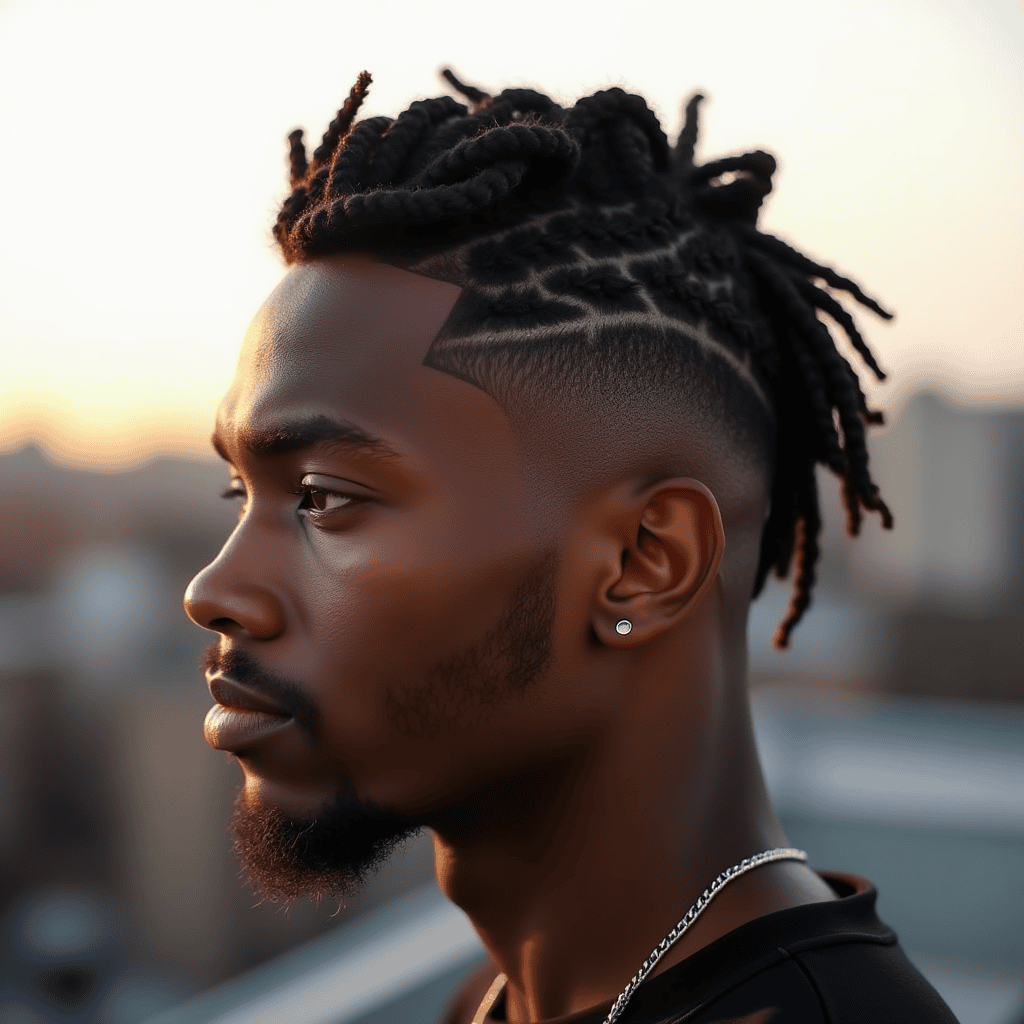
The cornrow mohawk concentrates braids through the center of the head while closely faded sides exaggerate the height and direction. Instead of lying in a broad field, the braids form a narrower band from forehead to nape. Curved outer rows can feed inward to make the central structure look even stronger.
Men who enjoy bold cuts and already wear fades are the natural audience for this one. Ask for “cornrows directed into a central mohawk shape with faded sides and enough width through the crown to keep the braids full.” The style limits what you can do next because the sides need significant regrowth before they can join a full-head braid pattern. It also demands clean barber work to keep the shape convincing.
Curved and Geometric Cornrow Hairstyle Ideas
Once the basics are familiar, parting becomes the design. Curves, diagonals, and alternating directions can reshape how the head looks without changing hair length. These cornrow hairstyle ideas demand cleaner sectioning because the scalp lines remain visible even when the braids themselves start to soften.
11. Curved Cornrows
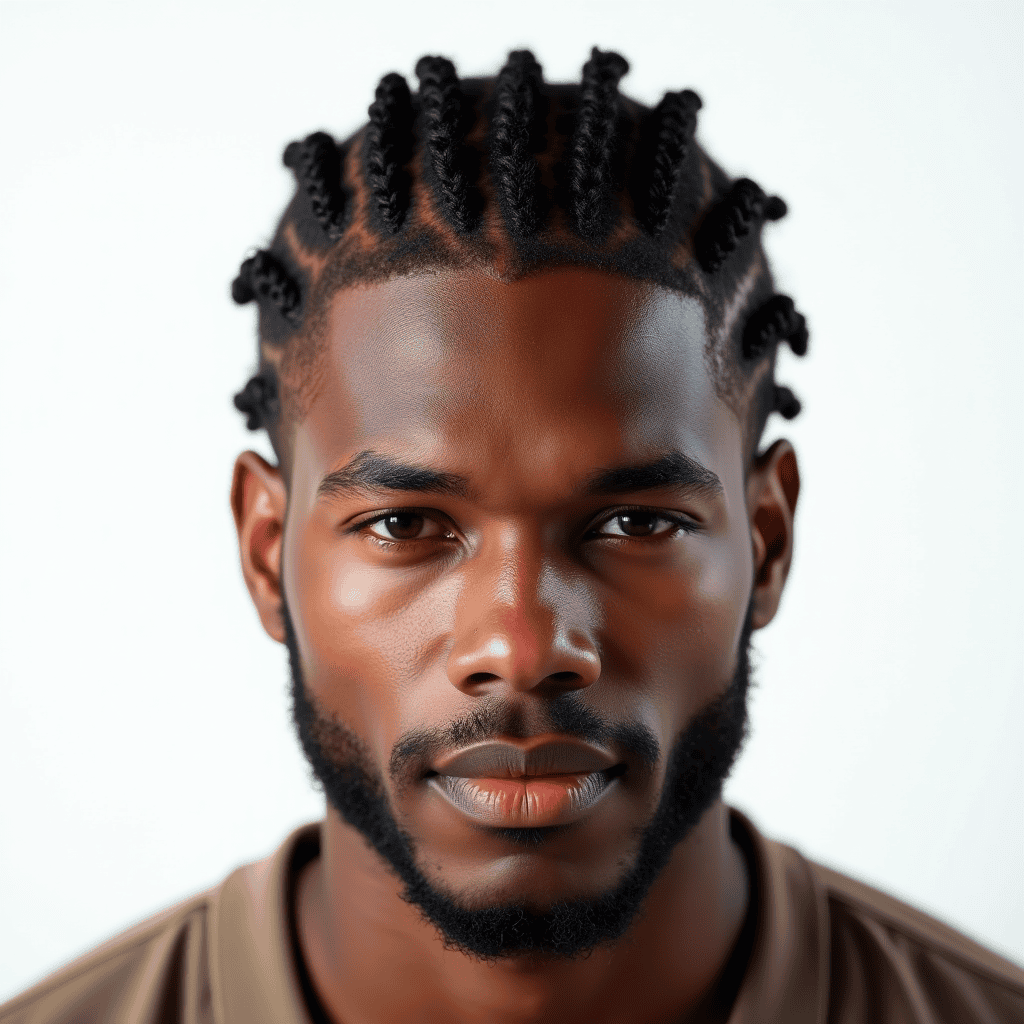
Curved cornrows follow broad sweeping lines instead of traveling directly backward. The braids may begin near the forehead and bend toward one side before returning toward the nape, making the pattern look fluid rather than rigid. Wider curves usually read better than several tiny direction changes because the shape stays visible from normal distance.
This design can flatter round and square faces by adding movement through the upper head. Ask for “medium curved cornrows with long smooth arcs rather than tight little turns.” The pattern requires enough length for the braid to follow the curve comfortably. The drawback is that uneven curves stand out quickly, so this is one of those styles where sectioning skill matters more than adding extra detail.
12. Side-Swept Cornrows

Side-swept cornrows send most of the pattern diagonally toward one side instead of dividing the head evenly. The strongest versions use a consistent direction, so the braids appear to move together rather than looking like unrelated sections. That directional pull creates a noticeable asymmetry while keeping the actual braids fairly traditional.
This is a good option for men who want distinctive cornrow hairstyle ideas without using extreme shapes or added accessories. Tell the braider, “angle the cornrows consistently toward one side and keep the sections clean through the crown.” Because the design is asymmetric, a poor starting angle can make the whole style feel unbalanced. Look at the planned parting before the braiding begins rather than judging it after everything is finished.
13. Zigzag Pattern Cornrows
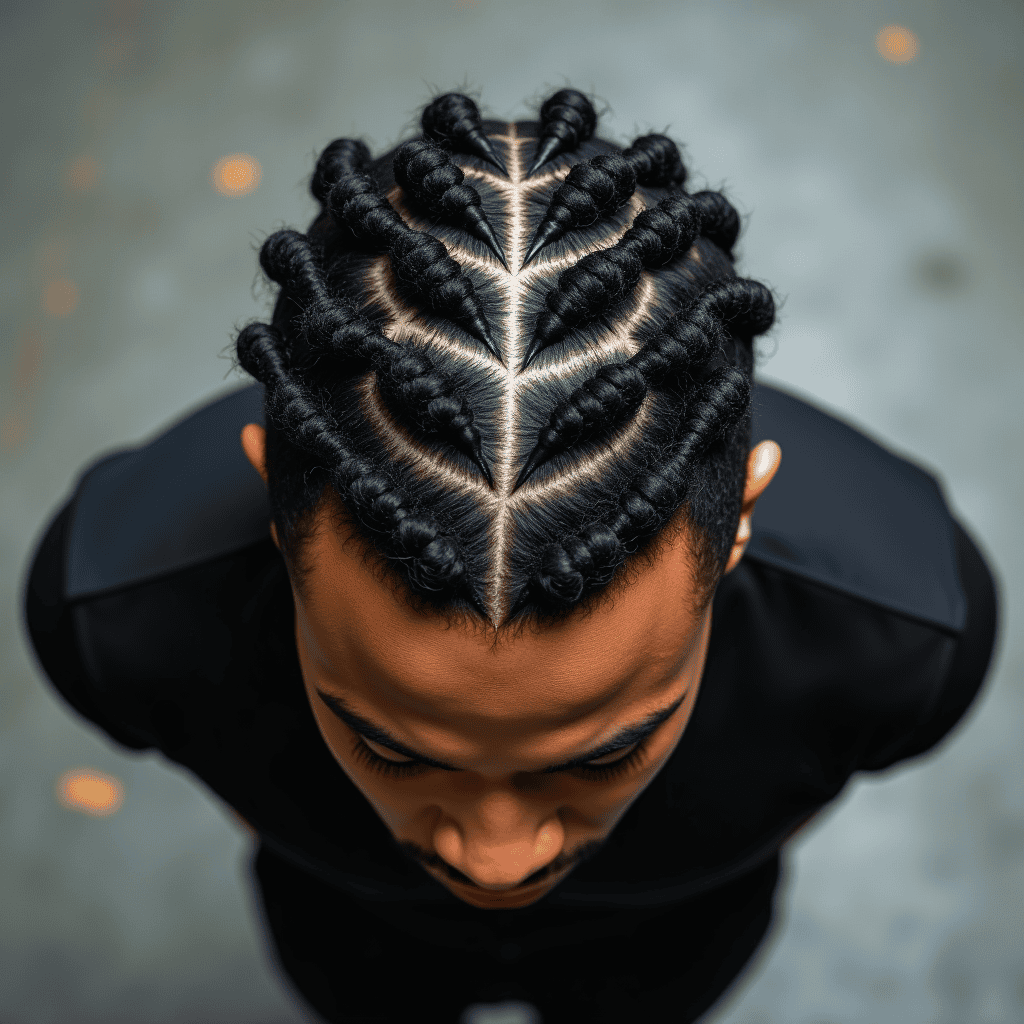
Zigzag cornrows turn the exposed parting into the main visual feature. Rather than drawing straight scalp lines, the sections move through sharp angular changes while the braids follow beside them. A few large zigzags usually look stronger than dozens of tiny ones because the geometry remains easy to read.
Men with dense hair and enough scalp coverage between sections get the cleanest version of this look. Ask for “medium cornrows with bold zigzag parts, keeping the angles large and evenly spaced.” It takes more planning than straight-back braiding and can take longer to section neatly. Once new growth appears, the sharp zigzag edges also lose definition faster than broad straight parts.
14. Crisscross Cornrows
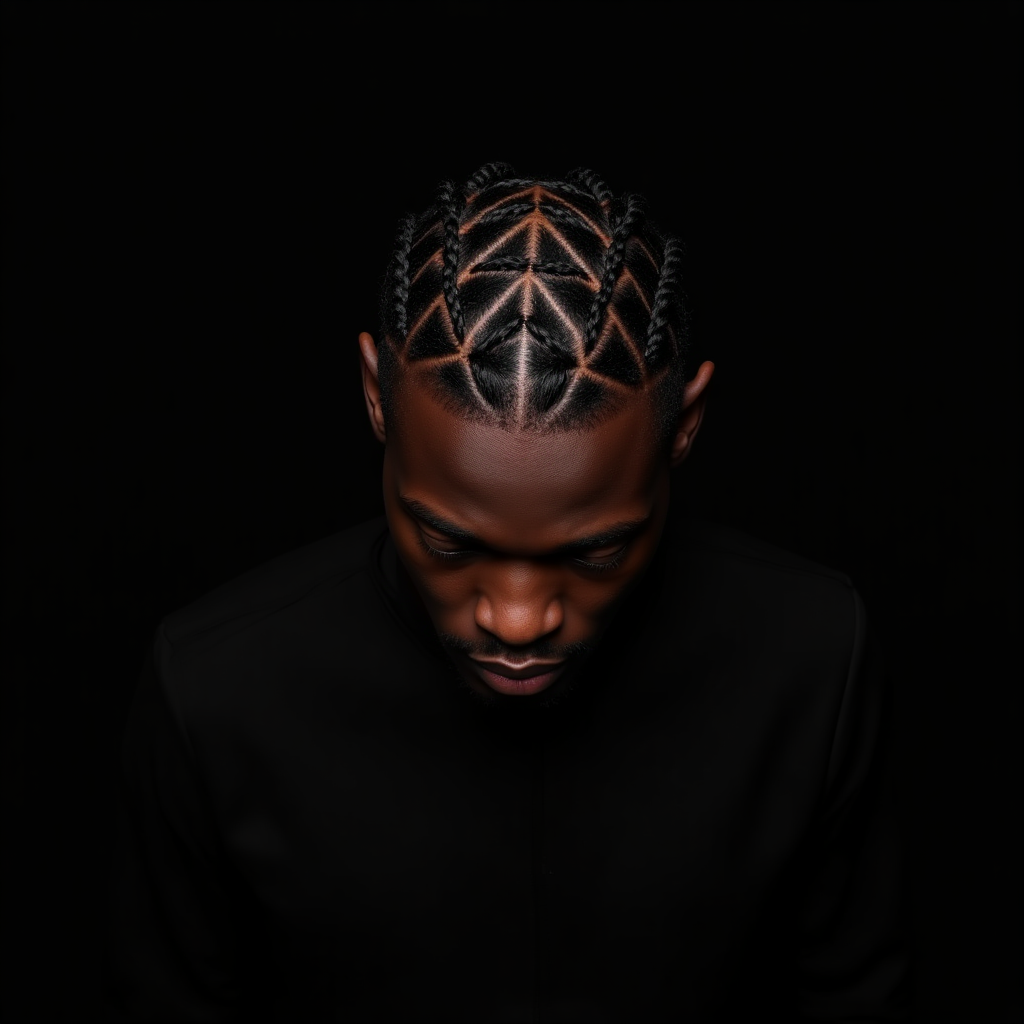
Crisscross cornrows create the illusion of overlapping paths by changing how sections are divided and directed across the scalp. The visual interest comes from carefully planned intersections and diagonal parting rather than physically weaving finished braids over one another everywhere. Done cleanly, the pattern looks almost architectural from above.
This works best for men who enjoy detailed designs and have enough density for multiple defined sections. Ask for “a crisscross cornrow layout with clear diagonal intersections and medium braid thickness.” This is not the style to rush. A confusing layout can quickly become visually busy, and small parting errors are more obvious because your eye naturally follows every intersection. Choose fewer strong crossings over maximum complexity.
15. Wave Pattern Cornrows
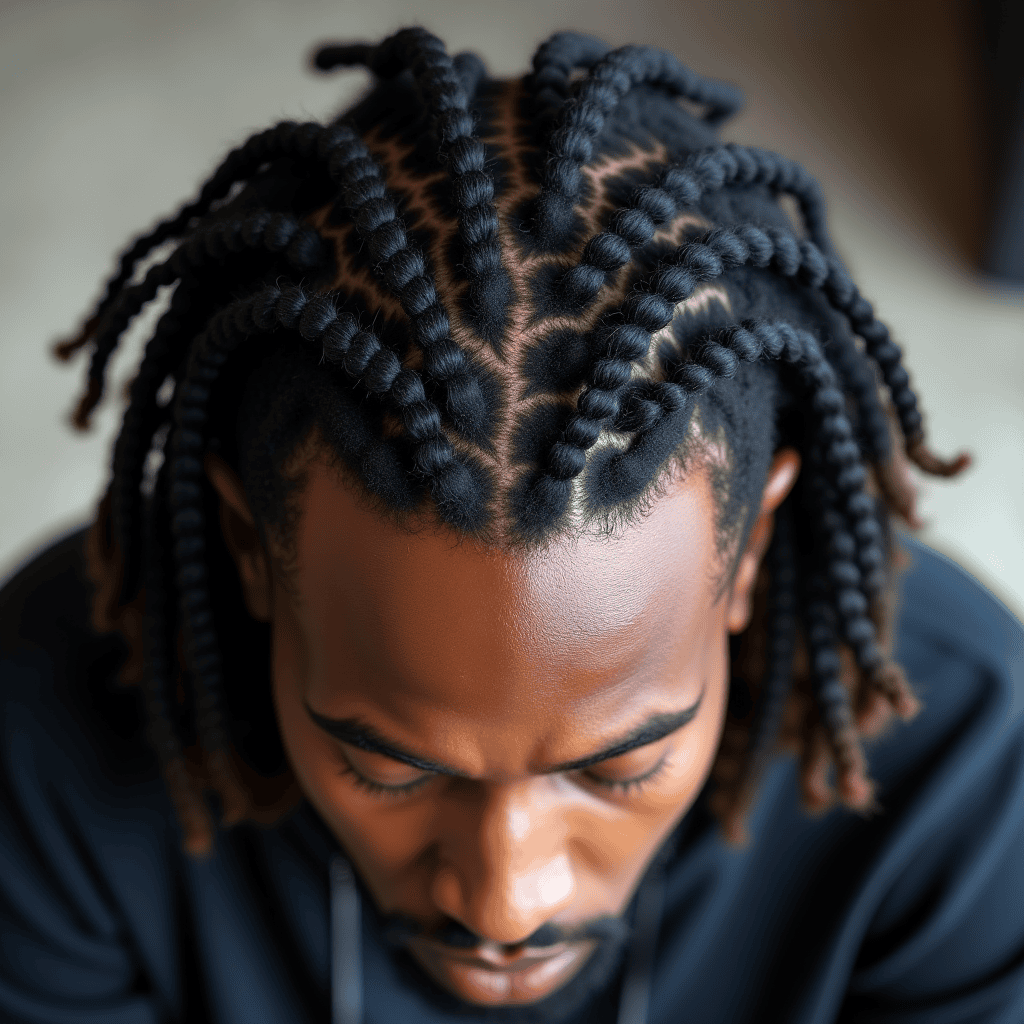
Wave pattern cornrows use repeated flowing bends that move across the head almost like contour lines. Unlike simple curved cornrows, several neighboring braids repeat a similar wave, creating rhythm when viewed from above. The style feels detailed without relying on sharp corners or extremely narrow sections.
This shape is especially useful for men who like graphic cornrow hairstyle ideas but find zigzags too aggressive. Ask for “parallel wave-shaped cornrows with smooth repeating curves and medium spacing.” Clean waves require careful parting around the crown where the head shape changes fastest. The design also loses some of its visual impact as the sections become fuzzy, so it looks best during the fresher part of the wear cycle.
Longer and Tied Cornrow Styles
Longer hair opens the door to styles that continue beyond the scalp. Cornrows can finish in hanging braids, gather into a bun, or transition into another braided technique. These cornrow hairstyle ideas have more movement, but the extra length also changes sleeping, washing, and daily styling.
16. Cornrows Into a Low Bun
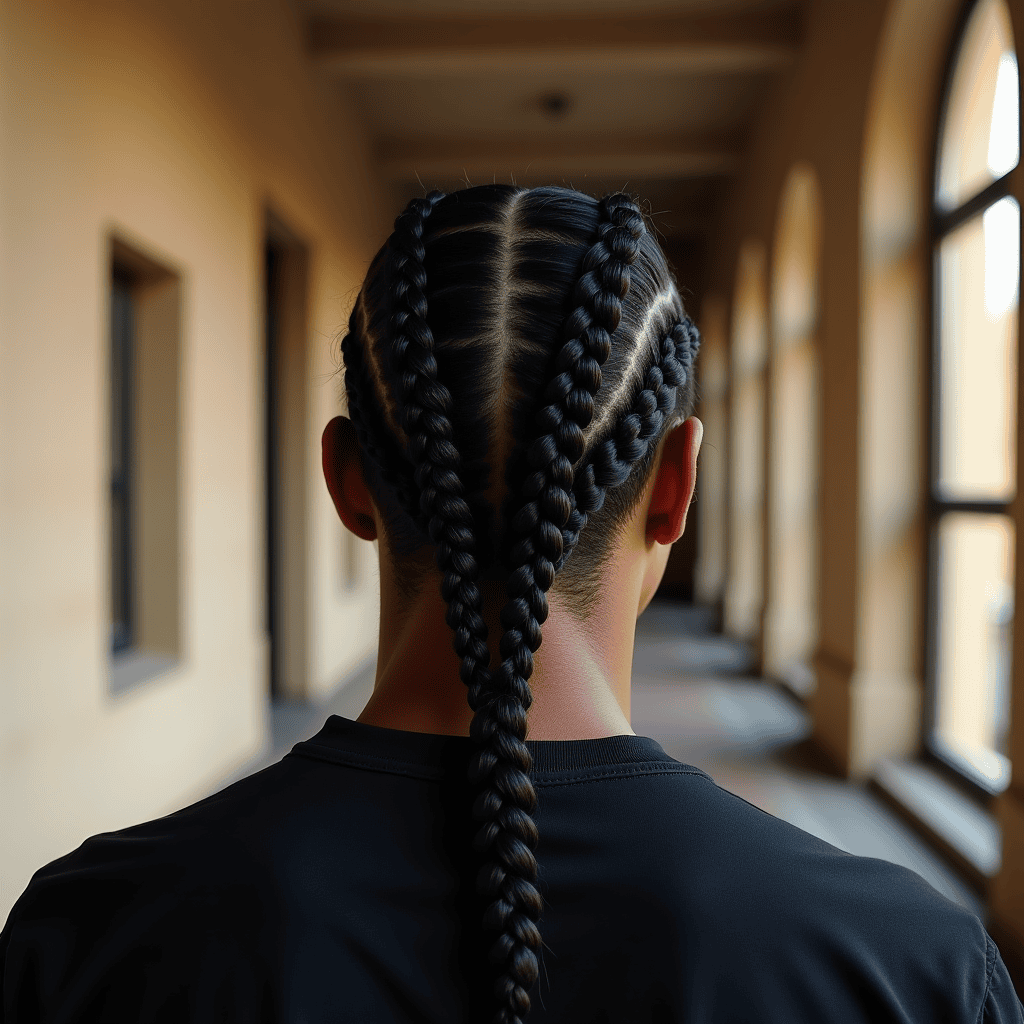
Cornrows into a low bun direct multiple braids toward the back and gather their remaining length near the nape. From the front, the style can look restrained and streamlined; the detail appears when the head turns and the rows converge into the tied finish. Keeping the bun compact prevents it from overpowering the scalp pattern.
This suits men with enough length to gather the braid ends comfortably without pulling. Ask for “cornrows directed toward a small low bun with relaxed tension at the gathering point.” It works nicely with jackets, collared shirts, and cleaner evening outfits because the hair stays controlled. The weak point is the tie area, where repeated tight fastening can create unnecessary tension if you constantly pull the bun firmer.
17. Cornrows Into a High Bun
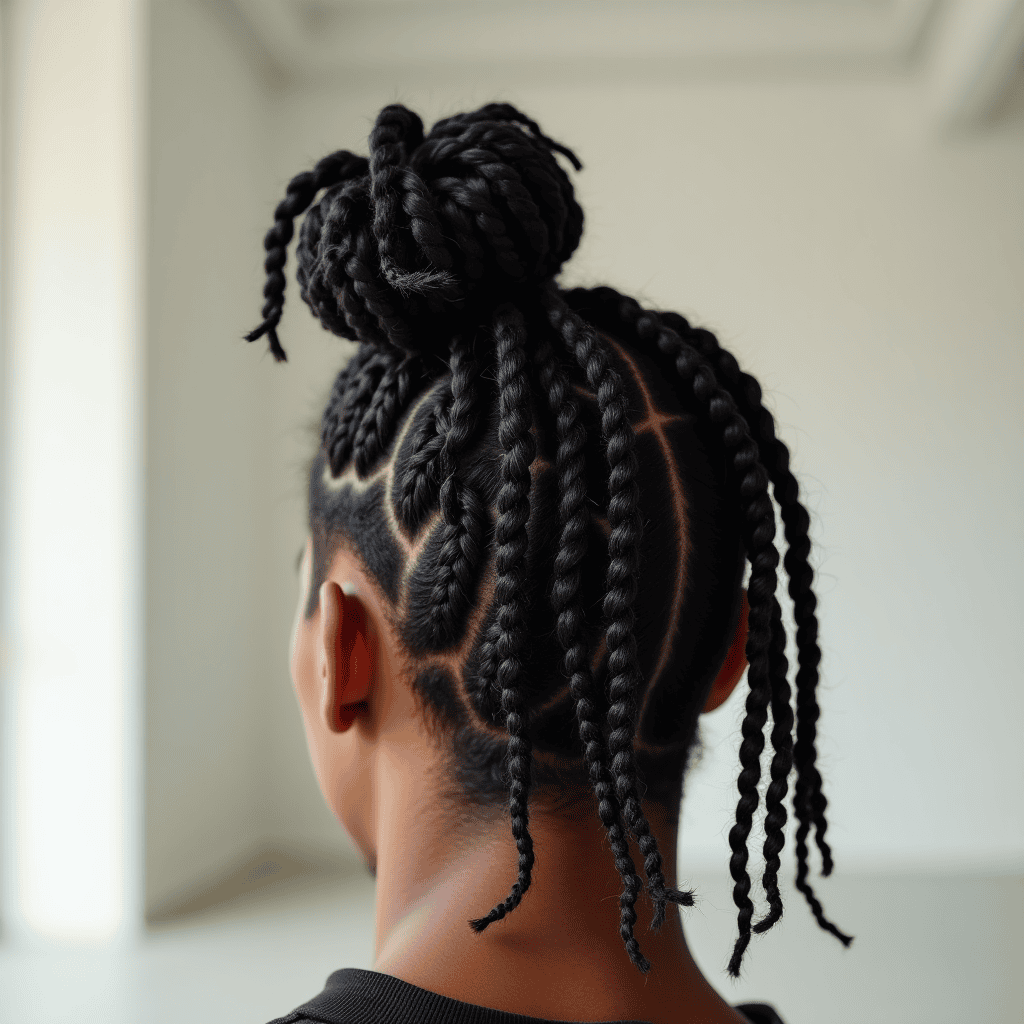
A high bun changes the entire direction of the pattern because the braids travel upward and inward toward the crown. Viewed from the side, the converging rows create visual lift before collecting into a compact knot above the back of the head. It feels more expressive than a low bun even when the individual cornrows remain simple.
Men with longer hair and strong density through the crown usually get the fullest result. Ask the braider for “cornrows directed into a high crown bun with smooth sections and no excessive pull around the perimeter.” Among tied cornrow hairstyle ideas, this one asks more from the roots because the braids change direction. Anyone who feels tenderness around the hairline should favor a lower gathering point.
18. Cornrows With Loose Braided Ends
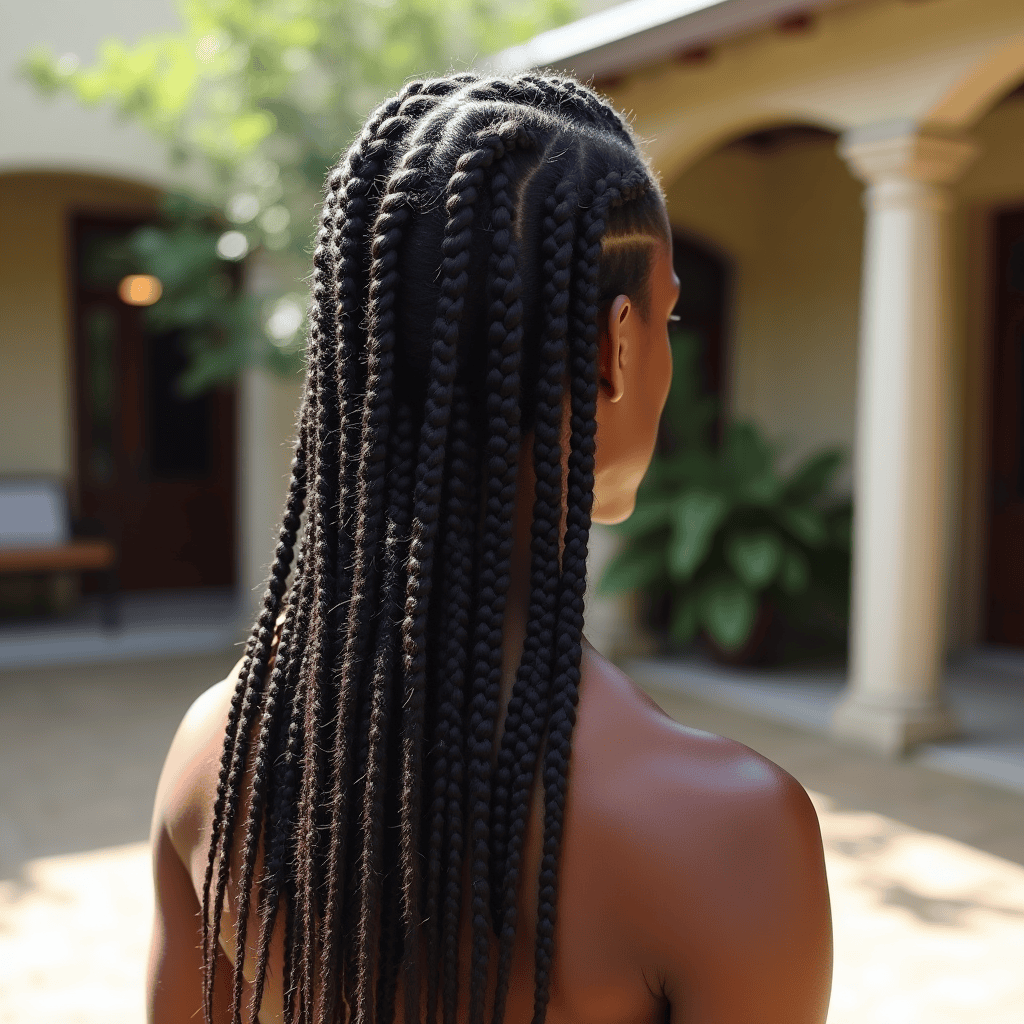
This style keeps the roots neatly cornrowed while allowing the braids to continue freely after they leave the scalp. The transition usually happens toward the back, so the front and crown remain structured while the ends gain movement. The hanging sections can stay medium thickness to match the cornrows rather than suddenly changing scale.
This is ideal for men with enough length to enjoy braids beyond the nape and who do not mind securing them during sleep or exercise. Ask for “clean cornrows through the scalp with the same braid size continuing loose at the back.” The free ends give you more styling options, but they also rub against clothing and move more during the day. That means the ends may look worn before the roots do.
19. Cornrows With Box Braids
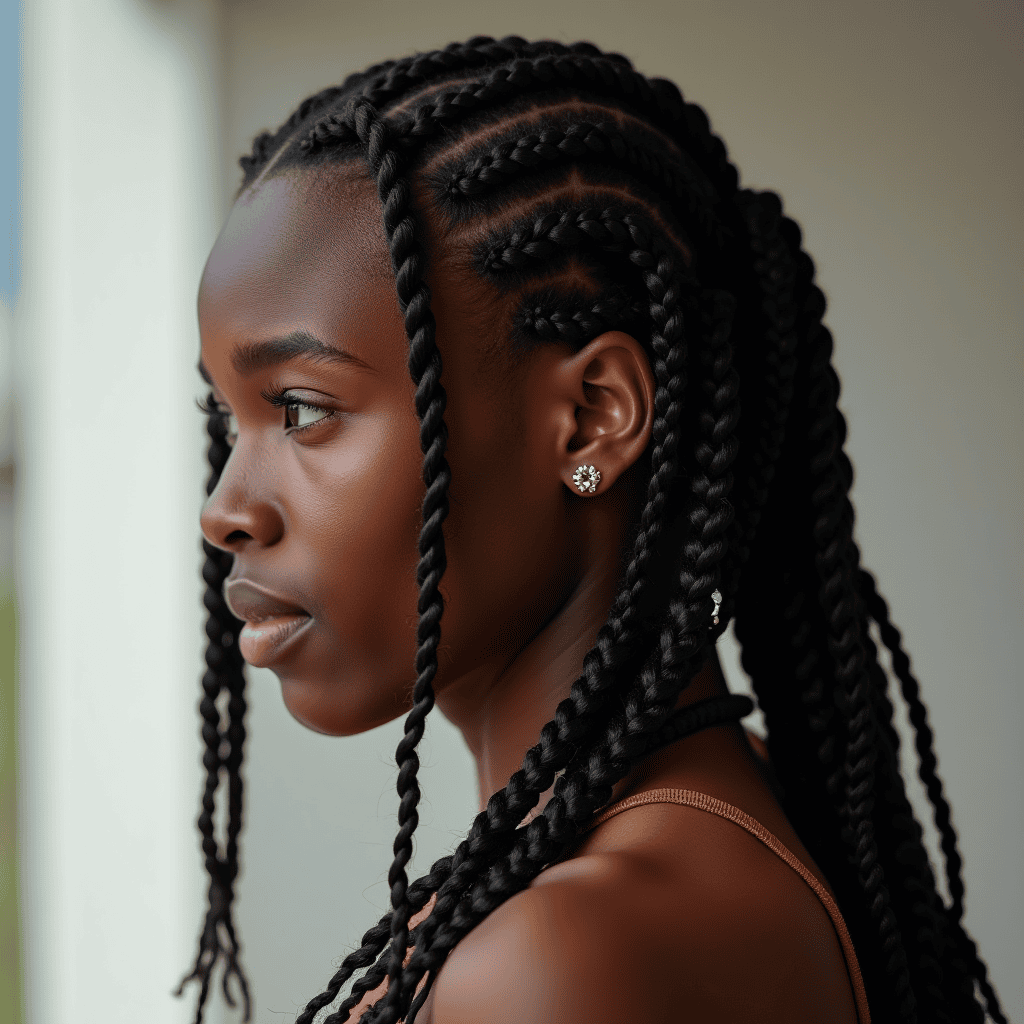
Cornrows with box braids combine two different structures in one hairstyle. The scalp can begin with directional cornrows through the front or sides, then transition into individually sectioned braids that hang freely. The contrast works best when both parts share a similar braid thickness so the finished style still feels connected.
Men seeking more versatile cornrow hairstyle ideas often like this because the loose sections can be tied or repositioned. Ask for “cornrows through the front and crown transitioning cleanly into medium individual braids, with consistent braid size throughout.” There is more hair movement and more styling flexibility, but there is also more work involved in keeping the loose lengths orderly. An overly complicated transition can make the design feel crowded.
20. Half-Up Cornrow Style
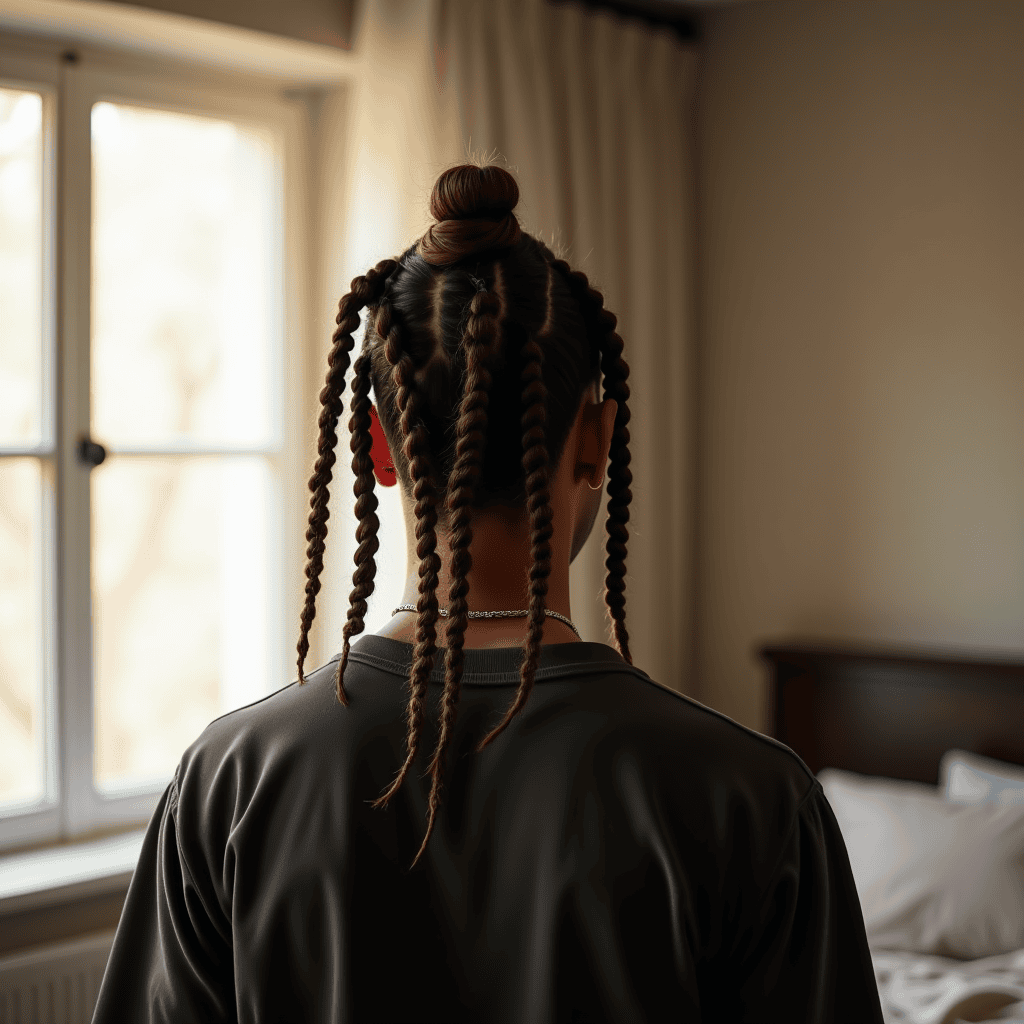
The half-up cornrow style gathers only part of the braided length while leaving the rest down. Cornrows can travel backward from the hairline, with the upper rows tied near the crown and lower braids allowed to hang naturally. That separation creates height on top without committing the whole hairstyle to a bun.
This works on longer hair when you want practical control around the face but still want visible length. Ask for “straight or lightly curved cornrows with the upper braids gathered loosely at the crown and the lower braids left down.” The look has more daily styling flexibility than a fixed bun. Its drawback is balance: gathering too much hair can leave the lower half looking thin, so the sections need to be planned before braiding.
Bold and Detailed Cornrow Designs
The last group pushes further into pattern work. These are the cornrow hairstyle ideas that make the scalp itself part of the design, so they reward thick hair, careful sectioning, and a clear reference image. More detail is not automatically better. The strongest complex styles still have one visual idea you can understand immediately.
21. Spider Pattern Cornrows
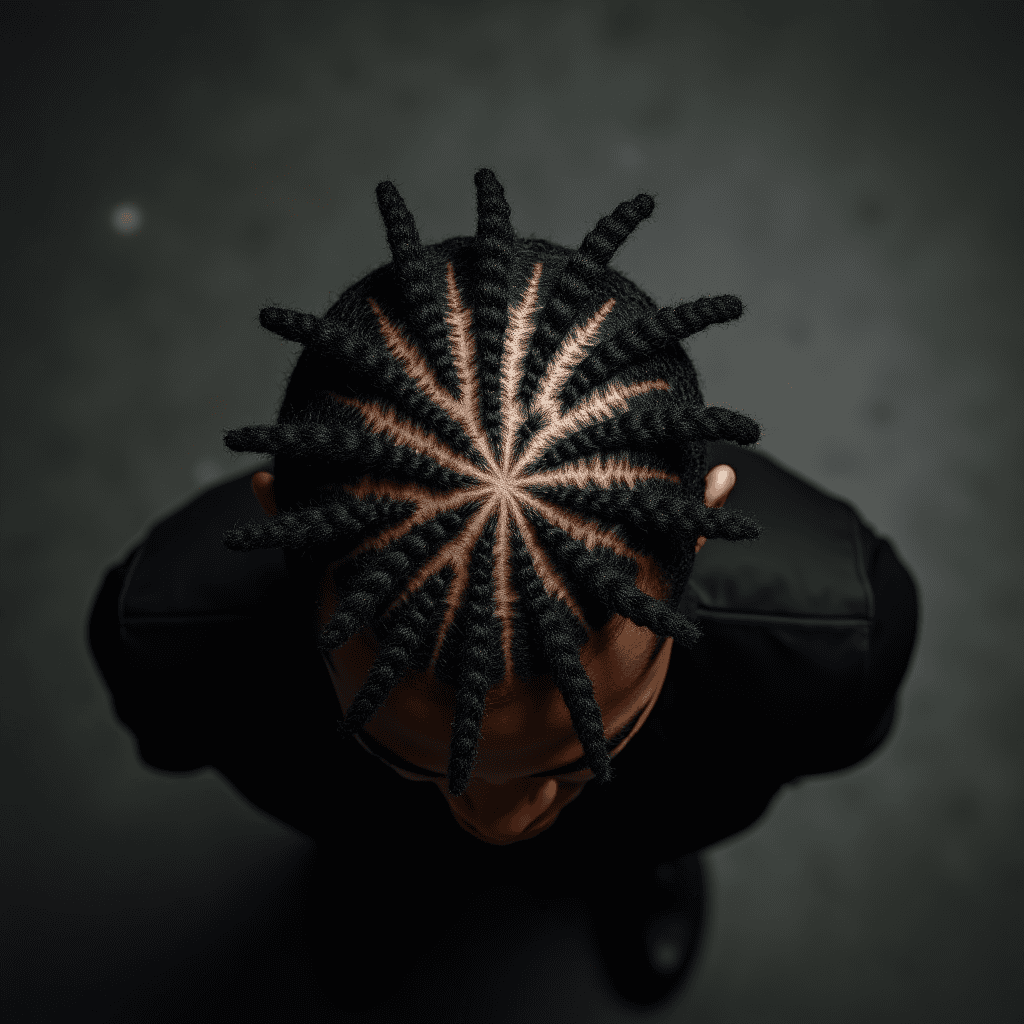
Spider pattern cornrows use a central or offset point with sections radiating outward like spokes. The effect comes from the direction of the parts as much as the braids, creating a circular or semi-circular pattern across the crown. A restrained number of spokes keeps the design readable and avoids turning the center into a crowded knot of tiny sections.
Men with dense hair and a broad crown have the most room for this graphic layout. Ask for “a radiating spider-style cornrow pattern with a clean central point and medium braid widths.” The design needs accurate placement before the first braid starts. If the center is slightly misplaced, the asymmetry becomes obvious from above, which is why this isn’t the best choice for a rushed appointment.
22. Small Detailed Cornrows
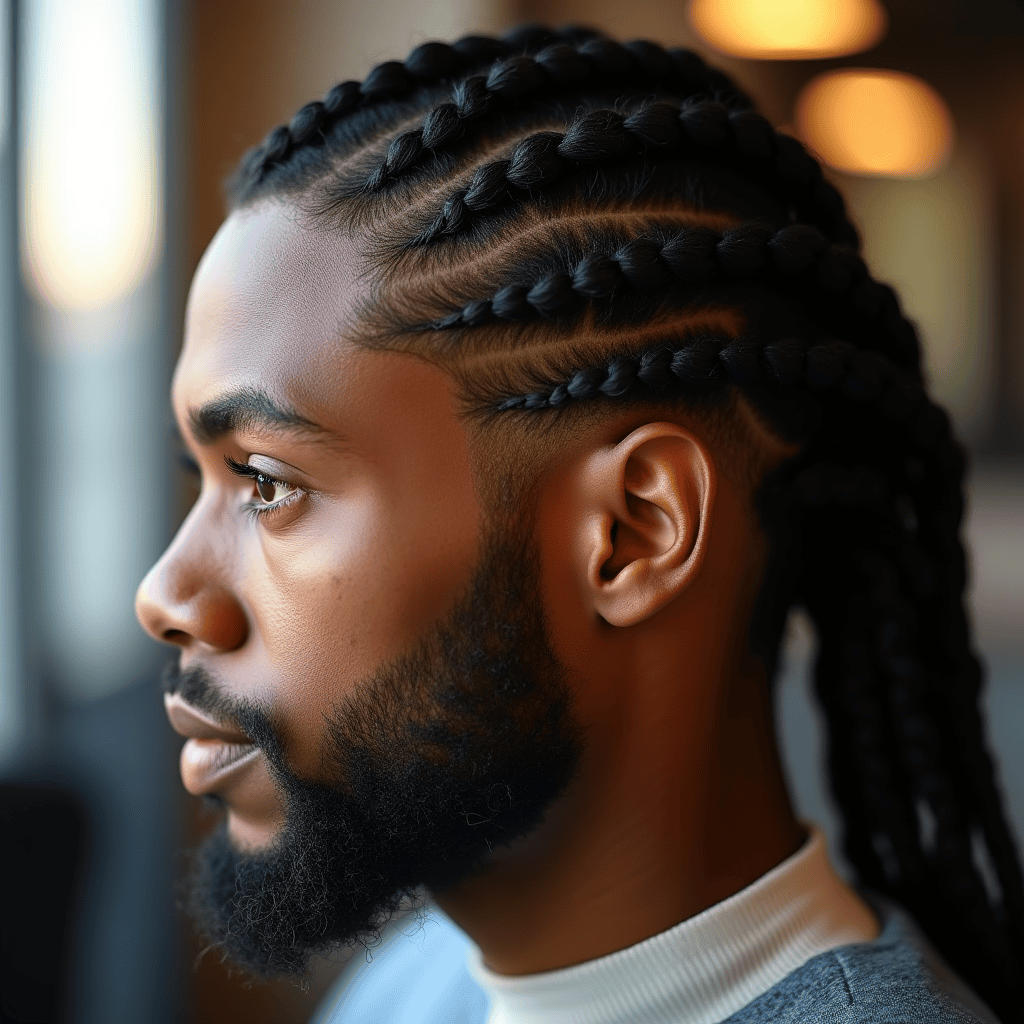
Small detailed cornrows cover the scalp with numerous narrow, closely controlled rows. Because each braid carries less hair, the pattern gains texture and intricacy without needing dramatic curves or sharp angles. From a distance the head appears finely ridged, while close up the precision of every part becomes the real attraction.
This style favors dense hair and someone willing to spend more time in the chair. Ask for “small evenly spaced cornrows with fine sections and comfortable tension, especially at the hairline.” These cornrow hairstyle ideas can look exceptionally polished, but they require patience during installation and removal. Smaller does not mean tighter, and discomfort should never be treated as evidence that the braids are being done properly.
23. Alternating Thick and Thin Cornrows
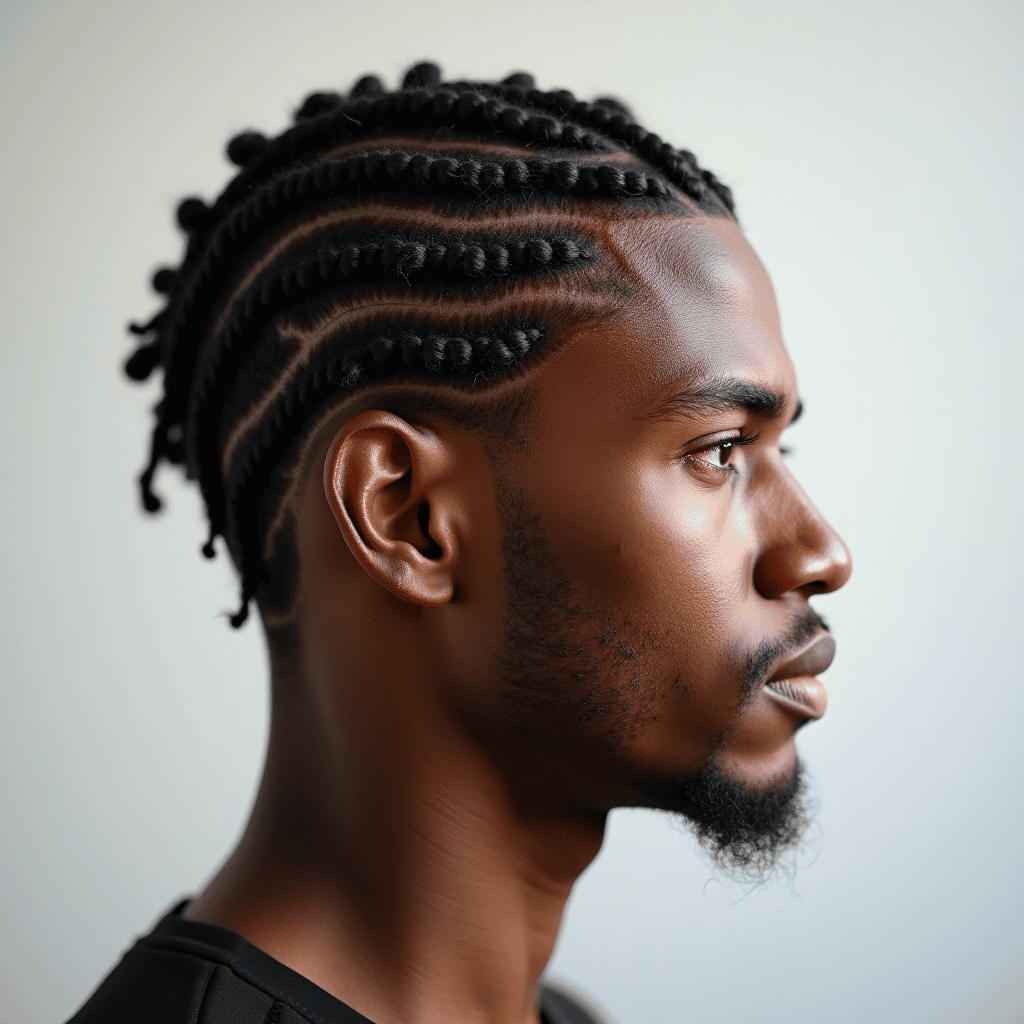
Alternating thick and thin cornrows create rhythm by changing braid scale across the scalp. A substantial braid may sit beside one or two narrow rows before the pattern repeats, giving a familiar straight-back layout much more character. The key is repetition. Random widths tend to look accidental rather than designed.
Men with thick hair have more freedom to vary section size without weakening the larger braids. Ask for “a repeating thick-thin cornrow sequence with balanced spacing from front to back.” It is a smart option if you want detail without geometric parting. The drawback is proportional: if the thin rows become too tiny beside oversized braids, the pattern can look lopsided instead of intentional.
24. Diamond-Part Cornrows
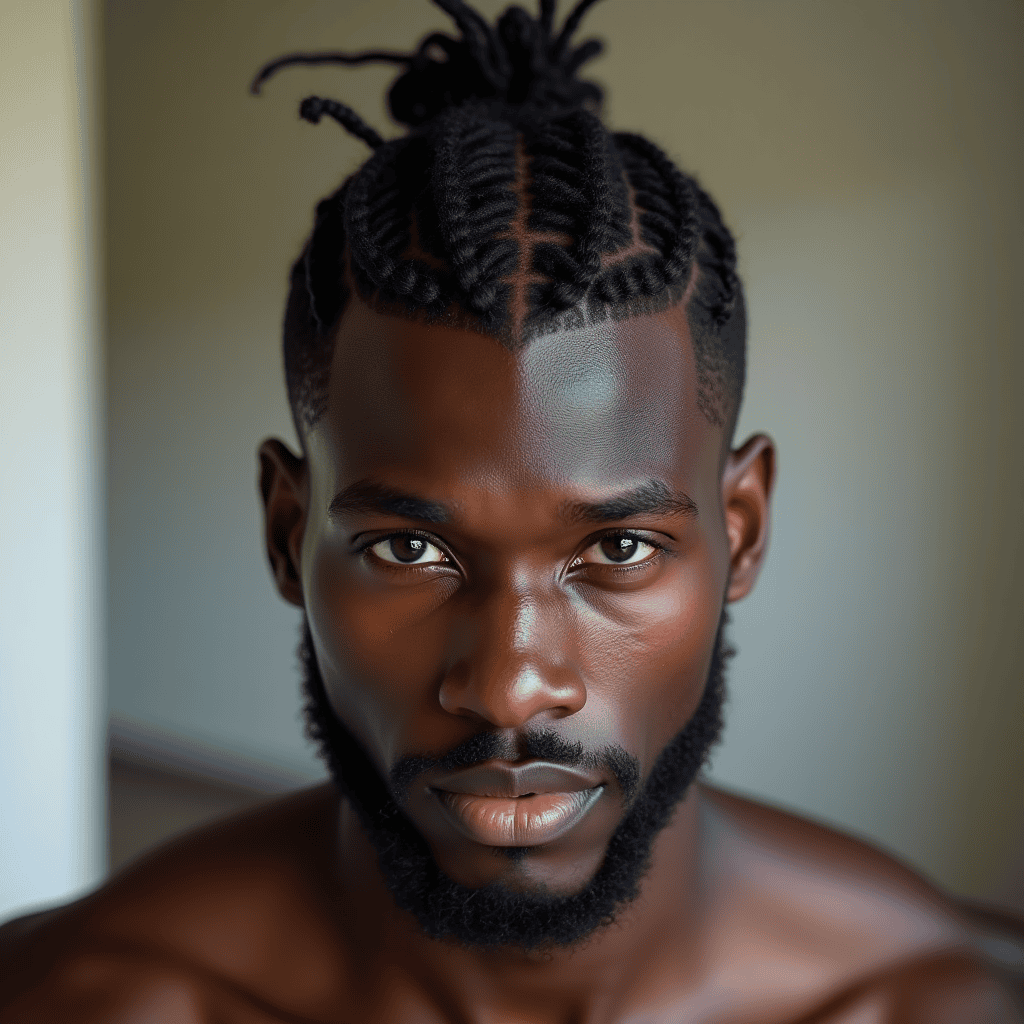
Diamond-part cornrows use angular section lines that form repeated diamond shapes between or around the braids. The diamonds can run through the center while neighboring rows frame them, giving the scalp a layered geometric pattern. Keeping the diamonds relatively large helps the design survive normal movement and mild regrowth better than tiny decorative sections.
This is best for men wanting detailed cornrow hairstyle ideas where the parting carries as much personality as the braid itself. Ask for “large clean diamond-shaped parts integrated into medium cornrows, with the pattern centered through the crown.” The geometry needs careful measuring by eye. If your hair density changes noticeably from one area to another, some diamonds may not appear as balanced as others.
25. Mixed Geometric Cornrows
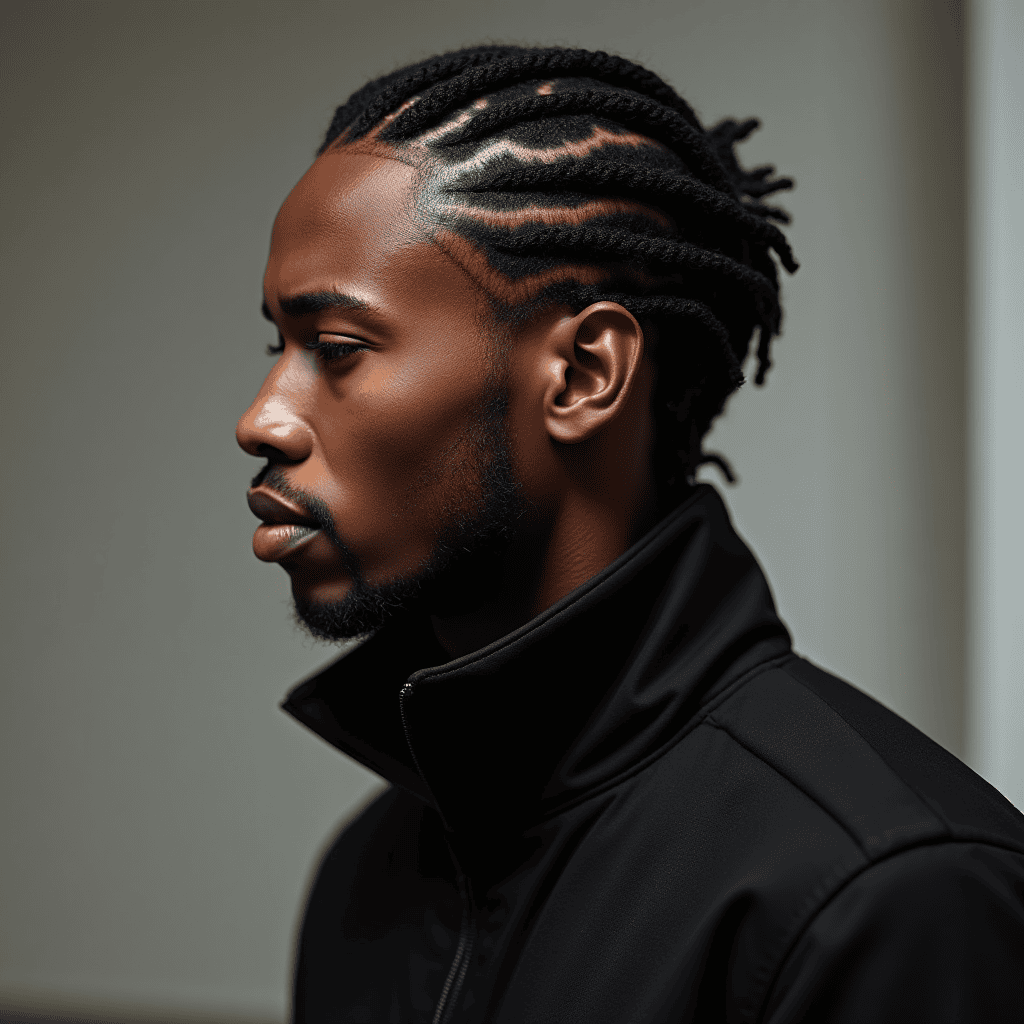
Mixed geometric cornrows combine straight lines, curves, and selected angular sections in one coordinated layout. The successful version does not use every pattern everywhere. Instead, one side might carry a sweeping curve while the center uses straighter braids and a few sharp parts connect the two, giving the head a custom-drawn appearance.
This is the most advanced option here and suits someone who already knows what they enjoy wearing. Ask for “a custom geometric cornrow layout using two or three coordinated parting shapes, with one dominant pattern rather than random sections.” The biggest drawback is easy to predict: overdesign. If every inch tries to become the focal point, none of it is. Bring a reference and agree on the main direction before sectioning starts.
How to Choose the Right Cornrow Hairstyle
Choosing among cornrow hairstyle ideas gets easier when you start with your actual hair rather than the pattern you saved online. Density, length, hairline shape, scalp sensitivity, and how often you want to revisit a barber all matter more than whether a design looks impressive in a single photograph.
For shorter hair, start with medium straight-back rows, four-to-six braid layouts, or a simple curved pattern. They need less loose length and keep the visual focus on the scalp design. Longer hair gives you access to buns, hanging braid ends, half-up arrangements, and transitions into individual braids.
Hair density affects scale. Dense hair can support alternating braid widths, fine rows, and complex geometric sections without exposing more scalp than intended. Lower-density hair often looks better with fewer, thoughtfully positioned rows. Packing dozens of tiny sections into limited density rarely creates the fuller appearance people expect.
Face shape is worth considering, but do not treat it like a rigid rule. Straight-back braids emphasize length and symmetry. Side-swept and curved cornrows can introduce diagonal movement. High buns and mohawk shapes add height, while broader full-head layouts create more width.
Bring two or three reference images to the appointment rather than one. Tell your braider which feature matters most: the braid thickness, direction, parting, fade, or finished length. A useful request sounds like, “I want medium braids and this general curved direction, but keep the tension comfortable around my front hairline.”
For an event, shoot, interview, or wedding, avoid experimenting with an unfamiliar high-tension pattern at the last possible moment. Give yourself enough breathing room to see how the style settles and how it works with your outfit. A clean cornrow design can pair easily with tailoring, streetwear, sportswear, or formal clothes when the pattern and haircut don’t fight for attention.
When Cornrows May Not Be the Right Choice
Not every head of hair needs to be braided simply because a pattern looks good online. Cornrows rely on having enough usable length and density for the chosen sections, and they should never require uncomfortable pulling to achieve the photograph you brought to the appointment.
Complicated patterns can also become poor value if you know you prefer changing your hair every few days. Small rows, elaborate geometry, and combined braid styles take more installation and removal effort than basic straight-back cornrows. Sometimes four clean rows will look better on you than sixteen technically impressive ones.
Be cautious with designs that depend on an aggressively shaped hairline. The strongest cornrow hairstyle ideas normally work with the natural perimeter instead of requiring the front to look unnaturally sharp. If the hairstyle only looks good after heavy manipulation around the edges, simplify the design.
And if a braid feels painfully tight, speak up during the appointment. A neat result and a comfortable result are not opposites. Good sectioning, even tension, and realistic braid sizing matter more than squeezing one extra week of crispness out of the style.
Frequently Asked Questions
The practical questions around cornrows usually come down to length, maintenance, barbering, sleeping, and choosing a pattern that works with your own hair. These answers focus on those decisions rather than pretending one style suits everyone.
What are the best cornrow hairstyle ideas for men getting braids for the first time?
Start with straight-back cornrows, four-to-six medium rows, or simple curved cornrows. They are easy to understand before the braiding begins, work with many hair densities, and make upkeep less confusing. Save highly geometric or mixed-direction patterns until you know what braid thickness and tension you prefer.
How long does men’s hair need to be for cornrows?
There needs to be enough length for the braider to grip and build a secure braid, but the practical minimum varies with texture, density, technique, and the intended pattern. Shorter hair usually limits complex designs. A braider can assess whether your current length will hold the style you want without excessive tension.
Do cornrows look better with a fade?
Neither option is automatically better. A fade creates stronger contrast and can make the braid pattern look sharper, while full sides give the braider more surface area for curved or side-reaching designs. A temple taper is a useful compromise if you want barbered edges without removing much braidable hair.
Which cornrow hairstyle ideas work best with a round face?
Straight-back rows, diagonal cornrows, side-swept layouts, and styles with moderate height can create longer visual lines around a round face. Broad circular patterns may emphasize width more strongly. Use face shape as a design clue rather than a rule, because beard shape and overall head proportions also affect the result.
Can men wear cornrows with short hair?
Yes, provided the hair is long enough for a braider to grip comfortably. Straight-back and simpler medium-width patterns usually make more sense on shorter lengths than buns, hanging braids, or complicated geometric designs. If extra tension is needed merely to keep very short sections from escaping, waiting for more growth may give a better result.
How should I sleep with cornrows?
Reduce unnecessary rubbing and movement around the braids while you sleep. A smooth head covering or smooth pillow surface can help keep loose fibers from catching as much overnight. Avoid pulling long braided ends into an unnecessarily tight position simply to keep them out of the way.
How do I choose between thick and thin cornrows?
Thicker cornrows create a bolder, simpler pattern and need larger sections of hair. Thin rows produce more detail but require more sectioning and generally more installation time. Your density should guide the choice. If your hair is less dense, forcing too many narrow sections can expose more scalp than you expected.
Can cornrows be combined with a taper instead of a full fade?
Yes. A temple or neckline taper preserves more hair around the sides, which means more freedom for future braid patterns. It also creates a softer transition than a mid or high fade. Ask the barber to keep the taper below the area your braider needs so the two services do not compete.
What cornrow hairstyle ideas are easiest to maintain?
Classic straight-back cornrows, two large cornrows, four thick rows, and six medium rows are among the least complicated choices. Their sections are easy to understand and there are fewer geometric details to lose definition. Longer hanging braids and intricate parting usually add more daily handling.
Are zigzag cornrows harder to maintain than straight cornrows?
The braids themselves may require similar basic care, but the zigzag parting can appear less crisp sooner because the sharp angles depend on clean exposed lines. Straight sections tend to tolerate a little visual softness better. If maintaining a freshly drawn scalp pattern matters to you, simpler geometry has an advantage.
What should I tell my barber before getting cornrows with a fade?
Explain how much braidable area you want to preserve before the fade begins. If possible, let the braid plan determine where the barber removes hair rather than cutting the sides high first and discovering that the desired pattern no longer fits. A reference showing both the braids and fade is more useful than separate photos.
What should I ask for when booking cornrows?
Describe the overall pattern, approximate braid thickness, whether you want a fade or full sides, and whether your hair will remain braided at the ends or hang loose. Mention any concern about tension before the service begins. The most useful next step is simple: ask whether your current length and density can support your chosen pattern comfortably.
Best Men’s Hairstyle Reports
Discover bold cuts, long hairstyles, braided looks and modern men’s grooming inspiration.