

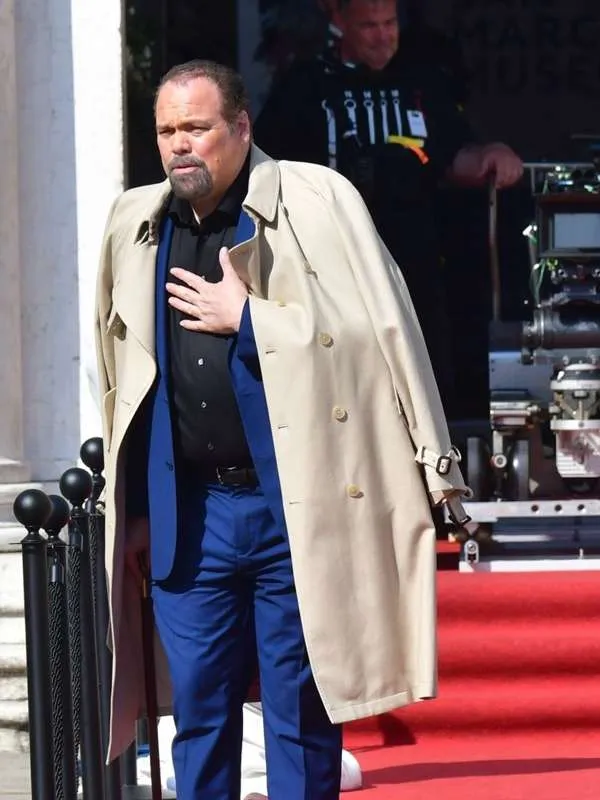
Vincent D’Onofrio has spent more than four decades proving that physical presence can be as expressive as dialogue. His towering frame, measured delivery, and willingness to alter his appearance have helped him disappear into characters ranging from the troubled Private Leonard Lawrence in Full Metal Jacket to Wilson Fisk in Marvel’s Daredevil universe.
Born on June 30, 1959, the American actor and filmmaker turned 67 in 2026. His public wardrobe has evolved alongside his career. Recent appearances show a preference for strong-shouldered suits, open-collar shirts, calm neutral colors, and refined casual clothing. His version of luxury streetwear is not driven by oversized logos or passing sneaker trends. It rests on good fabric, relaxed tailoring, dark layers, and pieces that work with his large proportions.
D’Onofrio’s sharpest formal looks often depend on simplicity. Black tailoring with a white shirt gives him authority, while navy and cream soften his size without weakening his presence. He is equally convincing in a checked blazer over a crew-neck shirt, an approach that offers more practical value to most men than copying a costly designer outfit.
His appeal reaches beyond fashion. Viewers search for his age, height, family, net worth, physical transformations, grooming choices, and current Marvel work. Together, those details reveal a performer whose image has been built through discipline, restraint, and a clear understanding of how clothes can support character rather than compete with it.
Biography, Age & Background
D’Onofrio’s background helps explain the adaptability that defines both his acting and personal presentation. He experienced several regional cultures while growing up, entered theater through backstage work, and developed his craft before celebrity brought stylists and formal premieres into his life. His biography is not the story of a polished Hollywood newcomer. It is the story of a working actor who learned how bodies, clothing, voices, and movement alter the way an audience reads a person.
A Brooklyn Birth Followed by a Childhood Across America
Vincent Philip D’Onofrio was born in Brooklyn, New York, on June 30, 1959. Public biographies describe him as the youngest of three children. His father, Gene D’Onofrio, worked in interior design and maintained an interest in amateur theater, while his mother, Phyllis, later moved the family following the parents’ separation.
His early years were not limited to one city. Accounts of his childhood connect him with New York, Hawaii, Colorado, and Florida. He eventually attended Hialeah-Miami Lakes Senior High School in South Florida. Moving between places may have sharpened his skill at observing different accents, social habits, and forms of masculinity, though D’Onofrio has not framed his childhood as a calculated preparation for acting.
He has also discussed being shy and inward-looking when young. That detail fits the actor audiences later came to know: physically noticeable, yet often most powerful when still. His wardrobe carries a similar tension. Large proportions naturally attract attention, so his best clothing avoids excessive decoration. Dark suits, controlled patterns, and uncomplicated shirts allow the person inside the clothing to remain the focus.
Backstage Work Taught Him How Performance Is Constructed
Before becoming known on camera, D’Onofrio encountered theater from behind the scenes. Biographical accounts say he helped with sets, sound, and community-theater productions connected with his father. That experience offered a broader view of performance than acting classes alone could provide. He saw how lighting, costume, scenery, and movement combine to establish a character before the first line is delivered.
He later studied Method acting at the American Stanislavsky Theater and the Actors Studio. The Lee Strasberg Theatre and Film Institute also lists him as a teacher and masterclass participant, confirming the lasting connection between his early training and his mature approach to performance.
During his early New York years, he acted onstage and in student productions while taking practical jobs to support himself. Work associated with clubs and security placed him in clothing chosen for function rather than display. That background still shows in his casual wardrobe. Even when he wears polished pieces, they tend to look substantial and wearable. Jackets have room through the body, shirts are rarely fussy, and footwear usually appears chosen for stability and comfort rather than theatrical effect.
The Audition That Opened the Door to Full Metal Jacket
D’Onofrio’s career changed when Matthew Modine alerted him to an opportunity involving Stanley Kubrick. In a 2026 account of the story, D’Onofrio recalled recording an inexpensive audition tape while he had no major film representation. He initially thought a follow-up call from Kubrick’s team was a prank and hung up before the caller tried again.
The eventual result was Private Leonard Lawrence, commonly called Gomer Pyle, in the 1987 war drama Full Metal Jacket. The part demanded a striking physical change and gave D’Onofrio an early demonstration of how fully the body can become part of a performance.
That breakthrough also established a pattern. He would rarely depend on a fixed leading-man image. Instead, he changed posture, weight, facial expression, hair, and clothing to suit each role. From the loose military uniform and vulnerable stance of Leonard Lawrence to Wilson Fisk’s white suits and severe coats, costume has remained part of his acting language. His personal wardrobe is quieter, but it reflects the same awareness: silhouette tells a story before detail does.
Height, Weight & Body Measurements
D’Onofrio’s size is central to the way audiences perceive him, yet many numbers repeated online are not based on current measurements. His height has been widely reported for years, while his present weight, chest size, waist, and shoe size remain unconfirmed. The more useful style question is not the exact number on a scale. It is how a tall, broad man can use structure and proportion without making formal clothing look stiff or casual clothing look shapeless.
How Tall Is Vincent D’Onofrio?
IMDb lists D’Onofrio at 6 feet 3½ inches, or about 1.92 meters. Other public profiles commonly round that figure to 6 feet 4 inches, and D’Onofrio has referred to himself as being around that height. Minor differences may come from rounding, footwear, posture, or measurements taken at different stages of adulthood.
His height gives him natural visual authority. On screen, directors can make that quality protective, threatening, awkward, or imposing according to posture and camera placement. On a red carpet, the same frame requires thoughtful tailoring. A jacket that is too short can make his torso appear larger, while narrow lapels can look undersized against his chest and shoulders.
D’Onofrio’s strongest suits tend to respect his scale. Medium-to-wide lapels, a clean shoulder line, and enough jacket length to cover the seat create balance. Men with similar proportions do not need exaggerated tailoring. They need components that are large enough to appear intentional. Small collars, narrow ties, and tiny accessories can look disconnected from a broad frame.
Why His Current Weight Cannot Be Stated Reliably
No dependable public source provides a verified current weight for D’Onofrio. Figures found on celebrity-measurement sites often mix old film weights, estimates based on photographs, and numbers copied from one another. His weight has also changed for professional reasons, making any single unsourced number misleading.
The most documented change occurred for Full Metal Jacket. In recent interviews, he has described moving from roughly 210 pounds to around 290 pounds for the role, an increase of about 80 pounds. Older accounts sometimes report a slightly smaller gain, which shows why figures should be tied to a period rather than presented as permanent measurements.
His present chest, waist, biceps, and shoe size have not been reliably published. Clothing analysis can still be made from public appearances, but it should remain visual rather than numerical. He has a broad torso, substantial shoulders, long arms, and a large head-to-body scale. Those features favor garments with visual weight: sturdy collars, fuller trousers, textured jackets, and shoes that do not appear too narrow beneath the hem.
Dressing a Tall, Broad Frame Without Adding Bulk
The first rule visible in D’Onofrio’s better outfits is continuity. Dark trousers paired with a dark jacket create one long vertical field. The eye travels from shoulder to shoe without being stopped by a harsh color break. This is one reason his black formal looks appear controlled despite his size.
Jacket length also matters. A coat that ends too high can divide a tall man at the widest part of his body. D’Onofrio usually benefits from traditional jacket proportions, moderate button placement, and trousers that sit high enough to avoid exposing a large area of shirt below the fastening point.
His cream suit at the 2025 Caught Stealing premiere showed a different method. The light jacket and trousers formed a continuous column, while the striped shirt added vertical movement. Soft footwear kept the outfit from becoming ceremonious. The lesson is useful for bigger men: wearing light colors is possible when the shades remain close and the fabric has enough body to fall cleanly.
Wife, Girlfriend & Family
D’Onofrio has lived much of his professional life in public while keeping family matters relatively contained. Reliable reports confirm a long marriage, three children, and an earlier relationship with actress Greta Scacchi. His current romantic status should be discussed carefully because divorce proceedings were reported, but later legal developments have not been documented consistently by dependable public sources.
His Marriage to Carin van der Donk and Reported Divorce Filing
D’Onofrio married Dutch model Carin van der Donk in 1997. They later separated for a period, reconciled, and raised two sons together. The couple appeared at selected industry events but did not build a highly public relationship brand around interviews, endorsements, or shared social-media content.
In June 2023, news reports stated that D’Onofrio had filed for divorce in Manhattan after approximately 26 years of marriage. Public coverage included a court appearance connected with the proceedings. A reliable and recent source confirming the final legal status was not located during research for this profile, so it would be unsafe to describe him as either currently married or conclusively divorced.
No current girlfriend or publicly confirmed partner should be added to his biography without direct confirmation. Photographs of a celebrity walking with another person do not establish a relationship. The restrained wording matters because his public work offers enough material for a detailed profile without turning uncertain personal observations into claims.
A Father of Three, Including Actress Leila George
D’Onofrio has three children. His daughter, actress Leila George, was born from his earlier relationship with Greta Scacchi. George later developed her own screen career and became widely covered during her marriage to Sean Penn, which ended in divorce.
He also has two sons from his marriage to Carin van der Donk. While some entertainment sites publish their names and personal details, the more respectful approach is to avoid expanding on information that the family has not made part of D’Onofrio’s regular public narrative.
Fatherhood has not been marketed as an extension of his celebrity image. There are no dependable reports suggesting that his children direct his wardrobe, choose his designers, or manage his public presentation. His fashion evolution is better linked to age, role demands, changing grooming choices, and the growing value of comfort. That distinction prevents family relationships from being used as a convenient explanation for style decisions that are visible but not personally documented.
Privacy Has Remained Part of His Public Identity
Some actors make homes, marriages, vacations, and family routines part of their commercial appeal. D’Onofrio has taken a different path. Interviews tend to focus on acting, directors, difficult roles, and the construction of characters. Family information appears in basic biographies, but it rarely becomes the main subject of his promotional work.
That separation supports his wardrobe image. He does not appear dressed for constant lifestyle documentation. His casual clothing often consists of pieces that can move between travel, rehearsals, interviews, and informal appearances without attracting attention on their own.
For readers, the useful takeaway is not to imitate secrecy. It is to understand that personal style does not require constant display. A strong wardrobe may be recognized through consistency rather than frequent outfit posts. D’Onofrio repeats ideas—dark jackets, substantial shirts, neutral trousers, simple shoes—while changing the formality around them. The result feels personal because the clothing appears connected to his working life instead of designed for nonstop online exposure.
Career, Income & Net Worth
D’Onofrio’s career covers stage acting, major studio films, long-running television, streaming franchises, directing, producing, writing, and teaching. That range almost certainly supports several income streams, but his financial records are private. Online net-worth figures should therefore be treated as estimates rather than confirmed assets. His career value is easier to trace through longevity, recurring roles, and continued demand from established filmmakers and television studios.
From Private Pyle to Detective Goren and Wilson Fisk
After Full Metal Jacket, D’Onofrio resisted being confined to one character type. He appeared in films such as Mystic Pizza, The Player, Men in Black, The Cell, and The Whole Wide World. The variety was unusually broad. He could play romantic, comic, damaged, intellectual, or threatening figures without preserving a single marketable appearance.
Television brought another defining role. As Detective Robert Goren in Law & Order: Criminal Intent, he led psychologically dense investigations and carried long interrogation scenes. In 2026, he described working schedules that could extend to around 17 hours a day during the show’s production. He also credited the series with strengthening his acting.
A newer generation knows him as Wilson Fisk. D’Onofrio first played the Marvel crime boss in Daredevil and later returned through Hawkeye, Echo, and Daredevil: Born Again. Marvel’s official material confirms his continuing role in the 2026 second season, where Fisk’s political power becomes central to the story.
Awards Recognition Reflects Range Rather Than Celebrity Branding
D’Onofrio received a 1998 Primetime Emmy nomination for guest actor in a drama series for his performance as John Lange in Homicide: Life on the Street. The Television Academy lists it as his Emmy nomination, and the episode remains one of the clearest examples of his ability to create emotional impact within a limited amount of screen time.
Film Independent records also show his Best Male Lead nomination for Household Saints. Across his career, he has received recognition from critics’ groups, genre organizations, and international festivals, though not every award has the same level of official documentation.
His career offers a useful contrast with fashion-led celebrity. D’Onofrio’s market value has not depended on maintaining a youthful face, athletic body, or luxury campaign image. It comes from transformation. That gives his wardrobe room to mature naturally. Gray hair, a fuller build, and relaxed tailoring do not conflict with his professional identity. They reinforce the sense that skill, age, and physical character are part of what productions hire him to bring.
What Can Be Said About Vincent D’Onofrio’s Net Worth?
No official document confirms D’Onofrio’s net worth, salary, investment portfolio, or total property holdings. Celebrity-finance websites publish widely repeated estimates, but those numbers are usually calculated without access to contracts, taxes, management fees, debts, real-estate equity, or private business arrangements.
His known income sources include decades of film and television acting, recurring franchise work, directing and producing credits, voice performances, teaching appearances, and writing. His children’s book Pigs Can’t Look Up was published in 2023 after growing from an idea he had shared publicly.
Long-running television and Marvel work suggest substantial career earnings, but earnings are not the same as current wealth. A performer may receive residuals, backend payments, or negotiated episode fees, yet none should be assigned an amount without reporting. The accurate answer is that D’Onofrio is an established, continuously employed actor whose exact finances remain private. Any precise net-worth number should be labeled as an outside estimate rather than fact.
House, Cars & Luxury Lifestyle
D’Onofrio’s lifestyle is far less documented than his filmography. Public material establishes a deep connection with New York and occasional glimpses of his home life, but it does not support detailed claims about property values, private garages, watch collections, yachts, or aircraft. His visible form of luxury appears to be access: long-term creative freedom, selective projects, good tailoring, travel for work, and the ability to maintain privacy.
New York Remains the Center of His Public Geography
D’Onofrio was born in Brooklyn and built his early career in New York theater. He later became closely associated with the city through Law & Order: Criminal Intent and his portrayal of Wilson Fisk, a character whose identity is inseparable from New York power, architecture, and social hierarchy.
A 2011 profile described his personal relationship with New York and referred to places connected with his life in the city. A 2015 photography feature also identified a portrait session as taking place at his Manhattan home. These sources support a general New York residence connection, but they do not justify publishing a private street address or claiming that he still owns the same property.
No dependable current valuation or detailed description of the home is publicly confirmed. Claims about square footage, purchase price, interior designers, or hidden amenities should therefore be avoided. The public image is less that of a property collector and more that of a New York working actor whose surroundings connect him to theater, film production, and the city’s artistic community.
No Verified Celebrity Car Collection Has Been Documented
There is no reliable public record establishing a Vincent D’Onofrio car collection. Lists that attach luxury SUVs, sports cars, or vintage vehicles to him tend to lack direct photographs, registration reporting, interviews, or auction documentation. A vehicle seen near an actor at an event may also belong to a studio, driver, hotel, or hired transport company.
This absence is worth stating because car ownership is one of the most frequently invented sections in celebrity profiles. D’Onofrio may own vehicles, but the brands and models are not part of his well-documented public identity.
His fashion choices suggest a similar attitude toward status objects. He rarely depends on a recognizable watch, brightly marked bag, or expensive sneaker to complete a look. That does not prove indifference to luxury. It shows that public evidence is centered on clothing shape rather than collectible products. For men building their own style, that is a useful correction: an outfit can appear expensive through fit, fabric weight, and restraint without displaying a costly object at every point.
An Understated Approach to Luxury Fits His Career
D’Onofrio’s version of luxury is easier to see in access and quality than in conspicuous consumption. He attends major premieres, works with high-level directors, travels for festivals and production, and wears professionally tailored clothing. Yet he does not present a public feed built around resorts, private flights, supercars, or rows of designer watches.
His 2025 cream premiere suit captured this approach. The outfit looked elevated because the palette was coordinated and the jacket sat cleanly on his frame. The striped shirt and slip-on shoes relaxed the formality. There was no need for a loud belt, oversized jewelry, or contrast-heavy accessories.
That restraint suits a performer known for inhabiting characters rather than extending one glamorous persona across every project. It also makes his wardrobe easier to interpret. The luxury comes from choice: enough room in a jacket, cloth that holds its line, trousers with proper length, and colors selected as a complete arrangement. Those principles can be copied without copying a private lifestyle that has not been publicly documented.
Celebrity Fashion & Personal Style
Fashion is where D’Onofrio’s proportions, career history, and preference for restraint meet most clearly. His strongest outfits do not try to make him look smaller or younger. They give his frame definition, allow his face to carry expression, and create a visual line that feels authoritative without becoming costume-like. Across formal and casual appearances, three ideas return: substantial tailoring, controlled color, and relaxed styling around the neck.
Black Tailoring Has Become His Most Dependable Formal Formula
At the 2024 Disney Upfront, D’Onofrio wore a black tailored jacket and trousers with a white open-collar shirt. The outfit contained no distracting pattern, tie, or bright accessory. Its impact came from contrast and proportion: a dark frame around the face, a clean shirt opening, and a jacket broad enough to sit naturally across his shoulders.
He has used similar black-and-white combinations at film festivals and premieres. The formula works because it matches his public persona. Black suggests seriousness and strength, while the open white collar prevents the outfit from looking like corporate office wear. A tie would add ceremony, but removing it creates more space around a broad neck and large head.
Men with comparable builds can use the same method. Choose a shirt collar with enough length and spread to remain visible beneath the jacket. Avoid a jacket that pulls into an X-shape at the button. Keep the trouser and jacket shades close so the body reads vertically. The outfit does not need to be slim. It needs to appear clean, deliberate, and comfortable during movement.
His Luxury Streetwear Is Refined Rather Than Trend-Driven
D’Onofrio’s casual event wardrobe rarely resembles youth-focused streetwear. He does not rely on huge graphics, stacked chains, or highly collectible sneakers. His approach is closer to elevated urban dressing: a dark crew-neck shirt, jeans or relaxed trousers, and a textured blazer that gives the outfit shape.
A 2015 screening appearance showed him in a dark blue checked jacket over a black shirt and black jeans. The tonal base lengthened his body, while the subtle check prevented the jacket from disappearing into the rest of the outfit. It was relaxed enough for a documentary screening but polished enough for photography.
That combination remains useful for mature men. Start with a dark column underneath, then add one structured layer with texture. The jacket can be wool, brushed cotton, corduroy, or a quiet check. Shoes should carry enough visual weight for the body, which often means a substantial loafer, clean leather sneaker, or simple boot. The luxury effect comes from material and fit, not from making every garment announce its label.
Navy, Cream and Pinstripes Expand His Formal Range
D’Onofrio does not stay exclusively in black. At the 2016 premiere of The Magnificent Seven, he wore a vivid blue suit jacket with dark trousers, a white shirt, and a deep tie. The blue brought energy to his complexion, while the darker lower half anchored his height.
His pinstriped suit at the Daredevil: Born Again premiere created another useful effect. Vertical stripes echo his height and give a broad suit surface more movement. Because the stripe was fine rather than theatrical, it supported the role’s political atmosphere without making the actor look as though he had arrived in character.
The cream suit worn for Caught Stealing offered the clearest departure. Light tailoring can expose poor fit, but the close relationship between jacket and trouser colors kept the result controlled. A striped open-neck shirt gave the face warmth and replaced the need for a tie. For everyday use, men can borrow the palette rather than the full outfit: a cream jacket, sand trousers, and a striped shirt create the same relaxed sophistication.
Hair, Beard & Grooming Style
D’Onofrio’s grooming has changed naturally with age and role demands. Earlier appearances featured fuller dark hair, while recent years have brought closely cropped gray hair, a receding hairline, and facial hair that ranges from short stubble to a shaped gray goatee. He does not appear to hide those changes. Instead, the grooming adds maturity and reinforces the grounded quality of his tailoring.
Closely Cropped Gray Hair Keeps His Look Strong
Recent public appearances show D’Onofrio wearing his hair short and close to the head. The reduced length creates a clean outline and prevents thinning areas from becoming the main visual feature. It also works with his broad face because there is little extra volume at the sides.
The style is low in decoration but not careless. A consistent crop requires regular maintenance around the temples, ears, and neckline. Leaving the sides too full could widen the face, while attempting a long comb-over would conflict with the direct, confident image he presents.
Men experiencing similar hair changes can take a practical lesson from his approach. Shortening the hair does not require shaving it completely. A controlled crop can retain texture while making the overall shape appear intentional. The barber should account for head shape, growth pattern, and any uneven density. D’Onofrio’s grooming works because it does not pretend his hair belongs to another period of his life. It frames the face he has now.
The Gray Goatee Adds Definition Without Heavy Coverage
D’Onofrio often pairs his short hair with a gray goatee or closely managed facial hair around the chin and upper lip. This creates a point of definition at the center of his face. On a broad or rounded face, that vertical emphasis can be more flattering than a full beard that adds equal volume along the cheeks.
At other appearances, he has worn lighter stubble or a fuller short beard. The changes appear connected with roles and production schedules rather than one fixed grooming identity. His cleanest formal looks usually feature facial hair with clear boundaries, particularly around the cheeks and neck.
Recreating the effect requires restraint. The goatee should not become too narrow, which can look disconnected from a large face. It should also avoid excessive length at the chin. Gray facial hair can appear sharp when the outline is maintained and the texture is conditioned, though no reliable evidence identifies D’Onofrio’s preferred products. A fragrance, beard oil, skin treatment, or razor brand should not be assigned to him without direct reporting.
Grooming and Clothing Work From the Same Principle
The connection between D’Onofrio’s grooming and clothing is consistency of scale. His jackets have enough structure for his frame. His shirt collars are visible rather than tiny. His facial hair creates a clear shape rather than scattered detail. Each part holds its own when seen beside a tall, broad body.
He also tends to let gray tones remain visible. Silver hair and facial hair sit well against black, navy, charcoal, cream, and white clothing. These colors create contrast without requiring an artificial attempt to appear younger. The result feels mature but not old-fashioned.
For readers, the strongest lesson is coordination. A sharp suit will not reach its full effect when hair around the ears and neck is overgrown. A casual blazer looks more intentional when beard lines are controlled. Expensive skincare is not required to understand this principle. Regular haircuts, a clean neckline, managed facial hair, and clothing colors that complement natural gray can create a more convincing result than chasing a dramatic grooming change.
Fitness, Diet & Body Transformation
Physical transformation has played an unusually large part in D’Onofrio’s career. His best-known early change involved gaining substantial weight for Full Metal Jacket, while his later Wilson Fisk work required a different mix of costume, body mass, posture, and targeted training. These experiences are documented more clearly than his everyday diet. No reliable public source provides a permanent workout schedule, calorie target, supplement list, or daily menu.
The Demands of Becoming Private Leonard Lawrence
For Full Metal Jacket, D’Onofrio gained roughly 80 pounds, moving from about 210 to around 290 pounds according to his 2026 account. The transformation altered more than his appearance. It affected how he walked, moved through military training scenes, and interacted physically with the other recruits.
Older biographies report that the added weight contributed to a knee injury during filming and that he later spent months returning toward his earlier size. The episode remains a warning against treating actor transformations as general fitness plans. Film preparation happens under unusual deadlines and may carry physical costs that are not visible in the finished work.
The transformation also influenced public perception. Because D’Onofrio was introduced to many viewers through that body, some did not immediately recognize him in later roles. It established his willingness to place character ahead of vanity. Yet it should not be romanticized as a safe method. Rapid weight change deserves professional medical and nutritional guidance, especially when joint stress or prior injury is involved.
Kingpin Requires Costume Scale and Targeted Upper-Body Training
Wilson Fisk presents a different physical problem. The comic-book character is massive, but D’Onofrio has explained that the production uses added body shaping rather than asking him to repeat the extreme weight gain of his youth. Recent reporting describes him wearing a large suit or prosthetic body layer for the role.
For the second season of Daredevil: Born Again, he trained for boxing material and wanted his visible arms and shoulders to match the scale created by the costume. That is a focused performance goal rather than proof of a year-round bodybuilding routine. Entertainment Weekly also reported physical preparation for major fight material in the season.
The clothing completes the transformation. Fisk’s high-buttoned jackets, white suits, heavy coats, and broad shirts turn width into authority. D’Onofrio’s posture then makes the mass feel controlled. Men inspired by the silhouette should copy the structure, not the padding: a firm shoulder, correct sleeve width, and jacket that closes without strain will look stronger than sizing down to create artificial tightness.
His Everyday Diet and Workout Remain Private
No verified interview provides a complete current Vincent D’Onofrio diet. Claims that he follows a named eating system, avoids a particular food group, counts a fixed number of calories, or takes specific supplements are unsupported unless tied to a direct statement.
The same limit applies to his regular training. Public reporting confirms role-related work, including preparation for boxing scenes, but it does not establish how many days per week he exercises outside production. His current body also should not be judged against the temporary shape required for a character.
A sensible lesson can still be drawn from the confirmed information. Training should support the task. An actor preparing visible shoulders for a boxing scene has a different goal from someone seeking daily mobility, heart health, or gradual fat loss. Older men may benefit from combining strength work, walking, balance practice, and recovery, but individual needs differ. D’Onofrio’s history shows commitment to roles; it does not provide a universal program. The safest inspiration is consistency and purpose, not copying an extreme change.
Conclusion
Vincent D’Onofrio’s public image has never depended on protecting one fixed version of himself. He has been leaner, heavier, clean-shaven, bearded, dark-haired, gray-haired, formally tailored, and dressed for physically awkward characters. The connecting thread is not a specific body or suit. It is his awareness that appearance carries meaning.
At 67, his strongest wardrobe choices accept scale and age rather than fighting them. Black suits create authority. Navy gives his formalwear controlled color. Cream tailoring shows that a broad man does not need to live in dark shades. Checked blazers, crew-neck shirts, and relaxed trousers bring polish to casual settings without forcing him into youth-driven streetwear.
His style also offers a correction to celebrity fashion culture. There is no verified list of favorite designers, rare watches, expensive cars, or private tailoring bills behind the appeal. Much of the effect comes from visible fundamentals: adequate jacket length, balanced lapels, coordinated tones, open collars, substantial footwear, and grooming that works with natural gray.
The practical lesson is to dress the body that exists rather than the body a trend expects. D’Onofrio’s wardrobe is distinctive because it leaves room for his size, history, and personality. Clothing supports his presence, but it never has to shout louder than the man wearing it.
Frequently Asked Questions
How old is Vincent D’Onofrio?
Vincent D’Onofrio is 67 years old as of July 2026. He was born on June 30, 1959, in Brooklyn, New York. His career began in theater before his breakthrough performance as Private Leonard Lawrence in Stanley Kubrick’s Full Metal Jacket.
How tall is Vincent D’Onofrio?
He is commonly listed at 6 feet 3½ inches, or approximately 1.92 meters. Some profiles round his height to 6 feet 4 inches. His tall, broad proportions are especially noticeable in structured suits, long coats, and scenes opposite actors of average height.
Is Vincent D’Onofrio still married?
He married Carin van der Donk in 1997. News reports stated that he filed for divorce in Manhattan in June 2023. A dependable current source confirming the final legal outcome was not located, so his present marital status should not be stated more firmly.
How many children does Vincent D’Onofrio have?
He has three children. His daughter, actress Leila George, is from his earlier relationship with Greta Scacchi. He also has two sons from his marriage to Carin van der Donk. He generally keeps his children outside his promotional and public fashion activities.
What is Vincent D’Onofrio’s net worth?
No official source confirms his current net worth. Published celebrity estimates do not have access to his contracts, taxes, property equity, expenses, or private assets. His known income has come from film, television, directing, producing, voice work, teaching, and writing.
Where does Vincent D’Onofrio live, and what cars does he own?
He has longstanding personal and professional ties to New York, and earlier photography coverage referred to a Manhattan home. His current property holdings and car ownership are not reliably documented. No credible evidence supports the detailed luxury-car collections sometimes attributed to celebrities online.
How would you describe Vincent D’Onofrio’s fashion style?
His style combines traditional tailoring with understated urban casualwear. He favors black and navy suits, white open-collar shirts, checked blazers, dark crew-neck tops, and coordinated neutral colors. His formal outfits rely on strong proportions, while his casual clothing uses texture rather than visible branding.
Did Vincent D’Onofrio gain weight for Full Metal Jacket?
He has said he gained about 80 pounds, moving from roughly 210 to around 290 pounds for the role of Private Leonard Lawrence. The change affected his movement and placed strain on his body. It was a demanding film transformation, not a fitness method that should be copied without professional supervision.
Celebrity Wardrobes and Timeless Menswear
Explore luxury streetwear, designer tailoring, signature jackets, refined accessories and memorable outfits from distinguished actors.