
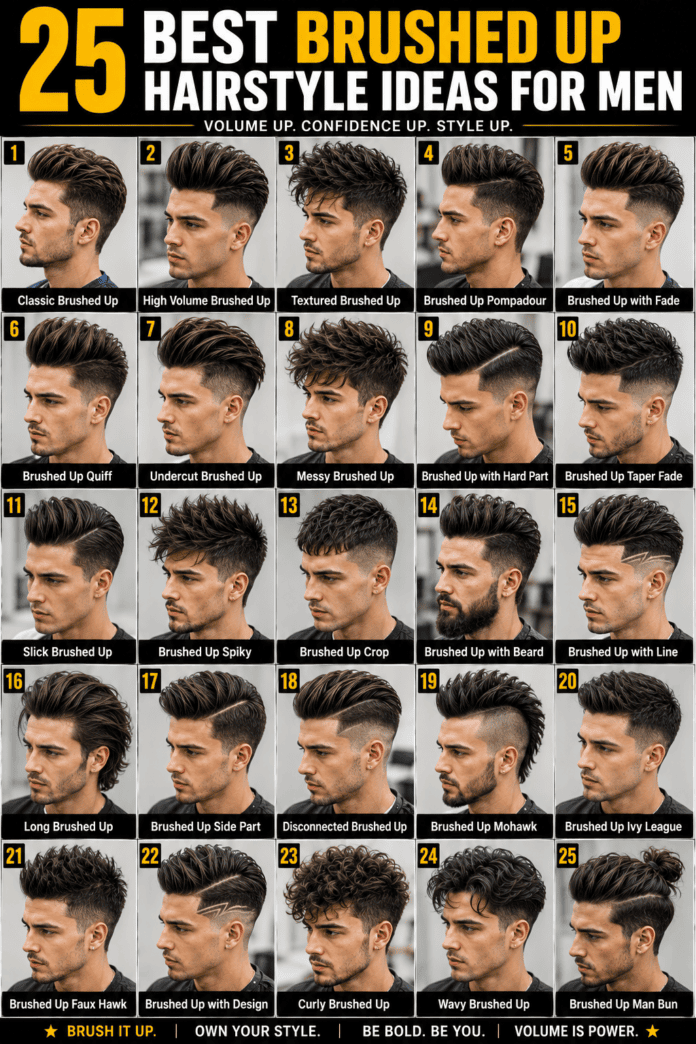
The strongest brushed up hairstyle ideas right now are the classic brushed-up taper, textured brushed-up crop, high-volume quiff, and brushed-up fade. Each gives the front of the hair noticeable lift without forcing every strand into a stiff shape. The right choice comes down to hair density, natural texture, and how much styling you want to do each morning.
I’ve spent years watching brushed-up cuts succeed or fail based on small details around the hairline, weight line, and crown. The biggest lesson is simple: height looks better when the haircut underneath gives it somewhere to sit.
| Quick Pick | Best For | Length on Top | Upkeep |
|---|---|---|---|
| Classic Brushed-Up Taper | Everyday versatility | 3–4 inches | Moderate |
| Textured Brushed-Up Crop | Thick or wavy hair | 2–3 inches | Low |
| High-Volume Quiff | Maximum height | 4–5 inches | High |
| Brushed-Up Low Fade | Clean office styling | 3–4 inches | Moderate |
| Brushed-Up Mid Fade | Balanced contrast | 3–4 inches | Moderate |
| Brushed-Up Skin Fade | Sharp definition | 3–4 inches | High |
| Short Brushed-Up Front | Fine or short hair | 1.5–2.5 inches | Low |
| Wavy Brushed-Up Style | Natural movement | 3–5 inches | Moderate |
| Messy Brushed-Up Hair | Relaxed texture | 3–4 inches | Low |
| Long Brushed-Up Flow | Longer hair | 5+ inches | Moderate |
Classic and Easy Brushed Up Hairstyle Ideas
The easiest brushed-up hairstyle ideas keep the basic shape familiar: clean sides, controlled length through the crown, and enough hair at the front to lift away from the forehead. These are the cuts I usually point toward first because they look intentional without demanding advanced blow-drying or heavy product.
1. Classic Brushed-Up Taper
The classic brushed-up taper keeps roughly three to four inches through the front, with the hair gradually becoming shorter toward the crown. The sides narrow cleanly without exposing too much scalp, so the transition feels softer than a fade. Comb marks can stay slightly visible because they give the lift some structure instead of making the hair look frozen.
This version works especially well on straight or lightly wavy medium-density hair and suits most everyday settings. Ask your barber for “a classic taper with enough length in front to brush upward and slightly back, keeping the top connected.” It needs a quick blow-dry for dependable height, and men with stubborn forward-growing hair may find the front falls sooner than expected.
AI Prompt: A man in his late 20s with medium-density brown hair wearing a classic brushed-up taper, three to four inches of hair lifted upward at the front with a softly controlled shape, gradually shorter hair toward the crown, clean tapered sides and natural comb texture, photographed from a three-quarter chest-up angle inside a refined modern barbershop with soft window lighting and gentle background blur, photorealistic, high detail, sharp focus, professional photography
2. Short Brushed-Up Front
A short brushed-up front gets its character from about two inches of length concentrated near the hairline. Instead of pushing the entire top backward, only the front section rises, while the crown stays compact and close to the head. That difference in height makes the style look sharper than a plain short back and sides.
It suits straight hair, fine-to-medium density, and anyone who wants one of the lower-maintenance brushed-up hairstyle ideas. Tell your barber, “keep the front long enough to lift vertically, but leave the rest of the top short and blended.” A matte paste is usually enough, though this cut gives you less flexibility if you later decide you want a larger quiff.
AI Prompt: A man in his early 30s with short straight dark hair styled with a compact brushed-up front, roughly two inches of lift at the hairline while the crown remains short and neat, softly tapered sides and a natural matte finish, close-up portrait framed from shoulders upward against a simple concrete studio wall with crisp side lighting, photorealistic, high detail, sharp focus, professional photography
3. Brushed-Up Low Fade
The brushed-up low fade places the strongest contrast close to the ears and neckline while leaving more darkness through the upper sides. On top, the hair rises from the forehead before settling gradually toward the back. The result feels clean without making the head look overly narrow from the front.
Men who want polished brushed-up hairstyle ideas for work, dates, or smart-casual outfits usually do well with this shape. Ask for “a low fade kept low around the temples, with three to four inches on top for upward styling.” The fade needs regular cleanup to stay sharp, even though the longer upper sides make grow-out more forgiving than a skin-heavy cut.
AI Prompt: A man in his 30s with thick straight black hair wearing a brushed-up low fade, the front lifted cleanly upward with controlled volume, darker upper sides flowing into a low fade around the ears and neckline, natural texture visible across the top, photographed outdoors from a three-quarter head-and-shoulders angle beside a modern brick building in soft late-afternoon light, photorealistic, high detail, sharp focus, professional photography
4. Natural Brushed-Up Taper
The natural brushed-up taper avoids sharp separation between the top and sides. The hair is lifted with the fingers rather than combed into strict lines, leaving small bends and uneven pieces across the front. A conservative taper around the sideburns and neckline keeps the outline neat while preserving plenty of fullness.
This is a strong choice for men who prefer relaxed grooming and don’t want their hair to look heavily styled. Ask your barber to “keep the top connected, leave natural weight through the sides, and taper only the edges so I can brush the front up loosely.” It grows out well, although thick hair may become bulky around the temples before the top actually feels too long.
AI Prompt: A man in his mid 20s with naturally full medium-brown hair wearing a loose natural brushed-up taper, fingerswept lift through the front, slightly uneven textured strands across the top, fuller connected sides and softly tapered edges around the ears, photographed waist-up in a bright minimalist apartment beside a large window with natural morning light, photorealistic, high detail, sharp focus, professional photography
5. Side-Angled Brushed-Up Hair
Side-angled brushed-up hair starts with vertical lift but directs the front slightly toward one side. The shape is less rigid than a traditional side part because there is no hard dividing line. From the front, the diagonal movement adds width and keeps the hairstyle from looking too symmetrical.
It can flatter oval, square, and longer face shapes, especially when straight hair refuses to sit perfectly backward. Ask for “three to four inches through the front with enough internal texture to brush it up and slightly to one side.” The direction needs to follow your natural growth pattern; forcing the hair against a strong cowlick can turn a five-minute routine into a fight.
AI Prompt: A man in his late 20s with straight chestnut hair styled upward and diagonally to one side, medium volume at the front, subtly textured top, neatly tapered sides with no hard part, photographed in a three-quarter profile from chest height inside a stylish coffee shop with diffused daylight and warm interior depth, photorealistic, high detail, sharp focus, professional photography
6. Brushed-Up Ivy League
The brushed-up Ivy League combines conservative side length with a little more height at the front than the traditional version. The crown stays short and controlled, while the hairline lifts neatly before angling back. Because the silhouette remains compact, it works well with tailoring and formal clothes without looking overly groomed.
For men who need professional brushed-up hairstyle ideas, this one is hard to misuse. Tell your barber, “cut an Ivy League shape but leave extra length at the front so I can brush it upward rather than flat to the side.” It favors straight or lightly wavy hair, and the drawback is that there is not enough top length for dramatic restyling between appointments.
AI Prompt: A professionally dressed man in his early 30s with neat dark brown hair wearing a brushed-up Ivy League, compact sides, short controlled crown and slightly longer front lifted upward and back, clean natural hairline and restrained matte texture, photographed head-and-shoulders in a modern office lobby with broad soft lighting and a subtle architectural background, photorealistic, high detail, sharp focus, professional photography
Textured Brushed Up Hairstyle Ideas
Texture changes the whole personality of brushed-up hair. Instead of creating one smooth wall of height, these brushed-up hairstyle ideas separate the top into visible sections, letting waves, curls, or point-cut ends do part of the styling work.
7. Textured Brushed-Up Crop
The textured brushed-up crop keeps the top shorter than a quiff but leaves enough length at the front to stand away from the forehead. Point-cut ends create visible separation, so the hair looks almost piecey when lifted. The sides stay tight enough to make those rougher top details stand out.
Thick straight and slightly wavy hair respond best because the texture holds without needing much product. Ask your barber for “a short textured top with choppy point cutting and extra length at the front for upward styling.” It is forgiving on rushed mornings, although anyone wanting a smooth, formal finish may find the intentionally broken texture too casual.
AI Prompt: A man in his mid 20s with thick dark hair wearing a textured brushed-up crop, short choppy sections across the top, separated point-cut ends and a slightly longer front pushed upward, tight clean sides with soft blending, photographed from eye level against an urban concrete wall under bright overcast daylight, photorealistic, high detail, sharp focus, professional photography
8. Messy Brushed-Up Hairstyle
The messy brushed-up hairstyle builds height first and then breaks it apart with the fingers. Some strands stand taller, others lean backward, and a few fall slightly off-axis near the temples. That controlled inconsistency keeps the top from looking like a single molded shape.
It works on medium-to-thick hair and is especially useful when natural growth patterns refuse perfect uniformity. Ask for “a layered textured top around three to four inches long, with the front left full enough to push up loosely.” Maintenance is easy between cuts, but the line between purposely messy and simply unstyled gets thin once the sides grow too heavy.
AI Prompt: A man in his late 20s with medium-thick dark blond hair styled into a messy brushed-up hairstyle, uneven lifted strands at the front, loose backward movement through the middle and controlled textured disorder across the top, softly faded sides, photographed from a close three-quarter angle on a city rooftop during muted golden-hour light, photorealistic, high detail, sharp focus, professional photography
9. Wavy Brushed-Up Hairstyle
Wavy brushed-up hair lets natural bends create the separation that straight hair often needs product to imitate. The front rises in loose arcs rather than stiff vertical sections, while the waves settle progressively flatter toward the crown. Keeping some weight at the upper sides makes the shape feel balanced.
Men with loose waves should ask their barber to work with those bends instead of thinning them away. Say, “leave enough length for my natural wave to show when I brush the front upward, and don’t over-texturize the top.” Humidity can change the final shape throughout the day, so anyone demanding identical styling every morning may prefer something shorter.
AI Prompt: A man in his early 30s with naturally wavy medium-brown hair wearing a brushed-up wavy hairstyle, loose curved strands lifted from the forehead, visible wave definition through the top and gently blended fuller sides, photographed outdoors from chest-up beside green foliage under diffused cloudy daylight with soft natural shadows, photorealistic, high detail, sharp focus, professional photography
10. Curly Brushed-Up Top
A curly brushed-up top focuses on positioning the curls upward instead of stretching them straight. The highest curls sit near the front hairline, while the rest stack behind them in a rounded slope. Shorter sides create contrast but should not climb so high that the top appears disconnected from the head.
This cut works best on defined curls with enough length to form their natural pattern. Ask for “a curly top left long enough to lift forward curls upward, with the sides gradually shortened but not taken too high.” Overworking the hair with a brush can pull apart curl definition, so finger styling is usually the better move.
AI Prompt: A man in his mid 20s with naturally defined dark curls wearing a curly brushed-up top, springy curls directed upward above the forehead, rounded graduated height toward the crown and neatly shortened blended sides, photographed from slightly below eye level in a clean studio with large softbox lighting and a neutral backdrop, photorealistic, high detail, sharp focus, professional photography
11. Piecey Brushed-Up Fringe
The piecey brushed-up fringe separates the front into narrow lifted sections rather than pushing it upward as one continuous mass. Small gaps between the strands expose hints of forehead, making the height feel lighter. The center can sit slightly taller than the corners to create a subtle peak.
It suits thick, straight hair that tends to clump together after product is applied. Tell your barber, “keep the fringe around three inches and add enough point-cut texture that I can separate it into pieces when I push it up.” Fine hair can copy the idea, but excessive texturizing may remove the density it needs to appear full.
AI Prompt: A man in his early 20s with thick straight dark brown hair wearing a piecey brushed-up fringe, narrow separated sections rising above the forehead with small visible gaps, slightly taller central lift and short blended sides, photographed tightly from the shoulders upward in a minimalist photography studio with directional window-style lighting, photorealistic, high detail, sharp focus, professional photography
12. Brushed-Up Hair With Choppy Layers
Choppy layers make brushed-up hair look more dimensional from every viewing angle. Shorter sections support longer strands above them, creating staggered height instead of a flat surface. At the front, the ends look visibly cut and separated, which gives the style more bite.
This variation works well on dense hair that otherwise collapses into one heavy block. Ask for “choppy internal layers through the top while keeping enough length at the front to style upward.” The extra texture helps with movement, but taking the layering too far can make coarse hair puff out rather than stay controlled.
AI Prompt: A man in his late 20s with dense dark hair wearing brushed-up hair with choppy layers, staggered sections creating varied height across the top, visibly separated ends at the front and closely tapered sides, photographed in side-three-quarter view inside an industrial loft with large windows and crisp natural daylight, photorealistic, high detail, sharp focus, professional photography
Fade-Based Brushed Up Hairstyle Ideas
A fade pushes more visual attention toward the top, which makes brushed-up height appear stronger even when the hair itself is not especially long. These brushed-up hairstyle ideas move from moderate contrast to sharper, more demanding finishes.
13. Brushed-Up Mid Fade
The brushed-up mid fade removes weight around the center of the sides while preserving a solid block of length above it. The front lifts upward, the middle leans gently backward, and the fade creates a clean horizontal contrast below. From the side, the hairstyle has a clear rise-and-fall silhouette.
This is one of the most balanced options for medium or thick straight hair. Ask for “a mid fade with the top left around three to four inches and enough weight at the front for a brushed-up finish.” The fade grows out faster than a taper, so the style starts losing its crisp proportions within a few weeks.
AI Prompt: A man in his late 20s with thick black hair wearing a brushed-up mid fade, strong upward lift through the front, smooth backward transition across the top and a clean fade beginning around the middle of the sides, photographed from a side-three-quarter angle in a contemporary barbershop with bright overhead and window lighting, photorealistic, high detail, sharp focus, professional photography
14. Brushed-Up High Fade
A brushed-up high fade creates a much narrower strip of dark hair around the upper sides. That makes three inches of top length look taller than it actually is. The front can stay vertical while the upper surface angles gradually toward the crown, producing a bold and clean profile.
Men with thick hair who like stronger contrast usually carry this cut best. Tell the barber, “take the fade high but leave enough transition below the top so it doesn’t look disconnected, then keep the front long for upward styling.” The exposed sides emphasize head shape, which is worth considering before committing to such a high transition.
AI Prompt: A man in his mid 20s with thick dark hair wearing a brushed-up high fade, pronounced vertical lift at the front, gradually lowering top toward the crown and high faded sides creating strong contrast, photographed from chest-up against a dark minimalist interior with controlled directional lighting across the face and hair, photorealistic, high detail, sharp focus, professional photography
15. Brushed-Up Skin Fade
The brushed-up skin fade takes the lower sides down extremely close before blending into darker hair higher up. Against that nearly bare base, the lifted top appears especially full. A slightly textured surface usually works better than a glassy finish because it keeps the contrast from looking too rigid.
Ask for “a skin fade that blends smoothly into a three-to-four-inch textured top, with the front kept long enough to brush straight up.” It suits men who enjoy a sharp barbershop finish and don’t mind frequent appointments. The obvious drawback is grow-out: even a small amount of new side length changes the intended clean-skin effect.
AI Prompt: A man in his late 20s with dark straight hair wearing a brushed-up skin fade, voluminous textured front pushed vertically upward, short controlled crown and sides fading smoothly down to skin, photographed at eye level in a bright modern grooming studio with clean white walls and crisp diffused lighting, photorealistic, high detail, sharp focus, professional photography
16. Brushed-Up Drop Fade
The drop fade curves lower behind the ears rather than following one straight horizontal line around the head. Paired with a brushed-up top, that curved fade keeps more visual weight toward the back while the highest point stays above the forehead. The side profile looks particularly well shaped.
It works nicely for men who want a fade with more contour than a standard mid fade. Ask for “a drop fade that follows the head shape behind the ears, with the top left long and textured for upward styling.” The haircut depends heavily on clean blending, so a rushed or uneven fade becomes more noticeable than it would on a softer taper.
AI Prompt: A man in his early 30s with medium-thick dark brown hair wearing a brushed-up drop fade, front hair lifted with textured volume, top gradually lowering toward the crown and a fade line curving downward behind the ears, photographed in a precise side profile against a muted studio background with soft edge lighting defining the haircut silhouette, photorealistic, high detail, sharp focus, professional photography
17. Brushed-Up Temple Fade
The temple fade keeps most of the side length intact and removes weight only around the temples and sideburn area. That small clean section sharpens the hairline while the top remains full and brushed upward. From straight on, it feels less aggressive than a complete fade but more defined than a standard taper.
This is a useful middle ground for men who want brushed-up hairstyle ideas without exposing the entire side of the head. Ask for “a temple fade kept tight around the corners while leaving fullness above the ears, with the front long enough to lift.” Because most of the sides remain, thick hair may still need debulking between full haircuts.
AI Prompt: A man in his mid 20s with full dark hair wearing a brushed-up temple fade, naturally lifted front with controlled texture, fuller hair above the ears and precise fading limited to the temples and sideburns, photographed from a straight-on head-and-shoulders angle outdoors beneath shaded architectural light, photorealistic, high detail, sharp focus, professional photography
18. Brushed-Up Burst Fade
The burst fade wraps in a curved shape around the ear while leaving more hair toward the back. With the front pushed upward, the haircut combines two distinct directions: vertical movement above the forehead and rounded clearance around the sides. The resulting outline feels more expressive than a conventional fade.
Men with thick or slightly wavy hair can use the extra top texture to keep the style from becoming too geometric. Ask your barber for “a soft burst fade around the ears while keeping the back connected and the top long enough to brush upward.” It is a more specific look, so anyone needing conservative business grooming may prefer a low fade or taper.
AI Prompt: A man in his mid 20s with thick slightly wavy dark hair wearing a brushed-up burst fade, lifted textured front and curved fading radiating closely around the ear while fuller hair remains toward the back, photographed from a side-three-quarter angle in an urban alley with bright natural daylight and textured masonry in the background, photorealistic, high detail, sharp focus, professional photography
19. Brushed-Up Fade With Line Up
A line up gives brushed-up hair a defined lower boundary by sharpening the front corners and temple edges. Above that precise hairline, the longer hair rises with deliberate volume and visible texture. The contrast between the straight edge and softer top is what makes the cut photograph so strongly.
It suits dense hairlines that can support a clean shape without pushing the edge unnaturally backward. Ask for “a clean line up with a blended fade, but keep the natural front edge and leave the top long enough to brush up.” Regular maintenance matters because the sharp perimeter softens quickly as short hairs begin growing back.
AI Prompt: A man in his late 20s with dense black hair wearing a brushed-up fade with a precise line up, sharply defined front corners and temple edges below a textured top lifted vertically from the forehead, smooth faded sides, photographed tightly from the chest upward against a deep neutral studio background with crisp frontal lighting, photorealistic, high detail, sharp focus, professional photography
High-Volume and Statement Brushed Up Hairstyle Ideas
Once the top gets longer, brushed-up hair moves away from simple everyday lift and starts behaving more like a quiff, pompadour, or flowing style. These brushed-up hairstyle ideas need more drying technique, but they also give you the most dramatic silhouettes.
20. High-Volume Brushed-Up Quiff
The high-volume brushed-up quiff creates its tallest point just behind the front hairline. The fringe lifts upward before rolling slightly back, while the rest of the top gradually flattens toward the crown. Keeping the surface airy rather than perfectly smooth prevents the shape from becoming too formal.
This look favors thick hair with enough length to hold four or more inches of lift. Ask for “a long front for a high brushed-up quiff, with gradual layers so the top can sweep backward without collapsing.” Expect to use a blow-dryer and some technique; without that foundation, heavier hair often falls forward by midday.
AI Prompt: A man in his early 30s with thick dark blond hair wearing a high-volume brushed-up quiff, tall airy lift directly behind the front hairline, slightly backward-curving fringe and gradually lower textured top toward the crown, neatly tapered sides, photographed from a low three-quarter angle in a stylish loft with broad window light emphasizing the height, photorealistic, high detail, sharp focus, professional photography
21. Brushed-Up Pompadour
The brushed-up pompadour is smoother and more sculpted than a textured quiff. The front rises in a rounded wall before flowing backward, with enough fullness continuing through the middle to avoid an abrupt drop. The sides can stay tapered rather than faded if you want the classic proportions to remain visible.
Straight, thick hair is the easiest starting point, although loose waves can give the surface extra character. Ask for “a pompadour shape with plenty of front length, gradual top layers, and sides that stay connected.” It takes more styling time than most brushed-up hairstyle ideas, and cutting the sides too short can make the top look detached.
AI Prompt: A man in his early 30s with thick dark brown hair wearing a brushed-up pompadour, smoothly rounded height above the forehead flowing backward through the middle, full connected top and classic tapered sides, photographed from a polished three-quarter portrait angle inside a vintage-inspired barbershop with warm directional window lighting, photorealistic, high detail, sharp focus, professional photography
22. Long Brushed-Up Flow
Long brushed-up flow uses five inches or more on top, but the hair isn’t forced into a fixed quiff. The roots lift away from the forehead while the longer ends move backward and slightly outward. From the side, you see height at the front and a softer, looser fall behind it.
This works especially well on medium-to-thick hair with natural movement. Ask your stylist for “long layers that keep volume at the front while letting the rest flow back naturally, with enough side length to stay connected.” Wind and humidity can shift the shape easily, so this is better for someone comfortable with movement than someone chasing a perfectly identical finish.
AI Prompt: A man in his late 20s with long medium-brown slightly wavy hair wearing a brushed-up flow, roots lifted away from the forehead, longer strands sweeping naturally backward and outward with connected medium-length sides, photographed outdoors from chest-up near a modern waterfront during soft late-afternoon light with gentle movement in the hair, photorealistic, high detail, sharp focus, professional photography
23. Brushed-Up Undercut
The brushed-up undercut keeps a clear length difference between the long top and short sides. Instead of a gradual blend, the top sits visibly above the cropped lower section. Brushing the front upward exaggerates that separation and creates one of the strongest silhouettes in the group.
Men with straight, dense hair get the cleanest shape, especially when the top is long enough to stay controlled after being lifted. Ask for “a disconnected undercut with three to five inches on top and the front left full for upward styling.” The drawback is commitment: once the top and sides are strongly disconnected, growing back into a softer blended haircut takes patience.
AI Prompt: A man in his mid 20s with thick straight black hair wearing a brushed-up undercut, long top lifted vertically and slightly backward above clearly disconnected short sides, crisp contrast at the transition and natural matte texture, photographed in profile inside a modern industrial studio with dramatic but soft directional lighting, photorealistic, high detail, sharp focus, professional photography
24. Slick Brushed-Up Hairstyle
A slick brushed-up hairstyle combines vertical front lift with a cleaner, more controlled surface. The strands remain grouped rather than separated, and the top follows one steady direction from the forehead toward the crown. A slight sheen emphasizes the shape without needing the wet, heavily coated look of older slick styles.
This fits evening events, formal dinners, and sharper tailoring better than rough matte texture sometimes does. Ask for “a connected top around four inches long that can be brushed upward and back smoothly, with neat tapered sides.” Fine hair may show more scalp when product pulls the strands together, so lighter application usually looks better than a heavy coating.
AI Prompt: A man in his early 30s with straight dark hair wearing a sleek brushed-up hairstyle, controlled front lift flowing smoothly backward with lightly defined grouped strands and a subtle natural sheen, clean tapered sides, photographed from chest-up in an elegant evening interior with soft directional lighting and blurred architectural details, photorealistic, high detail, sharp focus, professional photography
25. Dramatic Vertical Brushed-Up Style
The dramatic vertical brushed-up style takes the concept furthest by directing most of the front half of the top almost straight upward. The highest point stays close to the hairline instead of rolling backward like a quiff. Textured ends stop the shape from looking like one solid block.
This is best for thick hair, confident styling habits, and occasions where a stronger grooming statement makes sense. Tell your barber, “leave substantial length through the front and middle, remove enough internal weight for vertical lift, and keep the sides tight but blended.” It takes real blow-drying time, and men who wear hats often will find the height inconvenient.
AI Prompt: A man in his mid 20s with thick dark hair wearing a dramatic vertical brushed-up hairstyle, substantial front and mid-top length directed almost straight upward with textured separated ends, tight smoothly blended sides and a bold tall silhouette, photographed from a slightly low front-three-quarter angle in a contemporary fashion studio with crisp overhead and side lighting, photorealistic, high detail, sharp focus, professional photography
How to Choose the Right Brushed-Up Hairstyle
Choosing between these brushed-up hairstyle ideas gets easier once you stop judging only by the finished photograph. Look first at your natural growth direction, density, front hairline, and how much length you are willing to maintain.
Thick straight hair gives you the widest range, from short textured crops to large pompadours. Wavy hair usually looks better when the stylist leaves some natural movement rather than trying to flatten every bend. Curly hair needs enough length for the curl pattern to form before you can direct it upward without creating fuzz.
Face shape also changes the decision. Extra height can make a rounder face appear longer, while men with naturally long faces may prefer moderate lift with fuller sides. A low fade or taper keeps more width; a high fade removes it.
Bring two or three reference photos to your appointment, including at least one side view. Tell the barber how much time you are prepared to spend styling in the morning. That answer matters more than saying you want “volume,” because a short brushed-up crop and a tall quiff require completely different routines.
For product, start lighter than you think. A small amount of matte paste or clay can help short brushed-up hairstyles stay separated, while longer shapes usually depend more on blow-drying than on piling extra product onto the finished hair. Work from the roots first; coating only the ends often adds weight without creating support.
Where Brushed-Up Hairstyles Can Fall Short
Brushed-up hair isn’t automatically flattering because it has volume. Too much height paired with very tight sides can make a narrow or long face appear even longer. The fix is often less dramatic than changing the haircut entirely: lower the front slightly or keep extra fullness above the ears.
Another problem is chasing a photograph that fights your growth pattern. Hair that grows strongly forward may need more length, heat, and product before it stays upright. That doesn’t mean the style is impossible, but it does mean a five-minute routine shown online may become fifteen minutes in your bathroom.
Over-thinning creates trouble too. Removing some bulk can help dense hair rise, but aggressive thinning near the front sometimes leaves the ends wispy and weak. I go back and forth on heavy texturizing for exactly that reason. It can make one haircut look fantastic for two weeks and frustrating once it starts growing out.
And tall brushed-up hairstyle ideas aren’t especially friendly to hats, helmets, humid weather, or mornings when you don’t have a blow-dryer nearby. If those are normal parts of your week, a short brushed-up front, natural taper, or textured crop usually makes more sense than chasing maximum volume.
Frequently Asked Questions
What is a brushed-up hairstyle for men?
A brushed-up hairstyle directs the front section of the hair upward and usually slightly backward, creating visible height above the forehead. The sides may be tapered, faded, or left fuller. The finished look can range from a short casual lift to a large quiff or pompadour.
How long should hair be for a brushed-up hairstyle?
Around two inches can be enough for a short lifted front, while three to four inches gives you more flexible brushed-up hairstyle ideas. Quiffs, pompadours, and flowing versions usually need four to five inches or more so the hair can rise without sticking straight out awkwardly.
Are brushed-up hairstyles good for thick hair?
Thick hair is often well suited to brushed-up styles because it naturally provides density and structure. The barber may need to remove internal weight so the front lifts more easily. Too much thinning, however, can weaken the shape and make the ends look sparse as the haircut grows.
Can fine hair be brushed up?
Fine hair can be brushed upward, especially when the cut stays relatively short and the sides are kept neat. Moderate front height usually works better than an oversized quiff. Blow-drying from the roots and avoiding heavy, oily products can help the hair appear fuller without pulling the strands together.
What fade works best with brushed-up hair?
A low fade gives a softer finish, a mid fade creates balanced contrast, and a high or skin fade puts maximum attention on the top. The best option depends on how much side fullness you want to keep and whether you prefer conservative or sharper brushed-up hairstyle ideas.
How do I ask my barber for brushed-up hair?
Explain the amount of height you want, show a reference photo, and tell the barber how you normally style your hair. A useful request is, “leave enough length at the front to brush upward, keep the top textured and connected, and taper or fade the sides to match this photo.”
Do I need a blow-dryer for brushed-up hairstyles?
You can style shorter versions without one, but a blow-dryer makes medium and high-volume brushed-up hairstyles much easier. Directing warm air upward from the roots while guiding the hair into position creates the foundation. Product then holds the shape rather than being asked to create all the volume itself.
Should brushed-up hair look smooth or textured?
Either can work. Smooth brushed-up hair looks more formal and controlled, while textured versions feel looser and usually hide imperfect growth patterns better. Your hair type should guide the choice: natural waves often deserve visible movement, while straight dense hair can handle either finish.
What face shape looks best with brushed-up hair?
Oval and square faces can usually handle most levels of height. Rounder faces often benefit from some vertical lift, while longer faces tend to look more balanced with moderate height and fuller sides. These are guidelines rather than rules, because hairline, density, and head shape matter too.
How do I keep brushed-up hair from falling forward?
Start by drying the roots in the direction you want the hair to stay. Once the hair has cooled in its lifted position, work in a small amount of suitable styling product. If the front still collapses quickly, the problem may be excess length, excessive weight, or a strong forward growth pattern.
Are brushed-up hairstyles high maintenance?
Short textured versions can be surprisingly easy, often needing only a few minutes in the morning. Longer brushed-up hairstyle ideas such as pompadours and high quiffs demand more blow-drying and regular reshaping. Fades also need more frequent barber visits than softly tapered sides.
Can wavy hair be styled into a brushed-up look?
Yes. In fact, waves can give brushed-up hair more natural texture and dimension. The key is preserving enough length for the bends to form while directing the roots upward. Avoid brushing so aggressively that you stretch the waves into frizz or remove the movement that makes the style interesting.
What product is best for a brushed-up hairstyle?
The finish you want matters more than one universal product choice. Matte pastes and clays can add grip to short textured styles, while lighter creams may suit loose waves or longer flow. Start with a small amount and add more only if the hair needs extra control.
How often should I trim brushed-up hair?
Most brushed-up cuts start changing shape once the sides gain noticeable weight or the top becomes difficult to lift. Fade-based versions usually demand more frequent cleanup than classic tapers. Instead of following a rigid schedule, rebook when the haircut stops holding the proportions you originally liked.
Can brushed-up hair work for formal occasions?
A neat taper, low fade, Ivy League variation, or smooth brushed-up finish can work particularly well with formal clothing. Keep the height controlled and the edges tidy. Rough texture and dramatic vertical volume usually read more casual, so match the finish to the setting rather than changing the whole haircut.
The best brushed-up hairstyle isn’t automatically the tallest one. Choose the amount of lift that works with your hair’s natural direction, your face proportions, and the time you actually want to spend styling. Among these brushed up hairstyle ideas, the versions that look easiest on you will usually be the ones you keep longest. At your next appointment, bring a front and side reference photo and ask your barber exactly how much length your hair needs to recreate that shape.
Best Men’s Hairstyle Reports
Explore sharp barber cuts, textured styles, fringe looks and relaxed men’s hairstyles for modern grooming inspiration.