
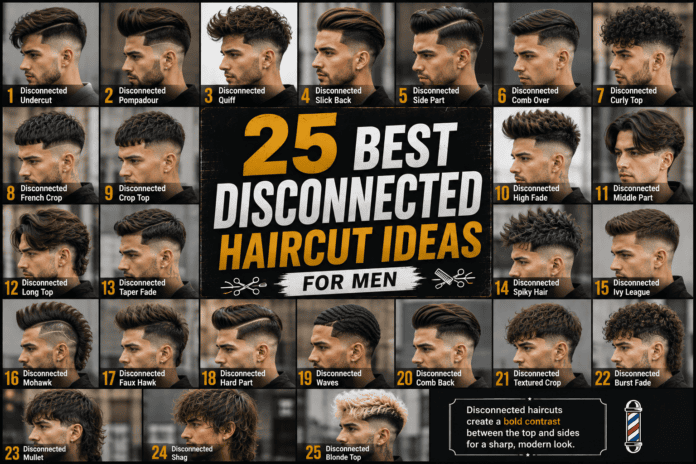
The strongest disconnected haircut ideas combine deliberate contrast with a shape that still suits the person wearing it. The Disconnected Pompadour is my best all-around pick, the Textured Crop with Disconnected Sides is easiest to live with, the Curly Disconnected Undercut handles natural texture beautifully, and the Long Slicked-Back Disconnect makes the boldest statement.
I’ve spent years watching disconnected cuts move in and out of barber chairs, and the versions that age well are rarely the most extreme ones. A good disconnect needs control: the top length, weight line, texture, and side profile have to work together instead of looking like two unrelated haircuts.
Here’s a quick way to compare disconnected haircut ideas before deciding how much contrast you actually want.
| Style | Best For | Top Length | Side Finish | Upkeep |
|---|---|---|---|---|
| Disconnected Pompadour | Classic statement style | Medium to long | Short and clean | High |
| Textured Crop Disconnect | Easy everyday wear | Short to medium | Tight | Low to medium |
| Curly Disconnected Undercut | Natural curls | Medium | Very short | Medium |
| Side-Part Disconnect | Office-friendly styling | Medium | Short | Medium |
| Slicked-Back Disconnect | Formal looks | Medium to long | Tight | Medium to high |
| Messy Fringe Disconnect | Casual texture | Medium | Short | Medium |
| Disconnected Quiff | Volume without full pomp | Medium | Tight | Medium |
| Long-Top Undercut | Styling flexibility | Long | Very short | Medium |
| Mohawk-Inspired Disconnect | Bold shape | Medium | Tight | High |
| Scissor-Cut Disconnect | Softer contrast | Medium | Scissor-short | Medium |
Classic Disconnected Haircut Ideas With Clean Structure
These are the disconnected haircut ideas I return to when someone wants obvious separation without turning the haircut into a novelty. The transition is intentionally missing, but the overall silhouette still feels controlled.
1. Classic Disconnected Pompadour
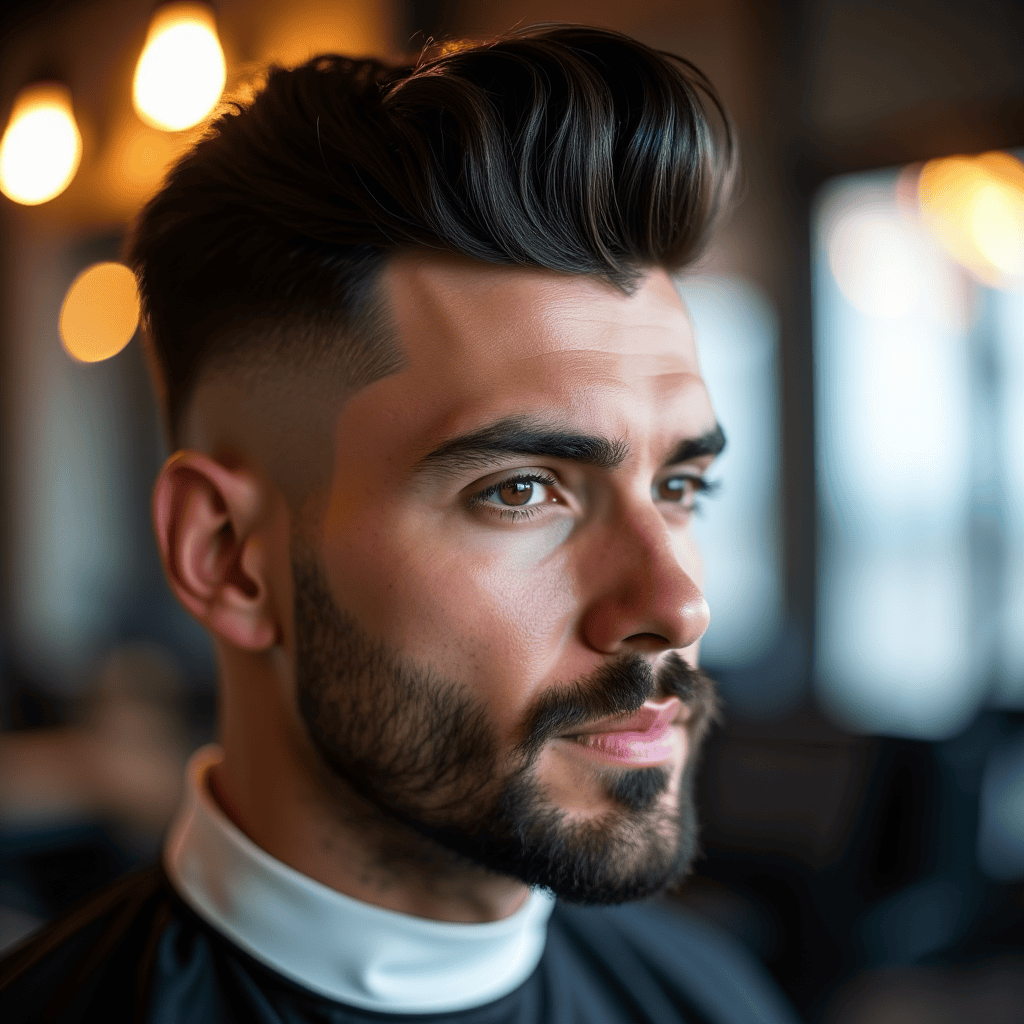
A classic disconnected pompadour puts height and sweep on top against sides that suddenly drop into a much shorter length. The front rises highest, then gradually settles toward the crown, while the temples stay tight enough to make that volume look even stronger. I like a little weight left around the upper sides rather than shaving everything flat because it stops the haircut from becoming too top-heavy. From the side, the defining detail is the clean shelf where the long top meets the short side.
This disconnected haircut works especially well on straight, thick, or lightly wavy hair and tends to flatter oval, square, and longer face shapes. Tell your barber, “Keep enough length through the front for height, leave a clear disconnect above the temples, and don’t blend the top into the sides.” Expect to blow-dry it into shape and use a workable styling product most mornings. Skip it if you hate styling or if your hair collapses quickly under its own weight.
2. Sharp Side-Part Disconnect
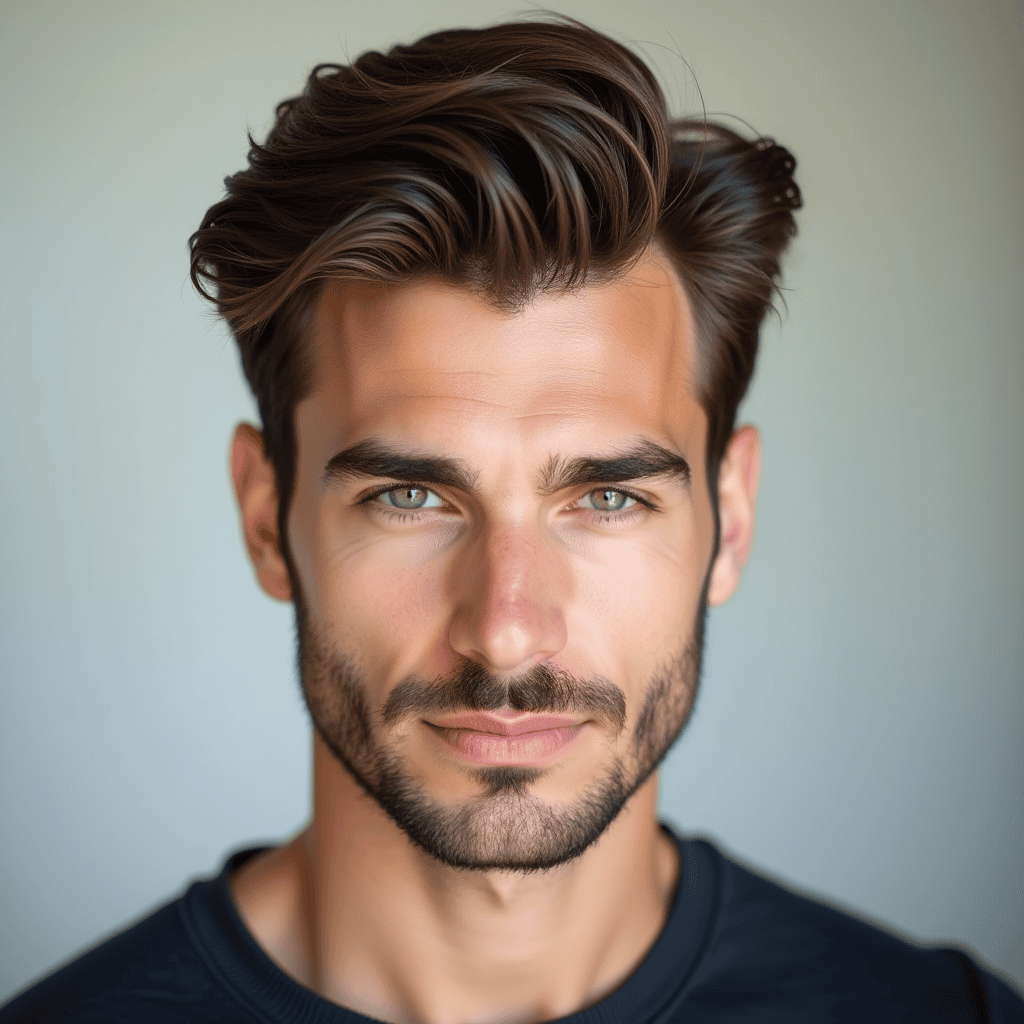
The sharp side-part disconnect has a cleaner, flatter profile than a pompadour, with the top combed diagonally away from a defined part. Length stays concentrated through the top and front while the side beneath the part becomes suddenly short instead of gradually blended. A little natural movement keeps it from reading like a helmet. The contrast looks strongest around the part line, where the longer section almost hangs over the cropped side.
Men with straight or slightly wavy medium-density hair usually get the cleanest result from this shape. Ask for, “A defined side part with the top left long enough to comb across and a clear disconnect underneath rather than a fade into the top.” You’ll need a comb and some product if you want the part to stay crisp all day. The drawback is that growth becomes obvious fairly quickly around the short side.
3. Slicked-Back Classic Disconnect

A slicked-back disconnect keeps the entire top flowing rearward in one broad sheet while the sides sit much shorter underneath. Unlike a heavily faded slick-back, there’s no gradual bridge between those two zones. The top can sit close to the head or carry a little lift through the front, depending on how much volume your hair naturally holds. Viewed from the temple, the long top creates a strong ledge over the compact side.
This version suits men who want disconnected haircut ideas that can move between office clothes and evening wear without feeling overly trendy. Tell your barber, “Leave the top long enough to push fully back, keep the perimeter controlled, and separate it clearly from the short sides.” Dense straight hair is easiest to manage, although soft waves can make it more interesting. Fine hair can struggle because too much product quickly exposes the scalp.
4. Disconnected Ivy League

The disconnected Ivy League keeps the polished direction of a traditional collegiate cut but removes the soft blend around the upper sides. The front remains long enough to sweep slightly upward and sideways, while the crown sits shorter and neater. Tight sides create a sharper outline than you’d expect from an Ivy League. It’s restrained from the front and much more modern when viewed in profile.
This is one of the better disconnected haircut ideas for men who want contrast without wearing a large amount of hair on top. Ask your barber, “Cut an Ivy League shape on top, but keep a visible break between the longer top and shorter sides instead of blending them together.” It suits straight and slightly wavy hair particularly well. Maintenance is reasonable, though the shape starts feeling less intentional once the sides grow into the top.
5. Gentleman’s Comb-Over Disconnect

The gentleman’s comb-over disconnect uses medium length across the top, combed cleanly to one side with a controlled curve rather than a hard flat sweep. Beneath it, the sides remain distinctly shorter and almost disappear under the overhanging top near the part. Keeping some softness in the surface makes it look more contemporary. Too much shine can push the whole thing into retro territory.
Oval, square, and round faces can all work with this disconnected haircut when the top height is adjusted properly. Tell your barber, “Give me a medium comb-over on top with a visible disconnect and enough side length to keep the cut polished rather than skin-tight.” Styling takes a few minutes, especially if you blow-dry the hair into direction first. Men with stubborn cowlicks around the part may find the daily control annoying.
Textured Disconnected Haircut Ideas for Everyday Wear
Texture makes a disconnect easier to wear because the top doesn’t need to sit perfectly in place. These disconnected haircut ideas work particularly well when you prefer movement, matte finishes, and hair that can survive being touched during the day.
6. Textured Crop With Disconnected Sides

The textured crop keeps the top short enough for easy control but leaves it visibly longer than the sides. Choppy sections sit forward and slightly sideways, creating small ridges and broken pieces rather than one flat layer. The fringe can stay blunt or irregular, while the side suddenly tightens beneath the upper edge. That sharp contrast gives a simple crop far more personality.
Men with thick straight hair usually get the strongest texture, although slightly wavy hair works beautifully too. Ask for, “A short textured crop with point-cut movement on top, a natural fringe, and clearly disconnected short sides.” This is one of the easier disconnected haircut ideas to maintain because finger styling is often enough. The main weakness is regrowth: once the sides become fluffy, the deliberate separation loses some bite.
7. Messy Fringe Disconnect

A messy fringe disconnect pushes most of the visual weight toward the forehead. The top stays medium length, with broken strands falling forward at different angles while the sides are cut distinctly shorter. Rather than looking sculpted, the surface should feel loose and slightly imperfect. The disconnect prevents all that fringe from making the head look overly wide.
This style suits straight, wavy, and moderately thick hair, particularly if you want to soften a longer forehead. Tell your barber, “Leave enough length through the front for a loose textured fringe, remove bulk through the top, and keep the sides disconnected and tight.” It looks best with low-shine product and finger styling. The downside is that heavy or oily hair can turn the fringe into a flat curtain by midday.
8. Choppy Disconnected Quiff

The choppy disconnected quiff builds height at the front without demanding the smooth architecture of a pompadour. Pieces lift upward, backward, and slightly sideways, leaving visible gaps between sections. The middle gradually settles toward the crown while tight sides create a hard visual base underneath. From the front, the haircut feels lively rather than rigid.
Thick straight and wavy hair handle this disconnected haircut especially well because both can hold rough volume. Ask your barber, “Keep three to four inches toward the front, texture it heavily so the quiff breaks into pieces, and disconnect it cleanly from the short sides.” You’ll probably need a dryer for consistent height. The drawback is that very dense hair can become bulky unless internal weight is removed properly.
9. Tousled Wavy Disconnect

A tousled wavy disconnect keeps natural bends visible across a medium-length top instead of brushing them into one direction. Waves overlap loosely around the front and crown, while the sides sit much closer to the head. That open contrast makes the waves look fuller without needing extreme height. I prefer this one slightly imperfect because polished wave placement defeats the point.
Naturally wavy hair is obviously the easiest starting point, especially at medium to high density. Tell your barber, “Preserve the natural wave pattern on top, remove weight without thinning it flat, and leave a definite disconnect over short sides.” Air-drying can work, though controlled drying usually gives better consistency. Skip it if you need the haircut to look identical every morning; humidity will have an opinion.
10. Spiky Textured Disconnect
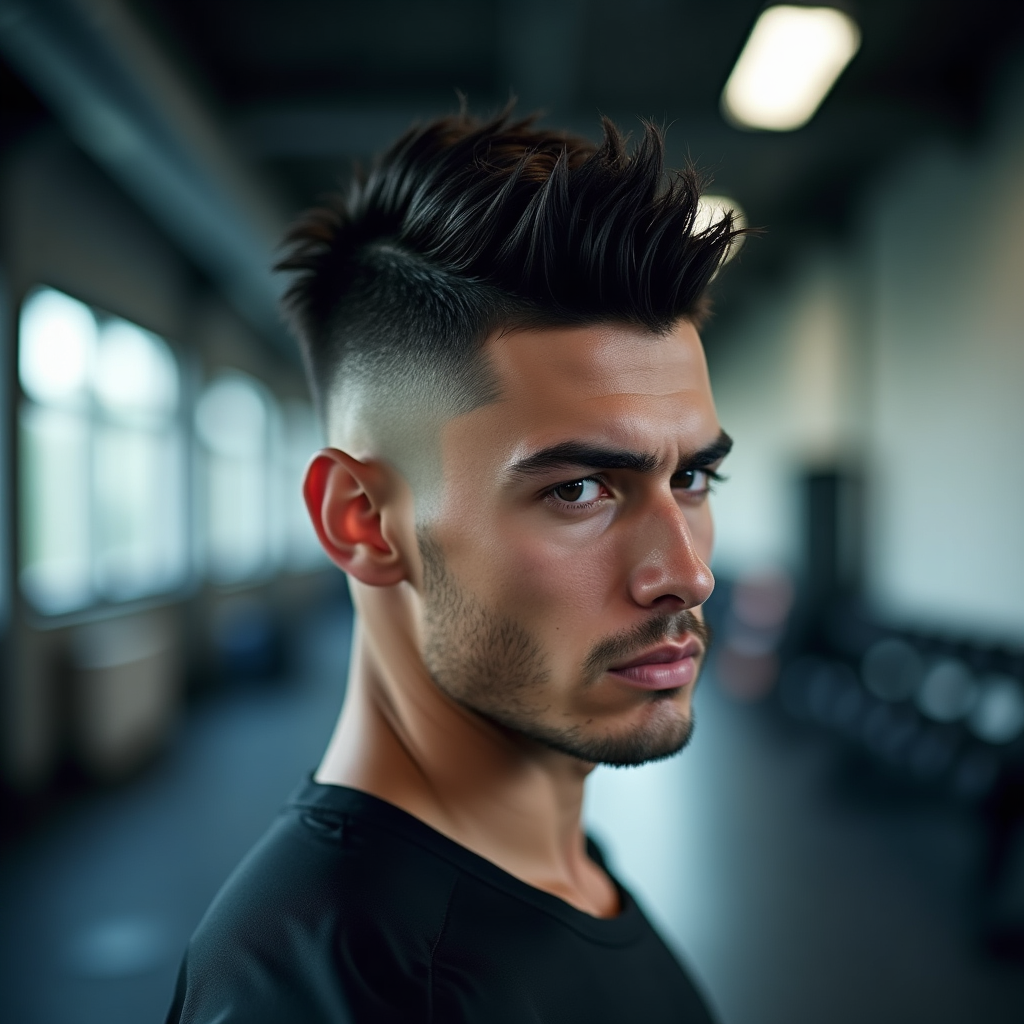
The spiky textured disconnect uses deliberately separated sections rather than the stiff uniform spikes associated with older gel-heavy styles. The top sits short to medium, with narrow pieces angled upward and slightly forward. Tight sides create a compact outline that keeps the texture concentrated through the center. A matte finish is what makes the haircut feel current.
This style is practical for coarse straight hair that naturally wants to stand rather than lie flat. Ask your barber, “Keep the top long enough to pinch into separated spikes, add broken texture, and give me a clean disconnect above the short sides.” Styling is quick once you know how much product your hair needs. Fine hair can wear it too, but too much separation may reveal more scalp than you want.
Disconnected Undercuts, Fades, and Tighter Side Profiles
These cuts make the separation more obvious by taking the sides shorter. If you’re comparing bold disconnected haircut ideas, this group gives you the cleanest contrast without automatically forcing the top into one specific style.
11. Curly Disconnected Undercut
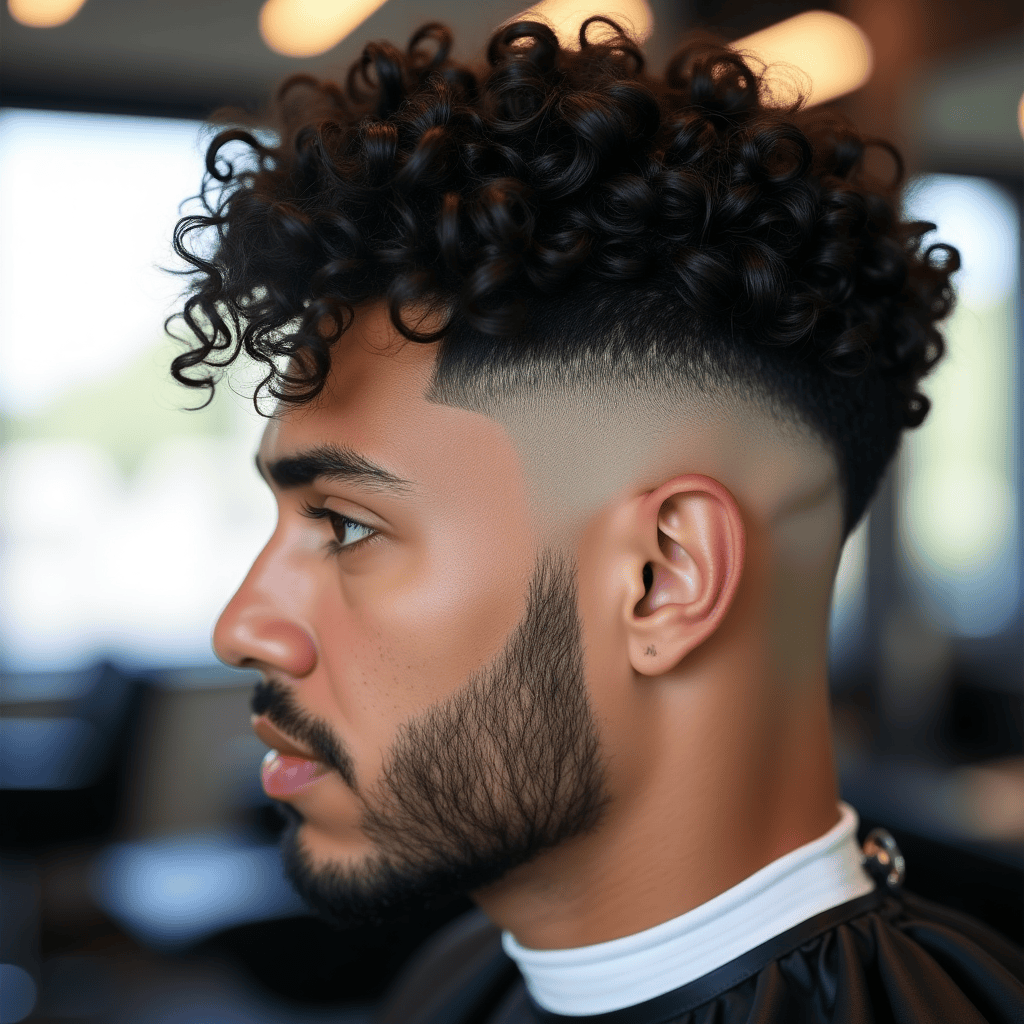
The curly disconnected undercut keeps natural curls full and dimensional across the top while taking the sides down sharply underneath. Curl clusters can sit forward, rise through the center, or spread slightly toward the temples depending on the natural pattern. The key is preserving enough weight that the curls don’t turn wispy. Short sides act almost like a frame around the texture.
Men with defined curls and enough density to keep the top full are the obvious candidates. Tell your barber, “Keep my curl pattern intact on top, shape it rather than flatten it, and disconnect the sides clearly underneath.” Curl care matters more than complicated styling, although occasional reshaping is needed. The biggest drawback is shrinkage: cutting the top too short while wet can leave you with much less visual length once it dries.
12. Disconnected Undercut With Brushed-Up Top
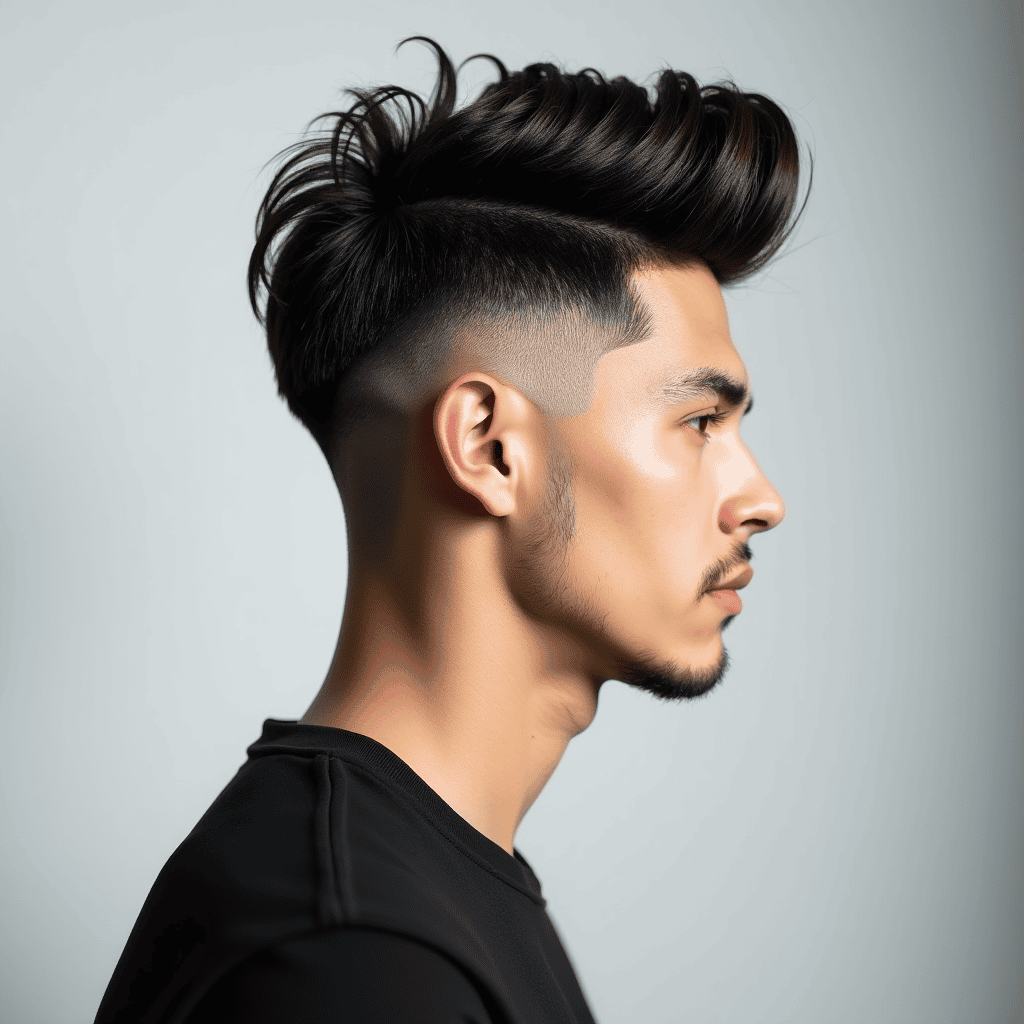
This disconnected undercut pushes the entire top upward instead of backward, creating vertical volume from the hairline through the middle. The tips stay slightly loose so the finish doesn’t resemble one solid wall of hair. Beneath that height, short sides produce a dramatic step in length. The side profile is especially strong because the top seems to sit directly on the undercut.
Straight or lightly wavy medium-to-thick hair gives you the best chance of holding the height. Ask your barber, “Leave enough top length to blow-dry upward, remove excess bulk, and undercut the sides without blending them into the top.” This disconnected haircut needs regular styling and a reasonably strong product. If your morning routine is already crowded, it can become more obligation than haircut.
13. High Disconnected Undercut
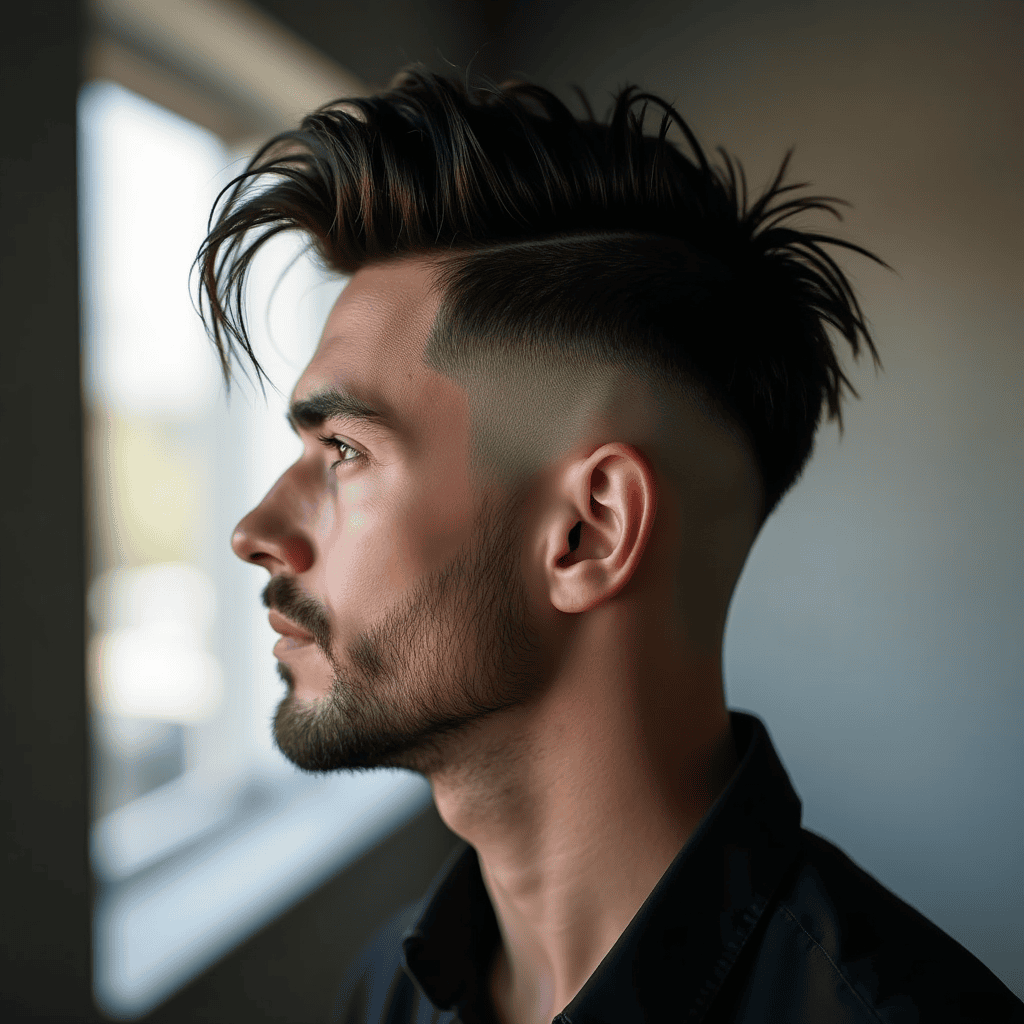
A high disconnected undercut places the separation well above the temples, leaving a broad field of short hair around both sides and back. The longer top becomes the dominant shape, whether it’s worn loose, pushed back, or swept sideways. Because the disconnect sits high, even modest top length appears dramatic. There’s nowhere for an uneven weight line to hide.
This one suits confident wearers with dense enough hair to keep the top from looking thin against the exposed sides. Tell your barber, “Set the disconnect high above the temples, keep the top fully separate, and make the side perimeter clean without blending upward.” You’ll see regrowth sooner than with a softer cut. High placement can also exaggerate a narrow or tall head shape, so the proportion deserves some thought.
14. Low Disconnected Undercut

The low disconnected undercut keeps the separation closer to the temples and around the upper ear, creating a subtler version of the same idea. More side weight remains visible, so the top doesn’t appear to float above the head. I like it with medium-length hair worn naturally backward or slightly sideways. From the front, it can pass for a conventional cut until you turn your head.
This is a smart entry point if you like disconnected haircut ideas but aren’t ready for a high, exposed undercut. Ask for, “A lower disconnect around the temple area, some weight left above the ears, and enough length on top to move naturally.” It grows out more forgivingly than a high undercut. The tradeoff is obvious: people wanting maximum contrast may find it too restrained.
15. Skin-Tight Sides With Disconnected Top
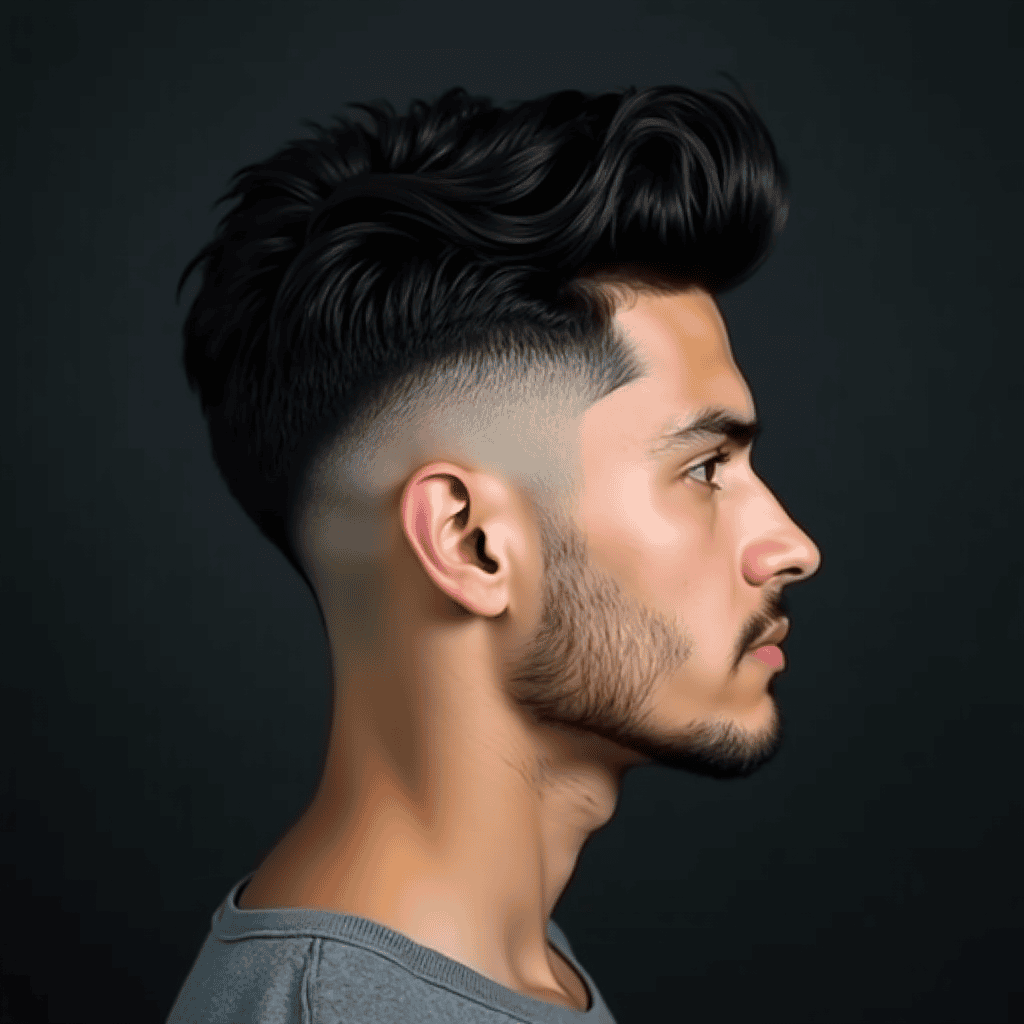
Taking the sides extremely short makes the longer top look heavier, wider, and more architectural. The top can stay textured or controlled, but its perimeter needs to be intentional because every edge becomes visible. A strong line above the temple separates the two lengths with no attempt at softness. This is one of the most graphic disconnected haircut ideas in the group.
Dense hair handles the contrast best, especially if the scalp coverage on top is even. Tell your barber, “Keep the top completely separate and take the sides very tight, with a clean weight line rather than blending into the top.” Maintenance is higher because short sides lose their fresh look quickly. I’d skip it if you prefer cuts that can grow for six or eight weeks without looking noticeably different.
Longer Disconnected Haircut Ideas With More Movement
Length changes the whole character of a disconnect. Instead of relying only on sharp barbering, these disconnected haircut ideas use flow, weight, and movement across the top to create contrast.
16. Long Slicked-Back Disconnect

A long slicked-back disconnect leaves enough hair on top for the strands to travel well past the crown when pushed rearward. The sides remain tightly controlled underneath, making the top look almost like a separate layer. A small amount of lift at the roots keeps it from lying flat against the scalp. From the side, the long sweep creates a strong continuous line from forehead to crown.
Thick straight or wavy hair gives this style the most substance. Tell your barber, “Keep the top genuinely long for a full slick-back, remove only the bulk that stops it moving, and disconnect it from short sides.” Styling takes patience because longer hair needs controlled drying before product. It also gets awkward during growth phases, especially around the back corners where the top starts escaping the intended shape.
17. Medium Flow With Hidden Disconnect

A hidden disconnect leaves the top and upper perimeter long enough to drape over much shorter hair underneath. When the hair is down, the contrast is subtle; when it moves or gets tucked back, the shorter interior becomes visible. The outer shape remains soft and flowing rather than boxy. It’s one of those cuts that reveals its construction only when you know where to look.
This works well for straight and wavy hair at medium or high density. Ask for, “Keep the outer top long enough to flow over the sides, but remove the interior underneath with a hidden disconnect so I lose bulk without losing visible length.” It’s useful for men who want movement but struggle with excessive side volume. The risk is going too high underneath, which can leave the outer layer looking thin.
18. Side-Swept Long Top Disconnect

The side-swept long top keeps several inches through the front and middle, then directs everything diagonally across the head. The longer strands create a pronounced overhang above the short side, particularly around the temple. Texture can stay smooth or slightly broken depending on the finish you prefer. Seen from the opposite side, the haircut looks almost entirely different.
Men with straight or naturally loose wavy hair have the easiest time maintaining the directional flow. Tell your barber, “Keep the front long enough to sweep well across, leave the top heavy enough to hold the shape, and disconnect the sides instead of blending them.” You may need a dryer to train stubborn growth patterns. The drawback is wind, plain and simple; long side-swept hair rarely stays where you left it.
19. Wavy Bro Flow Disconnect

The wavy bro flow disconnect combines a relaxed, medium-long top with unexpected shortness underneath the sides. Waves travel backward from the face and curve around the crown, creating a soft outer silhouette. The hidden or partially visible shorter side stops the hairstyle from becoming triangular as it gains length. It feels casual from the front and much more technical underneath.
If your hair naturally bends away from the face, this disconnected haircut can be surprisingly easy to live with. Ask for, “Keep my flow and wave pattern through the top, clean out the bulk underneath with a disconnect, and don’t shorten the outer layers too aggressively.” It needs regular conditioning and some patience during growth. Pin-straight hair can wear the shape, but it may fall flatter than the reference look you have in mind.
20. Long Fringe With Temple Disconnect

This cut keeps the front deliberately long, often reaching the brows or lower when relaxed, while the temples are carved much shorter underneath. The fringe can split through the middle, sweep sideways, or fall unevenly forward. Keeping more length toward the crown balances the front so it doesn’t feel like a detached curtain. The temple disconnect becomes most visible whenever the hair shifts.
It suits men who like longer disconnected haircut ideas but still want a clean area around the ears. Tell your barber, “Keep the fringe long and movable, preserve weight through the top, and disconnect the temple area underneath without taking the short section too far back.” Styling can be as simple as a light cream and air-dry. The obvious drawback is hair around your eyes if you dislike frequent repositioning.
Bold and Creative Disconnected Haircut Ideas
The last group pushes the break in length harder. These disconnected haircut ideas make the construction part of the look, so they work best when you’re comfortable with people noticing the haircut before anything else.
21. Mohawk-Inspired Disconnect
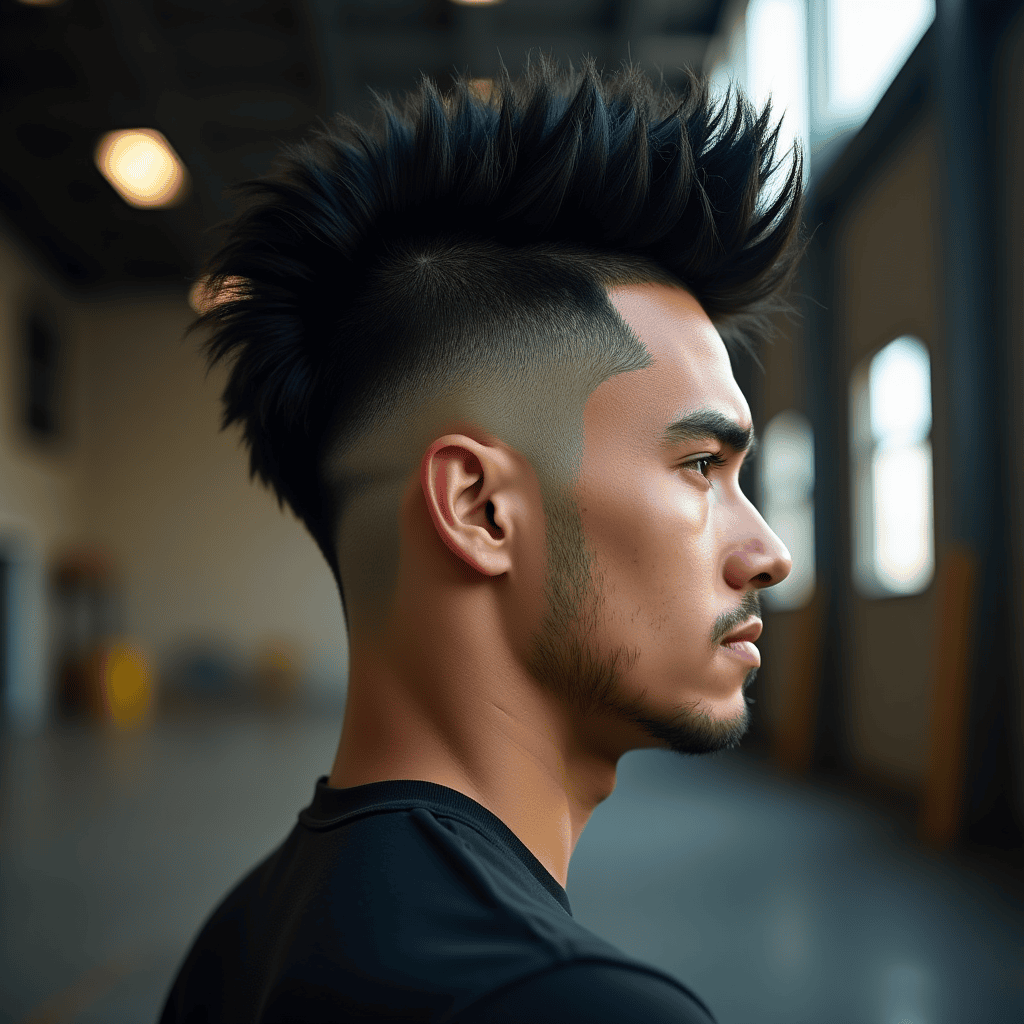
A mohawk-inspired disconnect keeps a wider strip of length through the center instead of shaving the sides into a traditional narrow mohawk. The top rises from the front and continues through the crown, with textured movement preventing it from becoming one stiff ridge. Short sides create a hard break along both edges. The result feels graphic without automatically reading as punk.
Coarse, thick, and naturally upright hair holds this shape especially well. Ask your barber, “Keep a wide central section with enough length to texture upward, disconnect both sides clearly, and avoid narrowing the top into a traditional mohawk strip.” Styling is fairly demanding if you want height every day. It’s also not the easiest cut to turn conservative when an occasion suddenly calls for it.
22. Asymmetrical Disconnected Top
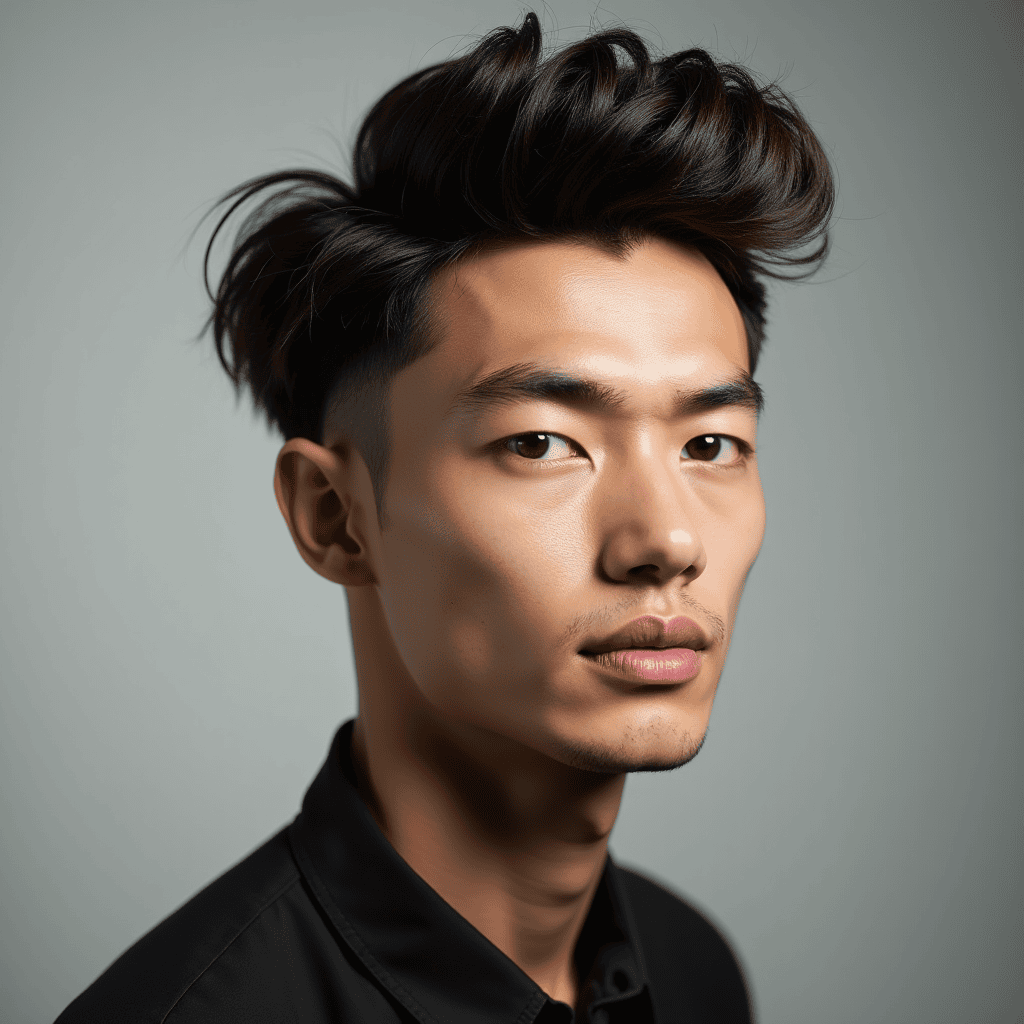
An asymmetrical disconnect deliberately carries more length and visual weight to one side. One section may sweep low toward the temple while the opposite side stays lifted or exposed above a short undercut. The imbalance has to look intentional, which means the perimeter and internal texture matter more than usual. Done well, the haircut changes shape as you move around it.
Straight or wavy hair with medium-to-high density gives a barber enough material to create the uneven architecture. Tell them, “Build an asymmetrical top with noticeably more length on one side, keep the other side exposed, and separate both from the short undercut rather than blending.” Daily styling is part of the deal. If you want to wake up, shake your head, and leave, pick something less directional.
23. Disconnected Faux Hawk

The disconnected faux hawk concentrates volume through the center but keeps enough side length on the top section to avoid a true mohawk outline. Hair angles upward and slightly inward from both sides, then becomes more relaxed toward the crown. The short sides sit completely apart from the styled upper section. I prefer the center broken into texture rather than pressed into one perfect ridge.
Round and square face shapes often respond well to the added vertical line, provided the top isn’t made excessively narrow. Ask your barber, “Leave enough top width for a textured faux hawk, create height through the center, and disconnect it from short sides without shaving the upper section too narrow.” Styling needs product and a little technique. The wrong proportions can look dated fast.
24. Scissor-Cut Soft Disconnect

A scissor-cut soft disconnect proves that separation doesn’t have to mean bare sides. The top stays medium length while the sides are cut shorter with scissors, leaving visible density and natural edges around the temples and ears. There’s still a definite shift in length under the upper section, but the surface looks softer and less mechanical. It grows with far more grace than most clipper-heavy versions.
This is one of my favorite disconnected haircut ideas for professionals who want modern structure without an aggressive undercut. Tell your barber, “Keep the top medium and movable, scissor-cut the sides shorter, and leave a definite but soft disconnect rather than blending everything together.” It works across straight and wavy textures. The only catch is that subtle disconnects depend heavily on precise weight control, so a rushed cut can simply look unfinished.
25. Disconnected Caesar With Modern Texture
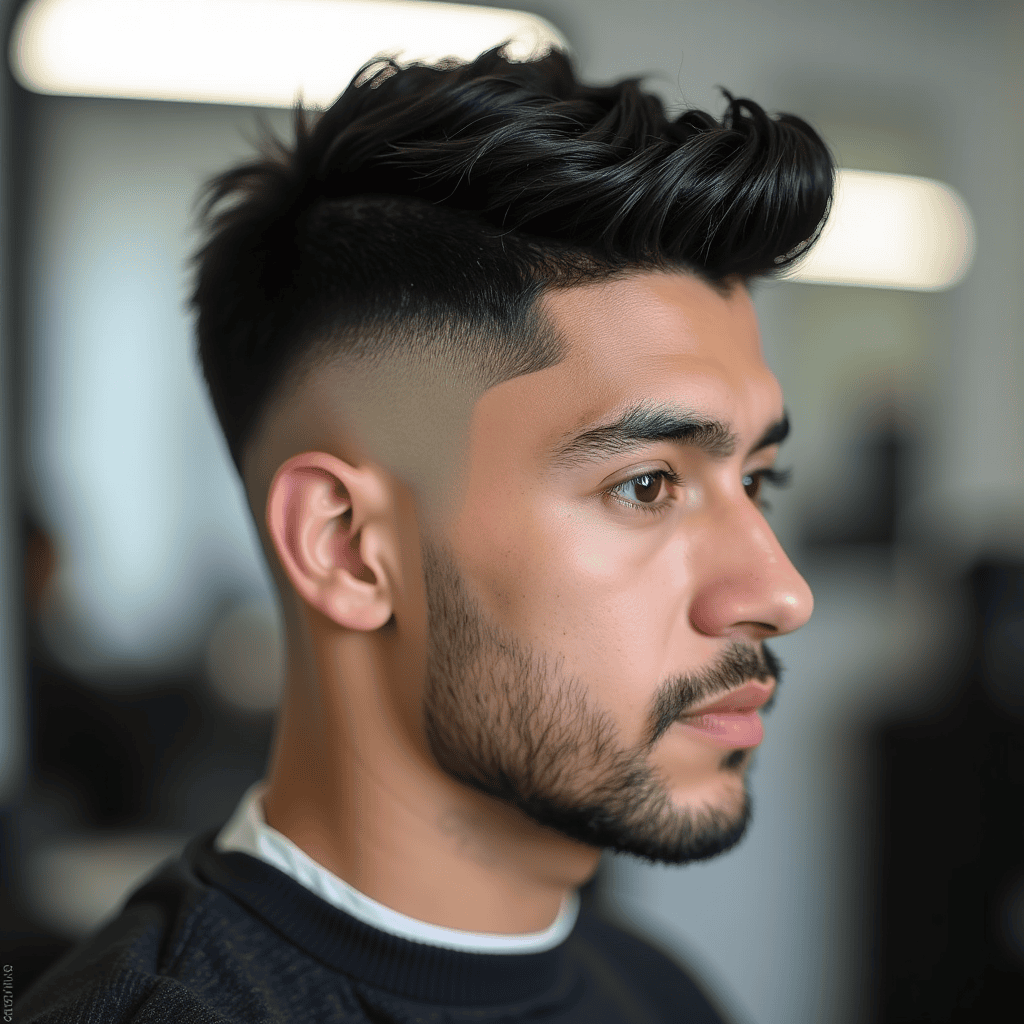
A disconnected Caesar keeps the top forward and compact, with a short fringe sitting firmly across or slightly irregularly over the forehead. Instead of blending into the sides like a conventional Caesar, the upper section stops abruptly above a much tighter perimeter. Broken texture through the top stops the silhouette from looking too flat. It’s short, controlled, and much sharper in profile than its classic relative.
Straight or coarse hair works particularly well because the forward direction is easy to maintain. Ask your barber, “Keep a short Caesar shape with textured movement and a defined fringe, then disconnect the top clearly from the shorter sides.” Upkeep is modest and styling can take under a minute. The drawback is the fringe line: if you dislike having your forehead visually shortened, another disconnected haircut will probably suit you better.
How to Choose the Right Disconnected Haircut
The best disconnected haircut ideas are chosen by proportion first and trend second. Start with how much top length you’re willing to style, then decide how exposed you want the sides to feel. A low or scissor-cut disconnect is easier to wear quietly, while a high undercut or skin-tight side makes the separation part of your identity.
Hair texture matters just as much. Thick straight hair can carry a pompadour, quiff, Caesar, or brushed-up top without collapsing. Wavy hair usually looks better when some natural movement is allowed to remain, while curly hair needs enough top weight to preserve curl groups rather than turning them into scattered short pieces.
Bring two or three reference photos to your appointment, ideally showing the haircut from more than one angle. The useful sentence to give your barber is specific: “I want this length on top, this much side exposure, and I want the transition disconnected rather than smoothly blended.” That tells them more than the style name alone.
Face shape should guide height and width instead of becoming a rigid rule. A longer face rarely needs towering vertical volume. A rounder face can often handle extra height but may benefit from tighter side bulk. If your head shape is uneven around the temples or crown, a softer disconnect often gives the barber more room to balance it.
And think about your calendar. A fresh disconnected haircut can look excellent for a wedding, interview, photo shoot, or formal event, but I prefer getting it cut several days before anything important rather than the same morning. That gives the top time to settle and gives you at least one chance to style it yourself.
Where Disconnected Haircuts Go Wrong
A disconnected haircut gets oversold whenever the dramatic before-and-after photo matters more than how the person will live with it. Barber photos are usually taken immediately after cutting, blow-drying, and finishing. Three weeks later, the short side has more bulk and the top may not sit nearly as precisely.
The most common mistake is pushing the disconnect too high. A high line can look strong on the right head shape, but once it exposes too much temple area it becomes difficult to soften without waiting for growth. Starting slightly lower gives you more options.
Another problem is leaving too much untouched weight on top. “Disconnected” doesn’t mean the upper section should remain a dense block. Internal texture, controlled layering, and strategic weight removal are often what make disconnected haircut ideas wearable outside the barber chair.
Then there’s maintenance. If you normally cut your hair every seven or eight weeks, an ultra-tight disconnect probably isn’t the smartest match. The less dramatic versions get you most of the visual separation with a far easier grow-out.
Frequently Asked Questions
What is a disconnected haircut for men?
A disconnected haircut has a deliberate difference between the longer top and shorter sides without the gradual transition found in a traditional taper or blended fade. The change in length is visible, creating a stronger outline and allowing the top to carry more volume, movement, or texture.
What are the best disconnected haircut ideas for thick hair?
Disconnected haircut ideas such as the pompadour, textured quiff, brushed-up undercut, Caesar, and slicked-back disconnect work especially well with thick hair. Density helps the longer top hold shape against the shorter sides. Good internal weight removal is still important so the top doesn’t become bulky.
Can thin hair work with a disconnected haircut?
Yes, but the contrast should usually stay moderate. Extremely short sides beside a thin top can make density differences more obvious. A lower disconnect, textured crop, or soft scissor-cut version often works better because it creates separation without making the scalp on top the focal point.
Are disconnected haircut ideas good for curly hair?
They can be excellent for curls because short sides remove bulk while leaving enough length on top for the curl pattern to show. The barber should shape curls in their natural state and avoid cutting the upper section so short that shrinkage removes the volume you wanted.
What is the difference between a disconnected haircut and an undercut?
An undercut describes the shorter section placed beneath longer hair, while disconnection describes the absence of a gradual blend between lengths. Many undercuts are disconnected, but a disconnected haircut can also use longer scissor-cut sides, a crop, side part, Caesar, or other top shapes.
How often should a disconnected haircut be trimmed?
Timing depends on how short the sides are. Skin-tight or very short disconnected cuts may start losing their clean contrast after a few weeks, while softer scissor-cut versions can remain balanced longer. If the weight line begins looking accidental rather than deliberate, it’s usually time for reshaping.
Which disconnected haircut ideas require the least styling?
A textured crop, short Caesar, low disconnect, and soft scissor-cut disconnect are among the easier options. Their shapes don’t depend on large amounts of blow-dried height. A small amount of matte styling product or light cream is often enough to keep texture controlled.
Which disconnected haircut needs the most maintenance?
High undercuts, skin-tight sides, large pompadours, and structured slick-backs generally demand the most attention. The sides reveal regrowth quickly, while the longer top may need blow-drying and product every day. They look sharp, but there’s no pretending they’re wash-and-forget cuts.
Can a disconnected haircut look professional?
Yes. Choose a lower or softer disconnect, keep the top controlled, and avoid exaggerated height. A disconnected Ivy League, side part, comb-over, or scissor-cut version can sit comfortably with business clothing while still looking more intentional than a conventional blended cut.
What face shape suits a disconnected haircut best?
There isn’t one required face shape. The useful decision is where to put volume. Longer faces generally benefit from less height, while rounder faces can often use controlled vertical lift. Square faces handle many disconnected haircut ideas well because the sharper sides complement an already defined outline.
How do I ask my barber for a disconnected haircut?
Show clear reference photos and explain three things: how long you want the top, how short you want the sides, and where you want the separation to sit. Say directly, “I want a visible disconnect here rather than a gradual blend.” That removes most of the ambiguity around the term.
Can a disconnected haircut grow out well?
Softer and lower versions usually grow out better than high, skin-tight disconnects. As the sides gain length, the original weight line gradually becomes less obvious. Keeping some side density from the beginning makes that transition easier and reduces the awkward stage between barber visits.
Disconnected haircuts are at their best when the contrast serves your hair rather than fighting it. Among all these disconnected haircut ideas, the smartest choice is the one you can recreate at home without needing the barber’s hands every morning. Save two reference photos that match your actual hair texture, then ask your barber exactly where they would place the disconnect before the first section is cut.
Best Men’s Hairstyle Reports
Explore disconnected cuts, barber techniques, modern fades and textured twist hairstyle ideas for men.